
Building Generative AI Applications with OpenShift AI
Last updated on Jun 19, 2026

With companies moving from simple interactive chat to advanced autonomous automation, generative AI has emerged as a critical component of today’s digital transformation. But moving advanced large language models (LLMs) and smart agents from experimental sandboxes to secure, scalable production environments creates major operational challenges.
That’s where Red Hat OpenShift (Red Hat OpenShift AI, to be specific) comes in to fill the gap. Organizations can leverage Gen AI workflows with the enterprise-grade Kubernetes platform from OpenShift for a flexible hybrid cloud foundation to train, fine-tune, and serve models securely.
Why is OpenShift the preferred platform for generative AI development?
Generative AI projects are very different from traditional software applications. Such applications need a lot of computing power, constant access to large amounts of data, infrastructure for model training, GPU acceleration, and scalable deployment environments. For organizations, managing all these parts separately can be complicated and expensive.
OpenShift resolves these challenges by offering a single platform where developers, data scientists, DevOps engineers, and business teams can collaborate effectively. OpenShift is built on Kubernetes and offers automated orchestration, container management, resource optimization and enterprise-grade security. This allows teams to spend more time on innovation and less on infrastructure management.
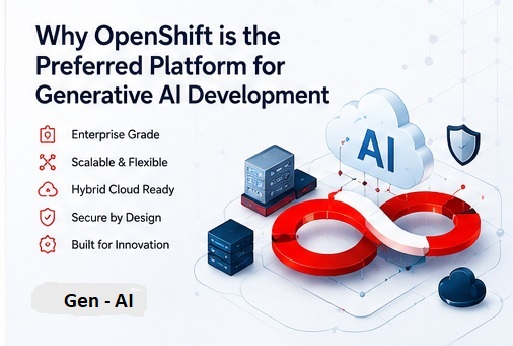
One key benefit of OpenShift is the ability to support hybrid and multi-cloud environments. Organizations can build generative AI applications once and deploy them on public clouds, private clouds, or on-premises infrastructure with little change. That flexibility helps organizations avoid vendor lock-in while still maintaining consistent operations.
With businesses becoming more AI-driven, there is a demand for people with OpenShift training. This expertise is also growing. Employers are seeking professionals who have a solid grasp of cloud-native technologies and the methods of deploying AI.
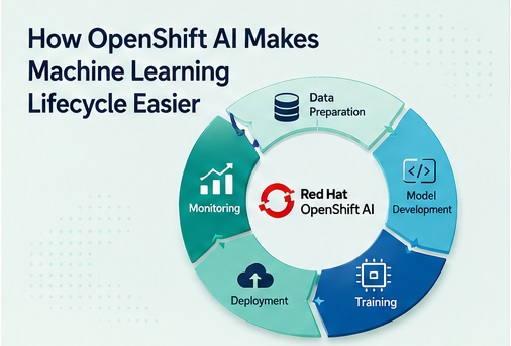
How does OpenShift AI simplify the machine learning lifecycle?
One of the greatest challenges organizations have in implementing generative AI is managing the full machine learning lifecycle. Developing a model is only part of the lifecycle process. Teams also need to manage data preparation, model training, deployment, monitoring, scaling, governance, and continuous improvement.
This lifecycle is simple thanks to OpenShift AI, which provides a unified environment for all phases of AI development. Data scientists can experiment with models, and developers can package applications into containers and deploy them using automated pipelines, all from Jupyter Notebooks.
It also enables collaboration among multiple teams. By using a single OpenShift environment, organisations can avoid maintaining separate development, testing, and production environments, reducing operational complexity and improving efficiency.
If you’re a student in an OpenShift course, it’s important to understand the entire machine learning lifecycle. This is due to today’s AI projects, as they need a mix of development, infrastructure, and operations skills. OpenShift lets professionals gain hands-on experience in all these areas.
Join OnlineITGuru to gain expertise in OpenShift training with expert mentors.
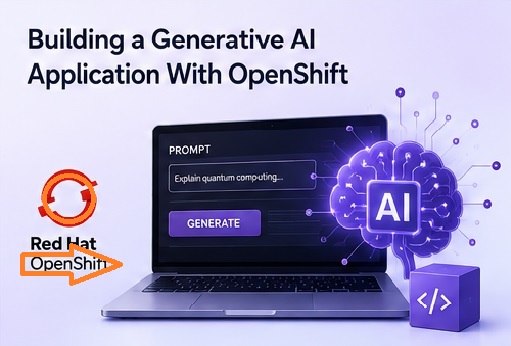
Building a Generative AI Application With OpenShift
Let us understand the steps to build generative AI using Open Shift.
Step 1: Establish the Use Case
Any successful AI project is built on a well-defined objective.
Step 2: Data Preparation
Data quality directly affects AI model performance.
Step 3: Create and Refine Models
OpenShift AI lets developers build and train models together.
Step 4: Package the Application
Containerization brings consistency across environments.
Step 5: Set Up Model Serving Infrastructure
The trained model is deployed through OpenShift serving capabilities
Step 6: Monitor and Optimize
Ongoing surveillance is essential after deployment.
Running Large Language Models on OpenShift
Today’s gen AI apps use large language models, or LLMs, to power their capabilities. These models drive intelligent chatbots, virtual assistants, code-generation systems, content creation platforms, and enterprise knowledge assistants.
There are several challenges when deploying LLMs in production. These models require high computing power, efficient use of GPUs, low-latency response times, and strong security controls. Traditional infrastructure often cannot meet these requirements at scale.
OpenShift is a scalable platform for hosting and managing LLMs. Containerized deployments allow organizations to package models and their dependencies into portable environments that can be deployed consistently across different infrastructures. Kubernetes orchestration automatically scales resources and allocates them based on user demand.
For instance, a customer support chatbot could handle a few hundred requests during normal operating hours but thousands of requests during peak business hours. OpenShift can automatically scale resources to accommodate this extra workload, keeping performance consistent without manual intervention.
This scenario is one reason many organizations investing in gen AI are also investing in Red Hat OpenShift courses and Open Shift certification training programs to build internal expertise.
The Role of MLOps in Generative AI Projects on OpenShift
As AI applications move from the lab to production, organizations need structured processes to manage models effectively. This discipline is called “machine learning operations,” or “MLOps.”
MLOps is the process of integrating machine learning, DevOps, and automation to make sure AI systems are reliable, scalable, and constantly optimized. Open Shift is highly important for MLOps because it provides automation, monitoring, deployment, and governance.
A typical generative AI project can have many versions of models, datasets, training pipelines, and deployment environments. Without effective MLOps practices, managing these components can be difficult, and mistakes are easy to make.
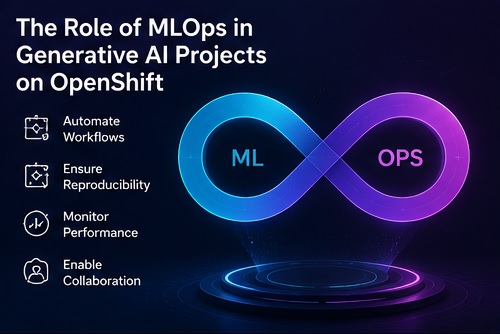
With OpenShift, teams can automate repetitive tasks such as model deployment, testing, rollback procedures, and performance monitoring. The automation reduces operational overhead and also makes the system more reliable.
Those who take an OpenShift online course often learn how OpenShift fits into modern MLOps frameworks and CI/CD pipelines. These skills become more critical as organizations scale their AI efforts.
Generative AI Applications: Security Considerations
Security remains one of the most important considerations when deploying generative AI applications. Many AI systems process confidential customer information, business documents, financial records, or proprietary IP.
Organizations must ensure security across the entire application lifecycle for their AI environments. Open Shift offers a range of enterprise-grade security capabilities to help protect AI workloads and sensitive data.
Role-based access control restricts users to the resources necessary for them to do their jobs. Network policies are used to prevent unauthorized communication between services, while container security mechanisms can be used to prevent vulnerabilities from reaching production environments.
Data encryption is an added layer of security to sensitive information when it is being stored or transmitted. OpenShift also supports compliance requirements for industries such as healthcare, banking, insurance, and government.
Careers in OpenShift and Generative AI
The rapid growth of generative AI has opened up large opportunities for careers throughout the tech industry. Organizations need people who can build, deploy, manage, and optimize AI applications in cloud-native environments.
With many enterprises standardizing on Kubernetes-based platforms for deploying applications, the demand for Open Shift skills is growing. These professionals can add value to AI projects, cloud migrations, DevOps initiatives, and platform engineering programs.
Typical career positions include Open Shift Admin, OpenShift Developer, Cloud Engineer, DevOps Engineer, MLOps Engineer, AI Platform Engineer, Kubernetes Specialist, and Infrastructure Architect. These positions often come with attractive salaries because of the demand for both cloud computing and AI skills.
Many employers are particularly interested in candidates who have completed an OpenShift course or OpenShift online training. These programs give you hands-on experience in real-world enterprise environments.
“As the use of AI globally increases, we expect that the demand for OpenShift professionals will remain strong for years to come.”
OpenShift AI and Edge Computing: Building Smarter Apps Closer to Users
One of the most exciting things happening in the AI ecosystem is the coming together of generative AI and edge computing. Traditionally, AI models were trained and deployed in centralized cloud settings. But today, businesses increasingly need to make decisions in real time from remote locations such as factories, shops, hospitals, telecommunication networks, and smart cities.
With OpenShift AI, organizations bring AI capabilities closer to where they create data. By deploying AI workloads at the edge, companies can reduce latency, speed up response times, and lessen their reliance on centralized cloud infrastructure.
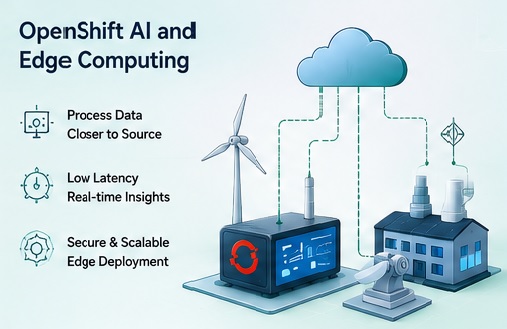
You might be a manufacturing company, for example, that uses AI-powered quality inspection systems on factory floors. Rather than transferring large amounts of image data to a central data center, AI models can analyze data locally and identify defects on the spot. This leads to increased operational efficiency and decreased production downtime.
Similarly, retail organizations can use intelligent recommendation engines at stores to offer a personalized experience to customers. OpenShift AI helps telecom providers optimize large traffic routing and detect anomalies in real time at the edges of the network.
With the evolution of edge AI, people with OpenShift training and OpenShift online training will be at the forefront of the most advanced technology projects in various industries.
OpenShift AI for Enterprise Knowledge Management
Every day organizations generate huge amounts of information. Documents, emails, policies, procedures, technical manuals, research reports, and customer interactions are all valuable knowledge assets. Sadly, much of this information still spreads across multiple systems, making it difficult to access when needed.
Generative AI is transforming enterprise knowledge management with intelligent search and conversational interfaces. OpenShift AI gives you the infrastructure to build these enterprise-grade knowledge assistants.
Instead of wading through hundreds of documents, employees query natural language questions and receive accurate answers from organizational knowledge repositories. This makes productivity much higher and reduces the time spent searching for important information.
Large businesses tend to have knowledge gaps between departments. OpenShift-based AI assistants can help bridge these gaps by combining sources of information and offering common access to knowledge throughout the company. Employees, when provided with the proper knowledge at the right time, can make better judgments.
As organizations’ digital transformation programs continue to balloon in size, they will drive substantial demand for these solutions. This trend makes learning OpenShift through an OpenShift course or an OpenShift online course even more important.
OpenShift AI and Responsible Artificial Intelligence
With the growth of AI adoption, there is a rising concern about the ethical use of AI, transparency, fairness, and governance of AI. Responsible AI is no longer a nice-to-have—it's a business must-have.
OpenShift AI has several different features that allow for responsible use of AI, including model performance monitoring, tracking data usage, managing model versions, and implementing governance policies. These features help organizations stay responsible throughout the AI life cycle.
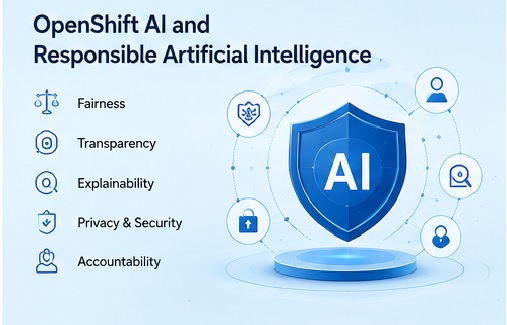
One of the main components of responsible AI is bias detection. There is a need for tools that can assess the fairness and bias of outputs generated by AI. OpenShift is a platform that enables such evaluations to be part of the development process.
Compliance with regulations is also gaining significance. Governments around the world are implementing policies demanding transparency in AI systems. Countries are applying policies that mandate transparency in AI systems. Auditability and operational controls are among OpenShift's solutions for enterprises to satisfy these requirements.
As organizations strive to responsibly leverage AI while meeting regulatory requirements, experts with expertise in AI governance principles and OpenShift technologies will be in demand.
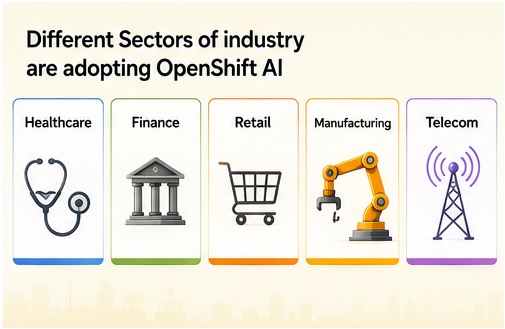
Different Sectors of industry are adopting OpenShift AI
Generative AI is not a technology company-only thing. Nearly every industry is investigating OpenShift AI to adopt it for the modernization of operations and better customer experiences.
Banking and Financial Services
Banks are implementing virtual assistants, fraud detection tools, automated document processing, and intelligent investment advice bots. Banks are rolling out virtual assistants, fraud detection systems, automated document processing, and intelligent investment advice platforms. OpenShift can be scaled to meet the demands of highly regulated financial environments and offers the security necessary for them.
Healthcare and Life Sciences
Generative AI in healthcare supports clinical documentation, patient communication, medical research, and operational automation. Open Shift enables enterprises to meet healthcare regulations and to support large AI workloads.
Retail and E-Commerce
Retail businesses are leveraging AI to generate personalized recommendations, optimize inventory management, automate customer service, and create marketing content. With OpenShift, the applications can scale efficiently during seasonal peaks.
Manufacturing
OpenShift AI is used by manufacturers to provide predictive maintenance, quality assurance, process optimization and supply chain intelligence. Smart analysis with AI lowers expenses and enhances productivity.
Telecommunications
AI is a key part of telecommunication providers' network optimization, customer support automation, predictive maintenance, and service assurance. Cloud-native technologies are well-suited to current telecom infrastructure needs, and OpenShift's architecture supports these requirements. This broad industry adoption is why OpenShift skills remain in demand globally.
OpenShift Professional salary in India
As Kubernetes, cloud computing, and AI technologies continue to gain traction in India, demand is surging for Open Shift professionals in the country. Various factors influence the salaries, including experience, certifications, technical expertise, and industry specialization.
Entry-Level OpenShift Professionals
The salary of freshers and professionals with 1 to 3 years of experience can be expected to be between ₹5 lakh and ₹10 lakh per annum. Hands-on project experience + OpenShift certification training can increase opportunities.
Mid-Level OpenShift Engineers
The average salary for professionals with 4-8 years of experience is between Rs. 12 lakh* and Rs. 25 lakh* per annum. Typically, these people have experience in managing Kubernetes clusters, orchestrating containers, automating DevOps processes, and deploying cloud-native applications.
Senior OpenShift Architects and Specialists
Experts with extensive experience in OpenShift and cloud platforms can earn between ₹30 lakh* and ₹60 lakh* per annum as senior professionals. The salary of architects involved in enterprise modernization initiatives can be even higher.
Consulting firms, cloud service providers, technology firms, financial services, healthcare institutions, and global capability centers are among the prime organizations that are actively looking for OpenShift professionals in India.
Integrating the knowledge of OpenShift with AI, machine learning, MLOps, and cloud engineering typically leads to better career advancement and pay.
OpenShift Professional Salaries Abroad
The rise in enterprise investments in cloud-native platforms and AI technologies has created even more opportunities for OpenShift professionals in the international market.
United States
Most OpenShift administrators and engineers make a yearly salary of $95,000 to $140,000*. Senior architects can earn more than $170,000* annually, as can cloud platform specialists and AI infrastructure experts for their roles.
Canada
The salary of an OpenShift professional varies from CAD 85,000 to CAD 140,000 per year, depending on their expertise and experience in the industry.
United Kingdom
The salaries of OpenShift engineers and cloud specialists range from £55,000 to £100,000 per year. Senior platform architects are able to make far higher salaries.
Australia
The demand for Kubernetes and OpenShift jobs has increased, and salaries start at AUD 100,000 and can go up to AUD 180,000 per annum.
Germany and Europe
Cloud modernization is a big investment for European organizations, and they are looking to hire OpenShift professionals. European organizations are making significant investments in cloud modernization, and they are seeking Open Shift experts. Average annual salaries between €65,000 and €130,000, depending on experience and location.
There are several benefits for those who happen to be qualified with the Open Shift training and higher cloud certifications when searching for opportunities abroad.
The Future of OpenShift AI
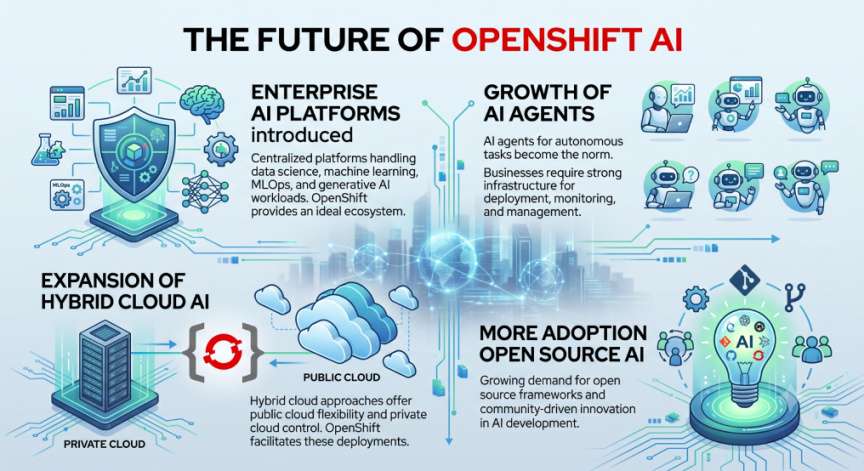
The future of OpenShift AI looks bright. With enterprises transitioning from experimental AI initiatives to turnkey AI deployments, there will be an increasing demand for reliable, secure, and scalable platforms. Several trends will influence the future of Open Shift AI.
Enterprise AI Platforms will be introduced
There is a growing demand for centralized platforms that can handle data science, machine learning, MLOps, and generative AI workloads. OpenShift stands out as an ideal platform for building these enterprise AI ecosystems.
Growth of AI Agents
The use of AI agents for autonomous tasks will become the norm. Businesses are going to need strong infrastructure to deploy, monitor, and manage such agents. The OpenShift platform offers complete flexibility and control to support these various deployments.
Expansion of Hybrid Cloud AI
Hybrid cloud approaches are attractive to many organizations that want the flexibility of the public cloud and the control of private cloud infrastructure. With its hybrid cloud capabilities, OpenShift is an appealing platform for future AI deployments.
More adoption of open source AI
The popularity of open-source AI models is on the rise due to their flexibility, transparency, and cost-effectiveness. OpenShift is designed to accommodate and facilitate the deployment of open source AI technologies in these ecosystems securely.
Enhanced integration of AI with DevOps
AI is increasingly integrated into DevOps.
The creation of AI and software engineering processes is becoming more and more interrelated. OpenShift will continue to support this convergence by delivering built-in MLOps, GitOps, and platform engineering features.
How Can OpenShift AI Support the Next Generation of Professionals?
One of the fastest-growing areas in technology is the intersection of cloud computing, Kubernetes, and generative AI. Open Shift AI skills today can be the foundation for a long and successful career for professionals of the future.
Another major advantage is the versatility of OpenShift knowledge. Open Shift is not a niche technology; it has applicability to many industries and business domains. This leads to varied job prospects that do not depend on one industry.
Learning OpenShift also means learning a host of related technologies such as Kubernetes, containers, cloud, DevOps, CI/CD pipelines, MLOps, infrastructure automation, and AI deployment strategies. These are highly transferable skills that have proven to be resilient to the changing landscape of technology.
Students entering the workforce can gain an advantage by gaining practical experience through labs, projects, internships, and OpenShift online course programs. OpenShift skills and Red Hat OpenShift training can help working professionals move into higher-paying cloud engineering, DevOps, platform engineering, and AI-focused roles.
The ones who will benefit most are those who bring together technical OpenShift skills with emerging AI knowledge. Organizations continue to invest in intelligent applications, and the demand for experts who can manage AI infrastructure, deploy machine learning models, and run cloud-native platforms will only grow.
If you’re thinking about your career for the next decade, Open Shift AI is a prime place to get in on one of the biggest tech transformations that’s currently upending the global business landscape.
Benefits of Developing Generative AI Applications on OpenShift
Please tell us the main benefits.
Time to market faster
Development teams can quickly deploy AI solutions with automated workflows and containerized environments.
Better Scalability
AI workloads are extremely diverse. OpenShift scales resources automatically based on demand.
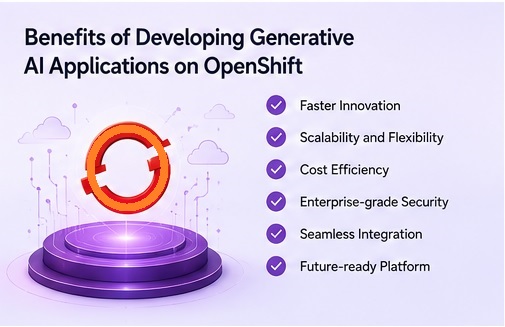
More Efficient Use of Resources
By managing GPUs and CPUs efficiently, you can spend less on infrastructure.
Further Collaboration
Data scientists, developers, and operations teams can collaborate seamlessly. Working together accelerates success on a project.
Corporate Security
Organizations have more control over data, applications, and AI models. Security and compliance are often the primary reasons why companies decide to go with OpenShift.
The Future of Generative AI on OpenShift
Adoption of generative AI is accelerating across industries. Companies are transitioning from pilot AI projects to large-scale production deployments.
Future trends are:
AI platforms multi-model
AI-driven automation
Enterprise knowledge assistants
AI Autonomous Agents
MLOps Best Practices
Hybrid cloud AI deployments
Accountable AI Governance
OpenShift is a great platform for these innovations because it is scalable, secure, and has enterprise-grade architecture.
Bottom Line
Generative AI is transforming business operations, but to build and run AI applications at scale, you need a powerful and reliable platform. Red Hat Open Shift provides the security, automation, flexibility, and scale you need to build, deploy, and run modern AI workloads efficiently. Open Shift allows organizations to confidently take AI projects from experimentation to production—whether it’s large language models, smart chatbots, enterprise knowledge assistants, or AI-powered automation. By investing in OpenShift course online, students and working professionals can create strong opportunities in one of the fastest-growing technology domains today. It is a remarkable opportunity for students and professionals who wish to build a future-proof career in cloud computing and artificial intelligence.