
Business ServiceNow Security Operations Smart Automation
Last updated on Jul 29, 2026

The enterprise security landscape has radically transformed in the last decade. The days of organizations protecting a few servers on-premises in a corporate data center are over. Today, the digital ecosystem is a complex web of public cloud platforms, hybrid infrastructure, containerized applications, Kubernetes clusters, SaaS environments, APIs, IoT devices, remote endpoints, and identity providers constantly exchanging data across geographically distributed networks. Telemetry from each authentication request, configuration change, API transaction, endpoint process, cloud workload, and network connection, helps to define an organization’s security posture. It’s no longer just about collecting security data, it’s about making sense of the mountains of operational data to create actionable intelligence before hackers can exploit vulnerabilities.
Most organizations rely on a Security Information and Event Management (SIEM) platform such as Splunk Enterprise Security, Microsoft Sentinel, IBM QRadar or Google Chronicle to collect security events from multiple sources including firewalls, endpoint detection solutions, email gateways, cloud platforms, intrusion detection systems and identity providers. They do a good job of log aggregation, event normalization and rule-based correlation, but when a suspicious event is detected, the security analysts have to determine what business service was impacted, who owns the infrastructure, whether they have known vulnerabilities, whether they need to consult threat intelligence, coordinate remediation, document all phases of the investigation and maintain compliance records. This puts a huge burden on operations. When distributed over many disparate tools, this is compounded greatly increasing both MTTD and MTTR.
The operational challenge here is the workflow orchestration layer between detection technologies and enterprise response processes, and that’s where ServiceNow Security Operations fits in. Instead of generating yet another ticket for analysts to sift through, the platform turns incoming security events into rich operational records that are contextualized (i.e. asset intelligence, vulnerability data, business relationships and automated workflows). Rather than requiring analysts to operate in multiple security consoles, ServiceNow consolidates operational data into a single investigation model. We employ automation, AI and enterprise integrations to support standard security incident handling processes.
How ServiceNow Converts Security Alerts Into Actionable Investigations?
One of the key differentiators of ServiceNow Security Operations is the manner in which it handles data before an analyst has ever seen an incident. Alerts are rarely the product of one technology. For instance, a SIEM platform might trigger an alert for an anomalous authentication attempt, an endpoint detection platform could flag suspicious PowerShell activity, and an identity provider could log an impossible travel scenario for the same user account. Alerts are often seen in isolation and a lot of time is spent trying to work out if events are connected. ServiceNow takes many of these manual tasks and automates them by normalizing security events into a common operational model.
When Security Incident Response receives an alert from REST APIs, IntegrationHub, Event Management connectors or Import Set integrations from an external security platform, Security Incident Response starts to correlate the payload with the enterprise data already available in the platform. Configuration Items stored in Configuration Management Database (CMDB) are associated with hostnames, IP addresses, usernames, process IDs, device IDs, cloud instance names, application IDs etc. The platform does not simply treat the affected system as another endpoint. It knows right away what its role is in operations, business ownership, service classification, maintenance group, deployment environment and infrastructure dependencies.
One of the things that makes ServiceNow different from traditional ticket management systems. The platform doesn’t just log that an endpoint generated a high severity alert. It assesses whether the endpoint has revenue-generating applications, regulated customer data, is part of a critical business workflow, or is a subset of a larger application service as defined in Common Service Data Model (CSDM). Security Incident Response uses this relationship knowledge to understand the enterprise impact from both a technical severity perspective and from a business context perspective, so that incident prioritization is based on operational risk and not just on the severity of alerts received from external monitoring tools.
The Security Incident record is a live record and is continually updated as new information becomes available. New observables are linked to past incidents, related configuration items, user identities, ongoing remediation activities, and existing security intelligence. Instead of beginning the investigation from scratch each time new evidence is introduced, analysts work against a dynamic operational record that is constantly updated to reflect the current state of the incident at each step in the incident’s life cycle.
Security Operations Intelligence Layer: CMDB
In ServiceNow Security Operations, the configuration management database (CMDB) is strategic, and far more than the inventory repository that most organizations think of it as. The CMDB is the operational intelligence that allows security investigations to transition from siloed technical events to business-aware investigations. The relationships between Configuration Items in the CMDB define what infrastructure supports applications, what applications deliver business services, what departments own the services, and what operational teams manage the underlying technology.
If the incoming alert is associated with a Configuration Item, Security Incident Response will automatically pull context information into the investigation. “Suspicious log in to an application server is no longer a single VM attack. The platform knows if the server is running an online banking service, a healthcare app, an ERP environment or an internal development platform. Knowing this changes the prioritization of the incident dramatically because you know the business impact before remediation efforts begin.
The Common Service Data Model maps business capabilities to technical infrastructure, enabling this relationship-centric approach. Instead of creating individual records, CSDM creates dependency relationships for servers, applications, databases, cloud resources and business services that ServiceNow can evaluate during an incident. Security Incident Response automatically detects the downstream impact when an attack affects a database used by several customer-facing services and displays it in the investigation workspace. This means analysts spend less time hunting for infrastructure and more time responding to real threats.
The architecture is even more valuable in hybrid cloud environments where workloads are constantly moved from on-prem infrastructure to public cloud platforms. Discovery, Service Mapping and cloud integrations continuously update CMDB records to give Security Operations current infrastructure relationships rather than stale inventory data. This gives security teams the same operational visibility into modern cloud-native environments that was once only possible for traditional data centers.
Intelligent Automation The core of modern security response
The power of ServiceNow Security Operations lies not only in the aggregation of information but in automating the operational decisions that follow. The platform uses the enriched context to validate the logic of workflows defined in Flow Designer, Business Rules, Assignment Rules, and IntegrationHub actions. These operational processes are running as per defined enterprise policies, instead of analysts manually assigning incidents, alerting infrastructure teams, conducting containment activities or creating remediation tasks.
For example, Microsoft Defender for Endpoint detects ransomware encryption activity and Microsoft Sentinel logs repetitive authentication anomalies from a single workstation. Security Incident Response will correlate both alerts into a single investigation if they are for the same Configuration Item and user identity. Flow Designer evaluates organizational response logic in real time, and then initiates a containment workflow. The compromised account is suspended through IntegrationHub and Microsoft Entra ID, and the endpoint is isolated from the network through Microsoft Defender APIs. At the same time, ServiceNow automatically generates appropriate remediation tasks, logs incident timelines, notifies the appropriate support teams, and records all automated actions for auditing purposes. The analyst is always in the loop, without having to do repetitive administrative work with multiple teams.
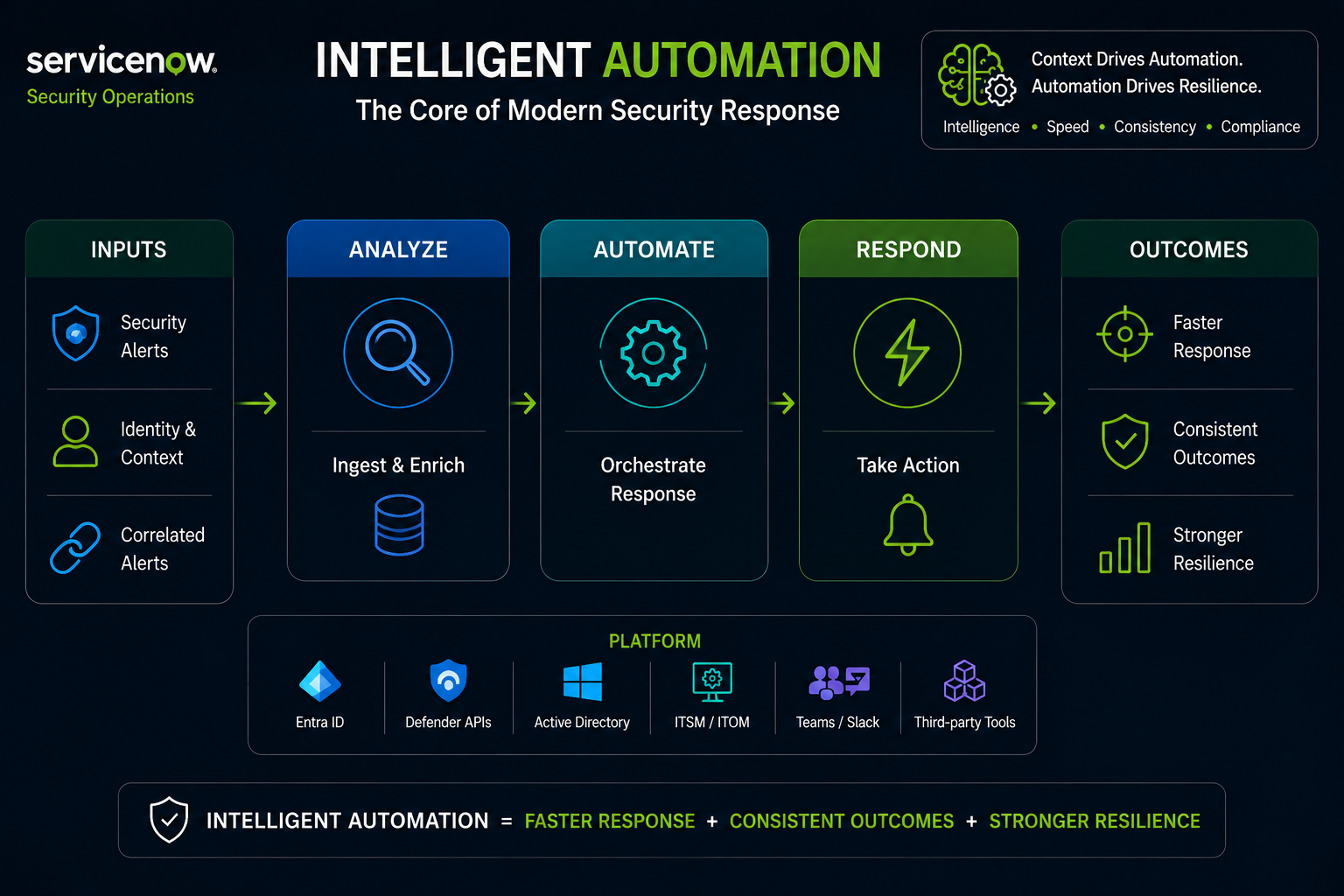
Automation is governance in action. Every workflow execution, field update, approval, API response, assignment change and remediation activity is automatically logged on the Security Incident timeline. This offers organizations a complete audit trail without analysts having to manually document each step of their investigation. This makes it easy to comply with ISO 27001, NIST Cybersecurity Framework, PCI DSS, SOC 2 and more. It also helps in providing uniform investigations across distributed socs across geography.
Enterprise Security Capability Development
As organizations continue to modernize their Security Operations Centers, the demand grows for professionals who understand the principles of cybersecurity AND the underlying architecture of the ServiceNow platform. For enterprise deployments you need professionals who can deploy SIEM platforms, configure Security Incident Response, extend workflows with Flow Designer, consume REST APIs, implement CMDB relationships and orchestrate automated remediation in complex technology environments. Hence, many professionals choose ServiceNow Course Online to learn practical implementation rather than using the platform.
Enterprise training topics include: Security Incident Response data models, CMDB relationship mapping, CSDM architecture, IntegrationHub spokes, Business Rules, Script Includes, MID Server communication, Scripted REST APIs, OAuth authentication, Performance Analytics reporting Learners will observe the normalization of incoming security events, enrichment with business context, correlation with infrastructure relationships, and processing through automated workflows that orchestrate multiple enterprise technologies. They learn how to design operational processes that reduce investigation time, improve governance and increase organizational cyber resilience, rather than isolated features. Practitioners can leverage a combination of platform engineering, workflow automation and cyber security skills to deploy scalable ServiceNow Security Operations that link technical response to enterprise business priorities.
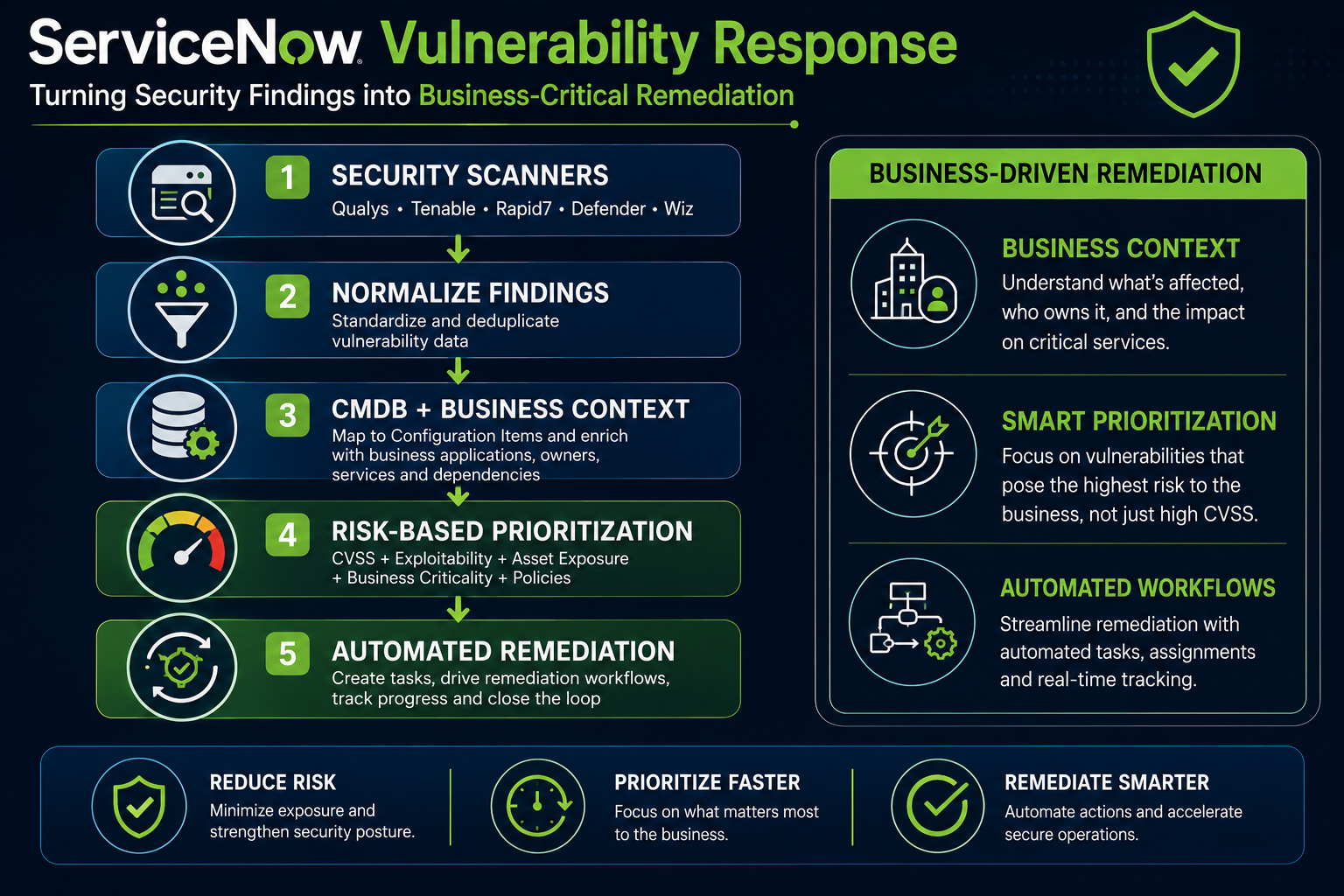
Vulnerability Response: Turning Security Findings into Business Critical Remediation
As organizations grow their hybrid cloud infrastructure, container platform, virtual machines, serverless applications, databases and internet-facing services, enterprise vulnerability management becomes more complex. Security scanners always find thousands of vulnerabilities, but the biggest problem is knowing which findings need to be fixed right away. A high Common Vulnerability Scoring System (CVSS) score does not automatically mean it is the highest business risk. In an organization, a medium severity vulnerability in a mission-critical application can be the highest security priority. ServiceNow Vulnerability Response solves this problem by layering operational intelligence on top of scanner results so that remediation decisions are made on business impact, not just technical severity.
Vulnerability scanners like Qualys VMDR, Tenable.io, Rapid7 InsightVM, Microsoft Defender Vulnerability Management or Wiz are used to assess and results are imported into ServiceNow through certified integrations, REST APIs or IntegrationHub connectors. Rather than storing the incoming records, the platform ingests data from several vendors, normalizes it to a common vulnerability model. This normalisation abstracts away variances as to scanning technologies, and allows security teams to triage vulnerabilities through a common operational process, regardless of the scanner that originally discovered it. Each finding that is imported is tied to a corresponding Configuration Item (CI) in the CMDB, giving the platform insight into the impacted business application, support group, infrastructure owner, cloud environment, operational status and service dependencies before remediation actions are taken.
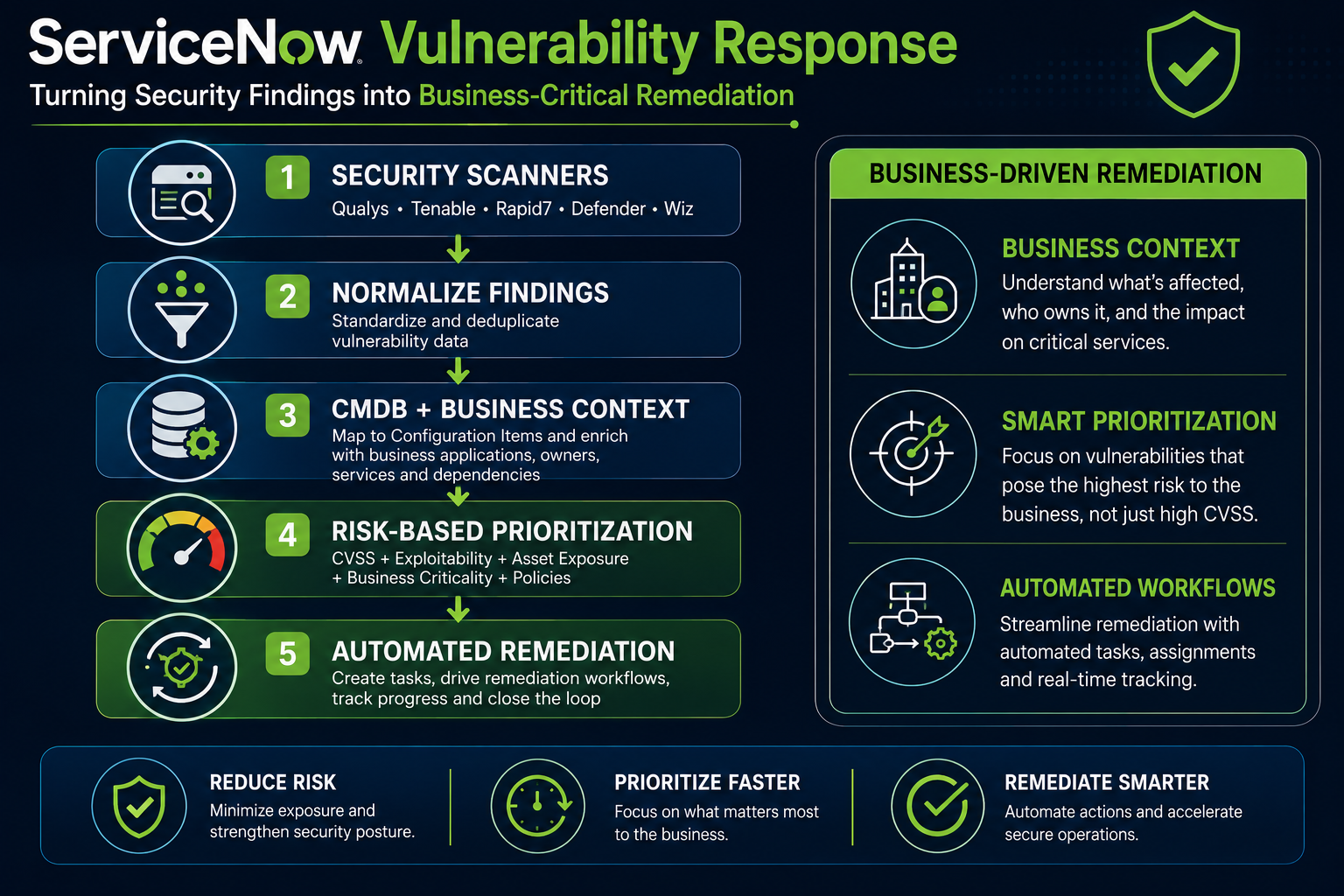
ServiceNow then normalizes the data and creates Vulnerable Item records to represent the relationship between an affected asset and a specific vulnerability. These are not information entries, but workflow enabled operational objects that are the foundation of enterprise vulnerability management. Every Vulnerable Item has its own remediation life cycle, ownership, priority, exception status, remediation history and related Change Requests. Throughout the remediation process, the platform is constantly updating related records so that security analysts, infrastructure teams, application owners and compliance managers are all working from synchronized information, not separate tracking systems.
A major feature of Vulnerability Response is the risk engine that extends beyond the standard CVSS score. Remediation priority is determined by exploit availability, asset exposure, business criticality, Internet access, environmental classification, maintenance windows and organizational risk policies. For example, a vulnerability in a customer portal exposed to the Internet and performing financial transactions may have a much higher enterprise risk score than an identically-scored CVSS vulnerability in a laboratory environment isolated from the Internet. This context-driven prioritization allows security teams to focus their remediation resources on what will have the biggest impact in reducing organizational risk.
And we have some additional operational intelligence that comes from the overlap between Vulnerability Response and Security Incident Response. During a cyber investigation, Security Incident Response automatically searches for Vulnerable Items related to the affected Configuration Item. If any unpatched vulnerabilities are found that correspond to the exploitation techniques observed during the investigation, analysts will immediately know if the breach was likely due to an unpatched software vulnerability. Likewise, new threat intelligence on active exploitation of a newly disclosed CVE can automatically raise the priority of related Vulnerable Items and speed up remediation before the attack spreads by exploiting more systems. By integrating vulnerability management and incident response organizations can move from reactive patch management to proactively reducing cyber risk
Smart Context for Enhanced Threat Investigations
Threat intelligence is only valuable if it can be applied operationally to an active investigation. Enterprises’ security teams are often inundated with thousands of Indicators of Compromise (IOCs) from commercial intelligence providers, open source repositories, Information Sharing and Analysis Centers (ISACs) and industry threat-sharing communities. These indicators are only single pieces of data to reference, without any contextual processing, so when there is a suspicious activity, the analyst has to search for them manually. It then injects that information directly into ServiceNow Threat Intelligence, intelligence can be automatically attached to investigations as incidents move through Security Operations.
Threat intelligence feeds are consumed by importing malicious IPs, domains, URLs, file hashes, SSL certificate fingerprints, registry artifacts, email addresses, malware signatures and command-and-control infrastructure via vendor integrations or standards such as STIX and TAXII. ServiceNow ingests observables and normalizes them into standard indicator records that can be searched across the platform. Each indicator also includes metadata about confidence, threat actors, malware families, attack campaigns, first-seen timestamps, expiration times, and MITRE ATT&CK mappings so analysts can assess the quality and relevance of intelligence before deciding on investigations.
Security Incident Response automatically compares the observables in the incident to imported intelligence repositories when a new alert is created. When a matching IP address, domain or file hash is found, the Security Incident will be enriched with specific threat context, rather than analysts seeing separate technical artifacts. The investigation immediately determines if activity is related to ransomware activity, credential theft campaigns, advanced persistent threats, or commodity malware, enabling analysts to prioritize response based on adversary behavior, not the severity of an isolated event. With minimal need for analysts to perform repetitive manual intelligence lookups, enrichment happens automatically as part of incident processing.
Threat Intelligence also enables proactive threat hunting, by correlating newly ingested indicators with Security Incidents, Vulnerable Items, CMDB records, and operational logs already collected in the platform over time. ServiceNow publishes indicators from intelligence feeds on a new attack campaign and can check if enterprise assets have historically interacted with those indicators, assisting analysts in finding possible breaches that were possibly overlooked. This continuous correlation makes threat intelligence an active — not passive — part of enterprise security operations.
More sophisticated Security Operations strategies use ServiceNow Training Online to understand Threat Intelligence integration with Security Incident Response, Vulnerability Response, CMDB, Flow Designer, and IntegrationHub. This hands-on experience with these capabilities allows professionals to design automated workflows to enrich incidents with intelligence, correlate enterprise assets against emerging threats, and orchestrate timely remediation actions across complex digital environments.
Enterprise System Synchronization for Workflow Integration and Automation in Security Operations
ServiceNow Security Operations not only automates complex security processes intelligently, it automates what people don’t do well with manual coordination across teams. A large portion of an analyst’s time in a Security Operations Center (SOC) is spent on administrative tasks, such as incident assignment, stakeholder notifications, creation of remediation tasks, approval requests, documentation of investigation progress, and liaison with infrastructure, network, identity, and application support teams. These tasks are critical for incident resolution but they also consume valuable time which could be used for threat analysis and decision making. To this end, ServiceNow provides a single orchestration engine that combines Flow Designer, IntegrationHub, Business Rules, Script Includes and event driven automation to automate enterprise response procedures.
Flow Designer detects workflow conditions and initiates the proper automation sequence when a Security Incident reaches a certain severity level, or meets an organization’s response criteria. Workflow engines typically employ static routing rules. Flow Designer is dynamic and reacts to changes to the incident record such as priority, assignment groups, Configuration Items, threat indicators, vulnerability status, and business service relationships. Information is available and the workflow execution is adapted accordingly . This keeps operational procedures updated to the changing investigation.
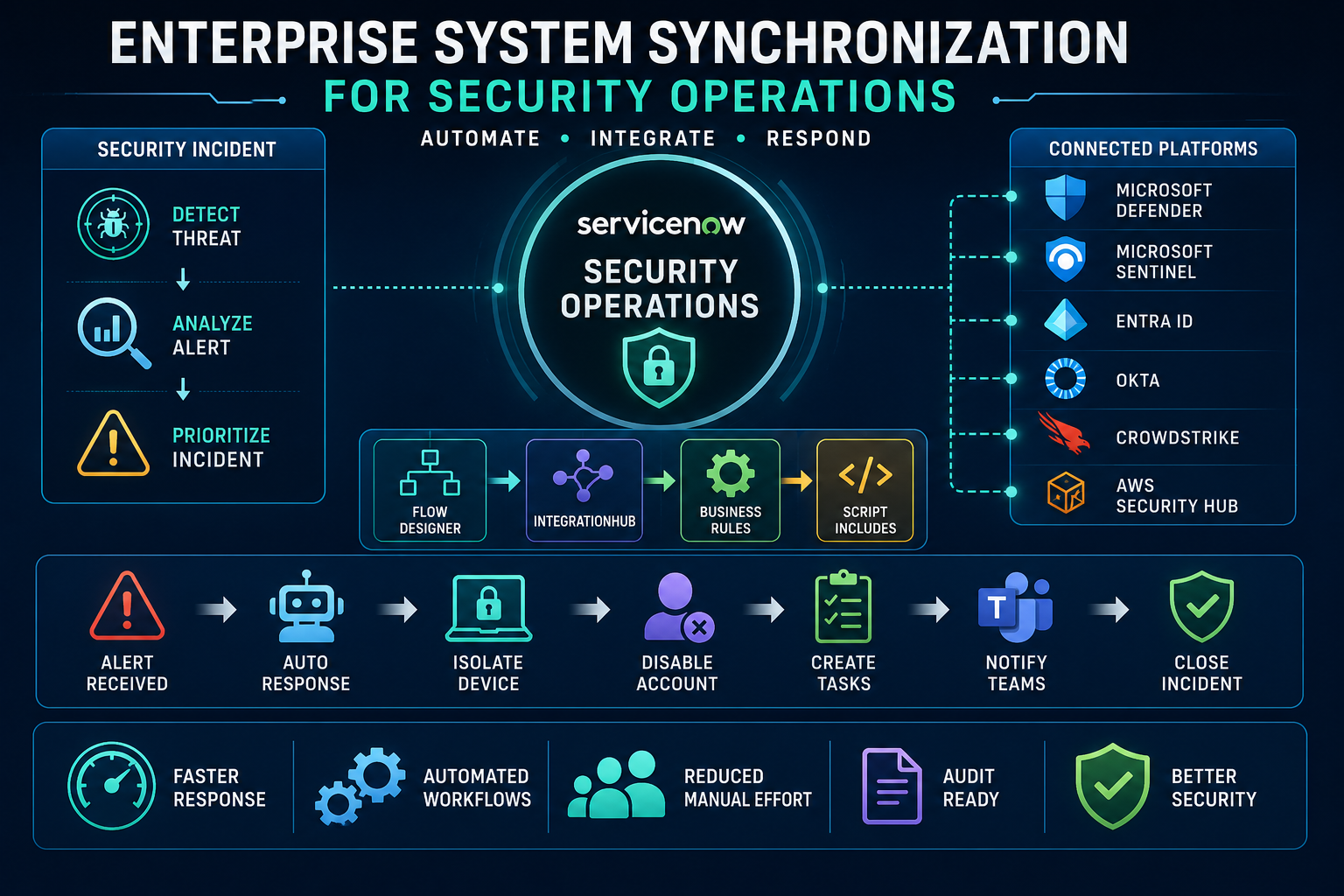
IntegrationHub extends the automation framework, making it even more powerful. IntegrationHub expands the ServiceNow platform to connect securely with other enterprise technologies using REST APIs, SOAP services, Graph APIs, JDBC connections, PowerShell, SSH, and MID Server connectivity. ServiceNow certified spokes allow ServiceNow to connect to Microsoft Sentinel, Microsoft Defender XDR, CrowdStrike Falcon, Palo Alto Cortex XDR, Cisco SecureX, Qualys VMDR, Tenable.io, Rapid7 InsightVM, Microsoft Entra ID, Okta, AWS Security Hub, Azure Security Center, Google Security Command Center and a host of other enterprise security products. This two-way communication allows ServiceNow to not only receive alerts, but also take containment and remediation actions in third-party platforms.
If endpoint telemetry indicates encryption activity that looks like ransomware then it is malicious. When Security Incident Response evaluates the severity of the event, Security Incident Response will call Flow Designer to initiate IntegrationHub actions to integrate with Microsoft Defender APIs to isolate the impacted endpoint from the corporate network. At the same time, Microsoft Entra ID is called in an authenticated manner to temporarily disable the compromised user account and remediation tasks are automatically offered to infrastructure support teams based on ownership information obtained in the Configuration Management Database. Emergency Change Requests are raised with no analyst intervention. The executive gets a notification on Microsoft Teams. All automated activity is recorded in the Security Incident timeline. ServiceNow orchestrates operational execution across the enterprise rather than jumping between various admin consoles, which helps analysts complete their investigations faster.
The orchestration framework also supports conditional decision making during the incident lifecycle. If additional evidence is found that indicates lateral movement to critical production systems, the workflow can automatically escalate the incident priority, alert senior security leadership, generate major incident procedures and start enhanced monitoring activities. Alternatively, if further forensic analysis confirms the alert as a false positive, automation may halt containment activities, close out any related remediation efforts, update knowledge records, and revert to normal operational status with full documentation for future audit requirements. This adaptive workflow capability allows for the scaling of response procedures to the actual risk of the investigation.
Business Rules and Script Includes are the brains behind these automated workflows. Business Rules allow for real-time monitoring of Security Incident records for major changes to fields and determine if assignment logic, notification policies, risk calculations or remediation activities should be performed immediately. Script Includes are reusable server-side objects that contain functions for calculating enterprise risk, validating Indicators of Compromise, enriching incident meta data, retrieving Configuration Item relationships, or calling external APIs. The central position of these components in the platform allows organizations to achieve uniform automation logic across applications, reduce duplication of development effort, and ease maintenance.
Governance and operational reporting are also automated. Audit logs for each workflow run are available, to track in detail what actions were taken, when, what integrations were called and if external systems responded successfully. Performance Analytics collects operational metrics such as automation success rate, Mean Time to Detect, Mean Time to Respond, length of workflow executions, SLA adherence, accuracy of assignments and rate of remediation completion. This helps security leaders know how many incidents the organization has dealt with and how well automated response processes have worked over time. Such analytics insights are also useful for continuous improvement endeavors, identifying workflow bottlenecks, repetitive manual tasks and additional orchestration opportunities.
Enterprise cybersecurity is moving away from individual security tools to more integrated workflows. Organizations want to hire the professionals who can build, deploy and maintain the automation frameworks. With Online Training ServiceNow allows techies to get hands-on experience on Flow Designer’s interaction with IntegrationHub, Business Rules, Script Includes, MID Server architecture, OAuth authentication, and REST-based integrations to create scalable enterprise security workflows. Understanding how automation, scripting and architecture of the platform interact, allows practitioners to build Security Operations solutions that reduce the amount of manual effort, increase the consistency of response and increase organizational resilience to modern cyber threats.
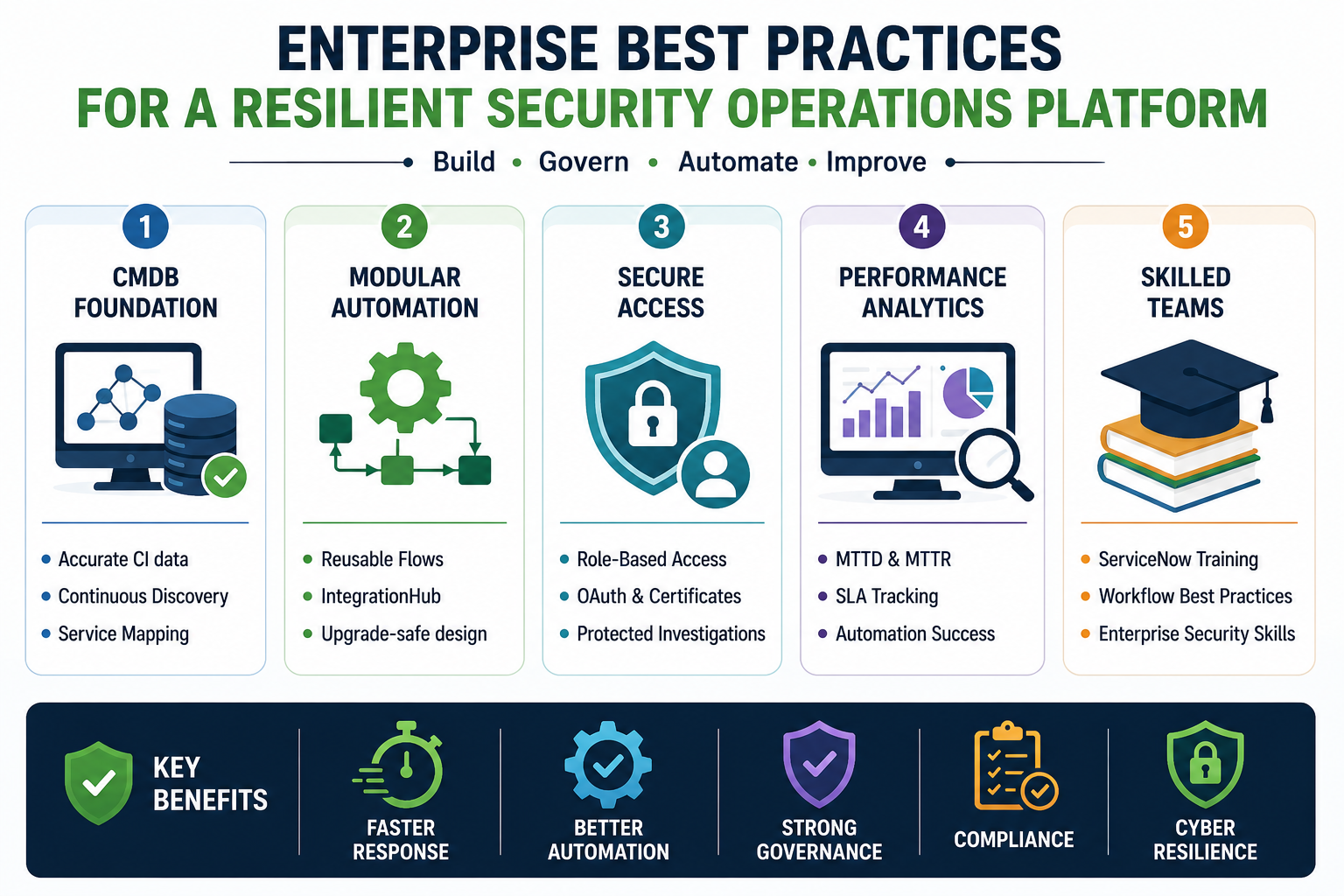
Enterprise Best Practices for Creating a Resilient Security Operations Platform
ServiceNow Security Operations deployment success is not about flipping the switches on platform features, but rather, creating a governed operational architecture that can scale with the enterprise. Many organizations deploy security tools without first validating the accuracy and currency of the records in the Configuration Management Database. Many Security Incident Response, Vulnerability Response, Change Management, Asset Management and Performance Analytics, and bad CMDB data impact prioritization accuracy and automated decision making and are based on Configuration Item relationships. That’s why Continuous Discovery, Service Mapping and governance processes are a key part of a successful Security Operations implementation.
Moreover, workflow design should be modular, not hyper-customized automation to cover every use case. To create reusable Flow Designer actions, IntegrationHub spokes, Script Includes, and API services that are easier to maintain going forward and more upgrade compatible across releases of the platform. Reusable automation components enable security teams to add new integrations or modify existing response procedures without having to re-implement entire workflows. This gives the platform more flexibility as enterprise security technologies continue to evolve.
Security Operations 5. Identity and access governance is also key. Role-based access control, access control lists (ACLs), delegated administration, OAuth-secured integration, encrypted credentials, and authentication based on certificates limit sensitive investigation data to authorized users and trusted systems. Good platform security governance preserves the integrity of investigations and assists in compliance with regulatory requirements and organizational security policies.
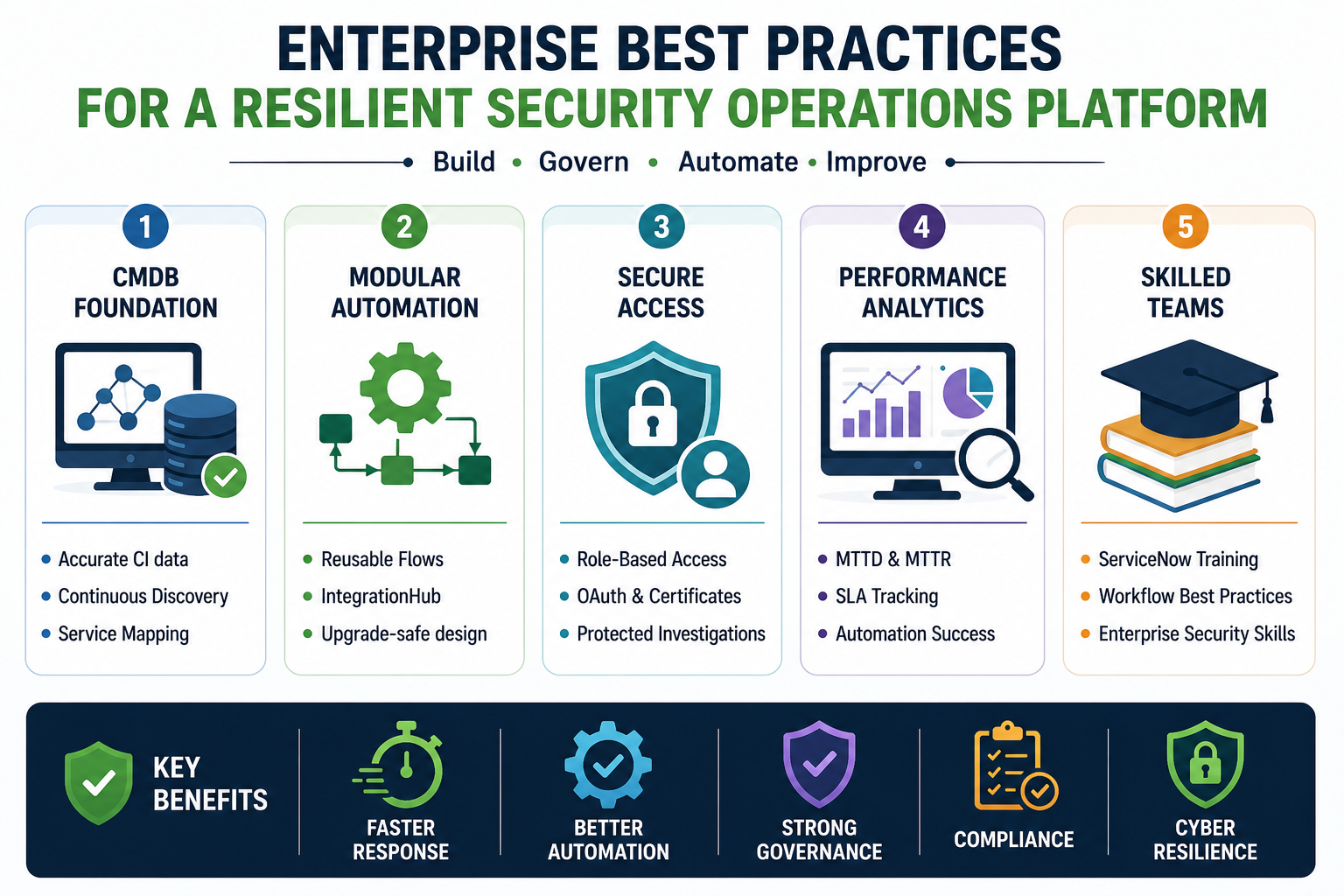
Performance Analytics also helps organizations with continuous measurement. Dashboards that monitor Mean Time to Detect, Mean Time to Respond, automation success, SLA adherence, investigation duration, remediation completion and vulnerability aging provide operational insight to drive continuous improvement. Security leaders can now see not just how many incidents were processed, but also the efficiency of their workflows, the effectiveness of their automation and the utilization of their resources, providing them with the data they need to make informed decisions that bolster their overall cyber resilience.
There are many seasoned professionals who join the ServiceNow Training Classes to learn more about how to successfully implement these enterprise practices. In these training classes they get to learn about advanced implementation methodologies, Security Operations architecture, workflow optimization, platform governance, enterprise integrations, scripting techniques and upgrade safe customization strategies. This type of pragmatism allows organizations to create scalable Security Operations environments that are maintainable, secure and in tune with ever-evolving business and cybersecurity needs.
Summary
ServiceNow Security Operations brings together Security Incident Response, Vulnerability Response, Threat Intelligence, CMDB, AI and workflow automation in a single operational platform that goes beyond stand-alone security monitoring. With intelligent data enrichment, enterprise integrations and automated response workflows, organizations can shorten investigation time, improve remediation accuracy and boost cyber resilience. People with knowledge and skills at these capabilities are well suited to support modern enterprise security initiatives. OnlineITGuru provides an end-to-end learning experience that allows aspiring administrators, developers and security professionals to gain hands-on ServiceNow Security Operations skills that are aligned with the requirements of the modern enterprise.