
DevOps Best Practices for Faster and More Reliable Deployments
Last updated on Jun 15, 2026

Today, software development must be fast, scalable, consistent and reliable. All companies in all industries are constantly looking for software updates to be faster and not lose quality. That has made DevOps a business imperative, not just a technical approach. What is DevOps ? DevOps is a set of development and operations practices, that enable better collaboration, automation of processes and faster deployment cycles without compromising on stability and security. Better DevOps practices means more frequent release cycles, lower operational risk and increased customer satisfaction. Organizations can leverage proven DevOps best practices to build a common development ecosystem that can help drive continuous innovation and sustainable growth.
DevOps Culture Creation
One of the most important DevOps best practices for faster and reliable deployments is a strong culture of collaboration across development, operations, quality assurance, security and infrastructure teams. Most software delivery models are based on the assumption that development teams work in silos building features and operations teams are responsible for deployment, infrastructure and production stability. Separation causes communication bottlenecks, long feedback loops, inconsistent environments, and deployment failures, which negatively impact release schedules and business outcomes.
DevOps addresses these problems with a shared responsibility model where everyone is working towards the same goals of delivery and operational success. DevOps cover all the phases of SDLC (Software Development Life Cycle) starting from requirement gathering, application designing, development, testing, integration, deployment, monitoring and continuous improvements. Teams working toward common goals can achieve results faster without compromising system reliability and performance.
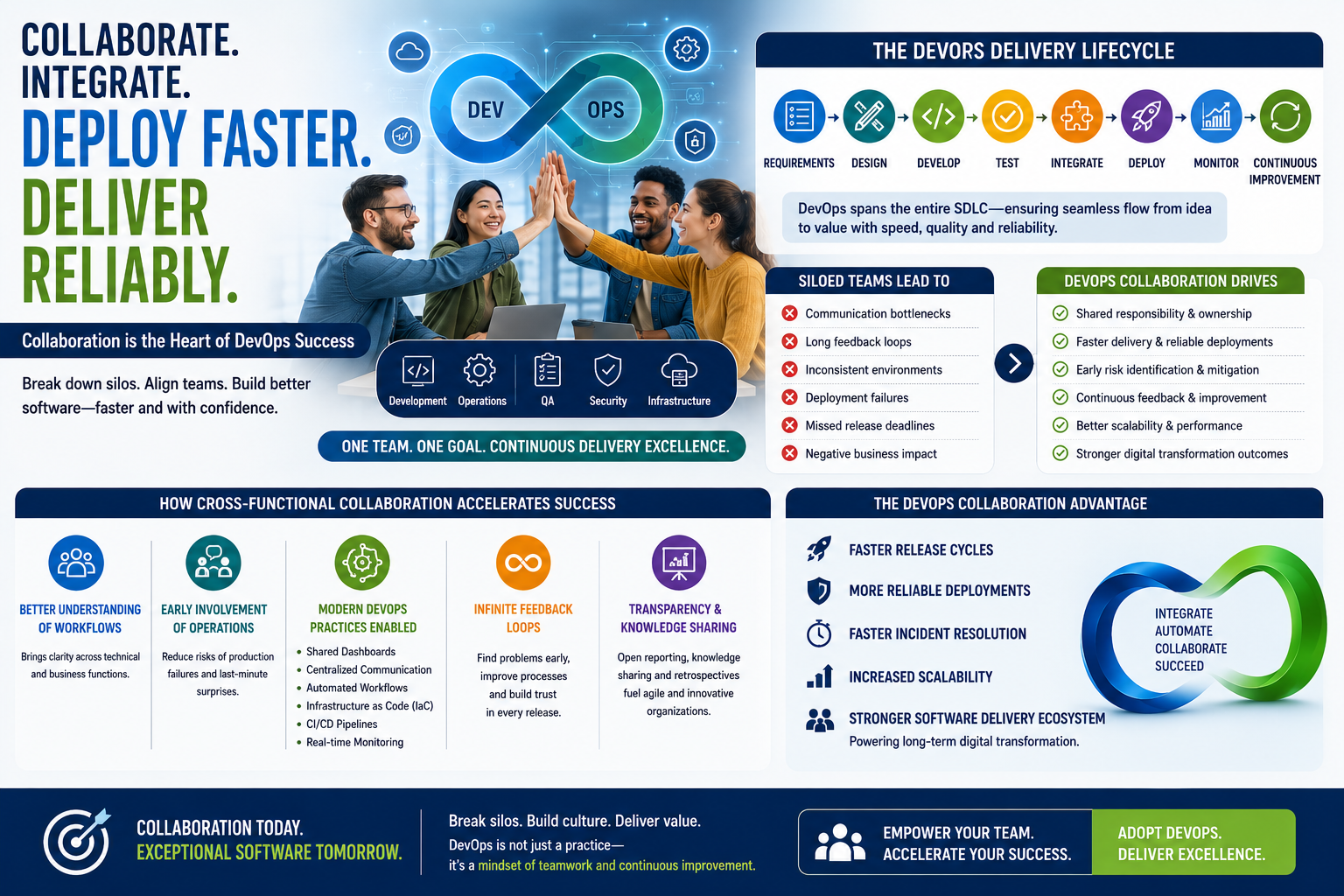
Cross functional working means better understanding how work flows, better decision across technical and business functions. It provides operational insight and introduces the operations teams earlier in the development planning process to minimize the risk of production failures and last minute surprises. Modern DevOps practices (shared dashboards, centralized communication, automated workflows, Infrastructure as Code (IaC), Continuous Integration and Continuous Delivery (CI/CD) pipelines and real-time monitoring solutions) can readily enable this type of collaboration.
Infinite feedback loops allow teams to find problems early, improve their processes and trust their releases. Open reporting, sharing knowledge and frequent retrospectives are the building blocks of agile and innovative organizations. Organizations that can establish a DevOps culture of collaboration will have faster release cycles, a more reliable deployment process, faster incident resolution, increased scalability, and a stronger software delivery ecosystem to support their long-term digital transformation efforts.
Fast deployment & Automated workflow
Automation is a key for successful DevOps implementation that enables faster, reliable and scalable software. Today’s development environments are plagued by manual processes that create operational bottlenecks, increased operational risk, and inconsistent deployments across environments. Automation for operational stability, efficiency and accuracy is a must for organizations working with agile delivery models and continuous release cycles.
Automation is the tool that DevOps uses to assist practitioners in automating and standardizing the repetitive tasks that take place in the software development lifecycle. Activities include source code integration, testing, configuration management, infrastructure provisioning, environment provisioning, application deployment, monitoring, release management.Workflow automation also reduces deployment time compared to manual intervention, and also improves reliability and repeatability.
Continuous Automation provides CI/CD pipelines that automatically validate, test, package and prep each and every commit for deployment. Infrastructure as Code (IaC) helps to ensure that development, testing and production environments are all in sync and reduces configuration drift and risk of environment specific failures. Automation enables you to provision resources at scale and manage infrastructure dynamically.
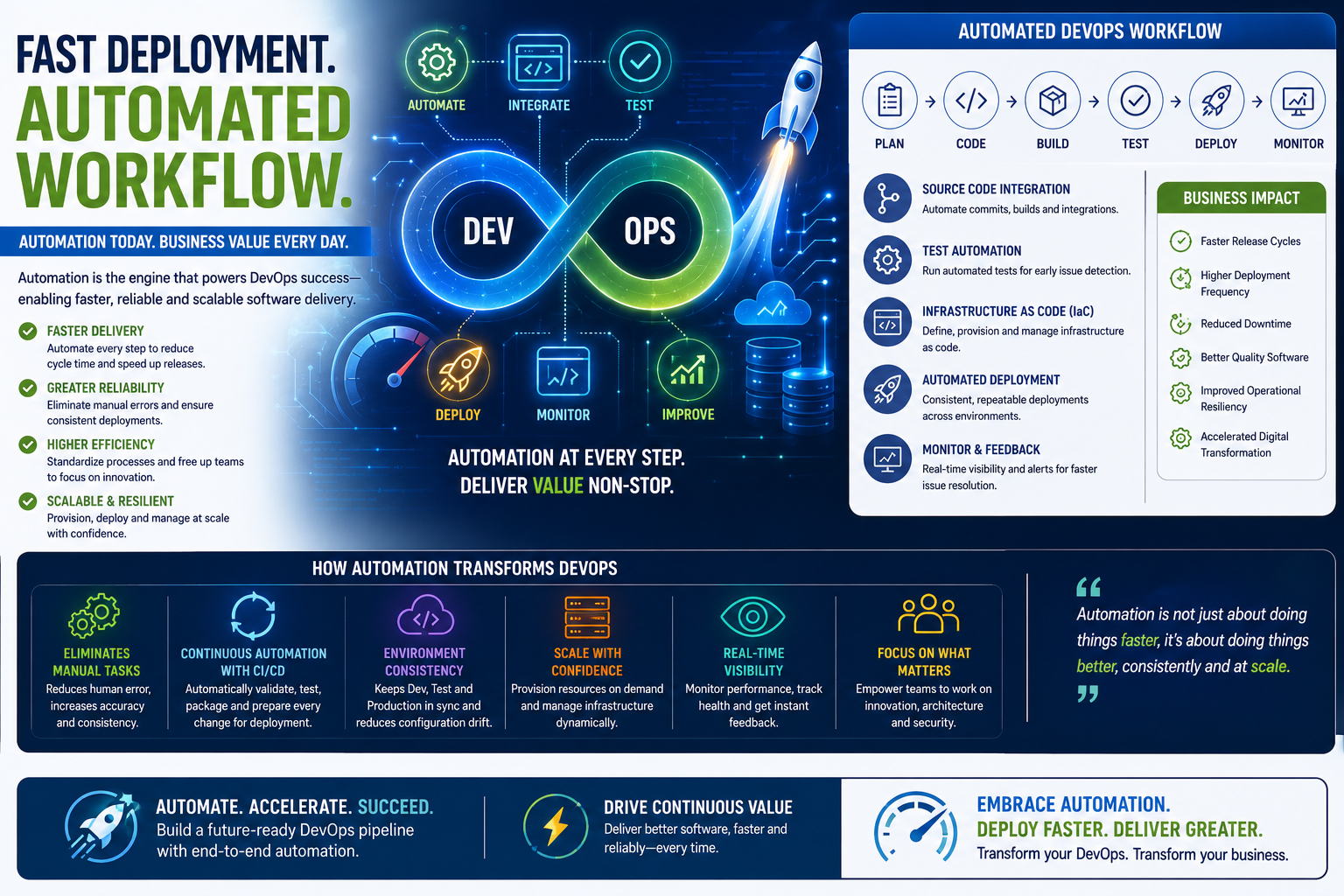
The primary benefit of automation is improved operational efficiency, allowing engineering teams to focus on strategic initiatives such as innovation, architectural improvements and security and performance improvements, rather than mundane administrative tasks. Automation, monitoring and feedback systems provide teams real-time visibility into application performance and deployment health so they can detect issues sooner and resolve incidents faster.
Organizations that have implemented end-to-end automation across their DevOps pipelines are realizing significant business benefits such as faster release cycles, higher deployment frequency, reduced downtime, higher quality software, improved operational resiliency and faster digital transformation. Automation is one of the most important DevOps best practices to remain competitive and deliver business value on an ongoing basis as the software ecosystem continues to evolve.
Continuous Integration: Deployment of More Secure Software
One of the main practices that speeds up the modern software deployment process is Continuous Integration (CI). It allows development teams to combine code changes to a shared repository frequently, in an orderly manner. CI encourages developers to commit to a shared repository many times a day. They don’t wait for a lot of changes to integrate, but they integrate incremental changes. Integrations automate running pre-defined validation processes such as code compilation, automated testing, security scans, and quality analysis.
Continuous Integration main advantage is detection of integration problems and defects at an early stage. Code merge helps to merge multiple development branches and reduces number of merge conflicts Proactive teams can identify problems early in deployment process instead of late, this saves lot of cost in problem fixing and delay in delivery.
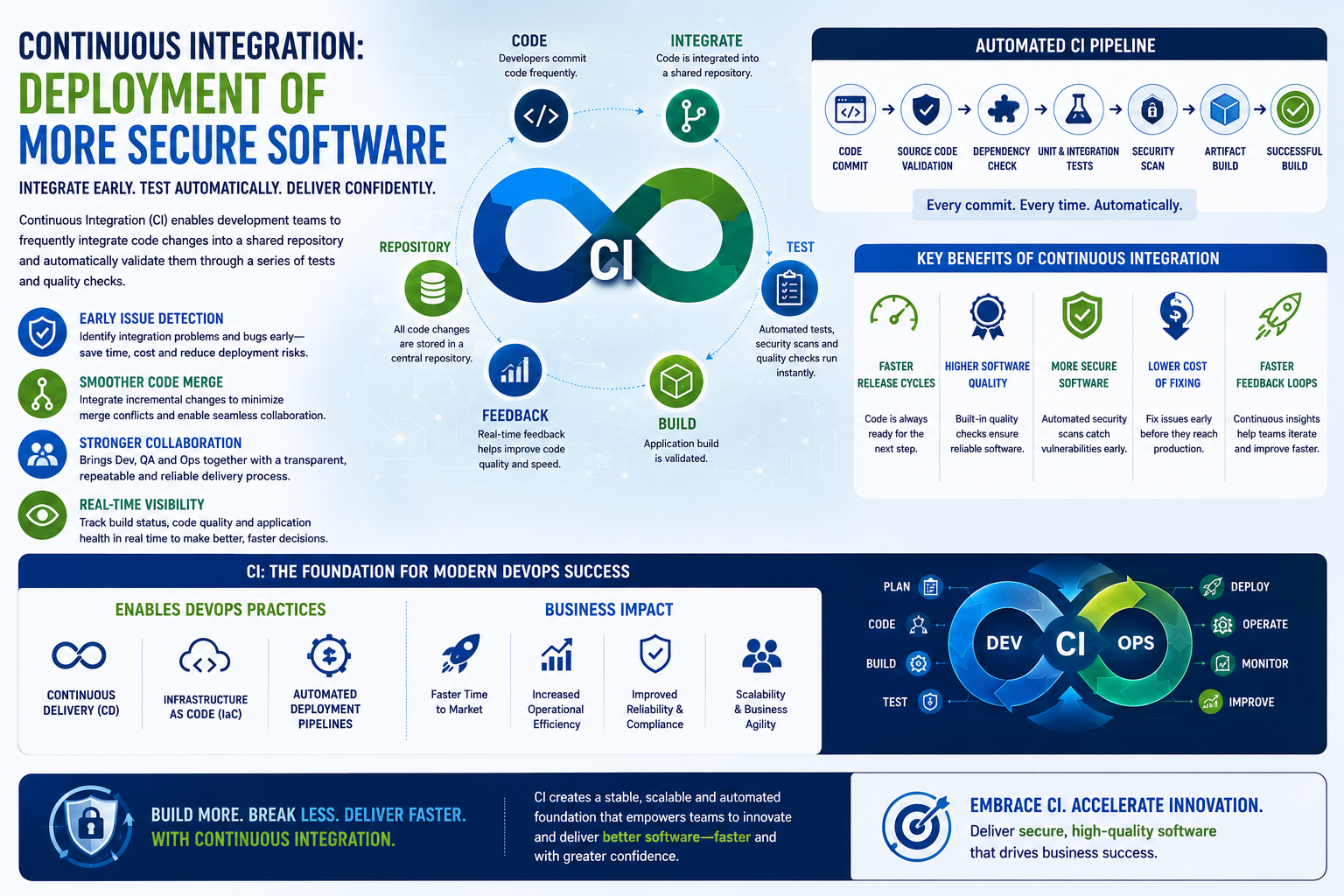
Automated build pipeline is core to CI implementation. When a code commit occurs, a series of automated tasks are initiated. This includes source code validation, dependency validation, unit tests, integration tests and artifact build. These automated processes ensure the stability of the application and the fit of the quality standards in the development environment. This makes the deployment predictable, does not require any manual intervention and mitigates the risk of human error.
Continuous Integration also enhances the collaboration between Development, Testing and Operations teams, where the delivery process is repeatable and transparent. Get real-time visibility into build status, code quality metrics and application health to make better decisions, faster and iterate faster.
CI also lets you do other DevOps practices such as Continuous Delivery (CD), Infrastructure as Code (IaC) and automated deployment pipelines. Continuous Integration allows organizations to create faster release cycles, better software quality, faster feedback loops and increased operational efficiency. CI offers a stable, scalable and automated development environment that powers rapid innovation allowing organizations to deliver better software, faster and with greater confidence.
Latest Continuous Delivery & Deployment news
Continuous Delivery (CD) makes it easy to deploy the application. Application can be deployed anywhere in the software development life cycle. Continuous Delivery is an alternative to the traditional release mechanisms. In the release process there are manual activities and long stabilization periods in the release cycles. Continuous delivery automates many of the steps involved in the release process: packaging the application, validating the build, testing, provisioning the environment, orchestrating the release. That closes the gap between code and ready to deploy; helping organizations deploy software updates faster, with more confidence.
Well defined Standard workflows
Continuous Delivery pipelines offer predictability in deployment and efficiency of operations. All code changes are automatically run through quality gates (unit testing, integration testing, security validation, performance testing and compliance checks) before being promoted into production environments. These controls result in a much lower rate of deployment failures and better quality software delivered in release cycles.
“Learn to deploy with confidence and minimum impact to your users by using controlled deployment strategies like blue-green deployments, canary releases, rolling updates, and feature flag management.” Fast rewind in case things go wrong. Continuous Delivery also ensures environment consistency with Infrastructure as Code (IaC) which makes sure that development, test, staging and production environments are reproducible and in-sync.
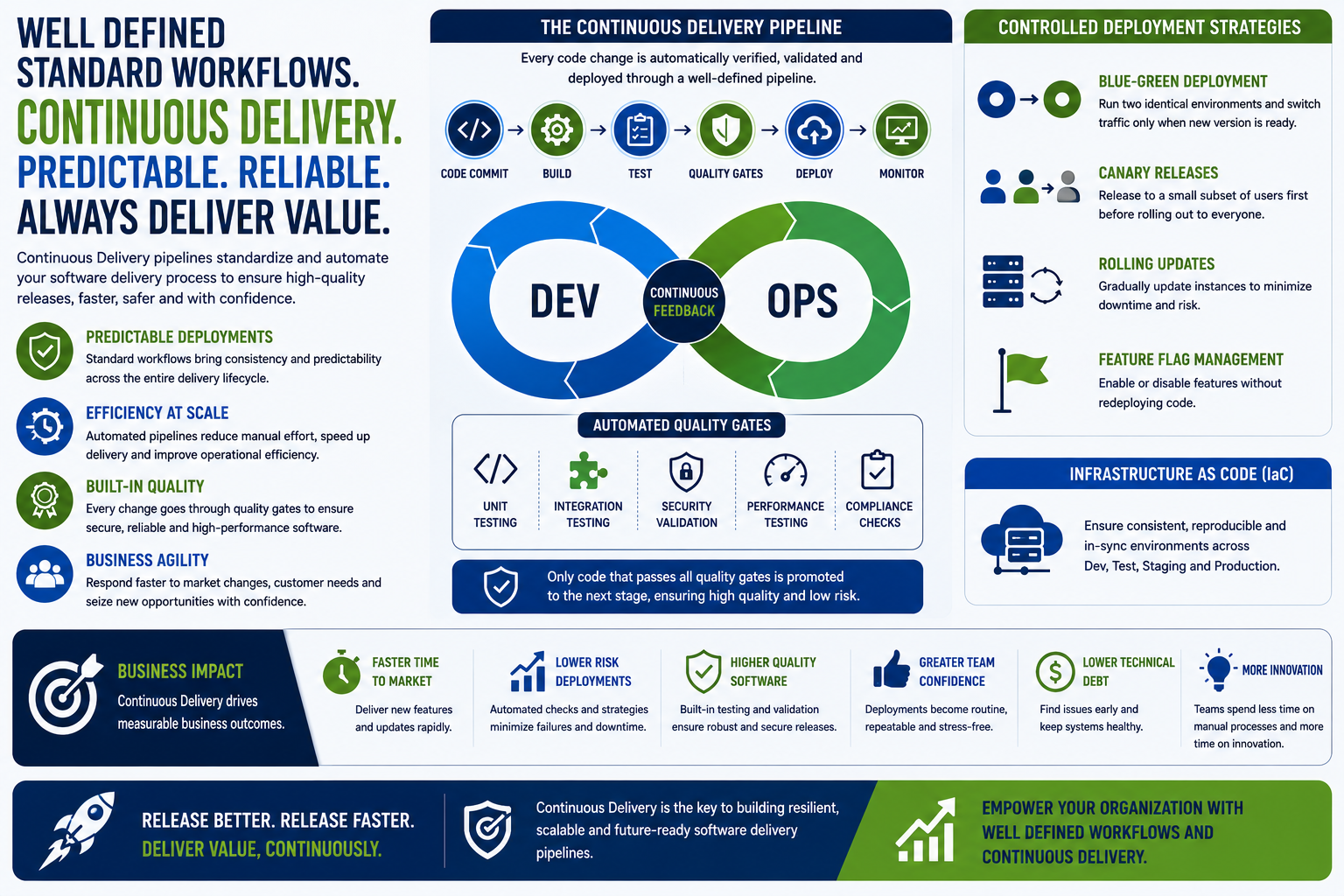
In business terms Continuous Delivery means organisations are highly responsive to changing customer expectations, market opportunities and operational imperatives. The development teams are more confident, deployments are low risk, routine affairs, not complex release events. You'll find problems sooner and fix them faster resulting in lower technical debt and more innovation.
In today’s world of cloud-native and enterprise applications, Continuous Delivery is a core DevOps practice for organisations who want to be agile, scalable and always deliver business value. It reduces the deployment risk, increases the release frequency, improves the resilience of the system and faster recovery from failures.
Infrastructure as Code - IaC Robust & Scalable.
Infrastructure as Code (IaC) is one of the most disruptive practices in modern DevOps ecosystems, and helps organizations achieve a higher level of consistency, scalability, and operational efficiency across infrastructure environments. Provision and configure infrastructure on the other hand can lead to configuration drift, inconsistency in deployments, operational bottlenecks and higher risk of human error. As cloud native and distributed environments grow, the underlying infrastructure becomes more complex and increasingly difficult to manage manually and consistently.
With Infrastructure as code, you solve this challenge by defining, provisioning, configuring, and managing infrastructure with machine-readable definition files, templates, and scripting methods. We version our infrastructure components like virtual machines, networks, storage, containers, security policies, cloud services, etc. in the same way as we version application code. The teams have the infrastructure defined in source control with versioning, peer review and automated rollback procedures if needed.
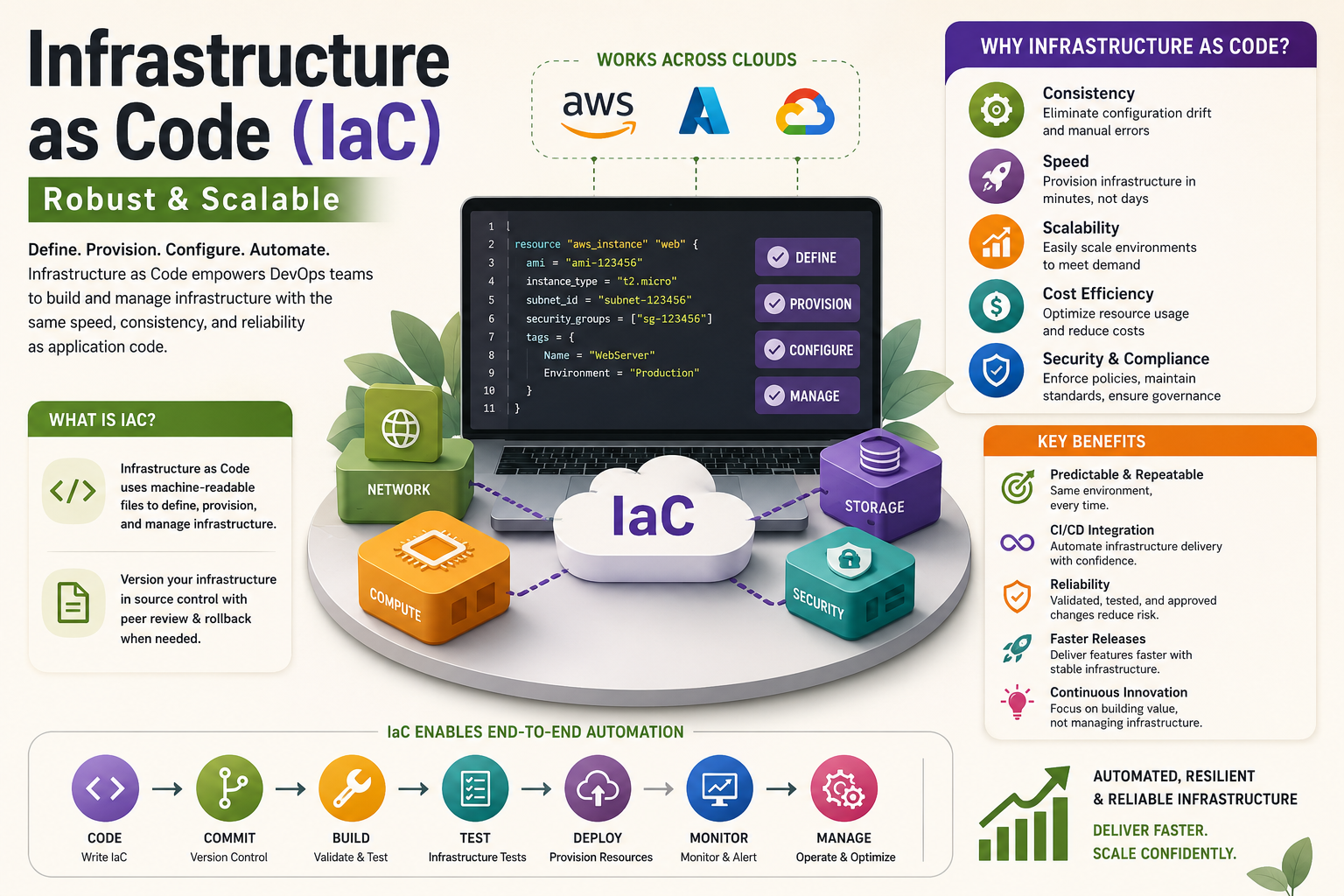
With Infrastructure as Code, organizations can offer predictable and repeatable environments for development, testing, staging, and production. We automate provisioning to eliminate inconsistent environments, shorten deployment cycles and allow teams to provision their infrastructure in minutes, not hours or days. Deployments are more reliable due to integrations with Continuous Integration and Continuous Delivery (CI/CD) pipelines, as infrastructure updates are validated and approved through normal processes.
Ultimately, Infrastructure as Code allows DevOps teams to build automated, resilient, and reliable infrastructure operations that deliver faster releases, consistent environments, and continuous innovation that can be deployed with confidence.
Automated Testing for Reliable Deployments
One of the key best practices in DevOps is test automation. It improves the quality of software, it improves the speed of the delivery cycle and it improves the reliability of deployment. Because the modern software development process is based on a CI/CD environment, manual testing can't keep up. Complex, fast moving application environments can suffer from bottlenecks, longer release cycles and missed defect detection with traditional testing approaches. Automation testing solves these issues and quality assurance is achieved in software development life cycle.
Automation testing enables the dev team to test the code at any point in the deployment pipeline. Teams can execute automated test cases on code changes and detect defects early, before they even make it to production environments. This shift left approach reduces the cost of remediation and improves the overall stability of the software.
The whole testing automation strategy consists of several layers of testing. Functional Testing ensures that the features of the application are working as intended and meet the business requirements. Integration tests ensure that services, APIs, databases, and other external systems work together well. Performance Testing ensures the responsiveness, scalability and stability of the application under various workloads which provide the best experience to the users. To find weaknesses in development stage for compliance needs Regression Testing is performed to check that new changes have no effect on the existing functionality.
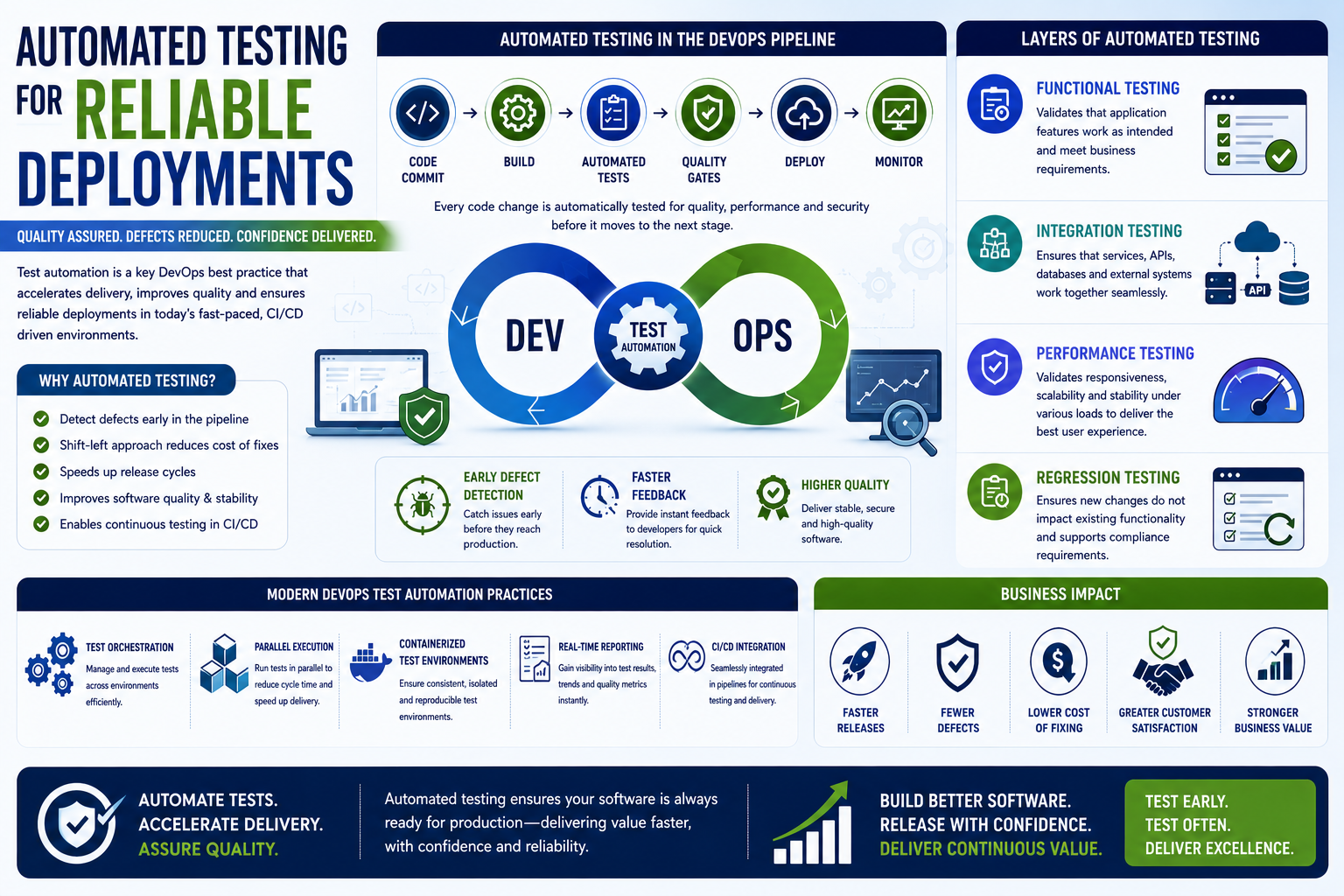
Today’s DevOps environments are raising testing to the next level with automated test orchestration, parallel execution, containerized test environments and real time reporting. The CI/CD pipeline integration gives immediate feedback to developers so they can fix problems as they commit code.
DevOps Monitoring and Observability
Monitoring and observability are the central pillars of modern DevOps infrastructures that provide us continuous insight into application performance, infrastructure health and health of the global operation. This provides your operations and engineering teams with the visibility they need to keep services available and applications perform as expected by the business. One of the advanced monitoring solutions is the automated alerting, i.e. the system generates alerts when thresholds are exceeded or anomalous behaviour is detected.
Observability is not just monitoring, it is helping teams understand the 'why' of a problem, not just that you have a problem. Observability is the collection of logs, metrics, traces, and other telemetry data, to better understand how your application is performing and what it depends on in the underlying systems. This is especially true for cloud native architectures, microservices environments and containerized deployments, which are composed of many services dynamically interacting with each other.
Continuous monitoring and observability:
Faster incident detection, root cause analysis and recovery time. This rapid response allows engineering teams to respond faster to production incidents, reducing downtime and impact to end users. They also aid in capacity planning and infrastructure optimization through historical performance analysis and predictive insights.
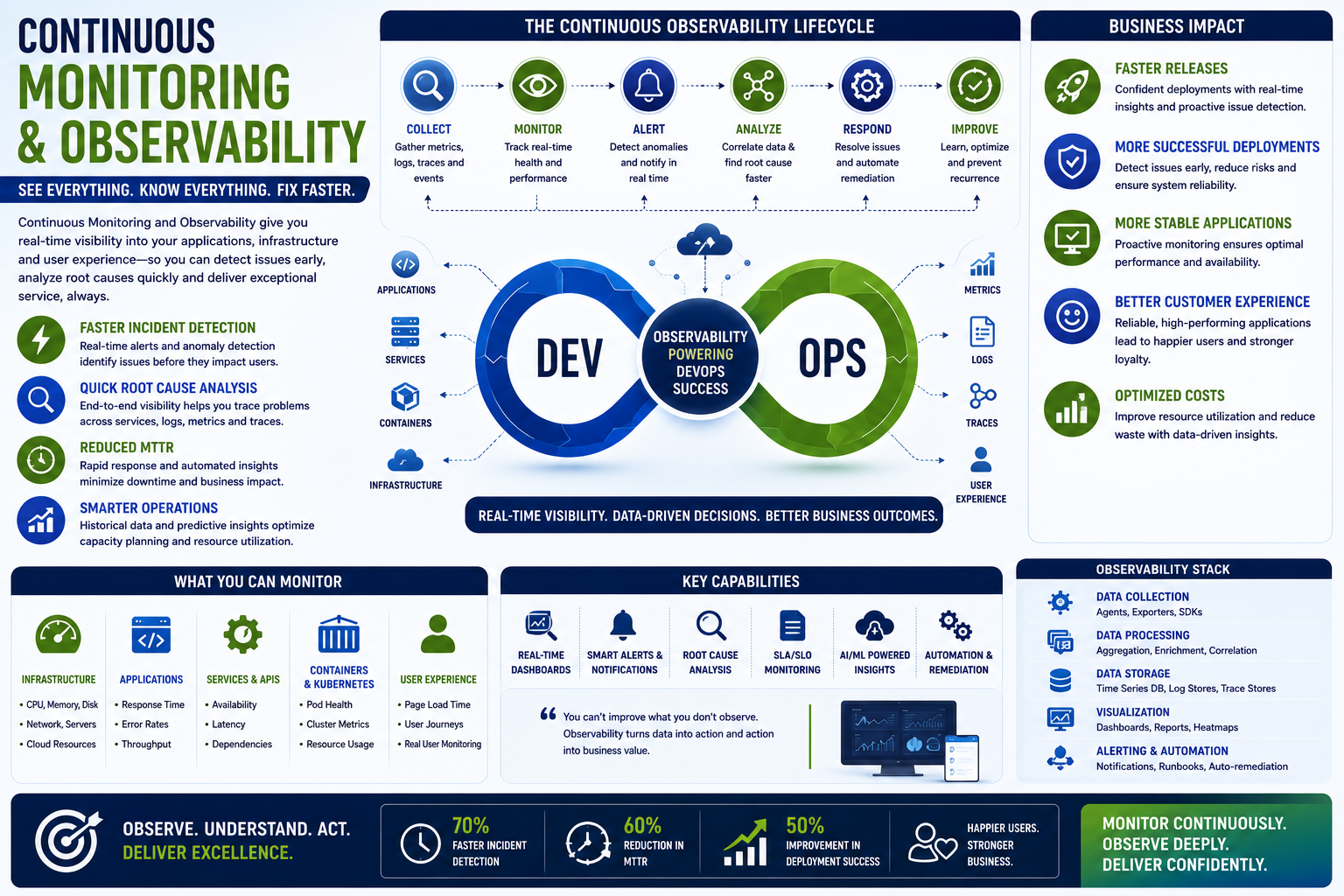
By embedding points of leverage for robust monitoring and observability into their DevOps pipelines, organizations can create a data-driven operational model that will result in faster releases, more successful deployments, more stable applications, and a better customer experience.
Security Integration Security Development Operations Security
Security integration is a necessity in today’s DevOps environment to provide the proactive protection mechanisms needed for rapid release cycles and continuous deployment. Security checks later in the software delivery life cycle create bottlenecks and ship unknown vulnerabilities to prod. This reactive approach creates operational and compliance risk for the organization and increases remediation costs and delays releases. Today in DevOps, the answer to this problem is DevSecOps. It simply builds security controls into every single phase of the software development lifecycle.
DevSecOps is a shift-left security model that allows teams to find and fix security vulnerabilities throughout the software development lifecycle, from planning and development to integration, testing, deployment, and continuous operations. Security scanners are constantly scanning source code, infrastructure configurations, containers, dependencies, and deployment pipelines for vulnerabilities
Identity and Access Management (IAM), role based access controls, secrets management and automated policy enforcement add extra layers of security to stop unauthorized access to development and production environments. Compliance validation frameworks are developed to be compliant with organization standards and industry regulations and do not require manual review. Learn distributed cloud native architectures, how to react fast to incidents with continuous monitoring and runtime threat detection.
Secure pipelines also include container security, API security and zero-trust security principles. Shift security left in your automation workflows and CI/CD pipelines to minimize risk and speed software delivery. Dev, Ops, and Security teams share security responsibilities to enable resilient, scalable and reliable deployment ecosystems that drive innovation without compromising the agility of operations or business continuity.
Cloud Deployments: How to Make It Work
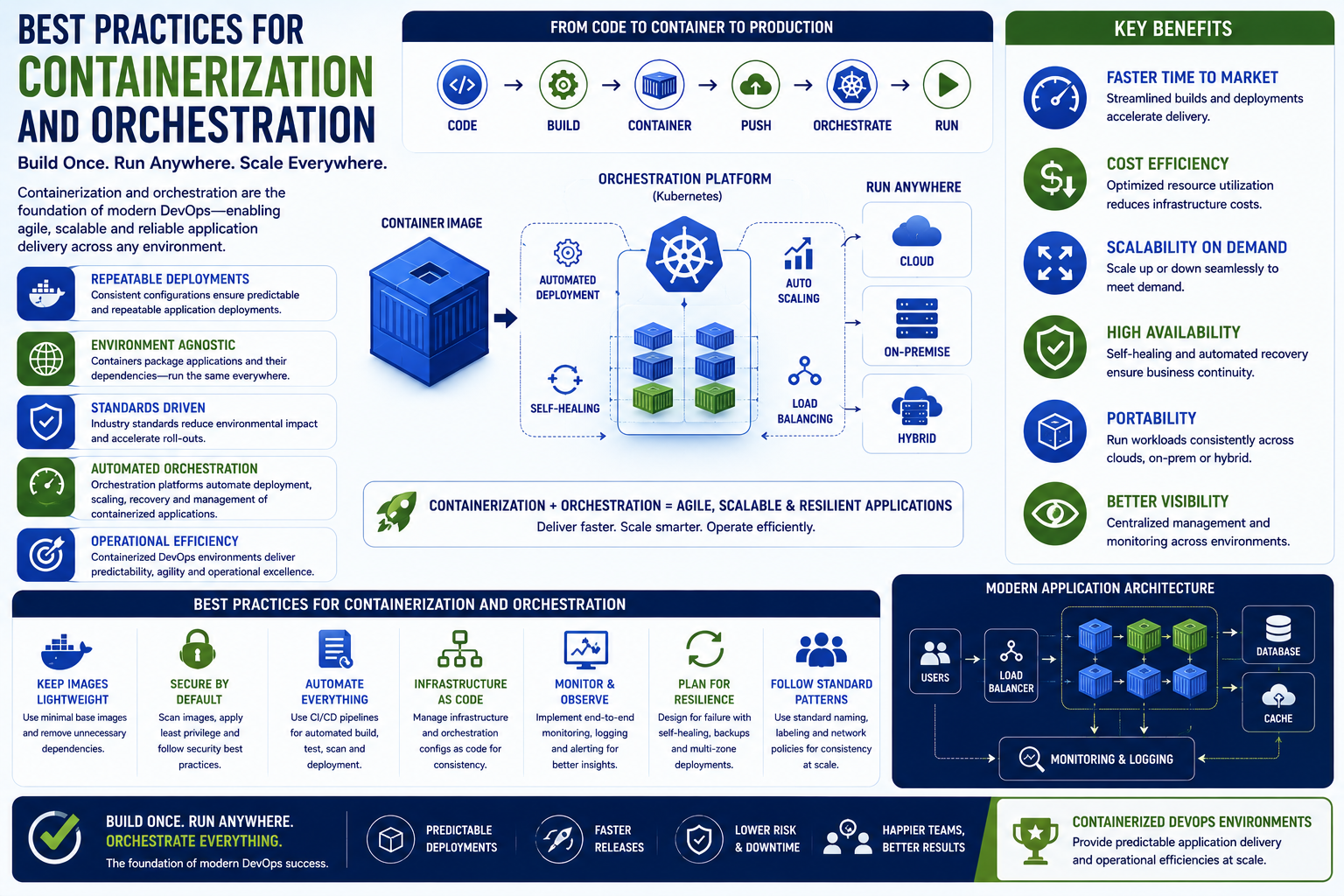
Cloud as a DevOps Deployment Enabler Cloud platforms offer elastic infrastructure, flexible resource management and a set of automation capabilities. “Cloud-native DevOps architectures allow organizations to provision quicker, with less infrastructure complexity and greater availability. Containerization and orchestration technologies take it a step further and easier to manage deployment in a distributed environment . Cloud-based DevOps environments are critical to enable teams to innovate at speed and respond quickly to changing market needs.
Best Practices for Containerization and Orchestration
Repeatable deployments Environment agnostic Containers bundle an application and its dependencies. Containers provide a common run-time environment on different underlying systems Standards reduce environmental impact and increase speed of roll-out Container orchestration platforms automate deployment, scaling, recovery and management of distributed systems Containerised DevOps environments provide predictable application delivery and operational efficiencies
Skill Development Online Learning Devops
Organizations are investing heavily in DevOps Online Training courses to get hands-on experience and industry-oriented knowledge to master the latest deployment techniques. Learning automation frameworks, deployment pipelines, cloud integration, infrastructure management, monitoring strategies and collaborative workflows is a great way for professionals to learn. Full training will provide the learners with the skills to implement and real world scenarios for deployment. Companies gain a competitive edge through a strong DevOps expertise in digital transformation initiatives.
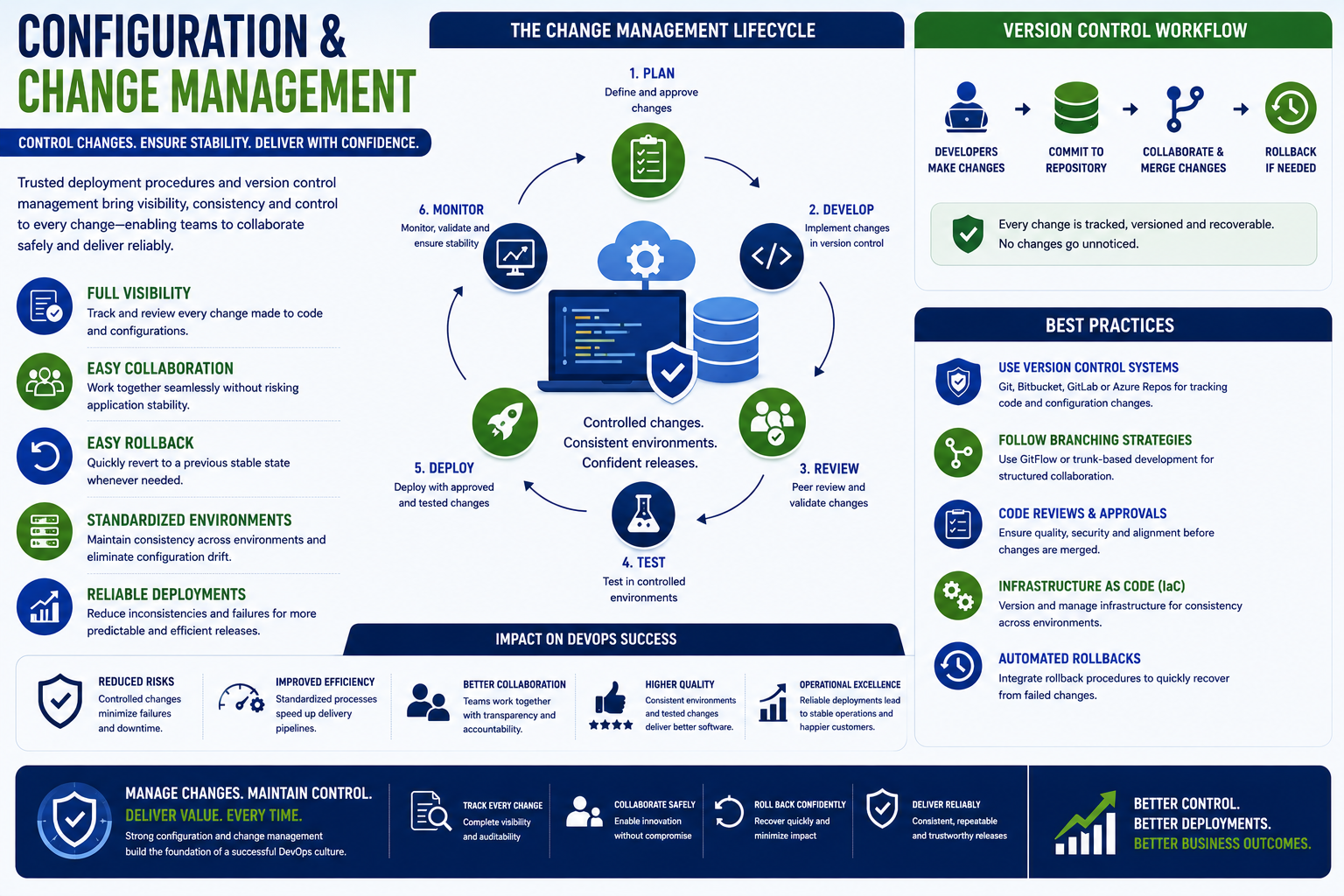
Configuration and Change Management
Trusted deployment procedures are another important aspect of version control management. With version control systems it is easy to see all the changes made to code . It is easy to collaborate , it is easy to roll back if needed . This lets developers collaborate without putting the app at risk. It also helps standardize environments and reduce inconsistency – leading to more reliable deployments and operational efficiency.
Deployment Process and Incident Response
How your deploy can make a world of difference to the reliability of releases and the customer experience. Blue-green deployments, rolling deployments, and canary releases are methods for reducing downtime and minimizing deployment risks. Well-defined incident management processes allow teams to react quickly to failures and build operational resilience over time.
Operational Efficiency and Performance Enhancement
Performance tuning is a must for reliable software deliveries. Applications must be efficient and scalable for different workloads. DevOps teams are always looking for system metrics to help them identify performance bottlenecks and optimize their infrastructure. PERFORMANCE engineering produces applications with improved user experiences and operational level.
Top Online DevOps Courses To Boost Your Career
Most organizations understand the importance of investing in a good DevOps Online Course to boost their tech capabilities and bring teams in sync with modern deployment practices. Topics of advanced courses include CI/CD implementation, Infrastructure as Code, cloud deployment models, security automation, monitoring frameworks and container orchestration. The requirements of theory and business execution challenge the practical experience of the professional.
Simple. Very scalable recursion. Continuous improvement.
Scalability planning ensures that the application scales in a sustainable way, resulting in a long-term successful deployment. Modern applications need to be performant, reliable and scale for ever increasing loads. Feedback loops help teams improve their deployment practice.
Serverless & Automation Architecture Administration
Automation governance secures and governs DevOps practices as the business scales. Governance Frameworks set standards for automation, access controls, compliance management and accountability within operations. Less Management Infrastructure Faster Software Delivery.
Serverless Architecture Allowed for distributed team collaboration.
Tools for Collaboration Help Visualize and Communicate Distributed DevOps Teams Embedded collaboration features for project management, deployment alerts, incident resolution and knowledge sharing Effective communication can help speed troubleshooting and coordinate deployments..
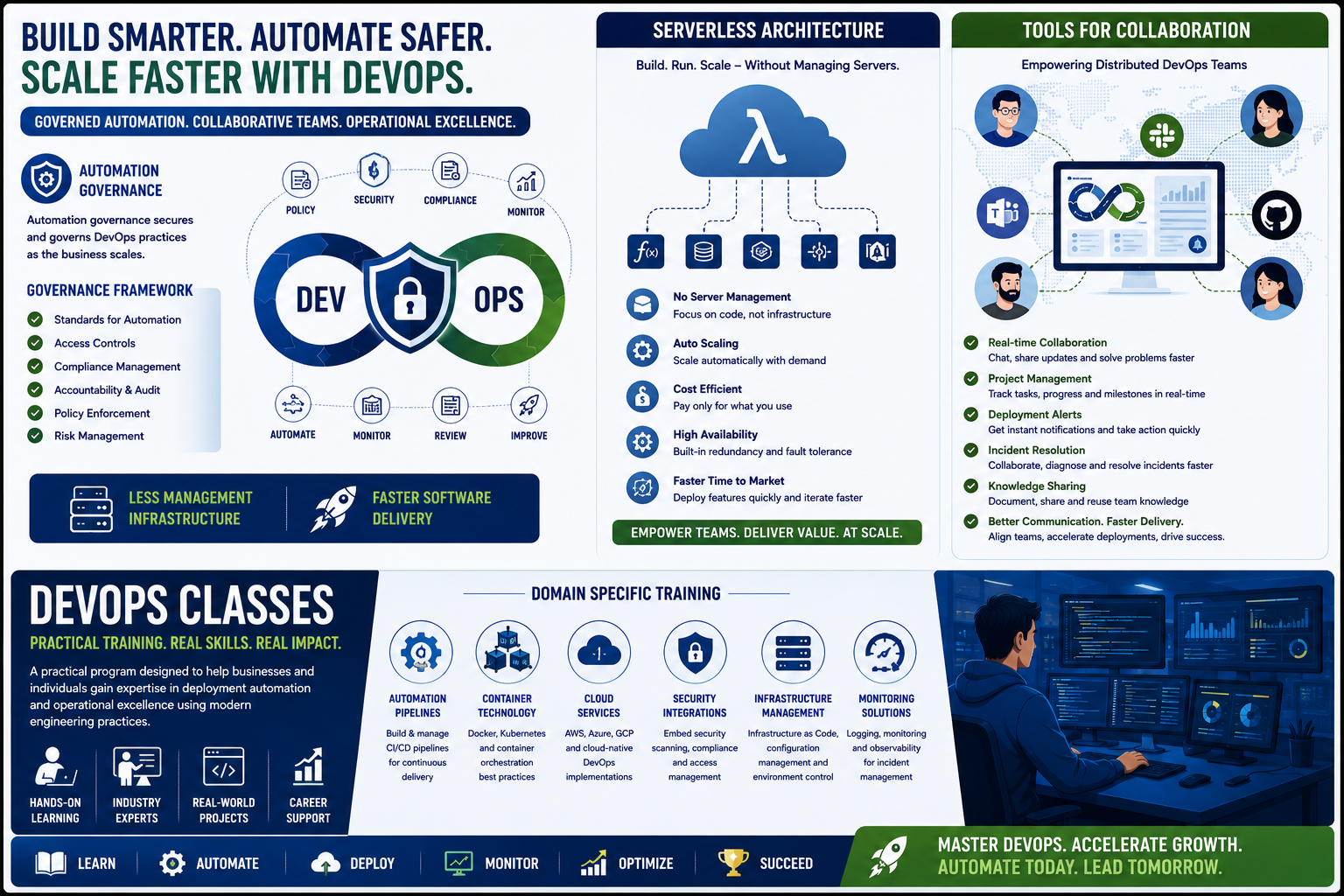
DevOps Classes is a practical program that helps businesses and individuals gain expertise in deployment automation and operational excellence by using modern engineering practices. Domain Specific Training - Automation pipelines, container technology, cloud services, security integrations, infrastructure management and monitoring solutions
Standard lifecycle management and business recovery planning
Standardization provides predictability of the environments they are deployed into and less operational complexity. Application Lifecycle Management (ALM) is the effective management of activities of planning, development, testing, deployment and support Disaster recovery planning is the automated backup and disaster recovery operations that ensures business continuity.
Structured DevOps Engineer Course learning paths are the first stop for professionals looking to build their careers long-term, and organizations looking to modernize delivery pipelines. This is a unique moment to build deployment capacity and operational capacity. These programs offer a solid base in DevOps practices and effective ways to implement them for digital transformation initiatives.
Conclusion:
In terms of speed, collaboration, automation and reliability, DevOps is how organizations develop, test, release and support software applications. Best practices such as Continuous Integration, Continuous Delivery, Infrastructure as Code, monitoring, security integration and performance optimization enable businesses to deliver high quality software at a high velocity. OnlineITGuru is a well organized professional learning platform that uses experts to give students the hands-on experience needed in today's deployment environments and to be successful in their careers in this ever changing field.