
DevOps Engineer in 2026: When Shipping Faster Isn't Enough Anymore
Last updated on Oct 5, 2026
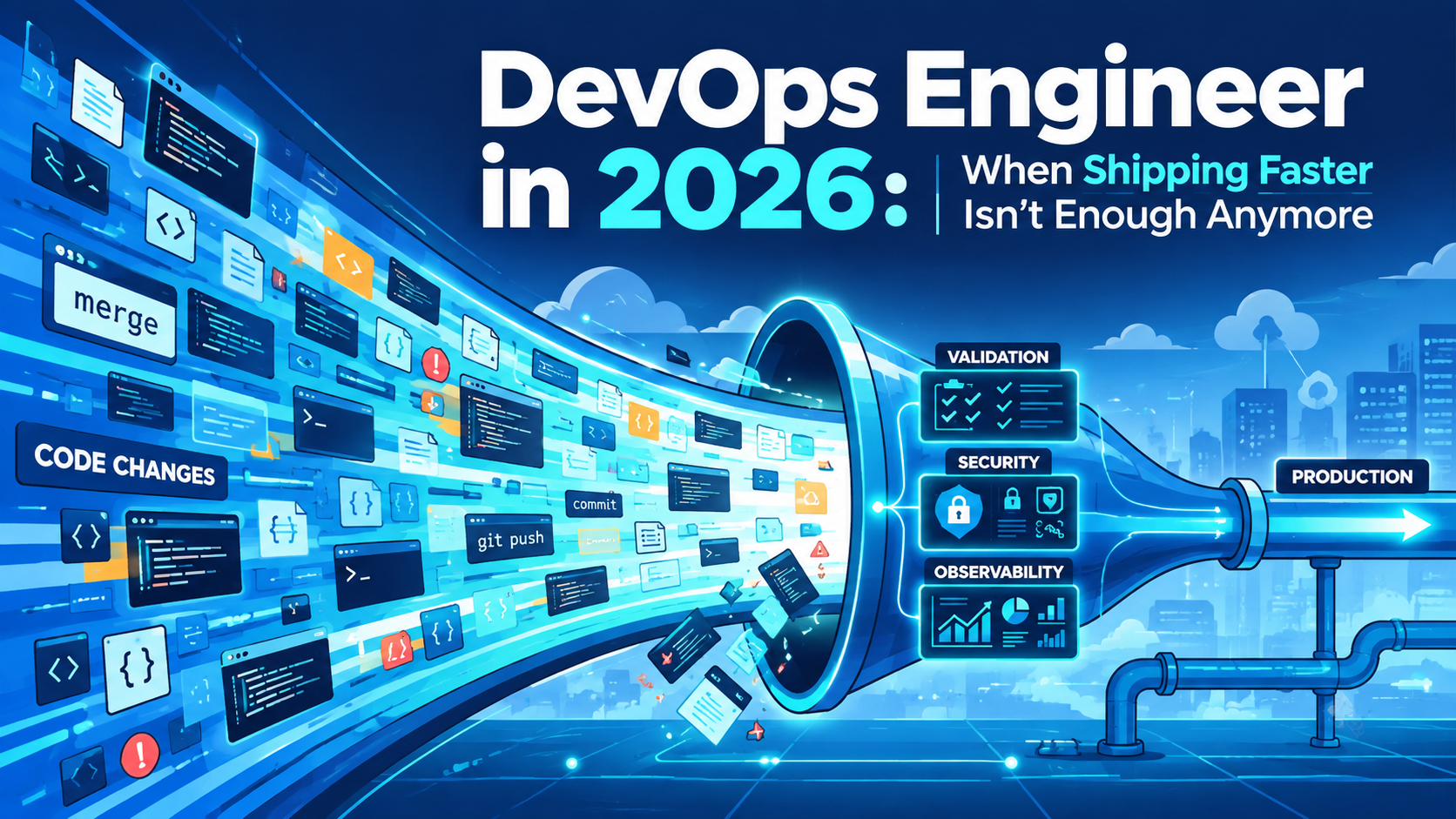
The Speed Race Has Changed
There was a time when the most impressive thing a DevOps team could say was how often it deployed. Ten times a day. Fifty. A hundred. Those numbers showed up on conference slides like medals, and for good reason: escaping the quarterly release cycle was genuinely hard, and the teams that managed it earned a real advantage. That race is largely over. Between AI coding assistants, managed cloud services, reusable components and mature CI/CD tooling, most competent teams can now ship at a pace that would have looked reckless in 2015. Speed has stopped being the differentiator. It has become the baseline.
And that raises an uncomfortable question. What happens when an organization can ship quickly but cannot reliably control what it ships? Fast delivery of a good change is a win. Fast delivery of a flawed change, an unreviewed dependency, an overly generous permission or an expensive scaling rule is just a quicker route to a bad Tuesday. This is the shift reshaping the DevOps Engineer role in 2026. The job is moving away from a narrow focus on pipelines and toward something closer to engineering the whole system: how code is written, validated, secured, released, observed and paid for. Deployment is one step inside that system, not the system itself.
That is the argument this article builds toward. In 2026, the value of a DevOps Engineer is no longer measured only by deployment frequency. It is measured by whether the organization can move fast and still know what is running, why it is running, whether it is healthy and what it costs.
The DevOps Engineer Has a New Problem: Developers Are Getting Faster
A typical developer in 2026 starts with advantages that earlier generations would have envied. An AI assistant drafts the boilerplate. A component library handles the interface. A managed database, a queue and an identity service are a few clicks or a few lines of Terraform away. Tests can be generated in seconds, and a template spins up a new service before lunch.
All of this is good news, until you look at what sits downstream. Developers can now produce software faster than most engineering systems can safely absorb it. More changes means more pull requests, more builds, more deployments, more dependencies pulled in along the way and more infrastructure definitions that someone has to keep consistent. The pressure doesn't disappear when code gets cheaper to write. It moves to everything that happens after the commit.
Consider a product team of eight developers building a subscription platform. With AI assistance, they go from shipping a few changes a week to a dozen a day. For the first month it feels like magic. Then the cracks appear. Two services quietly use different versions of the same library. A hotfix applied by hand in staging never makes it back into the infrastructure code, so staging and production slowly drift apart. A new endpoint ships without meaningful logging, and when customers report slow checkouts, nobody can say which service is responsible.
None of these problems come from careless people. They come from a delivery system that was designed for a slower rhythm. Configuration drift, dependency sprawl and missing telemetry are what happen when velocity outruns guardrails.
This is why the modern DevOps Engineer spends less time pushing releases through and more time designing the conditions under which developers can release on their own. Strong CI/CD guardrails, such as automated policy checks, enforced test gates, environment parity, progressive rollouts and automatic rollback, let teams move independently without creating chaos for the people who operate the result. The goal is not to slow developers down. It is to make the safe path the fast path. It also changes what newcomers need to learn. Anyone choosing a devops course today should be asking whether it goes beyond building a pipeline: does it explain why environments drift, how a release gets verified in production, and what happens when ten teams deploy into the same cluster? Basic CI/CD is the starting point now, and the interesting work begins where those tutorials usually end.
AI Didn't Replace DevOps. It Raised the Stakes.
Every few months, a confident prediction appears that AI will make operations roles obsolete. The logic sounds tidy: if a model can write code, generate tests, produce Terraform and even diagnose a failing pod, who needs a DevOps Engineer? The flaw in that logic is that producing a change and owning its consequences are different jobs. AI is genuinely useful in this field. It speeds up infrastructure-as-code drafts, suggests fixes from error logs, summarizes noisy incident timelines and writes the dull parts of a configuration file. A good engineer will use it daily. But it increases the volume of change entering the system, and volume is exactly what stresses delivery infrastructure.
Here is a scenario that is already common. A developer asks an assistant to make a service more resilient. The assistant adds an aggressive retry policy to every outbound call. The code compiles, the tests pass, the review looks fine. In production, a downstream payment provider has a brief slowdown, and every instance of the service starts retrying at once. Traffic to the provider multiplies, the slowdown becomes an outage, and the retry storm takes the service down with it.
Nothing about that change was technically invalid. What was missing was context: the model didn't know the provider's rate limits, the business cost of duplicate payment attempts, or how the system behaves under partial failure. AI can help produce changes, but it does not automatically understand what those changes mean once they meet real traffic, real customers and real money.
That gap is where DevOps becomes more important, not less. Someone has to define the environments where generated changes get tested realistically, the observability that shows when behavior shifts, the security controls that catch what a reviewer skims past, and the deployment policies that limit the blast radius when something slips through. Someone also has to set the standards for how much trust generated code earns before it reaches users. The human role shifts from writing every line to exercising judgment: reviewing, constraining, questioning. That is a harder skill than it sounds, and it is exactly the one an AI-saturated workflow rewards most.
From Pipelines to Platforms: Why Platform Engineering Is Changing DevOps
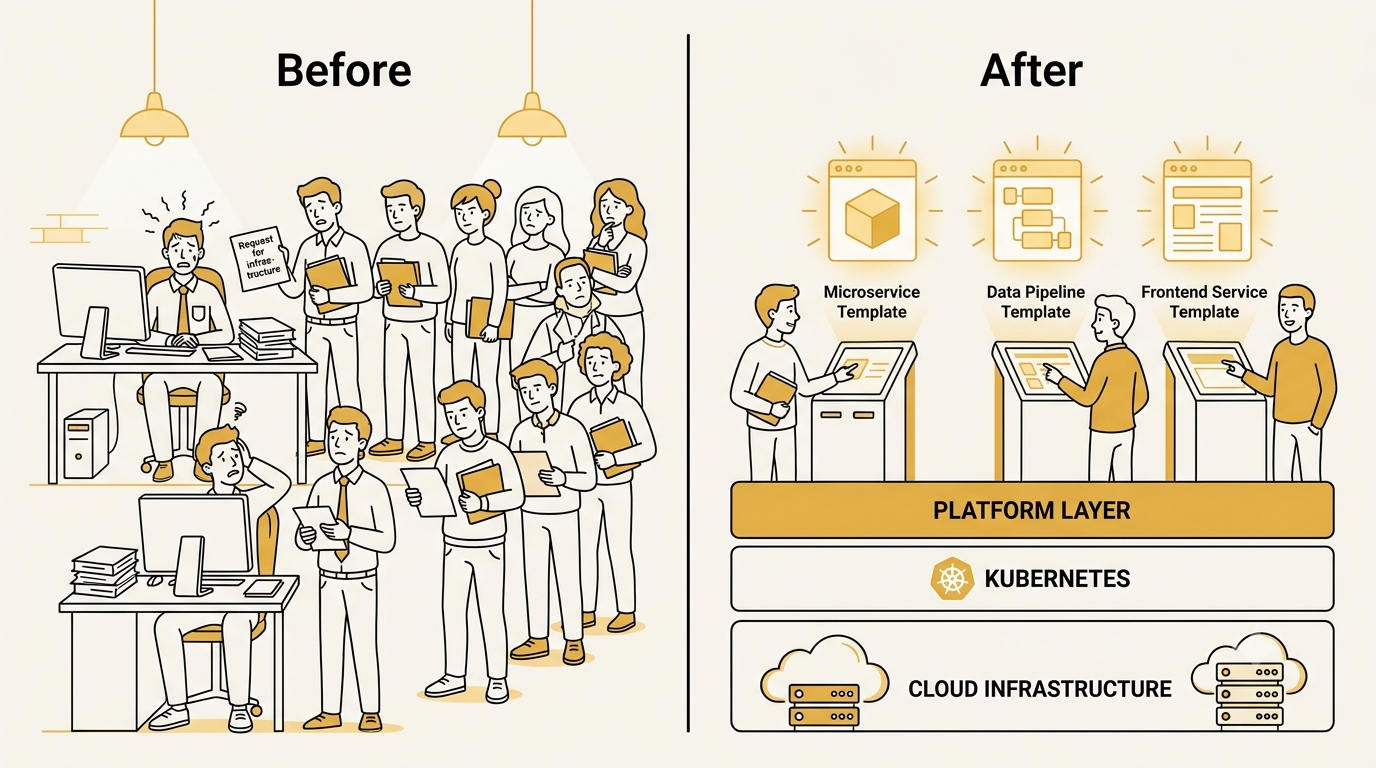
For years, the DevOps model in many companies looked like a help desk with better tooling. A team needed a new service deployed, so they filed a ticket or pinged a channel. A DevOps Engineer wrote or adapted a pipeline, set up the infrastructure and handed it over. It worked at ten services. At two hundred, it became a bottleneck with a friendly face.
Platform engineering is the response. Instead of helping every team individually, the platform team builds an internal developer platform: a set of self-service tools, templates and standards that developers use directly. A team that wants a new service picks a template, and the platform provides the repository structure, the pipeline, the Kubernetes deployment, the baseline monitoring and the security checks. These pre-built, opinionated routes are often called golden paths, and they work because they remove decisions that nobody needs to make twice.
The relationship between developers and DevOps Engineers changes with it. The engineer is increasingly someone who builds the system developers use to build and ship software, rather than the person who manually shepherds each application into production. Standardized environments, reusable deployment modules and infrastructure abstraction mean developers get speed and the organization gets consistency. Developer experience becomes a real engineering goal, not a nice phrase on a slide.
But platforms have a failure mode, and it is worth being honest about it. Some internal platforms grow into sprawling products nobody asked for: layers of abstraction over Kubernetes that hide so much that developers can't debug anything, dozens of configuration options, documentation that is always one version behind. A platform that makes simple things complicated will be quietly routed around, and the shadow infrastructure that results is worse than the ticket queue it replaced.
The practical test is simple. Do developers choose the platform because it makes their week easier, or because they are told to? Good platform teams treat internal users like customers: they measure how long a new service takes to reach production, watch where people get stuck, and remove steps instead of adding them. The best platform is often the one that stays boring.
The Pipeline Isn't the Product. Production Reliability Is.
A green pipeline is satisfying. Every stage passed, the artifact was published, the deployment finished. It is also, strictly speaking, evidence of very little. It tells you the process ran. It does not tell you whether the customer's experience survived it. There is a real difference between "the deployment succeeded" and "the customer experience remained healthy after the deployment." The first is a statement about the pipeline. The second is a statement about the product, and it is the one the business actually cares about.
Picture an e-commerce team releasing a new product-recommendation feature on a Friday afternoon. The pipeline is flawless. Within twenty minutes, however, the product page is taking two seconds longer to load, because the new feature makes a synchronous call to a service that was never sized for that load. Error rates creep up on mobile. No alert fires, because the existing alerts watch CPU and memory, which look fine. The first signal arrives from customer support, an hour later, as a pile of complaints about slow checkouts.
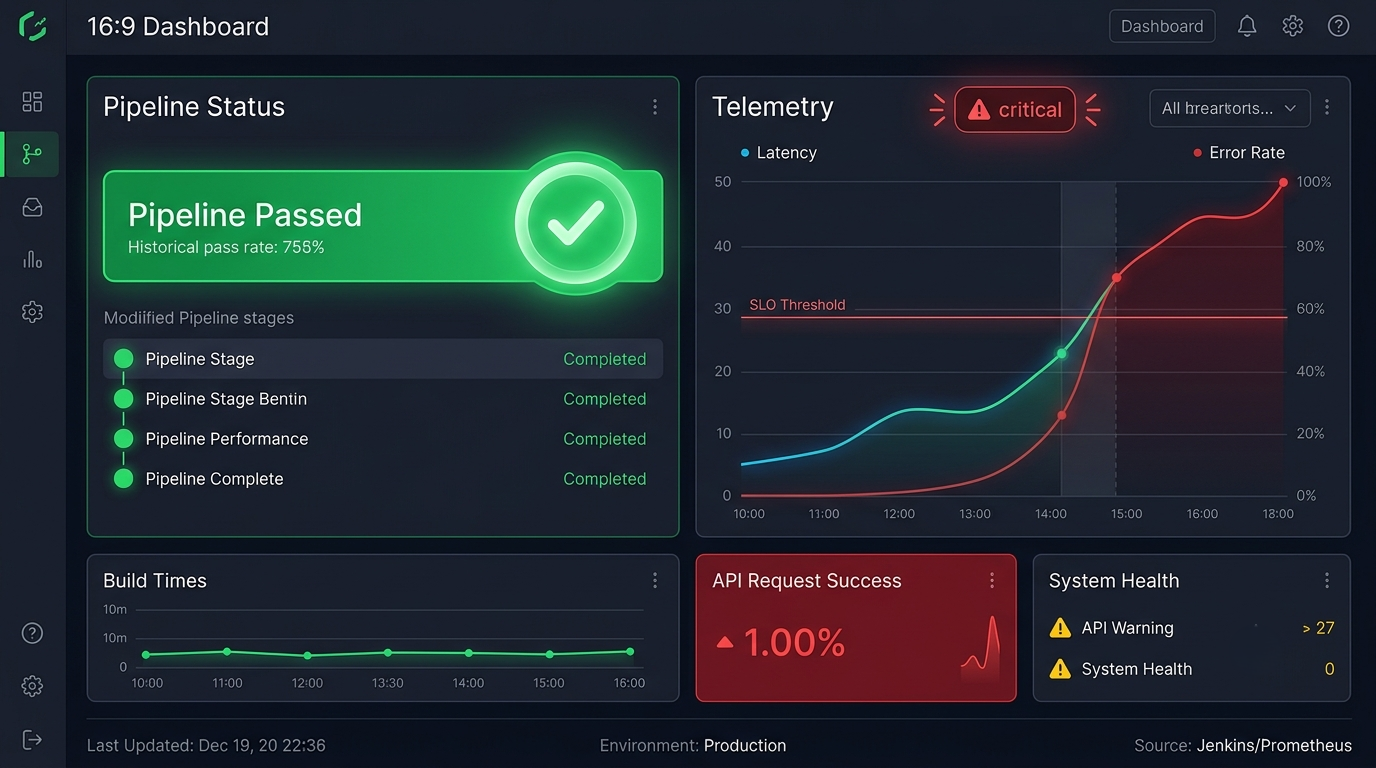
This is why reliability engineering has moved to the center of the role. Observability, meaning metrics, logs and distributed tracing working together, is what lets a team ask new questions about a system without redeploying it. Service level indicators and objectives (SLIs and SLOs) define what "healthy" means in terms users can feel, such as page latency or successful checkouts. Error budgets turn that definition into a decision tool: when the budget is healthy, ship boldly; when it is exhausted, slow down and fix reliability first.
Other practices round it out. Progressive delivery with canary releases limits how many users see a bad change. Fast, rehearsed rollbacks make mistakes cheap. Incident response practices and blameless reviews help teams learn instead of hide. Disaster recovery plans, tested rather than merely written, determine whether a regional failure is an inconvenience or a headline.
The common thread is ownership. A DevOps Engineer who stops caring at the moment of deployment has stopped halfway. Site reliability thinking asks a harder and better question: not whether the code went out, but whether the system is still doing its job.
The New Security Question: What Exactly Are We Deploying?
Security used to be a gate near the end of the process: a scan, a review, a sign-off. That model struggles badly when a company deploys dozens or hundreds of changes a day. There is no time for a gate, and the attack surface has grown well beyond the code a team writes itself. A modern application is mostly other people's work. Open-source libraries, transitive dependencies, base container images, build plugins, Terraform modules and third-party actions in the CI pipeline all end up in what gets deployed. So here is the deeper question: if a company can deploy hundreds of changes a day, can it actually explain what is inside those changes?
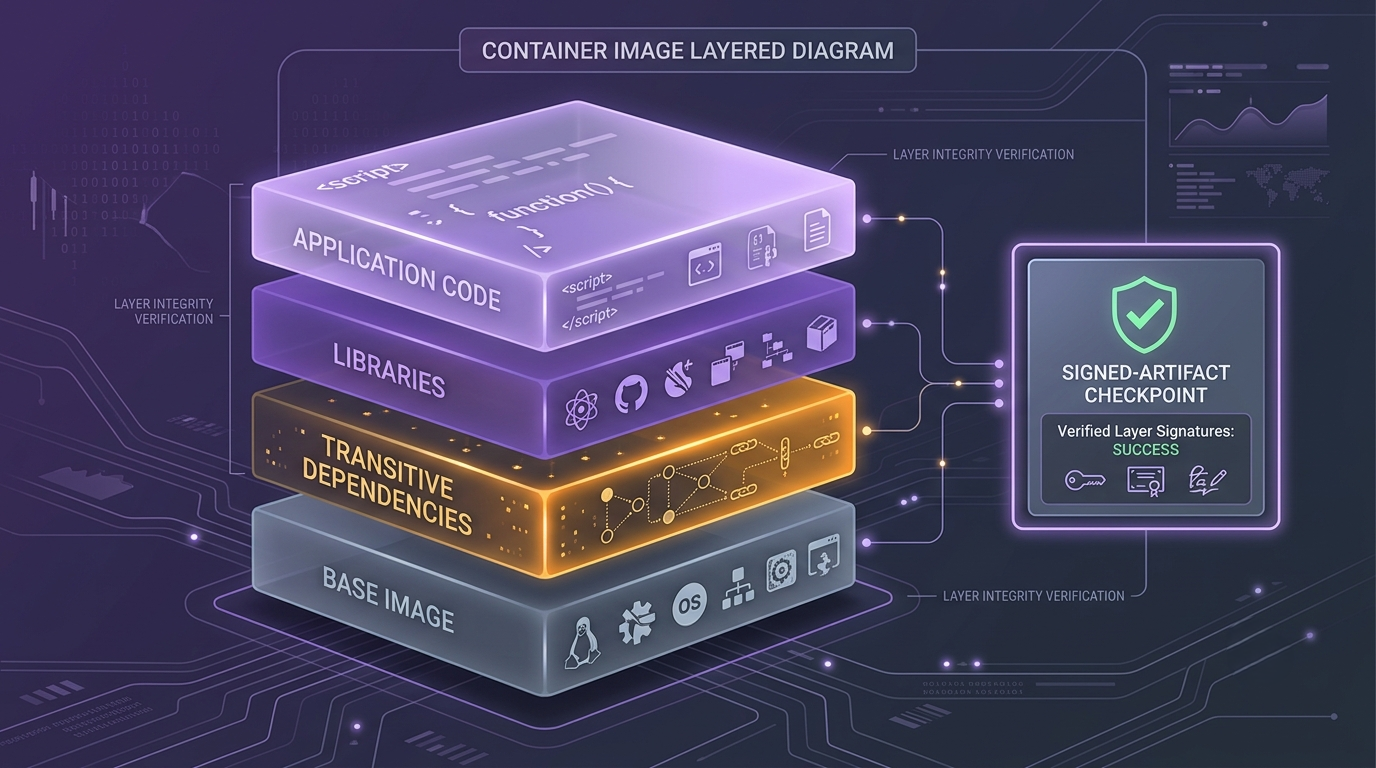
Take a realistic case. A team pulls in a small utility library to parse files. Two levels down, that library depends on a package whose maintainer account was compromised last week. Nobody on the team has heard of it, and no one reviewed it. The build is green, the container is published, and a malicious package is now running with production credentials. Software supply-chain attacks work precisely because they exploit trust nobody noticed they were extending.
The response is DevSecOps in a practical sense: security built into the delivery system, not stapled onto it. That means generating a software bill of materials for every build so the contents of an artifact are known. It means pinning dependencies, scanning container images, and signing artifacts so the pipeline can verify that what it deploys is what it built. It means keeping secrets in a proper secrets manager rather than in environment files, and applying least-privilege identity and access management, so a compromised build job can't touch the whole account.
Infrastructure as code deserves the same scrutiny as application code. A single permissive security group or a public storage bucket in a Terraform file can be provisioned in seconds, and policy-as-code checks can catch these before they ever exist. The CI/CD system itself is a target too, since it holds the keys to production.
AI-generated code and configuration add another layer. Generated snippets can include outdated patterns, over-broad permissions or packages that don't exist, and attackers have learned to register those invented names. The answer is not to distrust the tools but to make the default workflow secure: automated checks that run every time, policies that block risky changes, and a pipeline that makes the secure option the easy one.
The Cloud Bill Has Entered the DevOps Pipeline
For a long time, cost was somebody else's problem. Engineers built, finance paid, and a quarterly review occasionally produced an awkward conversation. Cloud infrastructure changed that arrangement, because every architectural decision now arrives with a price that updates by the hour. This makes infrastructure choices business choices. A deployment can be technically flawless and still count as a failure if it quietly adds thousands of dollars a month in unnecessary spend. The usual suspects are familiar: overprovisioned instances sized for a peak that never came, idle environments left running over weekends, orphaned volumes and snapshots, development clusters that grow into permanent fixtures, and data transfer between regions that nobody priced in. Even observability has a bill. Logging everything at high verbosity can cost more than the workload it describes.
Consider a team whose API slows down during a promotion. The quick fix is to scale up: bigger nodes, a lower autoscaling threshold, a higher minimum replica count. Latency recovers, everyone relaxes. A month later, the cloud invoice shows a sharp increase, and the investigation reveals that the real bottleneck was an unindexed database query. The scaling decision treated a software problem as a capacity problem, and the company is now paying every hour for a fix that never addressed the cause.
Kubernetes makes this harder to see. Shared clusters blur which team is responsible for which spend, resource requests are set once and forgotten, and autoscaling can multiply a mistake as efficiently as it multiplies a success. Without cost visibility by team and service, optimization turns into guesswork.
This is the territory of FinOps, the practice of bringing engineering, finance and product into a shared conversation about cloud spend. For DevOps Engineers, it means tagging and allocating costs properly, setting budgets and anomaly alerts, scheduling non-production environments to shut down, rightsizing based on real usage, and designing architecture with cost as one of its constraints from the start.
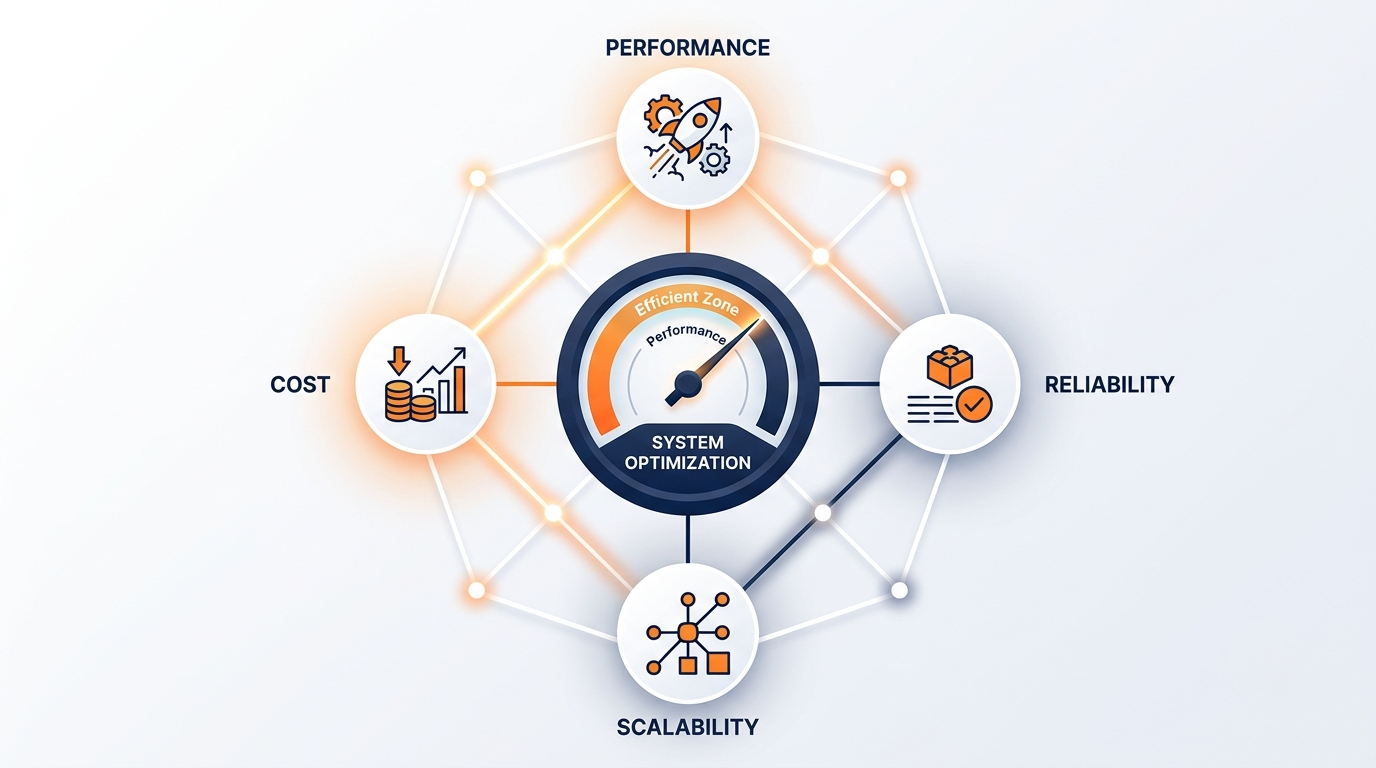
Performance, reliability, scalability and cost pull against each other. Redundancy improves availability and raises the bill. Aggressive caching lowers latency and adds complexity. The engineer's job is not to maximize any single one but to make the trade-offs visible and defensible.
The DevOps Engineer Is Becoming the Engineer Behind the Engineering System
Step back from the individual topics and a pattern appears. Automation, cloud infrastructure, CI/CD, platform engineering, security, observability, reliability, AI-assisted development, cost control and developer experience are not separate specialties competing for attention. They are parts of one machine, and the DevOps Engineer is increasingly the person responsible for how that machine fits together.
That is why "maintaining pipelines" has become too small a description. The role is turning into engineering the system that allows other engineering teams to move safely and efficiently. When it works, nobody notices: developers ship, incidents are rare and short, security issues are caught early, and the cloud bill makes sense. When it doesn't, every team feels it. Which skills matter most? Not a long list of tools, because tools change faster than careers do. The durable abilities are more like habits of mind. Systems thinking is the first: seeing how a change in one place ripples through load, cost, security and user experience. Automation remains central, but as a way to remove entire classes of manual error, not just save keystrokes. Cloud architecture knowledge matters because every decision about networking, identity or storage has consequences that appear later and elsewhere.
Troubleshooting is the skill that separates people quickly. Reading a trace, forming a hypothesis, ruling things out under pressure and explaining the result clearly is hard to fake. Closely related is communication, since a platform nobody understands is a platform nobody uses, and an incident that can't be explained can't be prevented from happening again. Underneath it all sits engineering judgment: knowing when to automate, when to standardize, when to leave a team alone, and when a clever solution is simply a liability.
This has implications for how people learn the work. Effective devops training in 2026 has to cover the wider engineering system, including how reliability is measured, how supply chains are secured and how cost is controlled, rather than stopping at the commands for building and deploying. Memorizing syntax produces someone who can operate a tool. Understanding the system produces someone who can be trusted with it. Cloud context sharpens all of this. A large share of production workloads now run on AWS, and the practical reality of the job often means working with its identity model, networking, container services and cost tooling every day. That is why an aws devops course is most valuable when it teaches how those services behave together under failure, load and budget pressure, rather than treating each service as an isolated checklist item. Depth in one major cloud, combined with portable principles, travels well across employers.
Conclusion
Shipping faster is no longer the finish line. It was the right goal for a long time, and it still matters, but it is no longer scarce. Almost every team can now move quickly. The harder and more valuable question is whether they can move quickly without losing their grip on what they are doing. The strongest DevOps Engineers of 2026 will be the ones who help organizations hold several things together at once: speed with control, automation with oversight, independence for developers with safety for customers, and ambition with financial discipline. They will build systems where a risky change is hard to ship and a healthy one is easy, where problems surface quickly, and where nobody has to guess what is running in production.
Look a few years ahead and the trend is clear. As AI generates more of the code and platforms absorb more of the routine work, the visible tools will keep changing. What lasts is the design of the system around them. DevOps is becoming less about mastering tools and more about building a resilient engineering system, one that can absorb speed without breaking under it.