
DevOps in 2026: How CI/CD, Automation, and AWS Are Redefining Modern Software Delivery
Last updated on Aug 14, 2026

Software development has changed dramatically over the last decade. Teams are no longer judged only by how quickly they can write code. They are expected to release software faster, maintain reliability, respond to failures quickly, protect infrastructure, and continuously improve the customer experience.
That is where DevOps has become increasingly important.
DevOps is more than a collection of tools or a job title. It represents a way of working in which development, operations, security, and infrastructure processes are connected through collaboration and automation. Instead of treating development and deployment as separate stages, DevOps brings them together into a continuous software delivery lifecycle.
Cloud platforms have accelerated this transformation even further. Organizations can now provision infrastructure through code, automatically test applications, deploy changes through pipelines, monitor systems in real time, and scale resources according to demand. AWS, in particular, provides a broad ecosystem of services that supports these practices. For engineers and technology professionals, understanding DevOps therefore means understanding how modern software moves from an idea to production—and how that process can be made faster, safer, and more reliable.
What Is DevOps and Why Does It Matter?
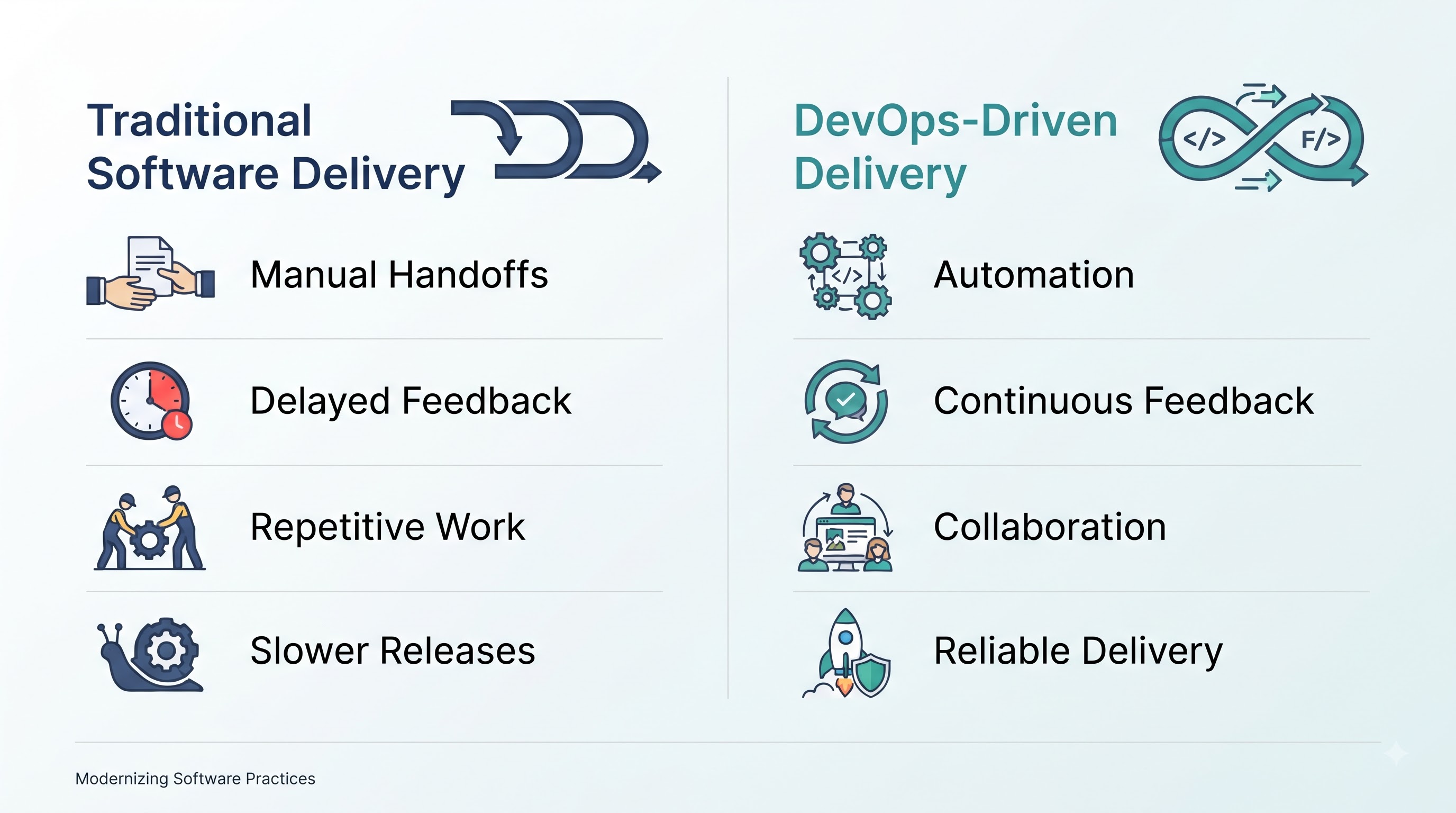
At its core, DevOps combines development and operations practices to create a more efficient software delivery process. In a traditional environment, developers might complete an application and then hand it over to an operations team for deployment. This separation can create delays, communication gaps, configuration inconsistencies, and difficulties when something goes wrong in production. DevOps attempts to remove these barriers.
A DevOps-oriented team works toward a shared objective: delivering reliable software continuously. Developers, operations engineers, cloud engineers, security professionals, and other stakeholders can contribute to the same delivery lifecycle.
The approach typically involves several interconnected practices:
Continuous integration and continuous delivery
Automated testing
Infrastructure as Code
Configuration management
Containerization
Cloud infrastructure
Automated deployments
Monitoring and observability
Centralized logging
Security and compliance automation
The important point is that DevOps is not simply about automating everything. Automation supports a larger engineering culture focused on repeatability, feedback, collaboration, and reliability. For example, imagine a developer making a small change to an application. In a mature DevOps environment, that change could automatically trigger code validation, testing, security checks, artifact creation, and deployment into an appropriate environment.
Instead of relying on a long sequence of manual steps, the organization creates a predictable delivery system.That shift can have a significant impact on both engineering productivity and business performance.
The Real Value of DevOps: Faster Delivery Without Sacrificing Reliability
Speed alone is not the goal of DevOps. Releasing an application quickly means very little if every deployment introduces instability. Similarly, an organization that prioritizes reliability but takes weeks to release even a minor improvement may struggle to respond to changing customer expectations.
DevOps attempts to balance these two requirements.A well-designed delivery pipeline allows teams to introduce changes frequently while maintaining controls around testing, security, approvals, and production deployment.
This creates a feedback loop:
Code → Build → Test → Validate → Deploy → Monitor → Improve
The loop does not necessarily look identical in every organization. Some teams may include additional security scans, compliance checks, staging environments, manual approvals, or automated rollback mechanisms. What matters is that the software delivery process becomes measurable and repeatable.
This also changes how teams respond to failure. Instead of treating every production incident as an unpredictable event, engineers can use monitoring, logs, metrics, and deployment information to identify what changed and where the problem occurred. The result is a more disciplined approach to software engineering.
CI/CD: The Engine Behind Continuous Software Delivery
Continuous Integration and Continuous Delivery—commonly abbreviated as CI/CD—are among the most recognizable practices associated with DevOps. Continuous Integration encourages developers to integrate code changes frequently into a shared repository. Automated processes can then compile the application, execute tests, analyze the code, and identify problems early.
Continuous Delivery takes the process further by keeping software in a deployable state and automating much of the release workflow. In some environments, organizations also implement Continuous Deployment, where successfully validated changes can automatically reach production without requiring a manual deployment step.
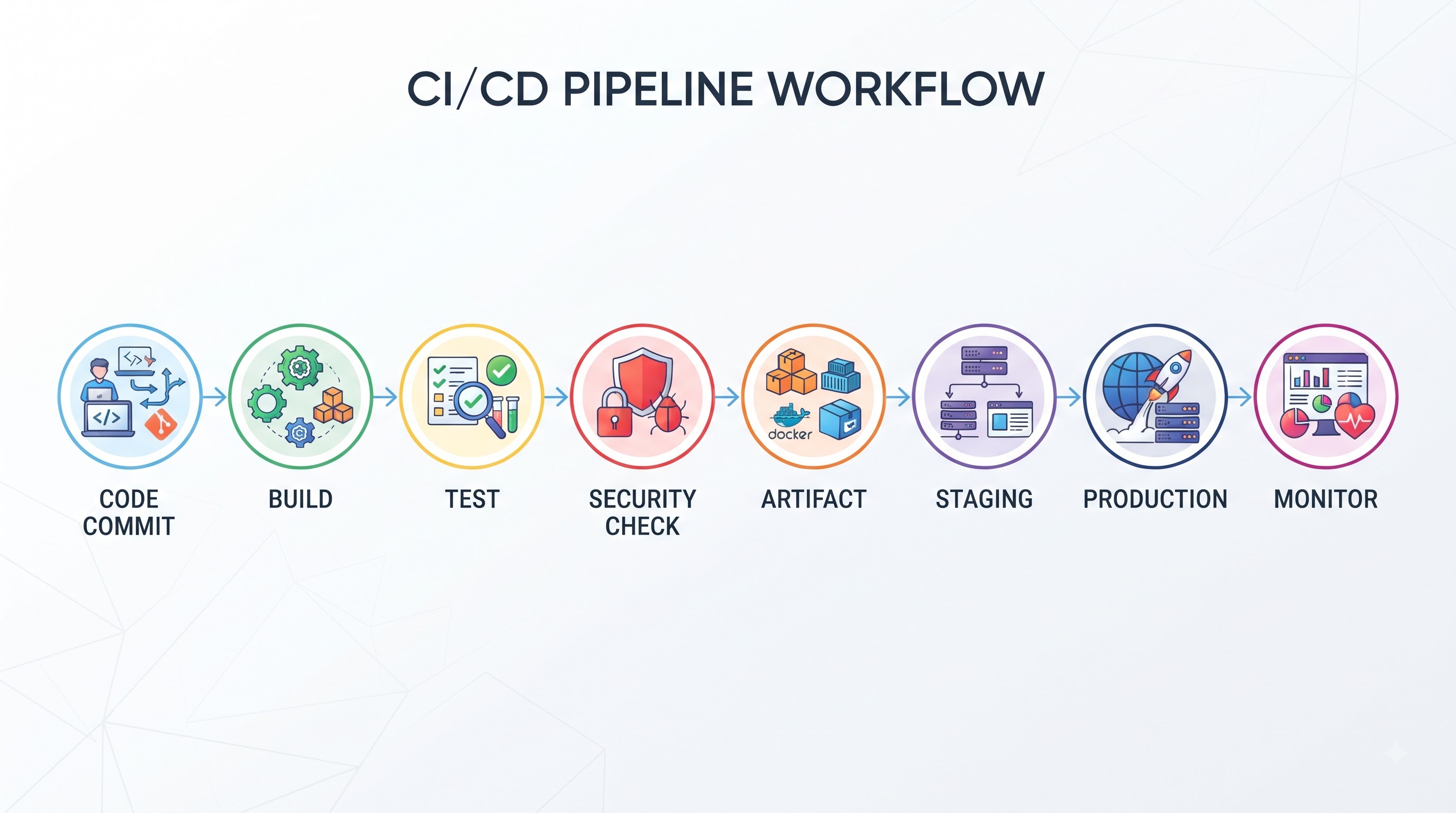
A typical pipeline might include:
A developer commits code.
The pipeline is triggered.
Dependencies are installed.
The application is built.
Automated tests are executed.
Security or quality checks are performed.
A deployment artifact is created.
The application is deployed to a testing or staging environment.
Additional validation takes place.
The approved release moves toward production.
Monitoring confirms whether the deployment behaves as expected.
This approach reduces dependence on manual intervention.
However, a CI/CD pipeline should not be considered successful simply because it contains many automated stages. Good pipelines are designed around business and engineering requirements. They should provide fast feedback, maintain appropriate quality gates, minimize unnecessary complexity, and make failures easy to diagnose.
Building Reliable CI/CD Pipelines
Designing a pipeline is different from simply connecting a few tools. A production-grade CI/CD architecture must account for source control, build environments, artifact management, testing, secrets, permissions, deployment strategies, rollback procedures, and observability. Pipeline design also needs to consider the application itself. A small internal application may require a relatively simple workflow, while a customer-facing platform operating across multiple environments may need sophisticated deployment controls.
This is where concepts such as immutable artifacts, environment promotion, automated testing, approval gates, and deployment policies become important.
A strong pipeline should answer several practical questions:
What changed?
The pipeline should identify the code or configuration responsible for a release.
Was it tested?
Automated validation should provide confidence before the release progresses.
Where is it being deployed?
The deployment process should clearly distinguish environments and account boundaries.
Can the release be reversed?
Rollback or recovery mechanisms should be considered before a production failure occurs.
Can engineers see what happened?
Logs, metrics, events, and deployment records should make troubleshooting easier.
These considerations transform CI/CD from a simple automation script into an important part of an organization's software delivery architecture.
AWS and the Growing Role of Cloud DevOps
Cloud computing has changed the infrastructure side of DevOps. In traditional data centers, provisioning servers could require hardware procurement, operating system configuration, networking setup, storage allocation, and manual maintenance. Cloud platforms provide APIs and managed services that allow much of this infrastructure to be provisioned programmatically.
AWS offers services covering compute, storage, networking, databases, security, monitoring, deployment, and infrastructure management. For DevOps engineers, the important skill is not memorizing every AWS service. It is understanding how cloud services can be combined to build a reliable delivery platform.
For example, an organization may use a source repository to manage application code, a build service to compile and test it, an artifact repository to store release packages, deployment services to move applications between environments, and monitoring services to observe production behavior. The architecture will vary depending on the application's requirements, but the underlying DevOps principles remain consistent.
Professionals pursuing an aws devops course should therefore look beyond individual service definitions and focus on how those services work together within an actual software delivery lifecycle.
Infrastructure as Code: Treating Infrastructure Like Software
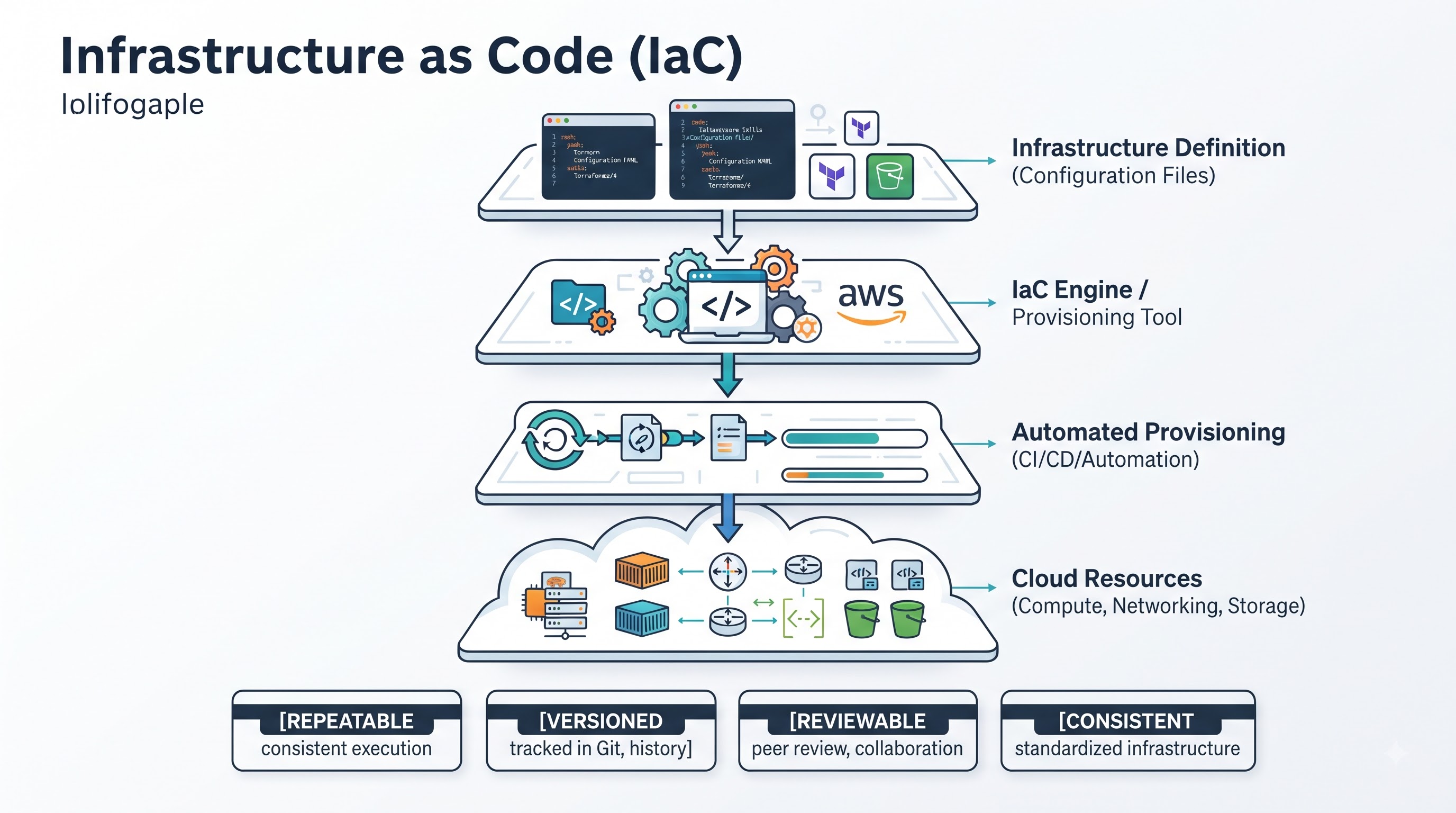
One of the biggest changes introduced by modern DevOps is the ability to define infrastructure through code. Infrastructure as Code, or IaC, allows teams to describe resources such as networks, compute instances, permissions, databases, and other infrastructure components using configuration files or templates.
Instead of manually creating infrastructure through a graphical interface, engineers can define the desired environment and use automation to provision it. AWS CloudFormation is one example of an infrastructure-as-code approach within the AWS ecosystem. The advantages are significant. Infrastructure definitions can be stored in version control. Changes can be reviewed before they are applied. Environments can be reproduced more consistently. Teams can reduce configuration drift and maintain a clearer record of infrastructure changes.
Consider an organization with separate development, testing, and production environments. If each environment is created manually, small differences can gradually appear. One server may have a slightly different configuration, one permission may be missing, or one dependency may be installed at a different version. IaC helps reduce this inconsistency by defining infrastructure in a repeatable manner. It also enables infrastructure changes to become part of the same engineering workflow used for application changes.
Configuration Management and Consistency
Infrastructure is only one part of a production environment. Applications also depend on configuration: environment variables, service settings, credentials, feature flags, connection parameters, and other operational values. Managing these settings manually can become difficult as an organization grows. Centralized configuration management provides a structured way to control configuration across environments while reducing unnecessary duplication.
Security is especially important here. Sensitive information such as credentials, tokens, and encryption keys should not simply be placed inside application source code or exposed through configuration files. DevOps environments need appropriate secret-management practices, access controls, rotation mechanisms, and auditing.
Configuration management therefore connects directly with security engineering. A mature DevOps environment treats configuration as an operational asset that must be controlled, versioned where appropriate, protected, and monitored.
Zero-Downtime Deployment Is an Engineering Challenge
For applications that serve customers continuously, taking the system offline during every release may not be acceptable. This is why modern DevOps teams use deployment strategies designed to minimize service disruption. Two widely discussed approaches are blue/green deployment and canary deployment.
Blue/Green Deployment
In a blue/green model, two environments are maintained. One environment serves the current production version, while the second environment contains the new version. After the new version has been tested and validated, traffic can be redirected toward it. If a serious issue appears, traffic can potentially be redirected back to the previous environment.
The major advantage is that the previous version can remain available while the new version is being prepared.
However, blue/green deployment can require additional infrastructure resources and careful management of databases, sessions, networking, and stateful services.
Canary Deployment
Canary deployment takes a more gradual approach. Instead of moving all users to the new version immediately, a small percentage of traffic is directed toward it first.
Engineers can monitor application performance, error rates, latency, and other indicators. If the release performs well, traffic can gradually increase.
If problems appear, the deployment can be stopped or rolled back before the majority of users are affected. Canary releases are particularly useful when organizations want real-world production feedback without exposing their entire user base to a new release simultaneously. Neither strategy is universally better. The right approach depends on the application's architecture, risk profile, infrastructure, traffic patterns, and operational maturity.
Multi-Account AWS Environments Add Another Layer of Complexity
As organizations grow, placing every workload into a single cloud account may create challenges around security, access control, billing, isolation, and governance. Many organizations therefore adopt multi-account strategies. Different accounts may be used for development, testing, production, security, logging, or other organizational purposes.
This structure can improve isolation, but it also introduces additional DevOps considerations. Deployment pipelines need appropriate permissions to operate across account boundaries. Identity and access management must be carefully designed. Infrastructure must be consistently provisioned. Logs and monitoring data may need to be aggregated centrally.
The engineering challenge becomes larger than simply deploying an application. The organization must build a delivery framework that remains secure and manageable as the number of environments increases. This is why cloud DevOps professionals increasingly need knowledge of both automation and cloud governance.
Monitoring and Logging: You Cannot Improve What You Cannot See
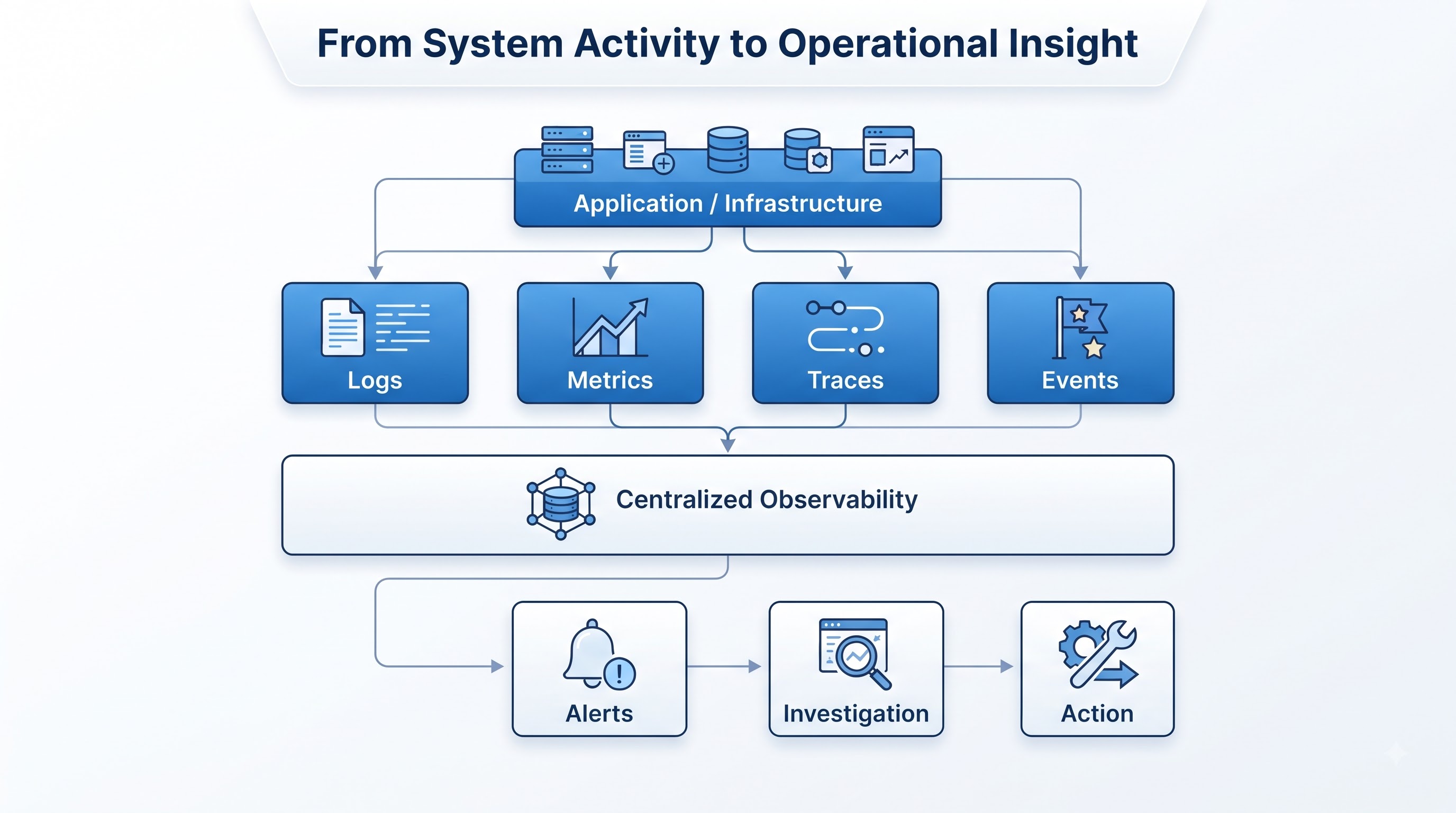
Deployment is only half the story.Once software reaches production, engineers need to know whether it is behaving correctly. Monitoring provides visibility into the health and performance of systems. Depending on the architecture, teams may track CPU utilization, memory consumption, request latency, throughput, error rates, application health, database performance, and other operational metrics. Logging provides another layer of visibility.
Applications, infrastructure components, and cloud services can generate large volumes of log data. Centralizing those logs makes it easier to investigate incidents, identify patterns, and understand application behavior. Modern observability goes beyond simply collecting logs.
Engineers increasingly combine:
Metrics
Logs
Traces
Events
Alerts
Deployment information
Together, these signals can help teams understand not only that something failed, but also why it failed and which change may have contributed to the problem. For example, if an application's error rate suddenly increases immediately after a deployment, engineers can correlate the incident with the release and investigate the affected service. This shortens the path from detection to diagnosis.
Security Should Be Part of the DevOps Lifecycle
Security cannot be treated as a final inspection performed immediately before production. Modern DevOps practices increasingly integrate security throughout the development and delivery process. This approach is often associated with DevSecOps. Security checks can be incorporated into source control workflows, CI/CD pipelines, infrastructure provisioning, dependency management, container workflows, and runtime monitoring.
This can include activities such as:
Dependency vulnerability scanning
Static code analysis
Infrastructure configuration checks
Secret detection
Access-control validation
Image scanning
Audit logging
Policy enforcement
The objective is not to slow development with unnecessary controls. It is to identify security problems earlier, when they are generally easier and less expensive to address. Cloud environments make this particularly important because infrastructure can be created and modified rapidly. Automation therefore needs to include security guardrails alongside deployment capabilities.
What Skills Does a Modern DevOps Engineer Need?
DevOps engineering requires a combination of technical knowledge and systems thinking. A professional entering this field does not necessarily need to master every tool available in the ecosystem. Instead, the focus should be on understanding the principles behind the tools.
Important areas include:
Linux and Operating Systems: A strong understanding of Linux fundamentals helps engineers work with servers, processes, permissions, networking, filesystems, and system troubleshooting.
Version Control: Git and source-control workflows are fundamental because modern development and automation processes depend heavily on versioned code and configuration.
Scripting and Programming: Automation often requires scripting. Python, Bash, or another programming language can help engineers build tools, automate repetitive tasks, and integrate systems.
CI/CD: Engineers should understand how pipelines are designed, tested, secured, and maintained.
Cloud Computing: Knowledge of cloud infrastructure is increasingly important, particularly for engineers working with scalable application platforms.
Infrastructure as Code: IaC allows infrastructure to be managed through repeatable and reviewable definitions.
Containers: Containers provide a standardized way to package and run applications and are widely used in modern cloud-native environments.
Monitoring and Observability: Engineers need to understand how to detect failures, analyze system behavior, and establish meaningful operational signals.
Security: Identity, permissions, secrets, network security, vulnerability management, and compliance are increasingly integrated into DevOps workflows.
The strongest DevOps professionals connect these skills rather than treating them as isolated subjects.
Why Practical Learning Matters More Than Tool Memorization
DevOps is difficult to learn effectively through theory alone. Reading about CI/CD does not automatically teach someone how to design a pipeline. Knowing what Infrastructure as Code means does not necessarily prepare an engineer to manage a complex infrastructure environment.
Practical experience creates a different level of understanding.
A useful learning project could begin with a simple application and gradually introduce additional components:
Stage 1: Store the application in Git.
Stage 2: Create an automated build process.
Stage 3: Add unit and integration testing.
Stage 4: Package the application for deployment.
Stage 5: Provision infrastructure using IaC.
Stage 6: Create a deployment pipeline.
Stage 7: Introduce monitoring and centralized logging.
Stage 8: Add security checks.
Stage 9: Experiment with blue/green or canary deployment.
Stage 10: Expand the architecture into multiple environments or accounts.
This type of project demonstrates how individual DevOps concepts fit together. For learners, comparing different devops training options, practical labs, real-world scenarios, troubleshooting exercises, and deployment projects can therefore be more valuable than a curriculum that focuses primarily on tool definitions.
DevOps as a Career Path
The DevOps career path is not limited to one specific job title. Depending on an individual's background and organization, DevOps-related responsibilities can appear in roles such as:
DevOps Engineer
Cloud Engineer
Site Reliability Engineer
Platform Engineer
Cloud DevOps Engineer
Automation Engineer
Release Engineer
Infrastructure Engineer
DevSecOps Engineer
The responsibilities can overlap, but each role may emphasize different aspects of the engineering lifecycle.
For example, a Site Reliability Engineer may focus heavily on reliability, service-level objectives, incident management, and observability. A Platform Engineer may concentrate on creating internal platforms that make it easier for development teams to deploy and operate applications. A DevOps Engineer may work across CI/CD, cloud infrastructure, automation, deployment, monitoring, and configuration management. The common thread is the ability to improve how software is built, released, and operated.
How to Build a Strong DevOps Learning Path
A structured learning path can prevent beginners from becoming overwhelmed by the sheer number of tools in the DevOps ecosystem.
A practical progression could look like this:
Step 1: Learn the fundamentals
Start with Linux, networking, Git, basic scripting, and software development concepts.
Step 2: Understand CI/CD
Learn how source code moves through build, test, validation, and deployment stages.
Step 3: Learn cloud fundamentals
Understand compute, storage, networking, identity, security, and cloud architecture.
Step 4: Learn Infrastructure as Code
Practice creating and modifying cloud resources through declarative infrastructure definitions.
Step 5: Explore containers
Understand container images, registries, runtime concepts, networking, and deployment.
Step 6: Develop monitoring skills
Learn how metrics, logs, alerts, and traces can be used to understand production systems.
Step 7: Add security
Integrate secure coding, secrets management, permissions, vulnerability scanning, and policy controls.
Step 8: Build projects
Create complete delivery workflows instead of studying each technology independently.
This progression helps learners move from individual concepts toward system-level understanding.
Choosing a DevOps Course: What Should You Look For?
The quality of a learning program depends heavily on how closely it connects theory with practical engineering scenarios. A strong devops course online should ideally provide more than recorded explanations of popular tools. Learners should have opportunities to build pipelines, troubleshoot deployment failures, work with cloud infrastructure, implement Infrastructure as Code, and understand monitoring and security.
Before choosing a program, consider questions such as:
Does the curriculum include practical projects?
Are CI/CD pipelines covered in depth?
Does the program include Infrastructure as Code?
Is cloud infrastructure part of the practical work?
Are deployment strategies explained through real scenarios?
Does the training address monitoring and logging?
Are security practices integrated into the workflow?
Can learners practice troubleshooting?
Does the program explain why a particular architecture is used, rather than only how to configure it?
These questions can help distinguish a genuinely practical learning experience from a course that primarily focuses on theoretical definitions.
Final Thoughts
DevOps has evolved from a set of development and operations practices into a broader engineering discipline focused on reliable, repeatable, and efficient software delivery. CI/CD enables teams to release changes continuously. Infrastructure as Code makes cloud environments more consistent and manageable. Deployment strategies such as blue/green and canary releases reduce the risks associated with production changes. Monitoring and centralized logging provide visibility after deployment, while security practices help protect the entire delivery lifecycle.
AWS and other cloud platforms have made these capabilities increasingly accessible, but the real value comes from understanding how the pieces work together. For anyone considering a career in cloud engineering, automation, or modern software delivery, DevOps offers a path that combines infrastructure, programming, cloud technologies, security, and operational thinking.
The most valuable skill is not knowing the largest number of DevOps tools. It is knowing how to design a system in which those tools work together to deliver software safely, consistently, and continuously. That is ultimately what modern DevOps is about: turning software delivery from a manual process into an engineered system.