
How ServiceNow Helps Businesses Automate Workflows
Last updated on May 19, 2026

In this fast moving digital world organisations are always looking to optimise the productivity, reduce operating costs and deliver faster services to customers and employees. But a lot of organisations still do their day-to-day business manually, using emails, spreadsheets and disparate systems. Traditional methods are subject to delays, miscommunication, human error and diminishing efficiencies. That’s where ServiceNow is the solution that the modern enterprise needs to have.
ServiceNow is the enterprise cloud platform that makes work, work better for people. Originally developed for IT Service Management, ServiceNow has expanded into other business functions such as Human Resources, Customer Service, Security Operations, Finance and Facilities Management. The platform enables companies to automate repetitive jobs, improve teamwork and
Business Workflow Automation Significance Today
Workflow automation is gaining importance as today’s companies are confronted with thousands of repetitive and time-consuming tasks on a daily basis. Onboarding new employees, managing IT support, processing approvals, handling customer service, tracking assets, monitoring compliance & verifying documents… These are all the tasks that require constant interdepartmental coordination. When these operations are performed manually, organizations suffer delays, communication gaps, inconsistent processes, and a higher risk of human errors. Employees are spending too much time on repetitive administrative work and not enough time on strategic and high value activities that will help grow the business.
“As organisations scale and customer expectations rise, manual processes are difficult to manage effectively.” Unresolved service requests, approval delays and disjointed workflows can hurt productivity, employee satisfaction and customer experiences. This is where ServiceNow shines in driving digital transformation. ServiceNow enables organizations to automate workflows through rules, intelligent task routing, and centralized process management. The platform automatically assigns the tasks to the relevant teams, speeds up the approval process, provides instant notifications and real-time tracking of the progress of the workflow.
ServiceNow workflow automation can be a great way to speed up and improve the accuracy of your business processes. Automated workflows causes less manual input, fewer errors and more standardized processes department-wide. Work becomes faster and allows more time for innovation, problem solving and business development rather than repetitive administrative tasks. Customers also get a better quality of service, and faster response times.
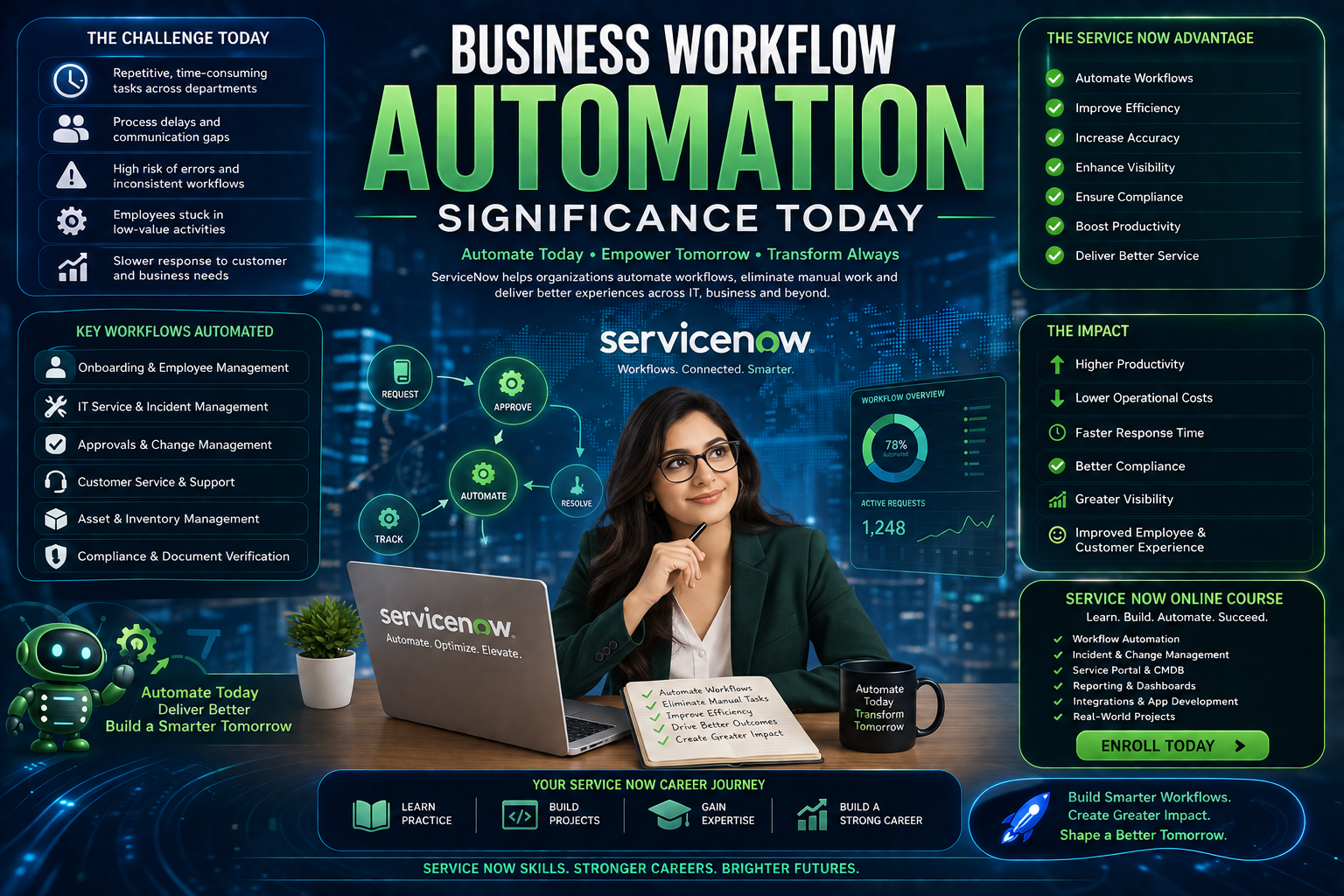
Workflow automation provides opportunities for businesses to increase productivity, lower operational costs, enhance compliance management and achieve greater visibility of business processes. ServiceNow helps companies automate mundane tasks, streamline processes and monitor the performance of their workflows through real-time reporting and analytics. Managers can quickly identify bottlenecks, optimize operations and make faster data-driven decisions. “This in turn makes organizations more agile, efficient and better placed for digital transformation initiatives.” The IT industry is in need of ServiceNow professionals who can automate workflows. ServiceNow Training Online courses will provide students and professionals with the opportunity to build successful careers in enterprise technology and digital operations. It will give them the practical knowledge in workflow automation, IT service management, reporting, integrations and application development.
Service Now for Single Site Work Flows Management
Another benefit of ServiceNow is the opportunity to optimize workflow management. Companies are able to handle different business processes on one integrated platform. Companies have many departments that use a lot of different tools and systems to run their daily business. For example, HR teams might use an app for employee management, IT teams might use a different system for support tickets, and finance and operation teams might use an entirely different system. This piece-meal approach can lead to communication breakdown, slower task completion, more manual coordination and less overall visibility into operations.
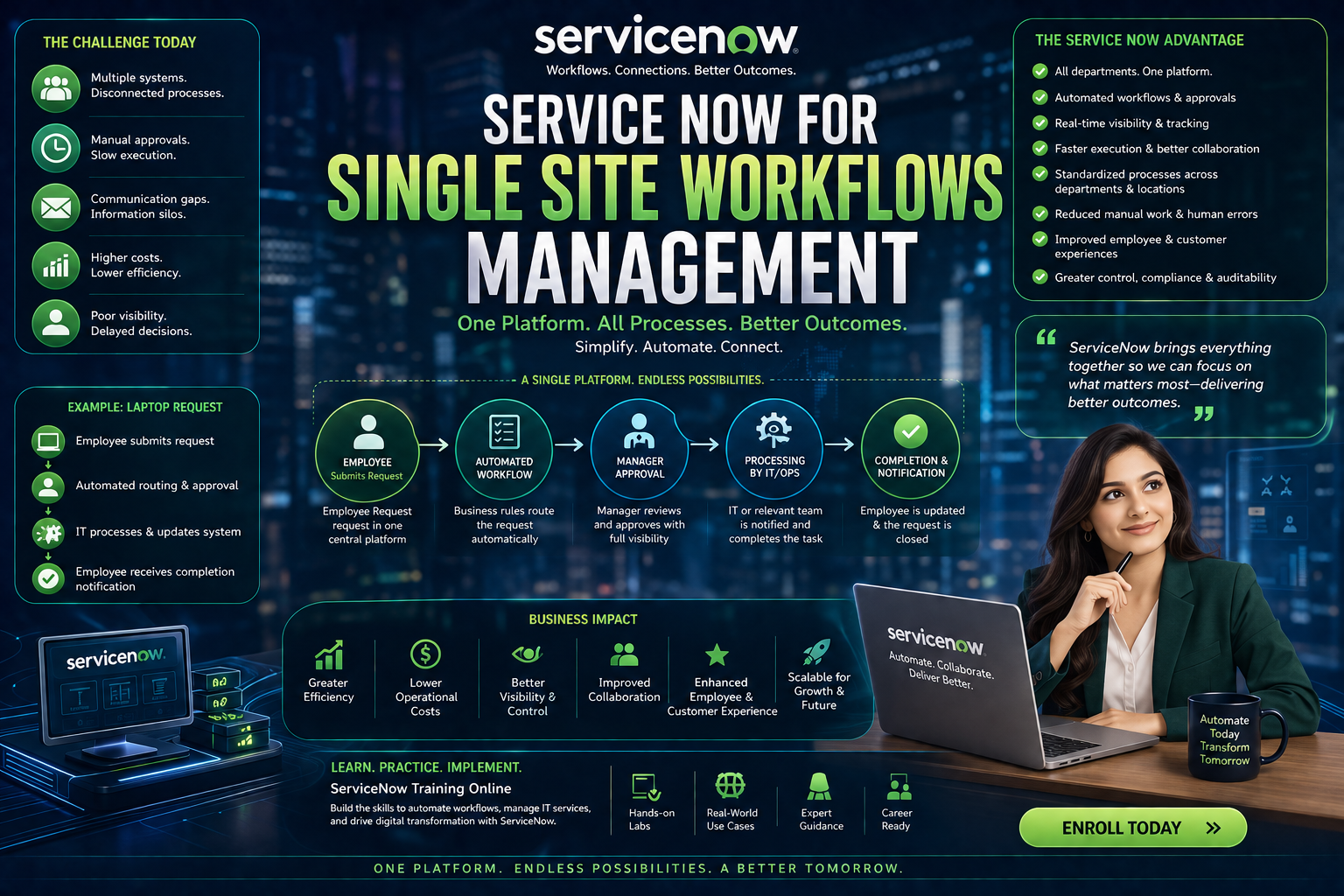
This is the kind of problem ServiceNow solves by bringing workflows, approvals, tasks and communications all on one platform. With a common system linking all departments, companies can get a better visibility into operations, improve collaboration between departments and speed up the execution of processes. Employees and managers have immediate visibility into the status of requests, approvals, incidents and workflow progress – eliminating endless emails and manual follow-ups. The centralized environment is more transparent, and organizations can achieve consistency in business operations.For instance, if an employee requires a new laptop, access to software or system permissions, ServiceNow initiates an automated workflow based on business rules. That is then forwarded to the proper manager for approval and to IT for processing and inputting into the system for tracking and compliance purposes. Employee will receive automatic notifications & updates once request is completed. The entire process is digital and there is no human intervention involved. So, the delays are reduced and efficiency is improved.
Centralized workflow management can also help companies to standardize the way they do things across departments and locations. Companies can standardize approvals, incident management, onboarding, customer service, compliance tracking and many more processes. It reduces confusion and mistakes and makes sure that all jobs are done in the same systematic process. “This enables organisations to become more productive, more nimble to handle increasing workloads efficiently and deliver better employee and customer experiences.
ITSM Automation Information Technology Service Management Automation
IT Service Management is a fan of ServiceNow because IT teams deal with a large volume of incidents, support tickets, technical issues, and service requests on a day-to-day basis. Carrying out these tasks manually is time consuming and often causes delays in response, poor coordination and lower quality of service. ServiceNow provides intelligent automation for IT workflows such as ticket routing, incident categorization, escalation management, approvals and service level agreement tracking. This ServiceNow platform then automatically routes issues to the appropriate support teams for resolution based on defined workflows, priority levels and issue types. Here, the tickets are not hand-routed. It halves the response time and helps IT teams resolve issues faster.
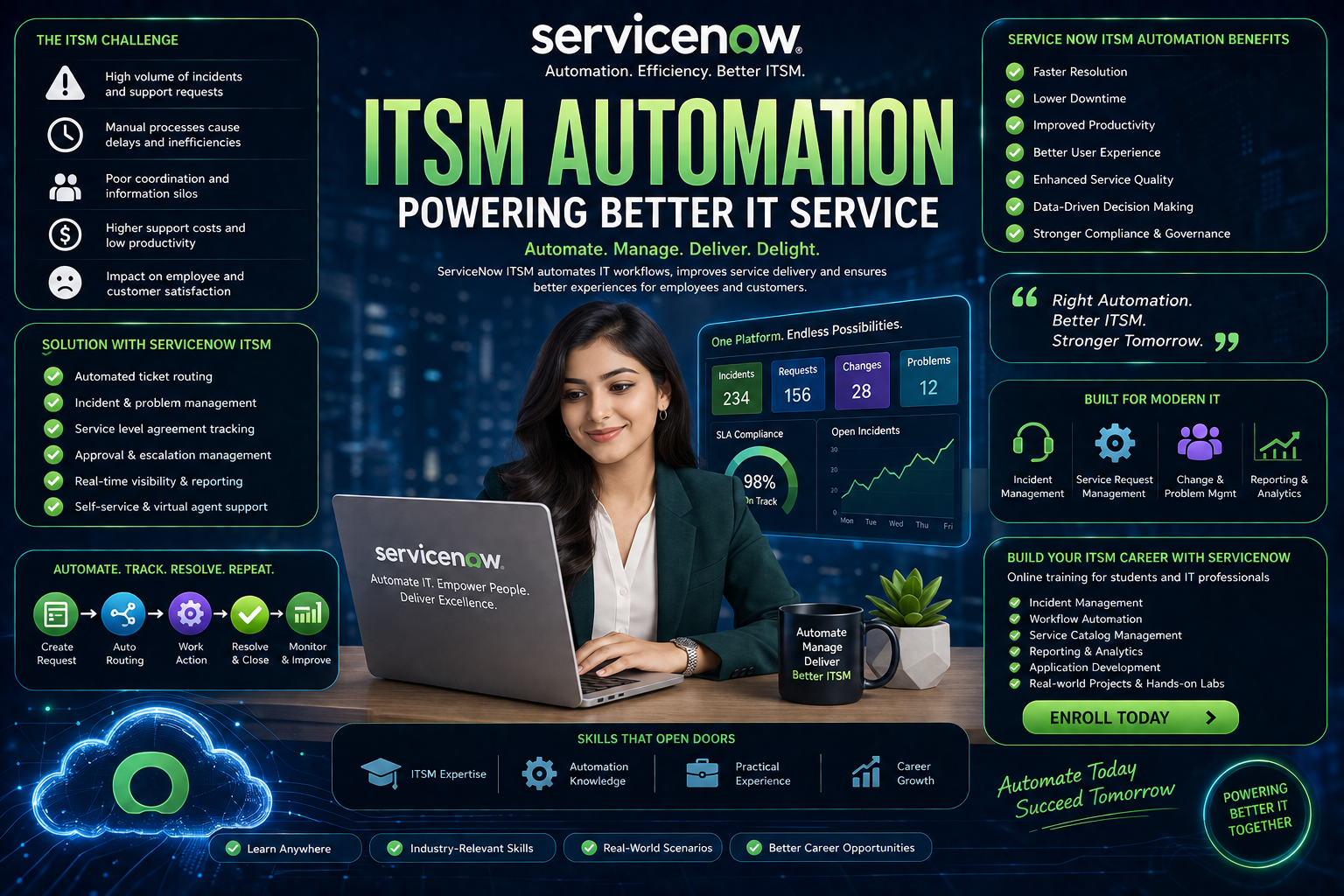
This platform also offers transparency where the employees, support teams and managers can view the status of incidents and service requests in real time. Automated notifications and status updates further enhance communication while work is being done. It also offers self-service portals and AI-driven virtual agents to take care of routine IT requests such as password resets, software installs and access requests without human intervention. “It removes the pressure from IT teams and enhances productivity all round.”
Automation of repetitive IT operations helps organizations reduce downtime, improve service delivery, and deliver better experiences to employees and customers. Reporting and rich analytics enable companies to identify patterns in problems and make incremental changes over time to improve IT performance. As more organizations embark on workflow automation and digital transformation projects, the demand for ServiceNow ITSM professionals continues to be massive across industries. Online ServiceNow Training for Students and IT Professionals makes you to Learn Incident Management, Workflow Automation, Service Catalog Management, Reporting and Application Development. ServiceNow Online Course equips learners for success in real-world enterprise environments, opening avenues for careers in IT service management, system administration, and workflow automation.
HR Automation and Employee Onboarding
ServiceNow also provides great value in other areas such as automating new hire onboarding and HR workflows. In many organizations, bringing a new employee on board requires work by Human Resources, IT, administration, finance, and security. Activities including: Employee Accounts Creation, Distribution of Laptops and Devices, Distribution of Application Access, ID Card Creation, Orientation Session Scheduling, Documentation Completion, and Others . These are all generally manual processes. This is a manual process which is time consuming and confusing and would likely result in delays or errors especially in large organizations that have a lot of hires to process on a regular basis.
ServiceNow – automates the entire onboarding process. Life is easier when workflows automatically fire up when a new employee is added to the system. The platform can automatically direct tasks to various departments according to pre-defined workflows and approval processes. "IT teams can use it for device allocation, HR teams can use it to manage employee records and documents and managers can get notified on approvals and training schedules. New employees benefit from a smooth, professional onboarding experience thanks to automated welcome emails, orientation plans and training reminders. This cuts down on admin work and gets employees up to speed more quickly.
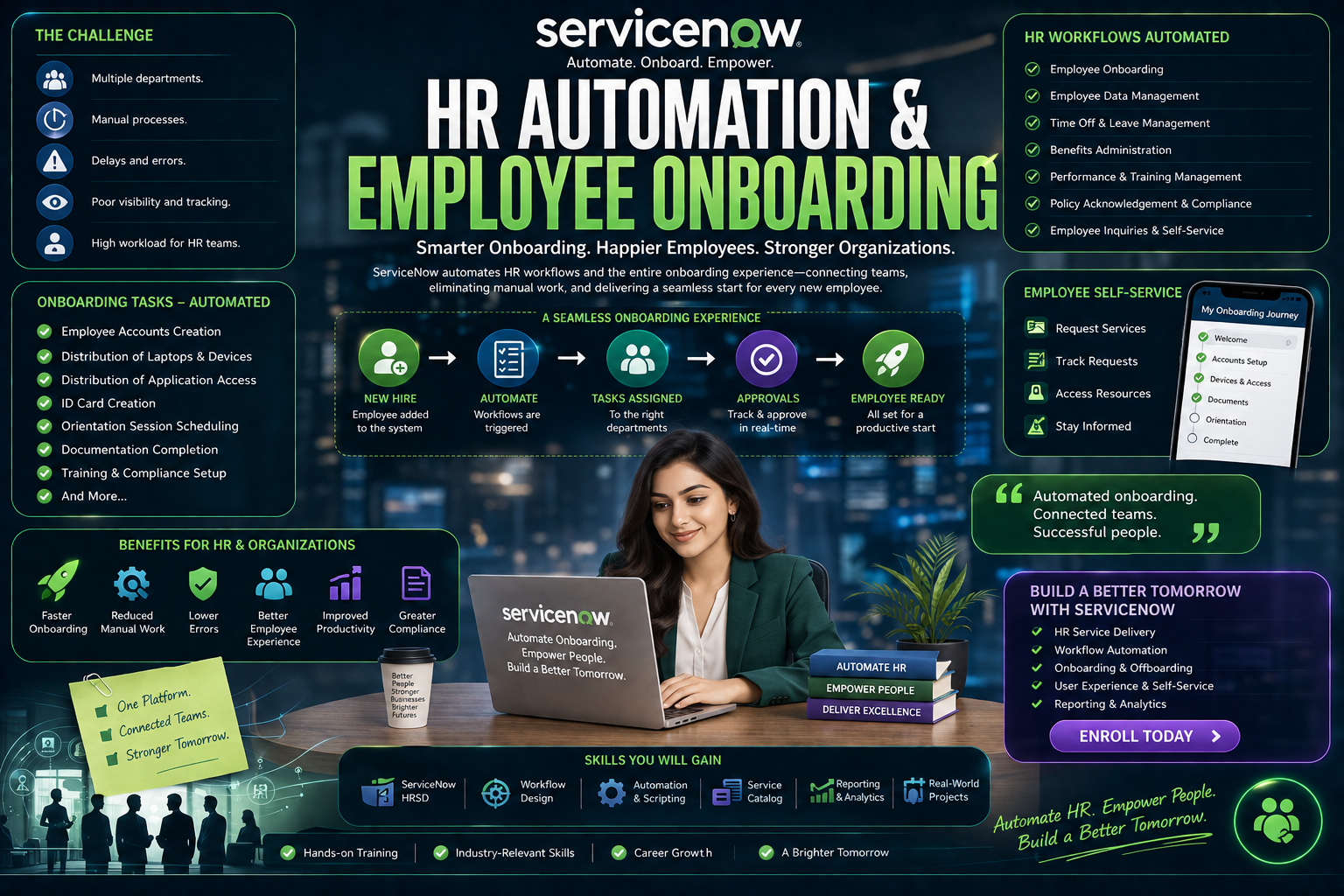
ServiceNow’s automation capabilities are also a big win for Human Resource departments that deal with day-to-day employee services. HR teams receive employee inquiries on everything from payroll to leave management to benefits enrollment to policy questions to performance documentation and verification and so much more. Self-service portals allow employees to request services, obtain company resources and track the status of their request in real time without having to manually communicate with anyone.
Automated workflows help speed up processing and route employee requests to the right departments. “Real-time notifications and a place to track work, helps teams be more transparent and communicate better. This in turn allows HR professionals to focus on strategic initiatives such as employee engagement, talent management and organizational development, rather than repetitive administrative tasks, and enables faster and more effective support to employees.
Customer Service Workflow Automation
Another area where ServiceNow helps organizations become more efficient and deliver better customer experiences is Customer Service. In today’s competitive business environment, customers have been conditioned to expect fast, accurate and consistent support across multiple communication channels including email, chat, phone, website and mobile applications. Every day, a large number of cases, service issues, complaints and inquiries inundate support teams and organizations can have a hard time in manually managing customer requests. Poor coordination of team members, responses and visibility into support processes can damage customer satisfaction and brand reputation.
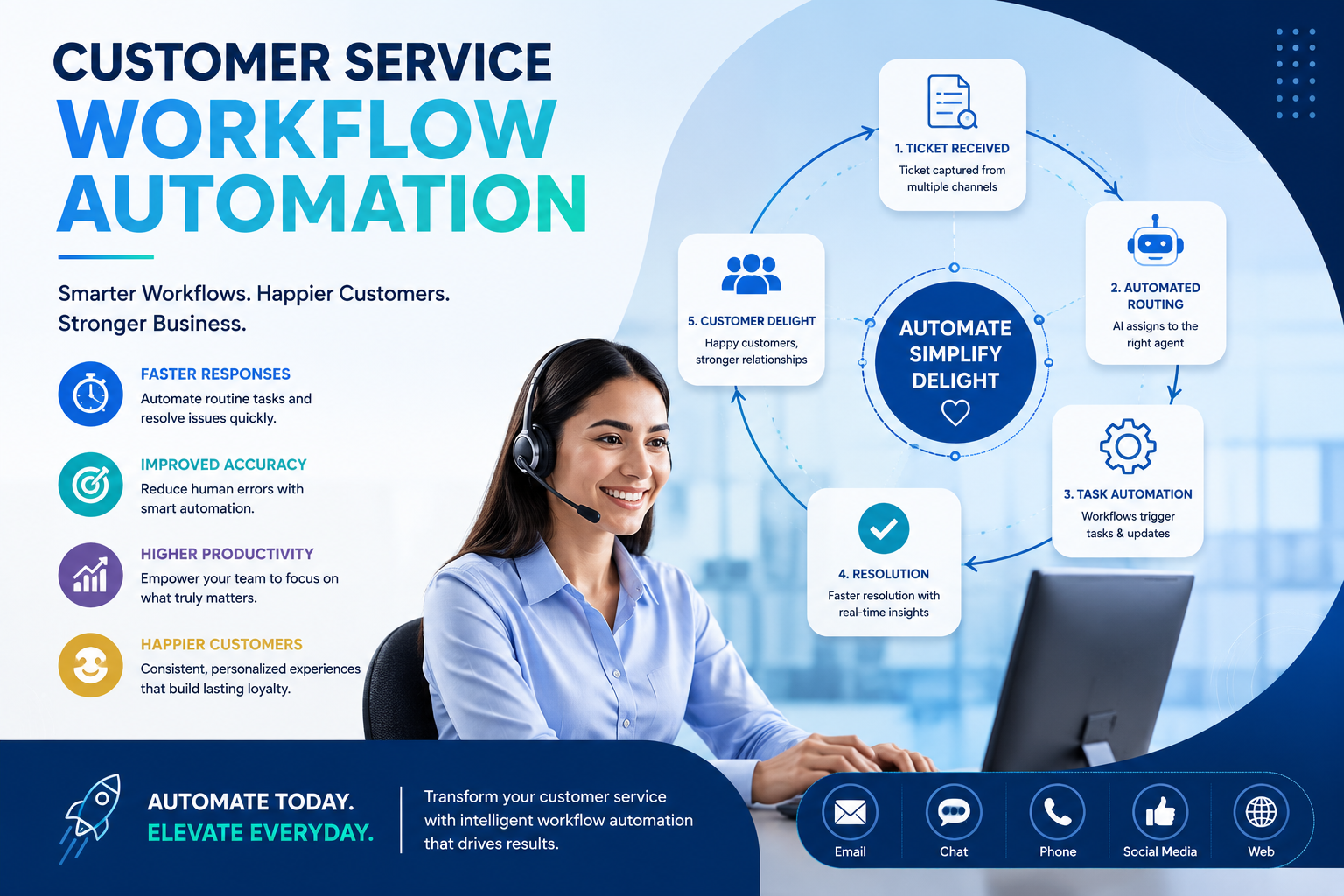
ServiceNow automates customer service workflows and offers a single platform to streamline support operations to solve these problems. It automatically classifies the service request or an issue raised by a customer as per the pre-defined rules and assigns them to the right department or support agent. The platform provides real time tracking of the complete resolution process. Workflow automation means less human intervention, less wasted time and fast, accurate resolution of customer issues.
Real-time communication and transparency in the support process is the best quality of ServiceNow Customer Service Management. In addition, this platform is capable of building trust and drive customer engagement through automated alerts, status updates, and estimated resolution times. Moreover here the support agents are able to access more of the customer’s history, including past interactions and open cases, enabling them to provide more personalized and efficient support.
ServiceNow also uses AI, virtual agents and chatbots to provide customers with instant answers to frequently asked questions, without the need for human intervention. Customers can use the AI chatbot to troubleshoot, reset passwords, track orders, book appointments and answer frequently asked questions, 24 hours a day, 7 days a week. This greatly cuts down wait times, accelerates responses and frees support teams up to deal with more complex customer problems.
Integration of business systems
Another important reason for the widespread adoption of ServiceNow by business organizations is its strong integration capabilities with other enterprise systems and business applications. Companies today have different software platforms to run different parts of the business. For example , CRM systems , cloud services , communication platforms , monitoring tools , HR systems , financial management software , etc . The manual data and workflow management across these disparate systems leads to delays, double efforts, communication problems and operational inefficiencies. ServiceNow helps meet this challenge by integrating with enterprise applications to help enable seamless workflow automation across departments.
“ServiceNow is one place where information can flow automatically from many systems in real time.” This ability to integrate means no manual entry, fewer errors and ensures teams and applications are speaking the same language. If a security-monitoring application detects suspicious activity or a system failure, ServiceNow can automatically create an incident ticket, alert the security or IT support team, escalate critical alerts and immediately trigger response procedures. You can also integrate ServiceNow with CRM to automate customer support workflows or HR systems to automate employee onboarding and service management workflows.
ServiceNow integrates multiple enterprise applications into a single workflow environment that helps companies run better, be more productive and make smarter decisions. This platform is also capable of creating a shared space for workflows and data so people can get work done without jumping between tools. Real-time syncing also adds transparency and ensures departments are working with the right information.
Strong demand for digital transformation and enterprise workflow automation skills, and the IT industry requires skills in ServiceNow integration and workflow management. By ServiceNow Training Online, learn practical knowledge in integration, IT service management, workflow automation, incident management, reporting and application development. Our ServiceNow Online Training course provides you with hands on exposure to real time projects and prepares you for a successful career in enterprise technology and workflow automation.
AI & Machine Learning on ServiceNow
Artificial Intelligence and Machine Learning play a big role in how ServiceNow is transforming the way it automates business workflows and boosts operational efficiency. Businesses generate a lot of business and operational data which makes it more difficult and time consuming to manage the processes manually . ServiceNow’s approach is to bake AI-enabled technologies such as predictive analytics, smart suggestions, automatic classification, virtual agents and natural language processing capabilities into its workflow automation platform. The new capability enables organizations to deliver faster and more accurate service to employees and customers and to streamline operations.
Another important feature is the use of AI-powered virtual agents and chatbots. These virtual assistants use natural language processing to communicate with employees and customers, process their requests, and provide real-time assistance. They can do simple things like password resets, software install requests, appointment scheduling, ticket creation and FAQs without the need for humans. “One way is it reduces response time, but it also makes the experience better for both employees and customers.”
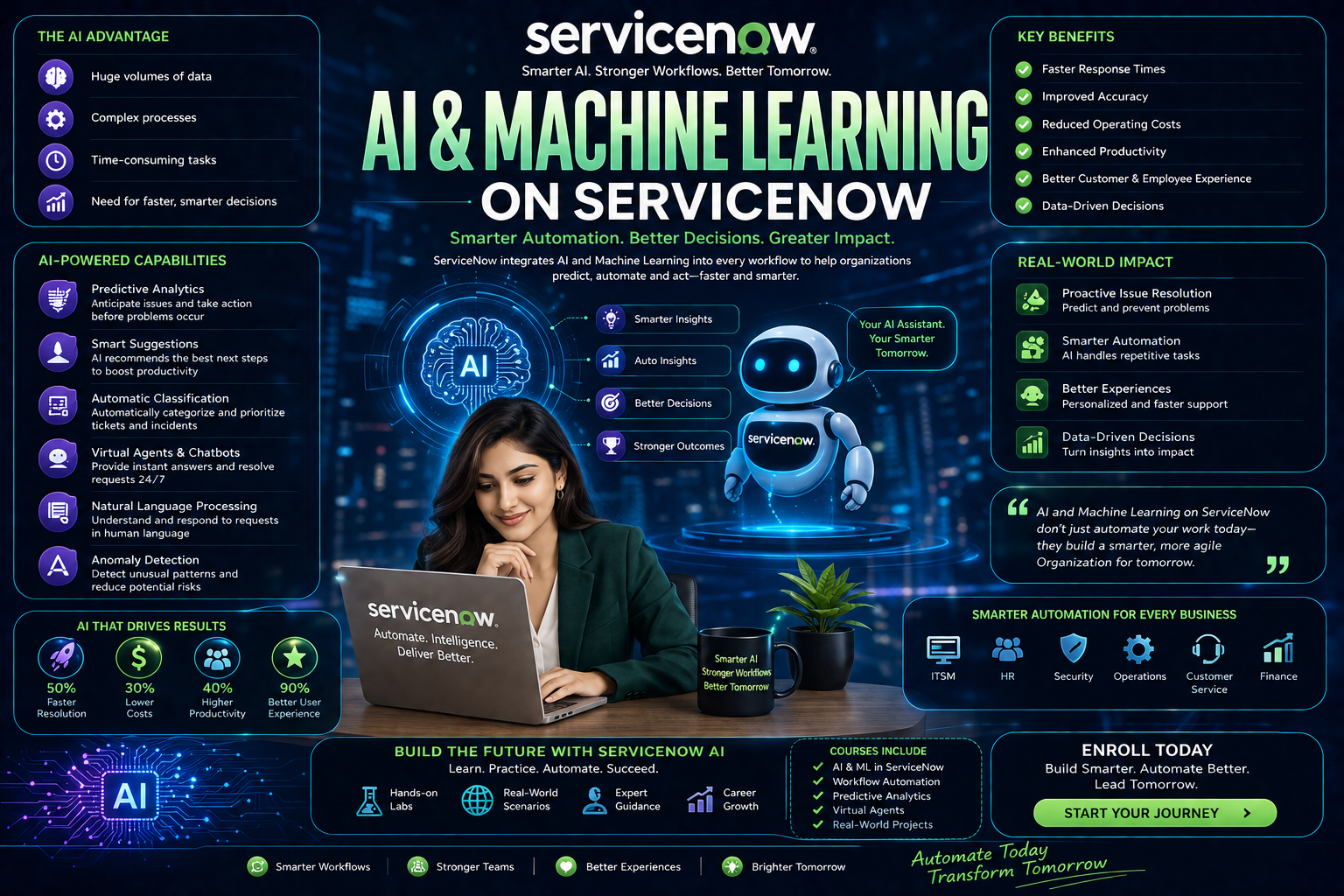
ServiceNow helps companies save time, reduce operating costs, increase productivity and deliver high quality services with artificial intelligence, machine learning and workflow automation. “The fast-evolving digital business landscape today requires organizations to be smarter and more competitive and these smart automation capabilities will help them get there.”
Low-Code/No-Code Development Capabilities
ServiceNow also offers a strong low-code/no-code development platform. It allows organizations to create custom apps and automate workflows with minimal programming knowledge. Building business applications requires highly skilled developers, a lot of code, and long development cycles. This can slow down digital transformation initiatives and increase the dependence on technical teams. ServiceNow makes it easy with simple drag and drop tools, visual workflow designers and prebuilt templates so companies can build applications and workflows faster and more efficiently.
ServiceNow’s low-code/no-code capabilities allow organizations to automate their unique business processes based on how they do business, without having to spend time and resources on custom development. Business users, managers and non-technical people can design workflows, approval processes, service forms, dashboards and automation rules with little knowledge of coding This helps departments resolve operational problems more quickly and relieves some of the pressure on specialized development teams.
For example, HR teams can create auto-onboarding workflows, finance teams can create expense management approval workflows and IT teams can create incident tracking systems, all through the easy configuration tools built into the platform. ServiceNow also offers pre-built workflow components and integrations that speed application development and scale. This allows companies to react more quickly to changing business needs and to increase operational efficiency.
It also accelerates innovation, allowing companies to test and implement new solutions faster. Organizations build and deploy workflows in days or weeks, not months waiting on application development. This flexibility is particularly crucial in today’s fast-evolving digital environment where companies need to be able to react quickly to the market needs and customer expectations.
“ServiceNow eliminates the need for traditional coding and development resources, so organizations can lower development costs, increase productivity and accelerate their digital transformation projects. These features make the platform extremely valuable for enterprises in search of faster automation, more agility and scalable workflow management solutions.
Monitoring, analysis and performance reporting
This ServiceNow tool provides advanced reporting and analytics that help organizations track real-time workflow performance. Through this Managers have the ability to track important metrics like incident resolution time, employee productivity, customer satisfaction, and Service Level Agreement (SLA) adherence.
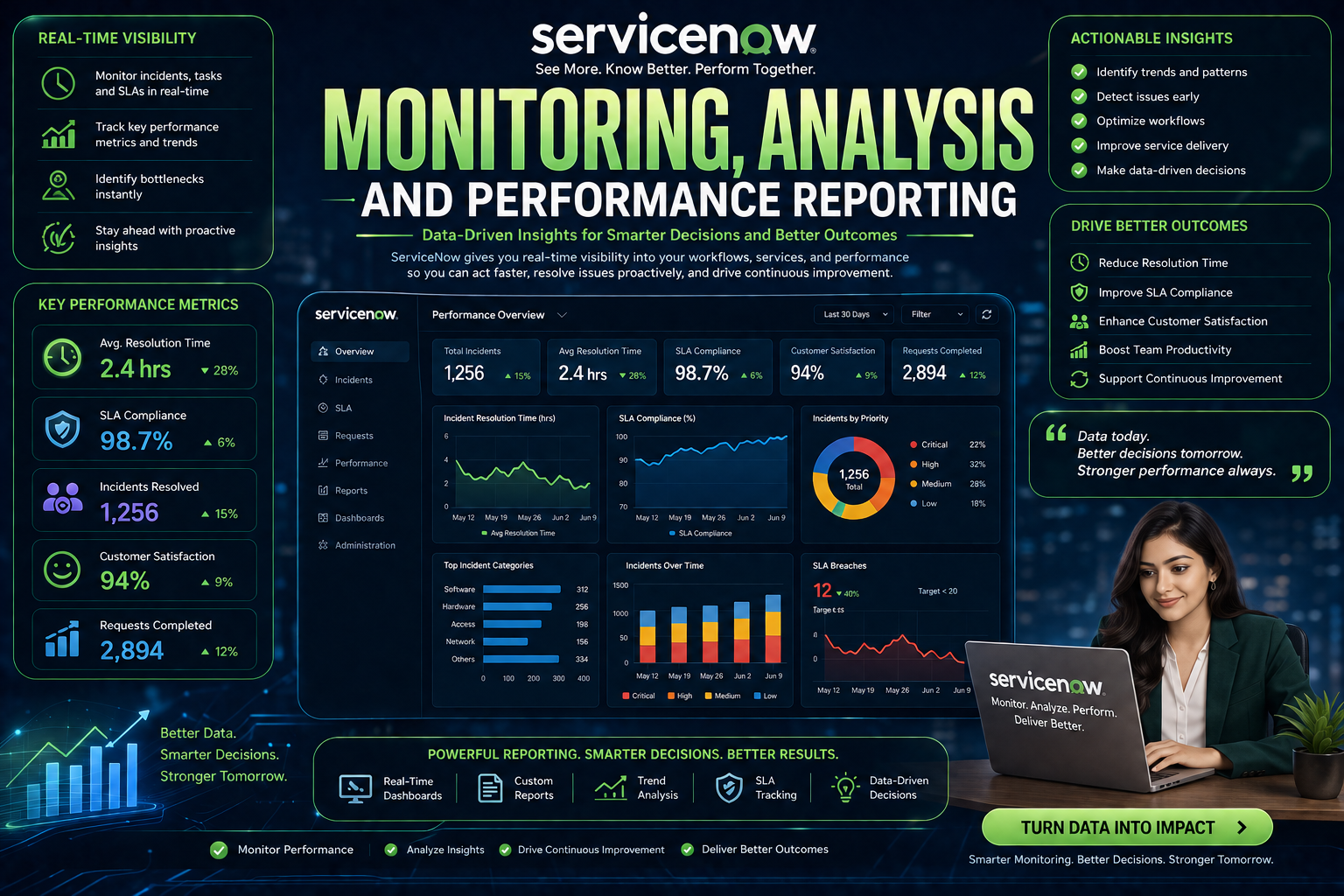
The reports that are visible in this tool can help companies identify bottlenecks, streamline operations and make data driven decisions. In addition Real time dashboards offer better visibility into organizational performance and help drive continuous improvement efforts.
Security & Compliance Management
Security and compliance is top of mind for businesses today, especially those in regulated industries. It is difficult to keep manual processes in compliance at all times.
ServiceNow manages standardized workflows, audits, and controls for role-based access. Governance will be improved and the risk of non-compliance reduced through automated approvals and documented processes. That is the reason why Industries like healthcare, banking, insurance and government sectors are so much dependent on ServiceNow.
Industries Using ServiceNow for Automation
Today, organizations in every industry are using ServiceNow to automate workflows and drive operational efficiencies. The platform is used by Providers to orchestrate IT operations and processes for the delivery of patient services. Financial services organizations use ServiceNow for customer service, incident and compliance management.
Manufacturers optimize asset management and maintenance workflows and retailers automate employee support and inventory management functions. ServiceNow is also being used by educational institutions and government agencies in their modernization efforts to better deliver service.
Now Service: The future of workflow automation
As more companies take on digital transformation initiatives, they’ll need intelligent workflow automation even more. New advanced AI capabilities, predictive intelligence and hyperautomation features are making ServiceNow better.
“Workflow automation is evolving toward intelligent decision-making systems, self-healing operations, advanced virtual assistants and highly automated business environments. By investing in ServiceNow, organizations can set themselves up for long-term business growth and operational efficiency.
Conclusion:
In summary, ServiceNow is enabling companies to optimize their workflows through system integration and AI automation. it boosts productivity, removes manual work, enhances the customer and employee experience and enables departments such as IT, HR, customer service or compliance management to make decisions more quickly. As more companies embrace digital transformation strategies, the demand for ServiceNow professionals has grown exponentially. The ServiceNow Institute in Hyderabad from OnlineITGuru is designed to provide students with practical experience in workflow automation, ITSM, integrations and application development to succeed in enterprise technology and workflow management.