
How ServiceNow Now Assist Is Changing the Game for IT Support
Last updated on Jul 6, 2026
The conventional landscape of IT Service Management (ITSM) has been for many years characterized by constant resistance to friction. Over the years, IT support staff have been working in the thick of skyrocketing ticket numbers, scattered information resources, and complicated tech processes. IT support agents have to switch contexts, go through extensive incident logs and write out resolutions in manual fashion. At the same time, end-users endure long wait time, experience frustration caused by rigid decisions of chatbots, and lack of self-service functionality which resolves users' issues.
However, a profound shift in the paradigm is taking place. The appearance of ServiceNow training online Now Assist – the native layer of GenAI implemented into Now Platform – has totally redefined the traditional approach to IT support in enterprises.
Now Assist is different from an independent AI chatbot because it works within the employed modules, workflows, and structures. With the new enterprise updates, organizations have embedded GenAI into their tier systems in the servicenow training online platform.
This article will delve deeply into the revolutionary changes that Now Assist brings into the field of IT support. We will discuss its architectural foundation, its skills as an agent, the trend towards autonomous agentic workflows, and the tangible business outcomes that make it a must-have technology in today's digital business environment.
1. The Architecture Revolution: Native GenAI vs. Add-ons
In order to see why Now Assist is revolutionary, we have to compare it with enterprise solutions that traditionally used to integrate AI. In most cases, if there was a need to integrate large language models (LLM) into processes, companies used to build bespoke integrations of their service desk databases to external API systems.
Such "bolt-on" architectures introduce serious operational and structural risks:
Data Isolation & Loss of Context: External AI models inherently cannot perceive the relational data inside an enterprise. They are unaware of its CMDB, incident history, access rights of employees, and internal structure.
Data Governance Issues: Sharing sensitive enterprise data, proprietary source code, and access credentials through external API gateways becomes an enormous data governance liability.
Integration Latency: There will be latency and additional points of failure involved when transferring information to and from the outside platform and core service desk.
Now Platform Approach
Now Assist bypasses this limitation because it runs natively on the ServiceNow AI Platform. The intelligence layer ingests enterprise workflow data, historical data, user context, and search context parameters along with optimized LLM architecture.
As the AI is integrated within the platform architecture itself, it adheres to all your security policies, Access Control Lists (ACLs), and data governance policies. Not only that, but it is not simply producing generic content; it is reading, analyzing, and acting within your specific operational environment.
2. Core Capabilities: The AI Toolset for IT Agents
Within a typical process for an IT helpdesk agent, much time is spent on documentation, context building, and administration. Now, Assist allows the agent to move away from such administration back to valuable problem solving by offering context aware AI skills embedded within the Service Operations workspace.
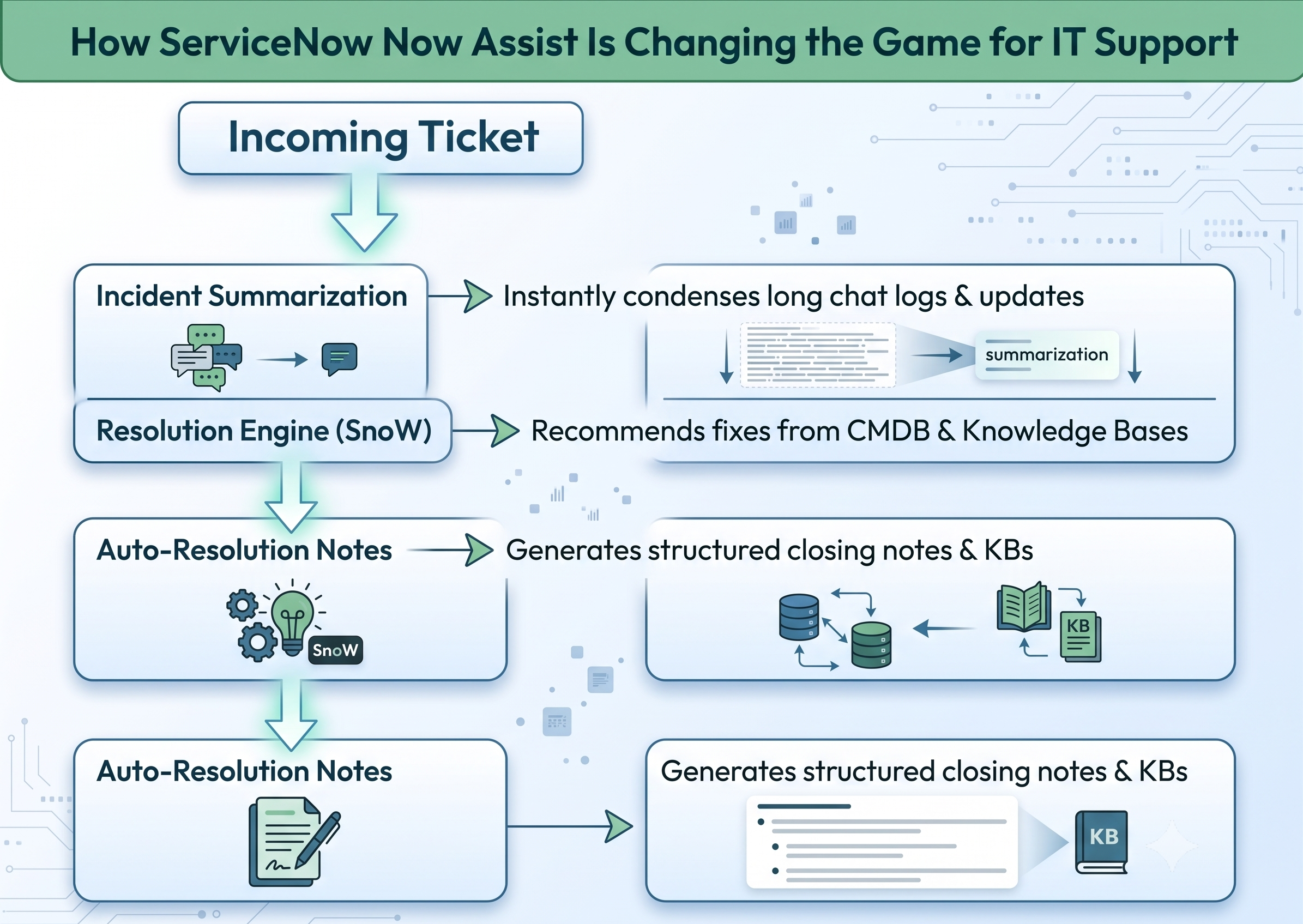
Summarization of Incidents and Chats
In case an incident has been escalated through various tiers or is assigned to a specialist working on call, the new agent needs to go through several pages of log information, documentation and user interaction in order to see what was done earlier.
With Assist, this problem is solved by means of the Incident Summarization tool. By one click, it analyzes the whole history of the ticket and generates a precise and structured paragraph describing the problem and the measures that were taken. Thus, there is no need for the multi-minute context gathering step; this process becomes just seconds.
Recommendations for Chat Reply and Activity Streams
In case of communication with end users through live chats or emails, the support agents spend much time creating replies and adding links and references. Assist generates recommendations for chat replies automatically.
Based on its analysis of the input provided by users and the relevance of the available internal resource, the AI will provide a suitable draft response that the agent can edit and then send out with just one click.
Automated Resolution Notes and Knowledge Synthesis
The documentation of resolutions is very important for the accumulation of institutional knowledge. However, documentation is one of the least performed and often skipped tasks in IT support. Once a problem is fixed, the Now Assist tool will analyze all the actions taken in the workspace and produce the structured Resolution Notes, which include the root cause, remediation, and closure categories.
Additionally, in case there is no document related to the problem, the tool can synthesize information from the incident record and write a structured KB article.
3. Transitioning Towards Autonomy: Agentic Workflows & AI Agents
Even though agent-based skills help minimize manual work, the real game changer for IT support is transitioning from assisted workflows towards autonomous processes. Service Now training online has developed Agentic Workflows using specific AI Agents.
While traditional automation depends on rigid conditional logic (If/Then), in case of encountering situations beyond exact code conditions, the process fails and needs a human being’s assistance. Autonomous AI agents, on the other hand, can recognize the situation in which they operate, make conclusions about ambiguous situations, choose the best course of action, and perform multi-step playbooks independently.
Regarding the evaluation of system performance, the ServiceNow Now Assist brings about a complete paradigm shift on four main aspects, as follows:
Execution Model: In contrast to the existing models which solely use rule-based and static logic tree structure that can be disrupted by the inability of the scenario to meet certain pre-defined conditions, Now Assist offers goal-oriented execution model powered by dynamic reasoning ability of the system.
Processing of Unstructured Input Data: Unlike existing models where the lack of clear information leads either to failure or prompt referral to human expert analysis, agentic workflows understand the intentions of users automatically via NLP.
Integrations: Contrary to fragile and difficult to maintain scripts based on the APIs used by traditional solutions, Now Assist makes use of dynamic orchestration provided by the Integration Hub functionality native to ServiceNow.
Escalation Handling: The use of manual routing of tickets through helpdesk triage teams causes significant service delays in traditional operations while Now Assist automates the whole process with the help of auto-classification powered by context-awareness of the system.
The helpdesk never actually had to physically lay hands on the ticket. It all happens in minutes rather than days or hours.
4. Business Impact: Measurable IT Service Management (ITSM) Metrics
Putting such advanced AI systems into practice requires an investment for which enterprises have to provide concrete performance indicators. Fortunately, using generative AI within core service processes helps tick every box in the realm of IT Performance Indicators.
Extreme Reduction in Mean Time To Repair (MTTR)
This is the ultimate indicator for the success of any enterprise IT operation. Any downtime means that the application or device in question isn’t working and costing the enterprise productivity and money. With Now Assist, you can lower MTTR on both sides:
Reduce the time spent investigating the issue through context summarization and pattern detection.
Cut down on the time spent resolving the issue through exact formulaic solutions and backend automated actions.
Ticket Deflection and Employee Experience (DEX)
With Now Assist, enterprises get to combine their existing virtual agent with the conversational experience to make self-service truly conversational for end-users. The AI analyzes the natural language, searches in all federated knowledge bases, and performs actions.
Shifting tier-1 basic tickets (like password reset requests, software access needs, and hardware issues) from human service desks means that companies reduce the cost per ticket and increase the Digital Employee Experience (DEX).
Busting Developer/Admin Bottlenecks
The Now Assist solution is not just beneficial to the service desk agents, but the ServiceNow administrators and developers also get advantages from its use. Administrators can employ Now Assist modules such as Now Assist for Creator to generate secure JavaScript for the ServiceNow training app, create test scripts, and even design workflow flows in App Engine Studio. The entire development process will now take much less time.
Training in AI Skills: In order to capitalize fully on the power of these technologies, one has to enroll in a formal course in service now. Such this enables the administrators to get rid of the outdated coding practices and use fast AI-assisted development methods. Secondly, to ensure that the whole team of technicians is aware of how to effectively instruct, provoke and audit native AI programs, thorough servicenow developer online training should be provided to all IT personnel.
5. Security, Governance, and Foundational Responsible AI
The main barrier to enterprise adoption of generative AI is security. Companies cannot allow their proprietary architecture to be exposed to any open models, nor do they want hallucinations from the AI to give wrong technical guidance that might cause system crashes.
Service Now training online solves this problem by building in strict governance in a transparent manner using technology such as ServiceNow AI Control Tower. The structure guarantees that AI deployment is secure, responsible, and fully audited:
Enterprise AI Security Framework
Data Isolation and Confidentiality: Enterprise data used by Now Assist stays isolated to the secure instance boundaries of the company. The data is not used for training publicly available foundation models.
Human-in-the-Loop Approach: In key processes, such as approving changes to production infrastructure, implementing significant security updates, or editing core access groups, Now Assist doesn't work independently. It serves as a co-pilot who gives recommendations and creates the plan which should be reviewed and implemented by a human engineer.
Hallucinations Prevention: Due to the fact that Now Assist uses only the verified data from the company's local instance, the probability of contextual hallucinations is much less than for generic open web AI services.
6. The Hidden Mechanism: How Now Assist Manages Requests
For better understanding of Now Assist's efficiency, it will be helpful to analyze the hidden mechanism of how a user's request goes through the native architecture. While traditional systems involve an intricate network of API calls, Service Now is processing all this within the same system structure.
Step 1: Semantic Anchoring & Intent Parsing
When the user enters an unstructured message through any channel such as portal, chat, or voice-to-text, the Now Intent Engine quickly removes all conversational noise from the message. It anchors the user’s request to specific platform entities. Rather than matching the user's keywords, it matches the user’s intent to the most similar enterprise ITIL process.
Step 2: Live Contextual Data Enhancement
Prior to the transmission of the parsed request to the LLM, the platform enriches the request by adding metadata, obtaining details about the software assigned to the user, the movements across locations, outages of the system, and the hardware model from the CMDB. By doing this, the LLM becomes acquainted with the technical infrastructure upon which the user operates.
Step 3: Local Guardrails Filtering
The enriched prompt passes through a local safety filter before being executed. The filter checks the user privileges based on local ACLs. When a Tier 1 employee makes a request for the AI to generate a script, which requires global administrative privileges, the guardrail prevents any configuration or data change.
Step 4: Generation of Special Tokens
Finally, the special model generates a token depending on the interface that the agent interacts with. If the agent is working in the Service Operations Workspace, the model outputs the list of diagnostic steps in bullet points. If the user is working from a mobile application, the model provides a choice list instead. The entire process takes less than two seconds to complete.
7. Addressing Challenge with Long-Term Enterprise Maintenance
The historical challenge that came along with the use of AI technology was the phenomenon known as "maintenance drift," which referred to the inevitable decrease in accuracy of systems due to changes within business processes over time. Now, Assist resolves this challenge by offering automatic platform alignment.
Automated Topic Architecture
Within the traditional virtual agent platforms, IT professionals were required to design conversation flows manually through node editors. Whenever there was an update made in the VPN technology, the IT professionals needed to find all of the nodes related to the chatbots and update them accordingly.
Now, Assist offers an automated solution to the maintenance bottleneck through dynamic knowledge ingestion. It ingests new internally published documents and adjusts its conversation flows automatically.
The Automated Vectorization of the Service Catalog
An organization with thousands of different service catalog items (from asking for a new computer screen to setting up a new AWS test cluster), managing the search functionality properly is extremely tough. Now, with Assist, vector embeddings native to our system constantly map all catalog items.
This implies that no matter how off-the-wall a request from the user might be - say, "My computer is running slow and I want a virtual sandbox up and running ASAP," the system will understand its intent and associate it with the right catalog item, fill out all the necessary form fields, and start the backend automation process.
8. The Strategic ROI: Implications for the Technology Executive (CIOs and CTOs)
For technology executives (CIOs and CTOs), rolling out Now Assist represents a paradigm change in capital deployment and talent allocation throughout the organization and not merely a faster service for service desk staff.
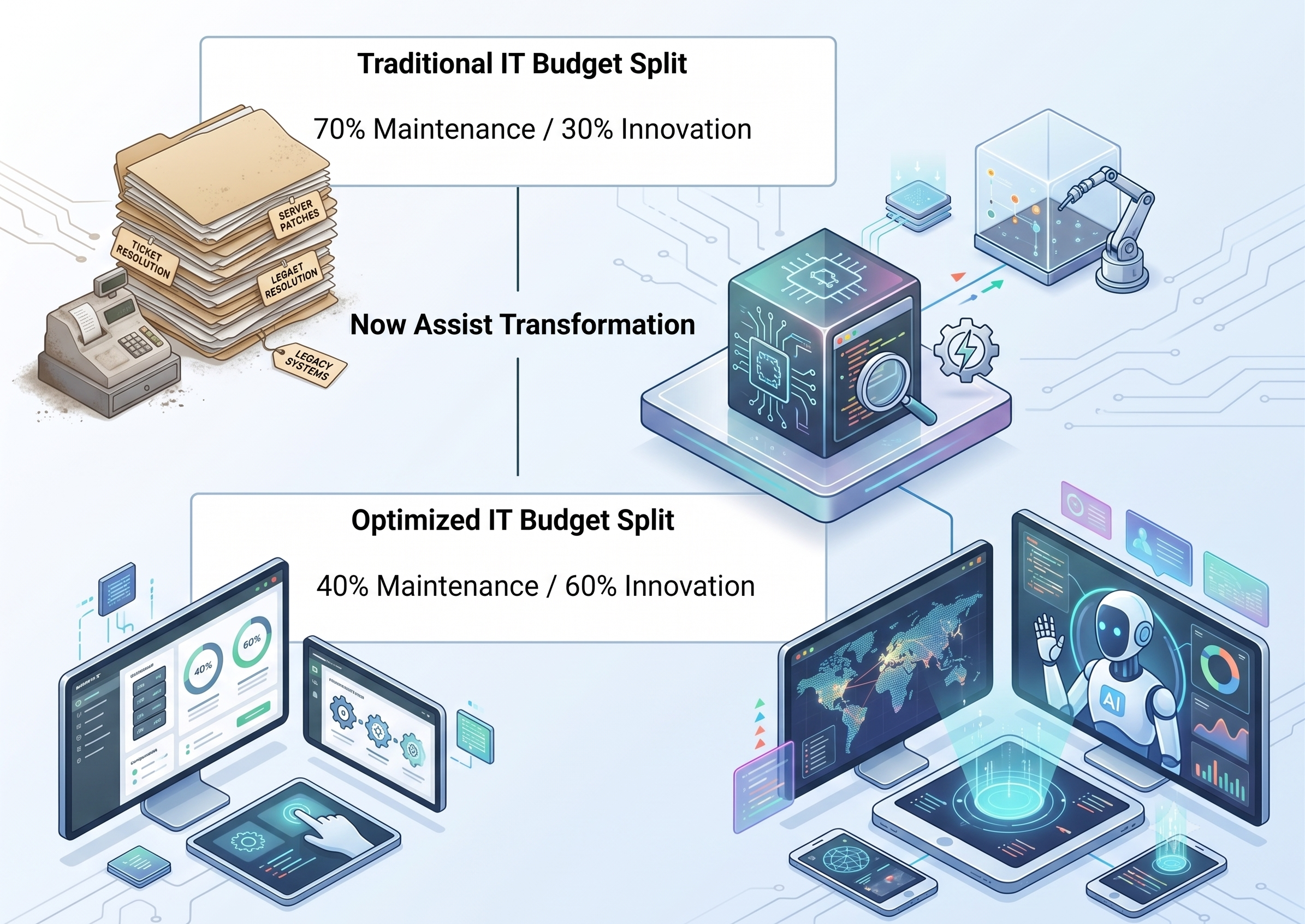
Reallocating Funds from Maintenance to Innovation
In most large companies about 70% of the budget for IT is spent on "keeping the lights on" which means carrying out maintenance for the different basic tasks such as resetting passwords, managing uptime, and doing some tinkering here and there in case there are bugs to be fixed. But when the job is done by robots such as AI the impact of saving money could be immense.
AI can take over routine processes in the IT department thus freeing up human resources to be used for innovative and creative processes so that the IT department can come up with new ideas and products.
Scaling up the Operations Without Increasing the Number of Employees
Typically as businesses grow and develop, their IT needs grow by the same amount as the volume of work grows. In this sense, one sees that there is a need to recruit a great number of specialists and get more space for working.
With Now Assist, corporations are able to eliminate this linearly dependent problem. Thanks to its AI structure, this app can deal with unexpected spikes of ticket requests. During an IT crisis situation or software migration, Now Assist can handle 3 times more requests, without the need of hiring new employees in the help desk department. The efficiency level of IT services can be increased with the help of this application.
Conclusion: The competitive advantage of enterprise IT
It is evident that in the near future electronic corporations won't be able to distinguish between software platforms and intelligent automated systems. The use of Now Assist proves that generative artificial intelligence should be related to the core business processes of any organization.
By taking out unnecessary red-tape for service agents, automating complex processes and providing real-time access to information, this company sets a new standard for the entire business industry. In today’s world, it is imperative for companies willing to be competitive in the future to implement the artificial intelligence platform.
To stay competitive in the changing business landscape, organizations need to adopt a native secure, deep-integration artificial intelligence solution in order to manage operations in an effective way without increasing the number of employees working in the same department. Upskilling employees through structured Service now training online classes helps to provide sufficient knowledge to internal managers to manage and optimize these complicated processes. It is true that businesses that are going to implement this kind of technology in future will struggle to cope with other firms that are already using artificial intelligence regarding the speed of implementation, efficiency, and scalability of the processes.