
How Workday Transforms the Hire-to-Retire Employee Lifecycle Essay
Last updated on Sep 30, 2026
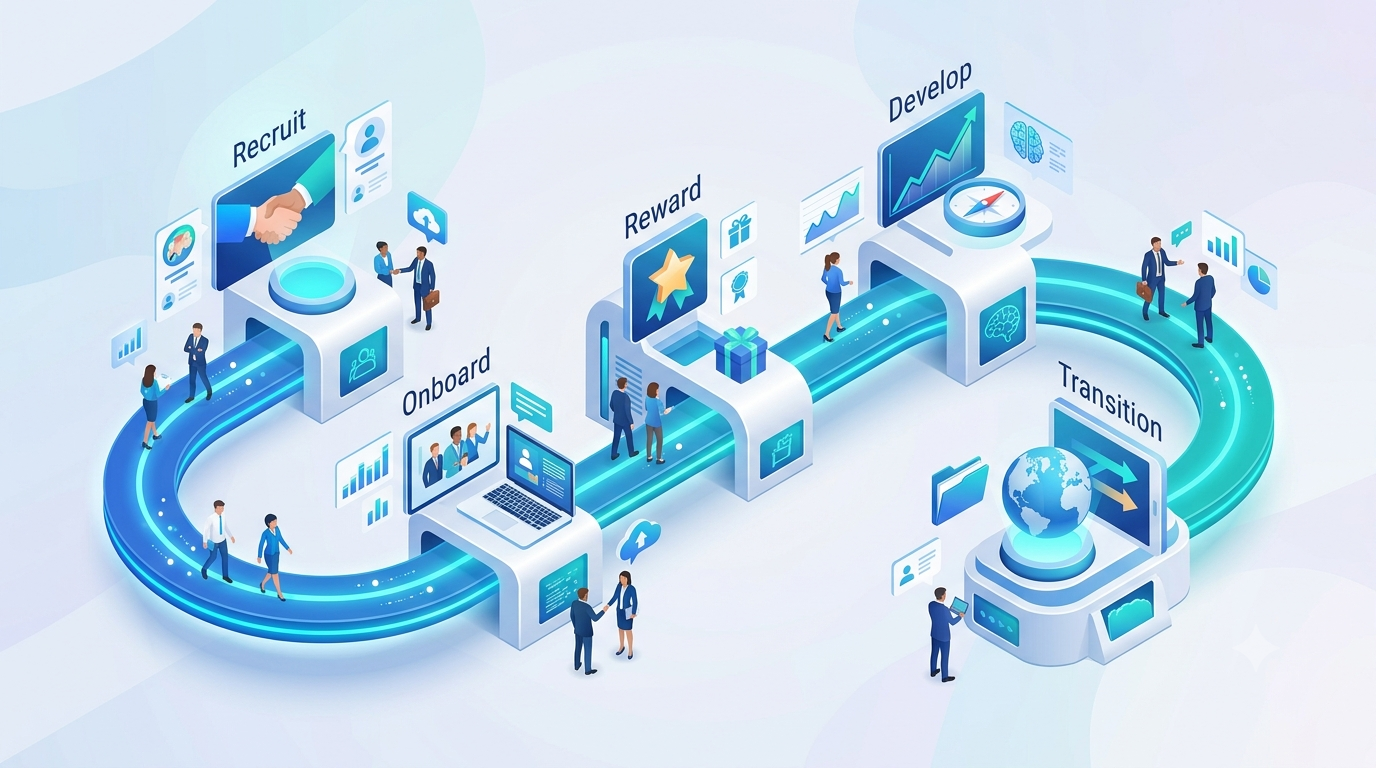
Nowadays, enterprises must ensure efficient management of their workforce. That is why many organizations are shifting from multiple legacy systems to cloud-based software in order to scale and optimize their processes. Products such as Workday HCM allow companies to make the most out of their employee data while providing integrated solutions for financial and people analytics.
Human Resource Information Systems are notoriously complicated and multifaceted. Various separate departments require different sets of data in different formats. This often complicates the work of HR managers and professionals who have to provide a consistent flow of relevant information to all parties involved in the employment process. Workday offers a cloud-based solution that effectively streamline the flow of data throughout the duration of the employee lifecycle. Let us explore the major stages of the process in chronological order in order to better understand how the program helps enterprises manage their staff.
Talent Acquisition and Recruiting
A company’s interaction with a prospective employee begins with the outreach stage. As such, the Workday system covers all major aspects of finding, hiring, and structuring new applicants. The organizing and attracting functions are placed directly into the recruiting module, which allows human resources departments to keep all of their data in one location. Unlike point solutions that need a lot of custom coding to link with apps, Workday Recruiting connects job requisitions to the organization’s staffing model and budget. Because of this, when a manager submits a requisition, the approval process will have a current view of the headcount and budgets available for the position. This solution stops requisition approvals, reduces data entry, and makes the requisition process faster.
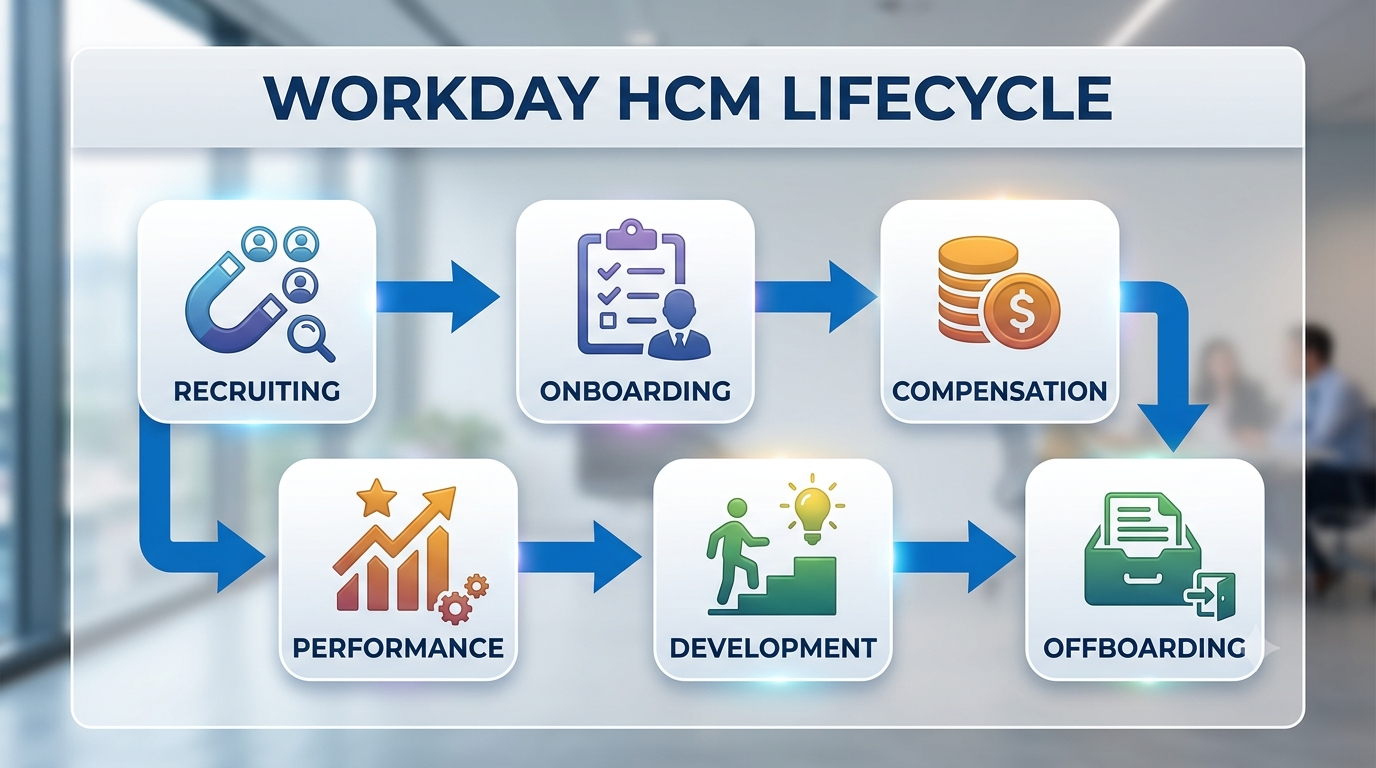
The recruitment solution lets candidates apply for jobs on their phones. They can. Read resumes, attach their qualifications, and check the status of their applications. Organizations get a tool that helps recruiters keep track of candidates’ qualifications. The tool gives an employer a picture of the recruitment pipeline. It helps recruiters and hiring managers work together well, rate candidates, give feedback, and check their skills. Finally, by using the tool’s built-in intelligence and machine learning, recruiters can look at candidates based on their skills and what the company needs. Of reading resumes they can pick candidates using scores and skill suggestions. In short Workday Recruiting provides a way of handling the recruitment process. It does this by bringing requisition management, applicant tracking and candidate selection tools. As a result the tool helps companies save time during the recruitment process and make hiring decisions.
Early Engagement
Following an acceptance of an offer by candidates, the onboarding process commences and lays the foundation for the employee’s journey in the company. It is a critical stage determined by the employer’s efforts to impact the engagement levels, retention strategies and productivity of the employee. Workday Onboarding digitizes the conventional, tedious paper-based process involved in traditional onboarding techniques into a more personalized and engaging digital experience.
This is primarily achieved by virtue of the software’s ability to capitalize on data collected pertaining to a candidate mustered during the recruitment phase and automatically transferred to the worker profile upon the candidate’s acceptance of the offer. This eliminates the need for re-submission of information and forms such as tax details and direct deposit by new hires. Candidates can personalize their onboarding experience by accessing portals provisioned through the system where they complete compliance checks, read policies, sign contracts and configure their preferences prior to the start of their official work date.
In addition to the automation of paperwork, effective onboarding requires orchestration and collaboration. Workday Onboarding facilitates the configuration of role-specific automated checklists which can be customized to fit the requirements of different functions, departments or geographical location to fit an organization’s unique needs. New hires receive automated communications, tasks, and introductions to key contacts and mentors within the organization. Furthermore, at appropriate times during the onboarding workflow, automated notifications are sent to internal support teams such as IT and facilities to complete their respective tasks long before the employee’s first day at work.
Finally, managers get the analytics and insights necessary to monitor the onboarding process of their direct reports. Through the dashboard, managers can track the percentage of tasks completed by their new direct reports, engage in early and meaningful conversations about training and set first-milestones for their new joiners. By automating manual tasks while boosting discoverability and collaboration, Workday Onboarding enhances the socialization and inclusion of new employees into the company from day one.
Compensation, Benefits & Time Tracking
After finding the right employees and motivating them to be with the company for a long time, it is essential to establish ways of keeping them satisfied and increasing their level of enthusiasm. Such mechanisms are related to the provision of compensation and benefits, as well as the regulation of the time spent working. The management of these two last factors should be done in an accurate, precise, and adaptable manner in order to meet the needs of the market.
The Workday Compensation and Benefits application is a great tool for managing and regulating the different sources of compensation for employees. This software is directly connected to the information regarding the workers held in the main application. This means that every change in the banding, rules matrix, compensation, and incentives will be automatically applied to the individuals in the specified categories. In addition, during the yearly compensation review, managers can use the assistance of the software in setting ranges, analyzing the data regarding the employee’s performance, the market value of the position, and past increases in pay.
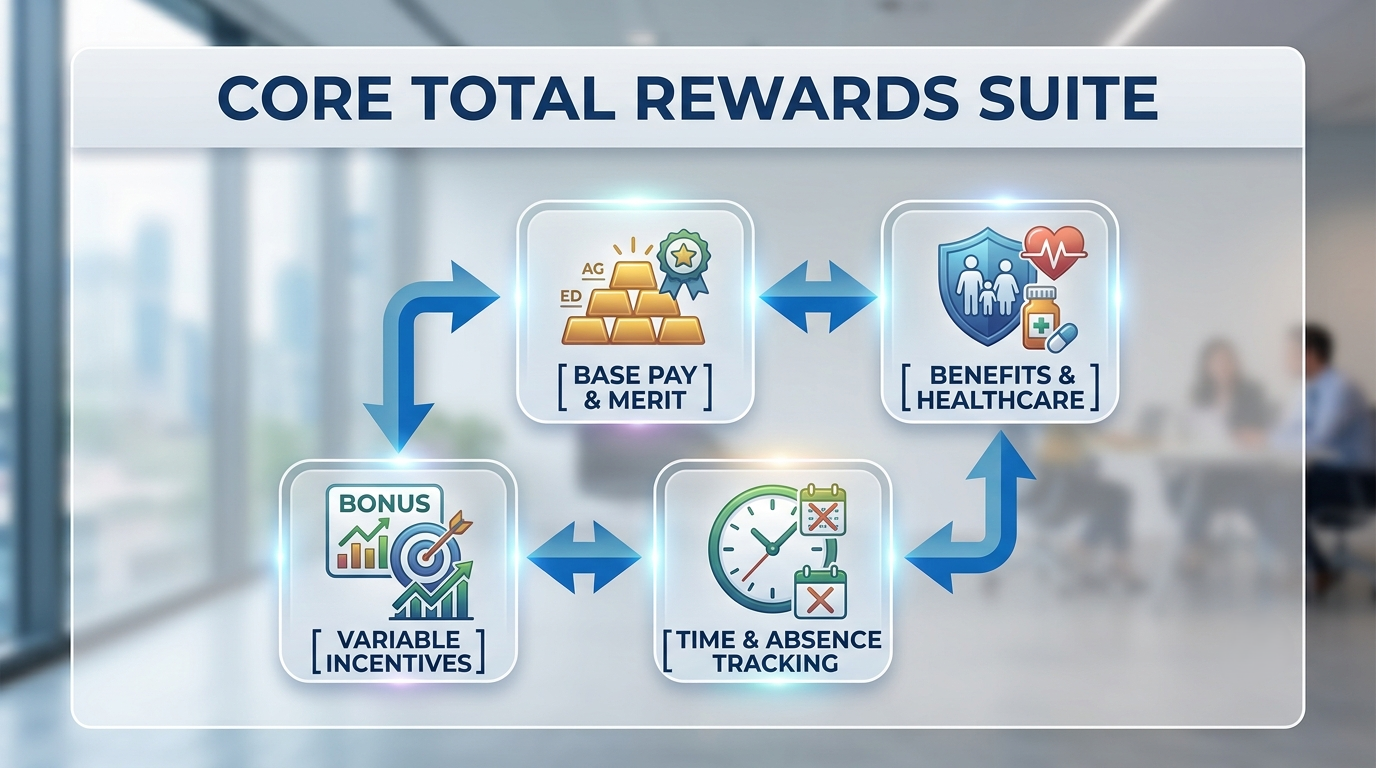
Benefits administration is just as simple. Employees can go online and make changes to their benefits during open enrollment, or if a life circumstance has changed. All the tools within the self-service access explain the options, the costs, and any dependencies. It's all very straightforward. Behind the scenes, you're able to push that information to third-party administrators, insurance carriers, so you're minimizing any manual data entry and minimizing errors.
Another example of precision is workforce tracking. With Workday Time Tracking and Absence Management, workers can access mobile tools to track their time, request time off, and check balances. There are also embedded global workforce compliance engines that calculate overtime, meal breaks, and leaves of absence based on their location and type of employee. Because this information feeds up into global payroll, companies are ensuring accurate, timely and compliant payroll processing. During bi-annual compensation review cycles, Workday transforms what used to be a task done in spreadsheets into a clear rule-based workflow that is tracked and audited.
Merit Budget Pools: Executive leadership can set up merit pools, define performance-based guidelines, and apply adjustment caps from one central location.
Manager Workspaces: People managers receive to-use dashboards showing each team member’s current salary, job profile, benchmark data, performance ratings, where they stand in their pay band (compa-ratio), and past pay changes.
Real-Time Financial Validation: When managers update merit increases market adjustments or bonus amounts the system instantly recalculates how much of the budget has been used. Alerts them if a proposed change goes beyond the allowed limits defined by corporate guidelines.
Audited Approvals: Once compensation changes are approved the process automatically moves through the defined approval chain and creates an audit trail. It will support HR compliance and financial reporting needs.
Automated Benefits Administration
Handling employee benefits requires accuracy, adherence to regulations and smooth coordination with outside insurance providers and third party administrators. Workday Benefits is built directly into the worker record so that eligibility rules are checked in time based on worker attributes such as employment status, age, location, weekly hours and job classification. Employees can manage their benefits on their own through self-service tools during an annual open enrollment or when a qualifying life event occurs; such as marriage, the birth of a child or a move.
Self-Service Guidance: The system helps employees compare plans, shows cost details, offers side-by-side coverage comparisons and explains how pre-tax and post-tax payroll deductions affect their take-home pay.
Automated Eligibility Engine: When a worker’s status changes, such as going from time to full-time Workday automatically detects that change and opens a new enrollment period for benefits.
Carrier Integration Network: Workday’s Cloud Connect for Benefits formats enrollment data, plan changes and terminations. Sends them securely to insurance carriers via API connections. Removes, the need for data entry and avoids billing errors from carriers.
Integrated Time Tracking and Absence Management
Ensure accurate compensation and benefits by recording time accurately. Workday Time Tracking and Absence Management breaks down the barriers between time-keeping applications and HR and payroll engines at the core of the business.
Continuous Performance, Talent & Development
Keeping the organization’s stars aligned with continuous performance management, career development and investment in skills is critical. Yearly performance reviews are becoming a thing of the past, and companies are looking for more agile ways to recognize continuous achievement, set goals and help everybody grow in their careers. Workday Performance and Talent Management offers a continuous performance management solution, helping organizations turn vague discussions about performance into a transparent, goal-driven, skills-based development of each employee. Using Workday Performance and Talent Management, users can design a continuously updated performance management system, set and track cascade goals and key deliverables, and utilize peer-to-peer recognition features to acknowledge achievements and keep a continuous record of accomplishments for reviews.
Continuous Performance and Any-Time Feedback
Workday is fundamentally different in that it replaces static, annual reviews with a more fluid environment conducive to continuous dialogue:
Goal Cascading: Strategic corporate goals set by executive leadership can be cascaded down through the organization to specific teams and individuals, who can then track progress toward those goals and make adjustments, while also demonstrating how they support the broader corporate strategy.
Check-In Framework: Managers and employees can use 1:1 check-in templates to capture and track the substance of their ongoing conversations and collaboration, including project progress, accomplishments, and any roadblocks encountered throughout the year.
Any-Time Peer Feedback: Employees and managers can give or request peer feedback at any time, including kudos for a job well done or even negative feedback about a project or individual. This feedback is captured in the employee’s profile and serves as a valuable reference for the annual calibration conversation.
Skill-Centric Talent Optimization and the Skills Cloud
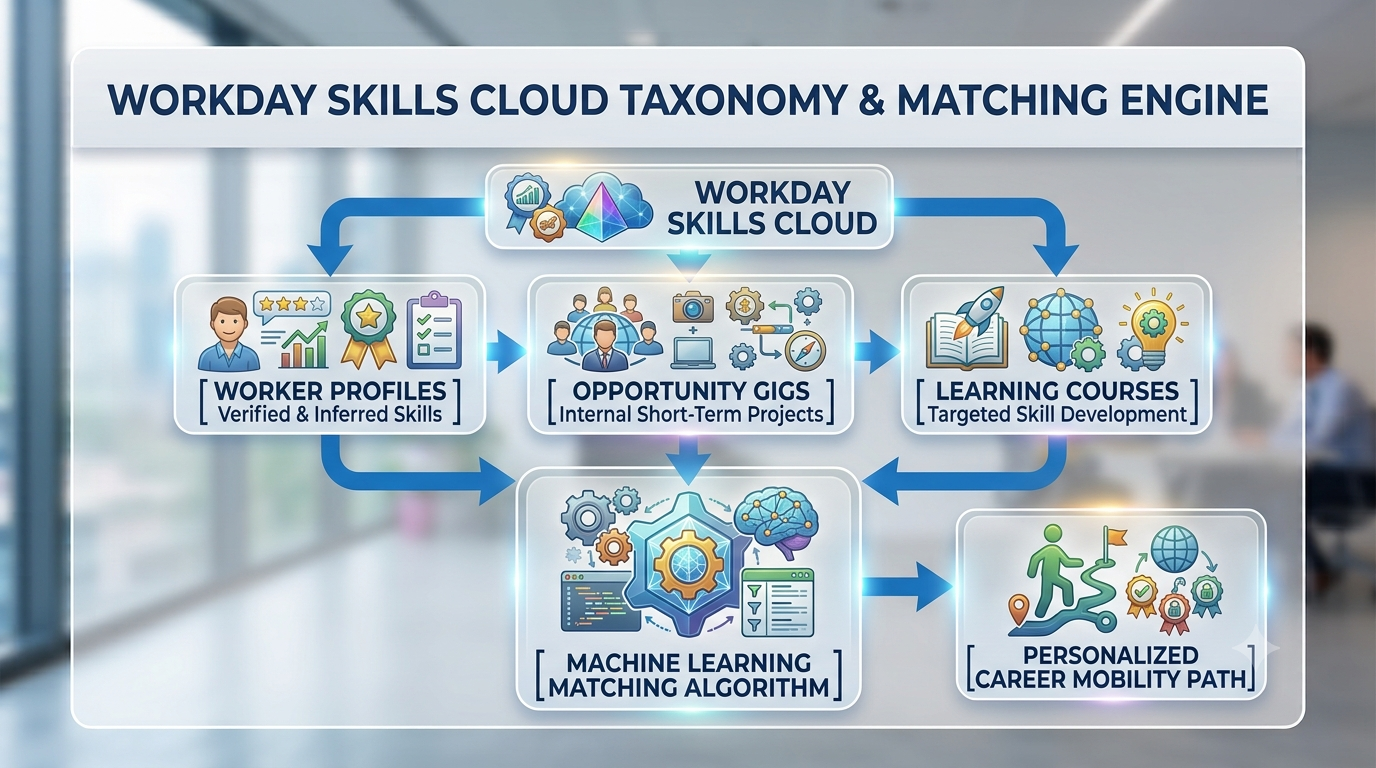
The Skills Cloud lies at the heart of Workday’s modern talent strategy. Using machine learning, the Skills Cloud essentially creates a common taxonomy that enables the definition of skills in a way that makes sense across different jobs, industries, and functions.
Skill Extraction and Inference: Workday analyzes accomplishments, feedback, project histories and external credentials to infer and validate worker skill sets automatically.
Skill Gap Identification: Employees can match their current skill profiles against potential job profiles across the enterprise, identifying what skills they need to acquire to reach their career goals.
Internal Talent Marketplace: Workday can automatically identify short-term project assignments, cross-functional initiatives, mentorship opportunities and internal job postings based on an employee's skill profile and career interests.
Targeted Learning Delivery: With Workday Learning, the system can recommend specific training courses, video-based learning and compliance certifications that can help close skill gaps directly within the user's workflow.
Succession Planning and Talent Pipeline Health
For executives and human resource (HR) managers, workforce planning and management ends with succession planning and ensuring that the organization has a healthy talent pipeline. With Workday, executives can view interactive 9-box grids to help them understand workers’ potential and performance. These two factors are then assessed and measured using objective information.
HR leaders then identify critical positions, evaluate their succession strategy, and determine how ready their pipelines are for these roles as well as those that could take one or two years to fill. They can also track the development and growth of talents while establishing learning and career paths. In this regard, organizations make decisions about their workforce using factual information, thus removing the risks associated with succession processes and maintaining executive talent.
Offboarding & Knowledge Transition
Every employee’s career cycle ends some day, which may be caused by voluntary resignation, retirement, or downsizing. The way the company manages offboarding is equally important as the hiring process because it helps ensure security, legal compliance, and the possibility of rehiring a former worker. In other words, an efficient exit strategy reduces risks and leaves a positive impression on a future candidate, client, or any other business partner.
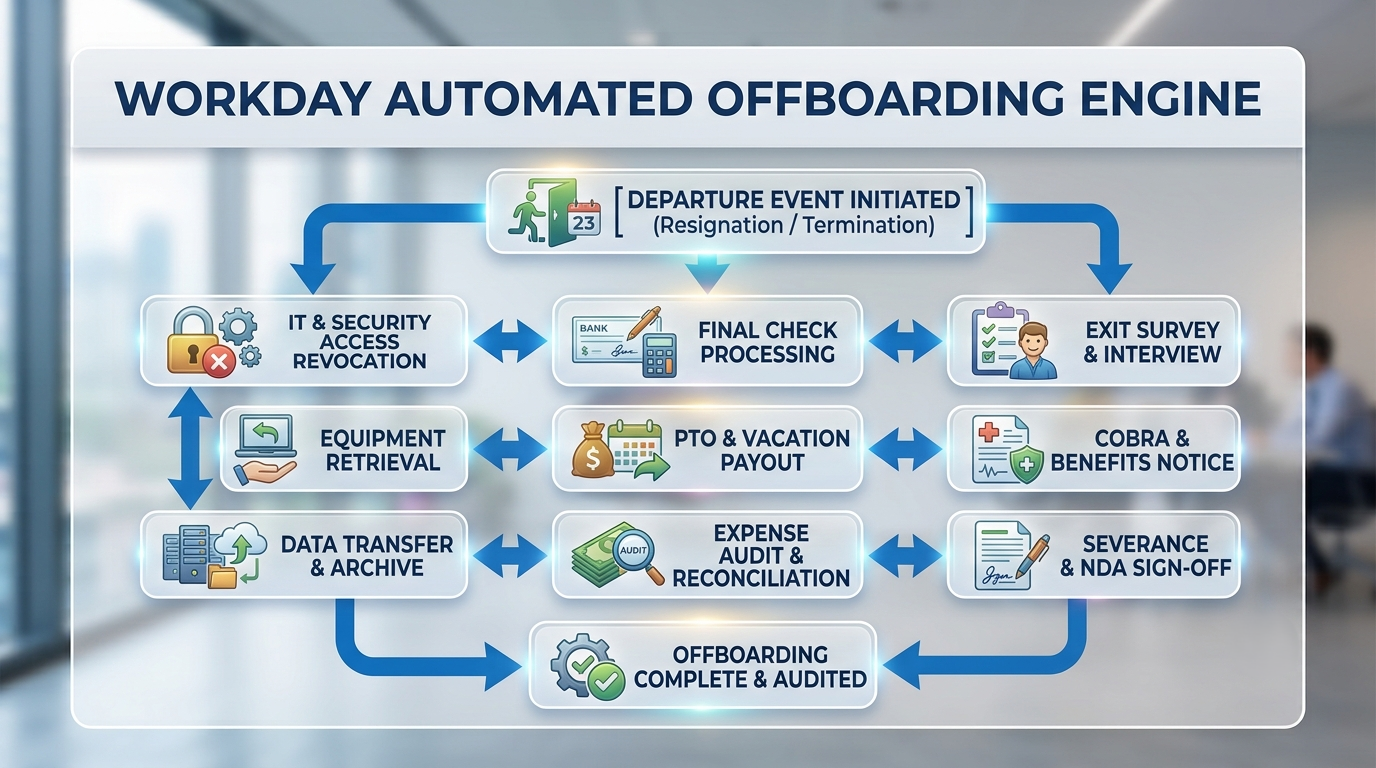
Triggered Business Processes and Security Protocols
Once an employee’s termination or resignation happens on Workday (either initiated by managerial personnel or the workers themselves), the business processes are triggered, initiating offboarding procedures according to specific categories of worker separation In particular, several security and system provisioning steps are taken right away, namely:
Revocation of system access: The information technology security teams receive alerts and automatically revoke single sign-on tokens, remote access permissions, and SSO identities in accordance with the worker’s end-of-employment date and time;
Asset tracking: The software produces asset recovery tasks that help track hardware, corporate credit cards, facilities keys, and intellectual property; and
Data reassignment: Digital workspaces, document ownership, and approval authority are reassigned to workers’ peers or managers.
Financial Reconciliation and Compliance
The process of offboarding demands accurate financial calculations to meet local statutory requirements and company’s severance policies. Workday is capable of automatically calculating the final paychecks with consideration of time worked during the last pay period, accrued but unused PTO (Paid Time Off), expense reimbursements, and applicable severance formulas.
The system also facilitates the distribution of required post-employment documentation, regulatory notifications (e.g., COBRA notifications, statutory separation certificate), and tax details. In addition, the tool provides ex-employees with the right to access (on a temporary basis) the special Alumni Portal to view year-end tax forms (e.g., W-2 form), historical pay stubs, and update their mailing address after the termination of employment.
Offboarding Knowledge Transfer and Alumni Engagement
Apart from withstanding security risks and ensuring payroll compliance, Workday also supports the collection of organizational knowledge and building relationships with the former staff. Indeed, exit interviews and engagement surveys can be administered digitally to capture and analyze such information as employee perspectives on leadership, compensation satisfaction, and working environment. Thus, the system contributes to the improvement of retention practices and reduction of turnover rates among the remaining workers.
Finally, the proper offboarding process enhances an organization’s image and promotes its reputation as an employer of choice. Therefore, the company can expand its talent pool and attract new candidates for future vacant positions. Besides, ex-employees may become the firm’s advocates, market its employer brand, and even return to the company as “boomerang” employees at a later stage and with more competencies.
Architectural Comparison: Legacy HR Systems vs. Workday HCM
To understand the core advantages delivered by Workday across the hire-to-retire lifecycle, it is useful to evaluate its structural architecture against traditional, multi-system legacy HR software environments.
Evaluating the System Infrastructure reveals a sharp contrast between legacy environments and modern cloud architectures. Traditional setups rely on disparate point solutions for applicant tracking, core HR, payroll, and learning management systems connected through fragile batch APIs. In contrast, workday hr training operates as a single multi-tenant cloud application built on a unified, object-oriented database, eliminating expensive integration maintenance, data latency, and custom middleware failures.
When examining Data Integrity, legacy systems frequently suffer from redundant data entry across platforms, leading to conflicting worker profiles and ongoing data decay. Workday establishes a single source of truth where worker information entered during hiring flows dynamically through every subsequent stage of the employee lifecycle, ensuring zero data redundancy, exceptional reporting accuracy, and complete audit trails.
Regarding Talent Acquisition, traditional HR setups handle job requisitions in isolation from corporate accounting and position budgets. Workday connects candidate requisitions directly to Supervisory Organizations, Job Profiles, and financial Worktags, preventing unbudgeted hiring, strictly controlling headcount costs, and accelerating time-to-hire.
In the realm of Onboarding, legacy processes rely heavily on manual paperwork, delayed IT equipment delivery, and siloed communication across departments. Workday modernizes this transition by automatically triggering cross-departmental business processes as soon as an offer is accepted, driving faster time-to-productivity for new hires and boosting early retention.
Managing Total Rewards in legacy environments often requires static spreadsheets for annual merit cycles and manual file exports to insurance carriers. Workday replaces these error-prone steps with real-time merit pool tracking, automated financial controls, and direct API carrier feeds, ensuring pay equity, minimizing payroll calculation errors, and streamlining benefits administration.
For Performance Management, older systems rely on retrospective annual reviews logged in isolated files that fail to connect with continuous learning. Workday transforms performance management into an ongoing growth engine featuring real-time feedback, cascaded goal tracking, and machine-learning-driven skill mapping via its Skills Cloud, fostering a high-performance culture and encouraging internal mobility.
During Offboarding, traditional manual procedures often delay system access revocation, exposing the business to security breaches and compliance penalties. Workday automates exit workflows through trigger-based execution that revokes IT permissions, manages asset returns, and processes final pay, protecting corporate security while maintaining positive alumni relationships.
Finally, in Reporting and Analytics, legacy systems force teams to extract data into external warehouses to generate comprehensive workforce reports. Workday delivers built-in, real-time matrix reporting, executive dashboards, and predictive analytics directly within the application context, equipping leadership with immediate, actionable workforce insights.
Strategic Importance Of Unified Lifecycle Of Employees
The digital revolution in human capital management is no longer about digitizing paper-based forms into PDFs or migrating local server-based applications to hosted vendor platforms; it is about transforming an enterprise’s approach to managing its total workforce. workday hcm course provides such transformation by recognizing that each stage in the employee lifecycle is connected. For example, recruiting decisions are used during onboarding, and information gathered during onboarding informs compensation and benefits administration. Similarly, total rewards strategies drive motivation, which then contribute to developing talent pipelines, and offboarding activities can safeguard enterprise assets while simultaneously contributing to improved recruiting efforts in the future.
By unifying these capabilities in a secure, cloud-based environment, Workday erases the inefficiencies, risks, and blind spots of the past, empowering organizations to act now — not five or ten years from now — to rapidly adapt to market changes, scale into new international markets, and attract and retain a skilled, engaged workforce.
In the end, looking to the future of your business means considering the future of your people — and how investing in workday hcm training can help you get the most value out of their time, talents, and skills.
Conclusion
Modern-day management tools should be designed to address the realities of the fast-paced and complex business world. Workday HCM is an innovative human capital management solution that digitizes the entire employee life cycle to help organizations achieve their strategic goals. It consolidates various human capital management activities into one cloud-based core to ensure end-to-end management of talent acquisition, onboarding, off-boarding, compensation, and performance while eliminating disjointed HR processes. The software is valuable for empowering businesses to transform and optimize the hire-to-retire employee lifecycle through increased productivity, visibility, and performance.