
Is OpenShift the New Home for Enterprise AI?
Last updated on Aug 10, 2026
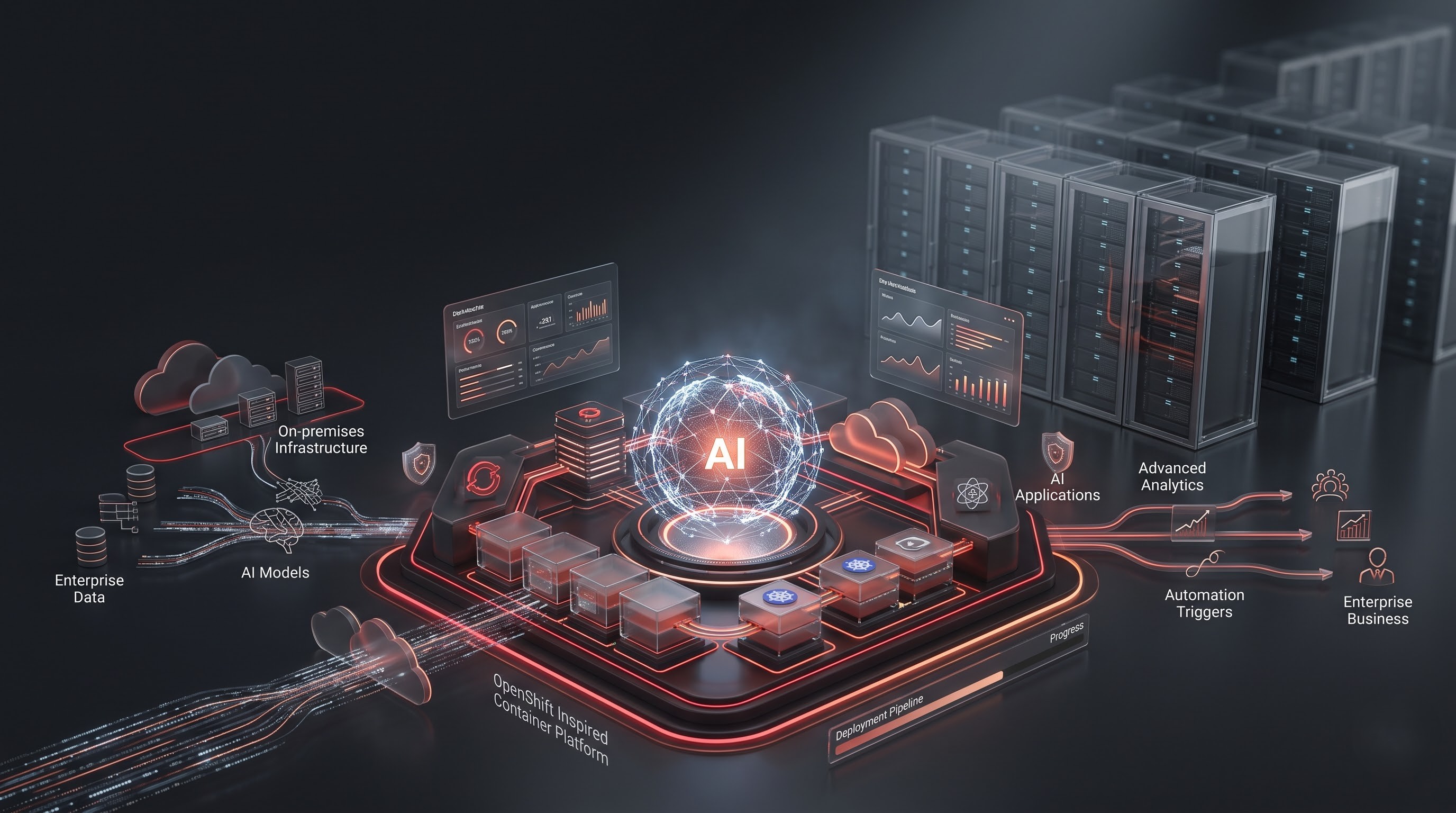
Artificial intelligence has changed the way businesses think about technology infrastructure. A few years ago, most conversations around AI were focused on models, datasets, and experimentation. Today, the conversation has moved somewhere much more practical:
How do we actually run AI inside a real enterprise?
That question is harder than it sounds.
A production AI application needs much more than a powerful model. It needs computing resources, GPUs, storage, networking, security, monitoring, application integration, scalability, and a reliable deployment process. It also needs to work with the systems a company already has instead of forcing the organization to rebuild everything from scratch.
This is where OpenShift is attracting attention.
OpenShift has traditionally been associated with Kubernetes, containers, application modernization, and hybrid cloud. But its role is becoming broader as organizations start bringing artificial intelligence into their everyday operations. With capabilities around AI/ML workloads, model serving, GPUs, virtualization, automation, and hybrid-cloud deployment, OpenShift is increasingly becoming part of the discussion about enterprise AI infrastructure.
But does that make OpenShift the new home for enterprise AI?
Not necessarily for every organization or every workload. The more interesting question is whether OpenShift can become a common enterprise platform where AI applications can coexist with traditional applications, containers, virtual machines, and other business-critical workloads.
That possibility is what makes OpenShift worth watching.
Enterprise AI Needs More Than Just a Great Model
The excitement around AI often starts with the model.
Which large language model is better? Which model produces more accurate answers? Should a company build its own model or use an existing one? How quickly can generative AI create useful content?
These are important questions, but they represent only the visible part of an enterprise AI project. Once an AI application moves beyond a demonstration and starts serving real users, infrastructure becomes a major concern.
Imagine a company building an internal AI assistant for its employees. During the development stage, perhaps only ten people are testing it. The application works well, the responses are quick, and everyone is impressed.
Now imagine that 20,000 employees start using it.
The situation changes immediately.
The company needs to think about traffic, response times, availability, authentication, data protection, resource consumption, monitoring, and failure recovery. If the AI model requires GPUs, the company also needs to understand how those expensive resources are being allocated.
This is where Kubernetes-based platforms become important.
OpenShift provides an enterprise application platform built around Kubernetes, allowing organizations to deploy and manage containerized applications while integrating enterprise capabilities around security, networking, storage, operations, and application lifecycle management.
Understanding OpenShift becomes far more valuable when you can apply its concepts to real deployment and application-management scenarios. For professionals who want to move beyond the basics and gain practical exposure, openshift training offers a structured path to building relevant cloud-native skills.
What changes when AI enters production?
A production AI system may need to handle:
High-volume inference requests
GPU or other accelerator resources
Model versioning
Data and application security
Monitoring and observability
Automated deployment
Scaling based on demand
Integration with existing applications
Cost and resource management
The model itself is only one component.
Consider a retail company using AI to generate product descriptions. The AI model may be responsible for creating the text, but the complete system could also include a product database, an API layer, authentication, content review, analytics, and a publishing workflow.
The AI is part of the application architecture.
That is a significant change in how businesses should think about artificial intelligence.
Instead of treating AI as an isolated experiment, organizations increasingly need to treat it like any other enterprise workload — one that must be deployed, secured, monitored, updated, and maintained.
This is one reason OpenShift is becoming relevant to the AI conversation.
It can provide a common platform where AI services can sit alongside the applications they interact with. Rather than creating an entirely separate infrastructure environment for every AI initiative, enterprises can build AI capabilities into an environment they already understand.
There is another factor that makes this particularly useful: hybrid cloud.
Many enterprises are not operating entirely in one public cloud. They may have applications in their own data centers, workloads running in public clouds, and systems distributed across different environments.
AI adds another layer to that complexity. Some workloads may need to stay closer to sensitive enterprise data. Others may require specialized cloud infrastructure. Some applications may need lower latency because they are being used in real time.
A platform that can support applications across different environments therefore becomes increasingly valuable.
This does not mean OpenShift is automatically the right answer for every AI project. An organization might choose managed cloud AI services, specialized infrastructure, or another platform depending on its requirements.
But OpenShift offers something that is particularly attractive to large organizations: the possibility of bringing AI into the same broader platform strategy as the rest of the enterprise.
And that leads to the next question — what happens when OpenShift is combined with dedicated AI capabilities?
OpenShift AI: From Experimentation to Production
Building an AI model is only the beginning.
A data scientist might train a model successfully in an experimental environment, but the business still has to answer several questions.
Where will the model run?
How will applications access it?
How will it scale?
How will the team monitor it?
How will a new model version be deployed?
What happens when demand suddenly increases?
These questions are where the gap between AI experimentation and enterprise AI becomes obvious.
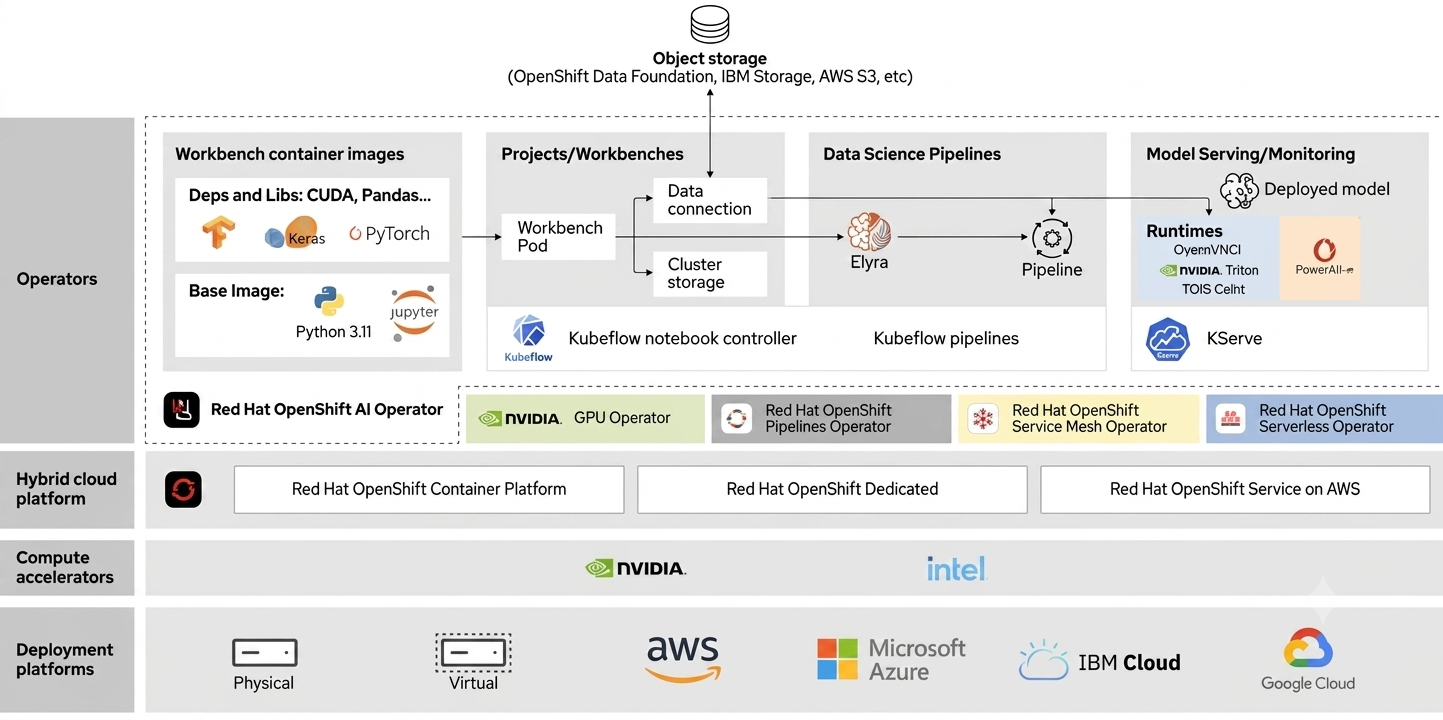
Red Hat OpenShift AI is designed around the broader machine-learning and AI lifecycle. Its capabilities cover areas such as model development, training, serving, testing, and monitoring across supported hybrid-cloud environments.
This makes the OpenShift ecosystem particularly interesting for organizations that want to move AI projects beyond individual data-science experiments.
A useful way to understand the idea is to think about the AI lifecycle as a journey:
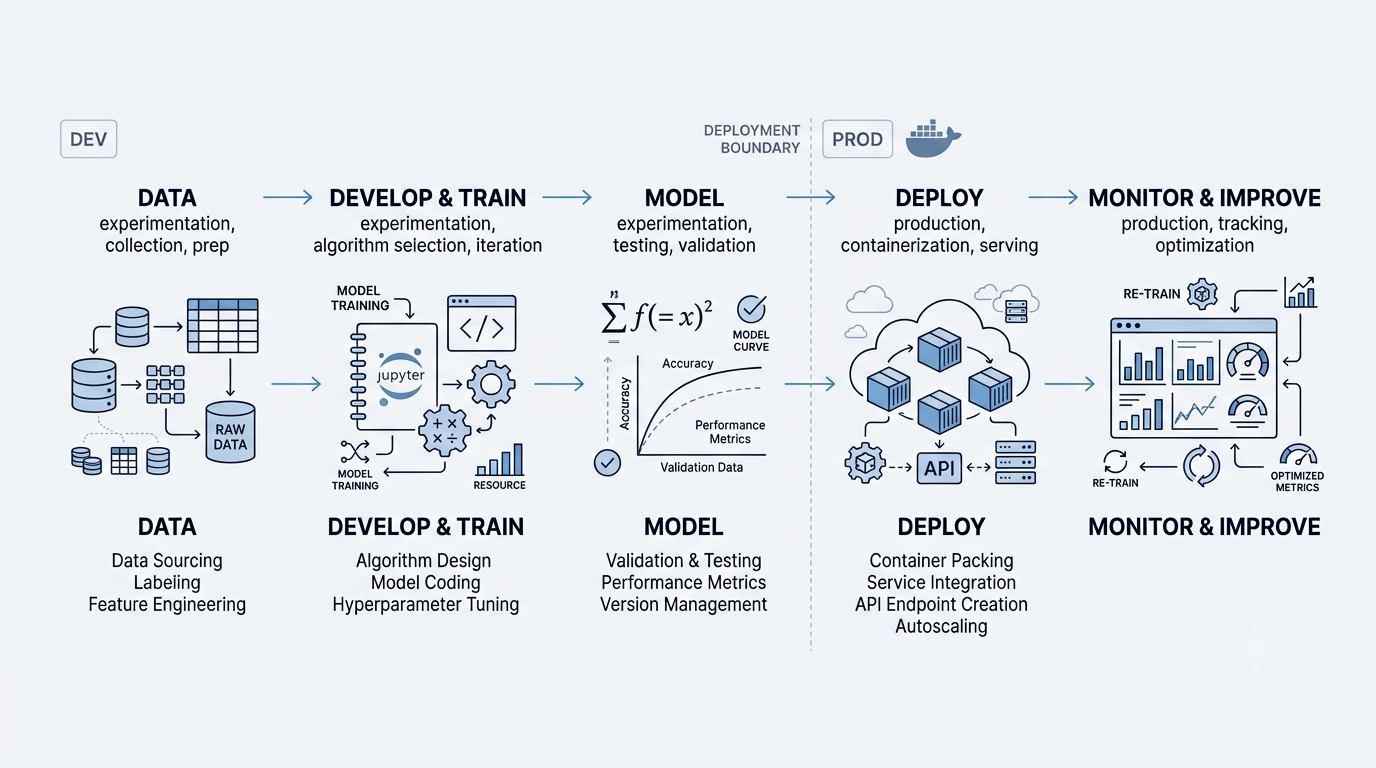
Each stage has different requirements.
A data scientist may spend most of their time developing and training a model. A platform engineer may be more concerned with the infrastructure required to deploy it. Developers may need an API through which their applications can communicate with the model.
OpenShift AI helps bring these activities into a more structured environment.
Why model serving matters
Training a model does not automatically make it useful.
Suppose a company develops a customer-support model capable of summarizing conversations. The model needs to be available to the company's customer-support application.
That means the model needs to become a service.
The application sends a request.
The model processes the request.
The response is returned to the application.
This is model serving, and it is one of the most important steps in turning AI research into an actual product.
OpenShift AI supports model-serving capabilities for AI/ML workloads, including approaches designed for modern generative AI and large-language-model workloads.
That opens the door to architectures where AI models behave much like other services within an enterprise application environment.
For example, a company could have:
A customer application
An authentication service
A business database
A document-processing service
An AI model-serving service
The AI does not need to replace the existing application. It becomes another intelligent component within it.
GPUs change the infrastructure equation
Modern AI also creates a different infrastructure challenge because many workloads benefit from specialized accelerators.
GPUs can dramatically improve performance for certain AI workloads, but they are expensive resources. An organization therefore needs to think carefully about how those resources are allocated and used.
OpenShift AI supports accelerator-based AI workloads, including support for GPU environments and model-serving technologies.
This is important because AI infrastructure cannot simply be treated like ordinary application infrastructure.
A normal web application might require additional CPU resources when traffic increases. An AI inference service may require access to a specific GPU configuration.That difference creates new requirements for infrastructure teams.
As these infrastructure requirements become more specialized, understanding how the different layers work together becomes increasingly important for developers, DevOps teams, and infrastructure professionals. A structured open shift training online path can help learners connect Kubernetes fundamentals with OpenShift, containers, AI workloads, networking, storage, and resource management—giving them a more practical view of how modern AI environments are built and operated.
The enterprise AI conversation is therefore becoming less about "Which AI model should we use?" and more about "How do we build a reliable environment around that model?"
That is a much bigger infrastructure challenge.
Why OpenShift Is More Than Kubernetes for Enterprise AI
OpenShift is built on Kubernetes, so a natural question is:
Why not simply use Kubernetes?
It is a fair question.
Kubernetes provides the core orchestration capabilities required to deploy and manage containerized workloads. It has become one of the most important technologies in modern cloud-native infrastructure.
But enterprise environments usually require more than the basic orchestration layer.
Companies also need security controls, identity management, networking, storage, monitoring, developer workflows, automation, governance, lifecycle management, and operational consistency
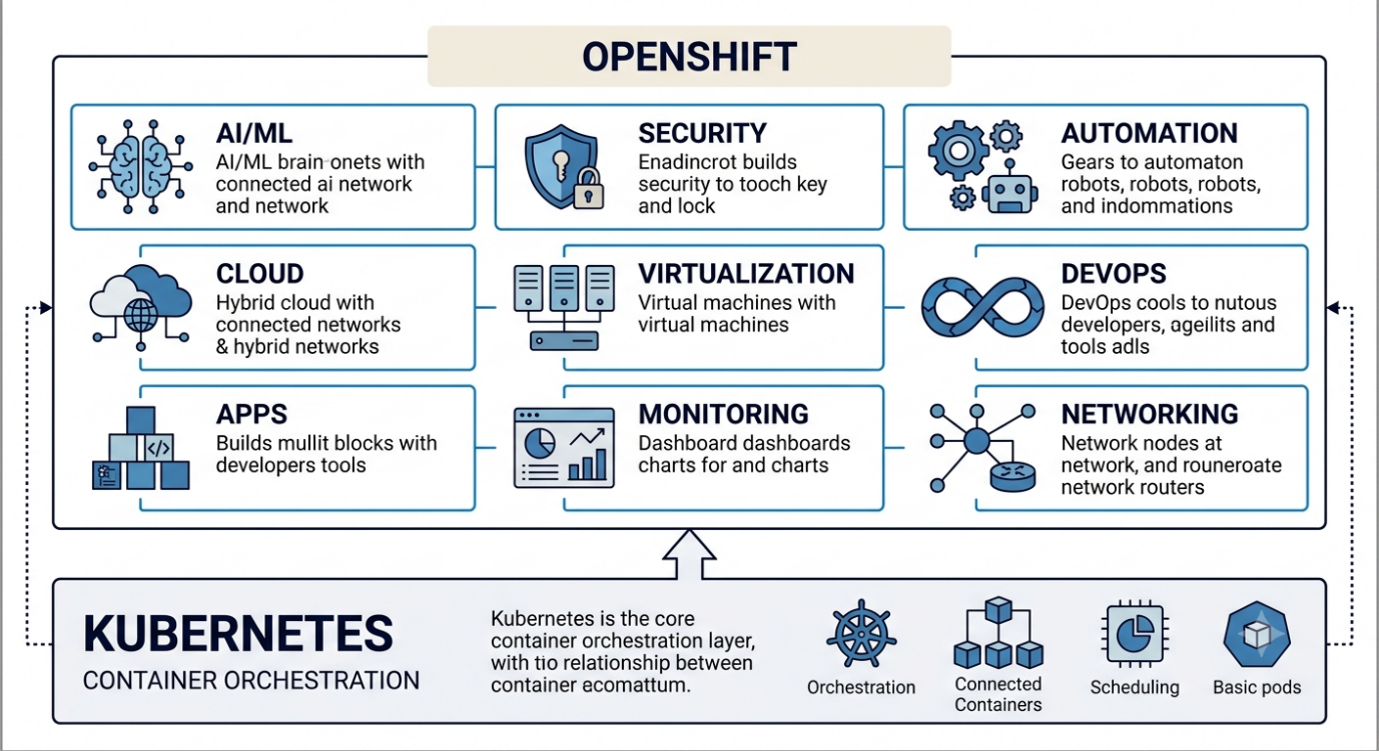
When AI enters the picture, those requirements become even more important.
Imagine an enterprise with hundreds of applications.
Some are modern microservices.
Some are older applications.
Some run inside virtual machines.
Some are containers.
Some now use AI services.
The company does not necessarily want five completely separate infrastructure strategies.
It wants consistency.
This is one of the stronger arguments for OpenShift.
AI does not exist in isolation
An AI assistant may need to communicate with:
Internal databases
Customer-management systems
Authentication services
Document repositories
APIs
Monitoring platforms
Existing business applications
If the AI environment is completely disconnected from the rest of the enterprise, integration becomes difficult.
A platform approach can reduce some of that complexity.
OpenShift allows organizations to manage application workloads using a common Kubernetes-based foundation while adding enterprise-oriented capabilities around them.
This is particularly relevant for security.
An enterprise AI application may process sensitive customer information, internal documents, financial information, or proprietary business data. Security therefore cannot be added as an afterthought.
Organizations need to think about who can access an AI service, what data it can access, where the workload runs, how its activity is monitored, and what happens if something goes wrong.
AI also creates new questions around governance.
For example, if an AI agent can call internal APIs, should it have unrestricted access?
Probably not.
The organization may want to give it only the permissions it needs to perform a particular task. That brings identity, authorization, auditing, and security into the AI architecture.
This is where enterprise platform engineering becomes increasingly important.
The rise of the internal AI platform
Instead of asking every development team to independently build its AI infrastructure, an enterprise platform team can create standardized environments.
A developer could receive:
A ready-to-use development environment
Access to approved models
Standard security policies
Deployment templates
Monitoring capabilities
Predefined infrastructure configurations
The developer can then focus on building the application rather than reinventing the infrastructure.
This idea is closely connected to platform engineering.
and it changes the role of OpenShift professionals.
As OpenShift becomes increasingly connected with DevOps, cloud, and platform
engineering, learning the platform in a broader context can open up more career possibilities.
An openshift course can provide the practical foundation needed to build those skills and move beyond traditional container administration.
That combination is becoming more valuable because enterprises are looking for people who can understand both the application and infrastructure sides of modern technology.
There is also another reason the OpenShift story is becoming interesting: virtualization Enterprises are not going to abandon their existing virtual machines overnight. Many critical applications still depend on them.
OpenShift Virtualization allows organizations to run virtual-machine workloads alongside container workloads within an OpenShift environment. That creates an interesting bridge between traditional infrastructure and cloud-native infrastructure.
And AI is now entering that picture as well.
The future enterprise environment may therefore look less like:
VMs → Containers → AI
and more like:
VMs + Containers + AI + Automation + Hybrid Cloud
all operating as parts of one larger infrastructure strategy.
That is a much more realistic picture of enterprise modernization.
OpenShift, AI Infrastructure and the New Role of Platform Engineers
The next phase of enterprise AI will not be determined only by better models.
It will also depend on infrastructure.
This is already becoming visible through the increasing importance of GPUs, model serving, workload scheduling, observability, security, and cost optimization.
AI infrastructure is different from traditional application infrastructure because the resource requirements can be much more demanding.
A large model may require significant memory and accelerator resources. Inference workloads may experience sudden changes in demand. Some applications need low latency, while others can tolerate slower processing.
That means infrastructure teams need to understand the behavior of AI workloads.
The GPU problem
GPUs are powerful, but they are not unlimited.
If an organization purchases expensive GPU infrastructure and uses only a fraction of its capacity, the business is wasting money.
On the other hand, if resources are over-allocated or poorly configured, applications may experience performance problems.
This creates a balancing act:
Performance vs. Cost vs. Availability vs. Resource Utilization
The infrastructure platform therefore needs to make it easier to manage these resources.
This is one area where OpenShift's AI and Kubernetes ecosystem becomes interesting. Organizations can approach AI workloads using familiar platform concepts while managing the specialized resources required by modern AI applications.
The challenge becomes even more complicated with generative AI.
A traditional machine-learning model might perform a relatively focused task such as classification or prediction.
A generative AI application may involve a large language model, retrieval systems, vector databases, APIs, authentication, monitoring, and multiple application services.
An AI agent can make the architecture more complicated still.
An agent may need to:
Understand a user's request
Retrieve information
Decide what action to take
Call an external or internal tool
Interact with another application
Return a result
That is not simply a model.
It is an application, and applications need infrastructure.
This is why the future of enterprise AI may increasingly depend on professionals who understand the intersection of AI and platform engineering.
Someone working in this area needs to understand more than just machine learning. They may need knowledge of containers, Kubernetes, Linux, networking, APIs, security, automation, observability, and cloud infrastructure.
As AI and cloud infrastructure increasingly converge, building expertise across both areas can create valuable opportunities for technology professionals. Redhat openshift training can provide a practical starting point for developing the OpenShift, Kubernetes, and infrastructure skills needed to work with modern enterprise environments.
A modern AI platform might include:
Kubernetes and containers for application orchestration
OpenShift for the enterprise platform layer
OpenShift AI for AI/ML workflows
GPUs or other accelerators for compute-intensive workloads
APIs for application integration
Observability for monitoring
Security controls for identity and access
Automation for deployment and operations
Hybrid-cloud infrastructure for workload flexibility
None of these technologies solves enterprise AI by itself.
The value comes from how they work together.
And that is exactly where the role of the platform engineer is changing.
The platform engineer is increasingly becoming the person who builds the environment in which developers, data scientists, and AI teams can work efficiently.
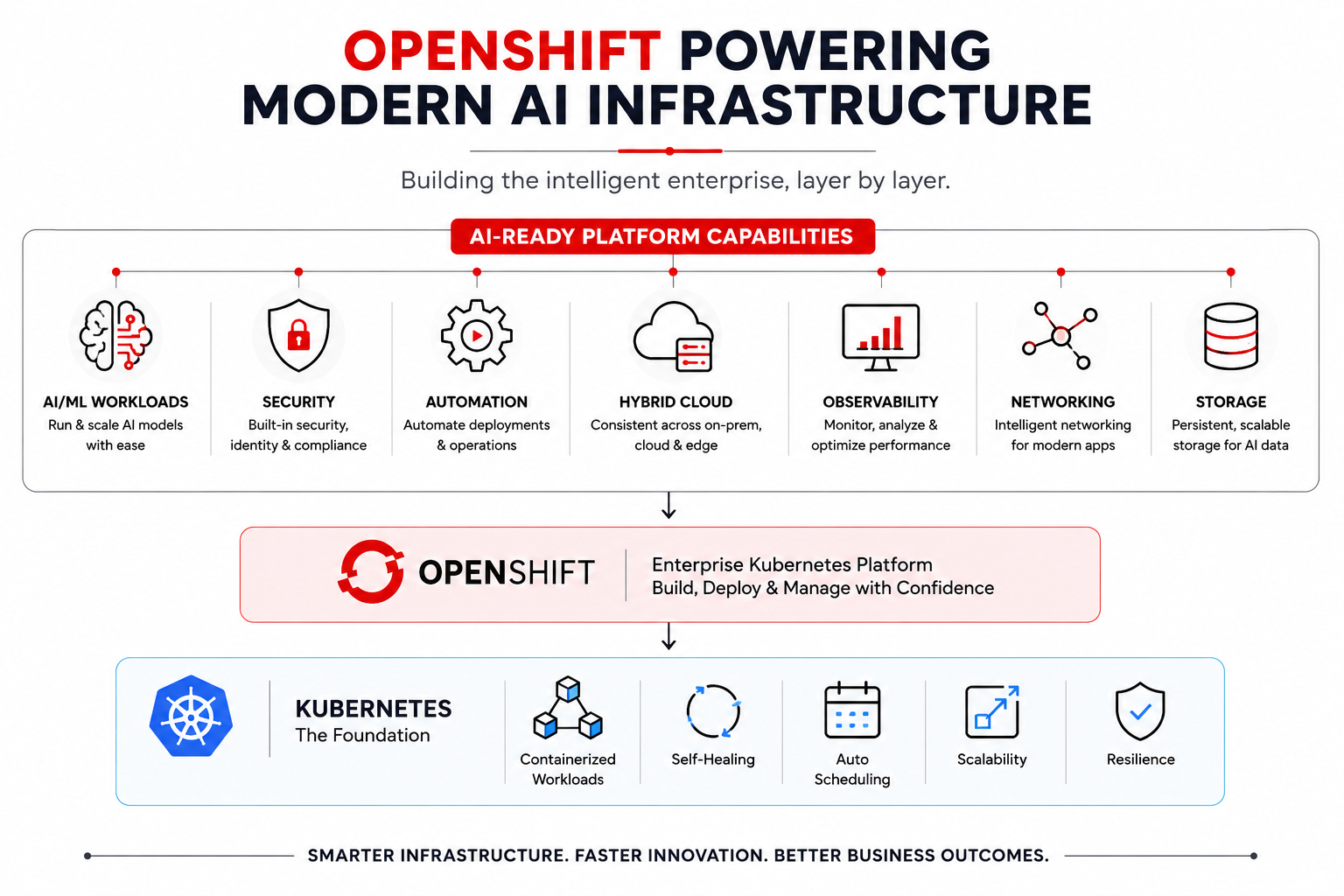
Enterprise infrastructure is moving toward Standard platforms that reduce manual effort and abstract away unnecessary complexity. Platform teams create reusable deployment paths for developers, integrate security controls directly into the delivery process, and use automation to manage repetitive operational tasks. The result is an environment where applications can be delivered more consistently without requiring developers to manage every layer of the underlying infrastructure.
This is becoming a defining direction for modern enterprise infrastructure, and the rapid adoption of AI is accelerating that transformation.
So, Is OpenShift Really the New Home for Enterprise AI?
Organizations have different requirements. Some may already have strong cloud-native environments. Others may prefer managed AI services. Some workloads may be better suited to specialized infrastructure.
Technology decisions should always be based on the workload rather than the popularity of a platform.
But if "home" means a common enterprise platform capable of bringing AI together with applications, containers, virtual machines, security, automation, and hybrid-cloud operations, then OpenShift has a compelling position.
That distinction is important.
The future of enterprise AI is unlikely to be just about models.
It will be about everything surrounding those models.
A company might have an excellent AI model, but if it cannot deploy the model reliably, secure the data, manage the infrastructure, monitor performance, control costs, or integrate the AI with existing applications, the model alone has limited business value.
That is where platforms become important.
OpenShift's current direction reflects this broader shift. Recent releases and Red Hat's wider platform strategy increasingly connect application modernization, virtualization, hybrid cloud, automation, security, and AI workloads.
The significance is not that OpenShift suddenly became an "AI platform" overnight.
The significance is that AI is becoming part of the enterprise application platform conversation.
That is a much more meaningful development.
Think about a large organization five years from now.
It may have traditional applications running in virtual machines. It may have hundreds of containerized services. It may use multiple AI models. It may have AI agents communicating with internal systems. It may have workloads distributed between its data centers and multiple cloud environments.
Managing that environment will not be simple.
Companies will need platforms that can provide consistency without preventing teams from using different technologies.
That is where OpenShift can potentially play a major role.