
Managing Multi-Cluster Environments with Red Hat OpenShift
Last updated on Nov 10, 2026
Introduction to Multi-Cluster Strategies for Modern Enterprise Architecture
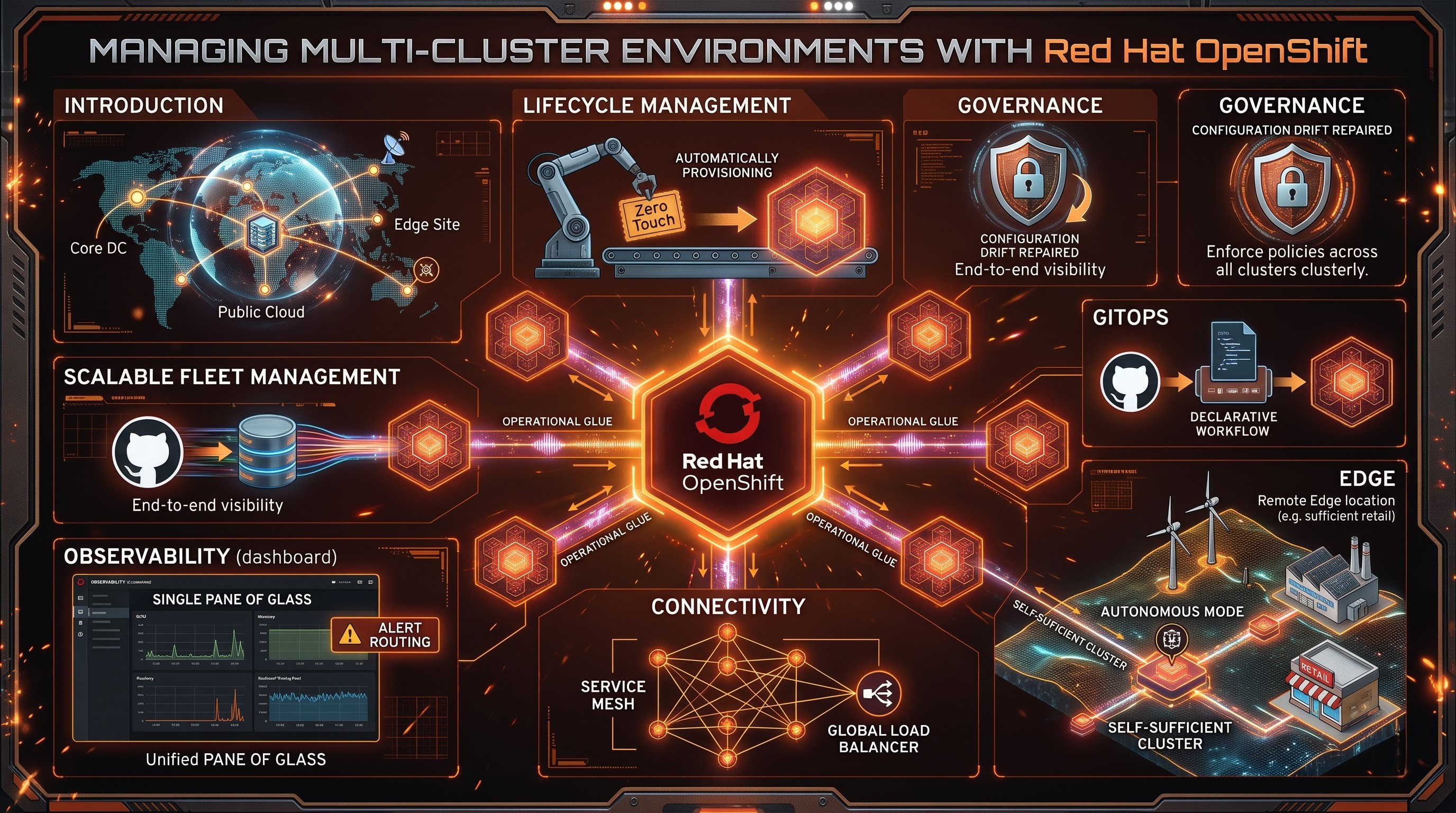
Over the last decade, enterprise IT has completely transformed from monolithic data centers to distributed, agile and cloud-native computing models. As organisations run more and more of their workloads on containers, a single Kubernetes cluster is often not enough. Today’s enterprises are often driven to multi-cluster architectures by stringent data residency regulations, disaster recovery requirements, geographic proximity to end-users, isolation between business units, and the blast-radius limitations of large-scale infrastructure.
Red Hat OpenShift has become the industry’s leading enterprise Kubernetes platform for these complicated topology requirements. But building a good container platform is the start. But operating a fleet of clusters on bare metal, in private datacenters, public clouds and at the edge is a big operational challenge. The lack of centralised control quickly leads to configuration drift, security exposures, distributed monitoring and complex deployment pipelines for organisations. Red Hat OpenShift multi-cluster management is the operational glue that provides platform engineering teams consistent governance, visibility and automation across heterogeneous infrastructures.
Drivers and barriers of multi-cluster adoption
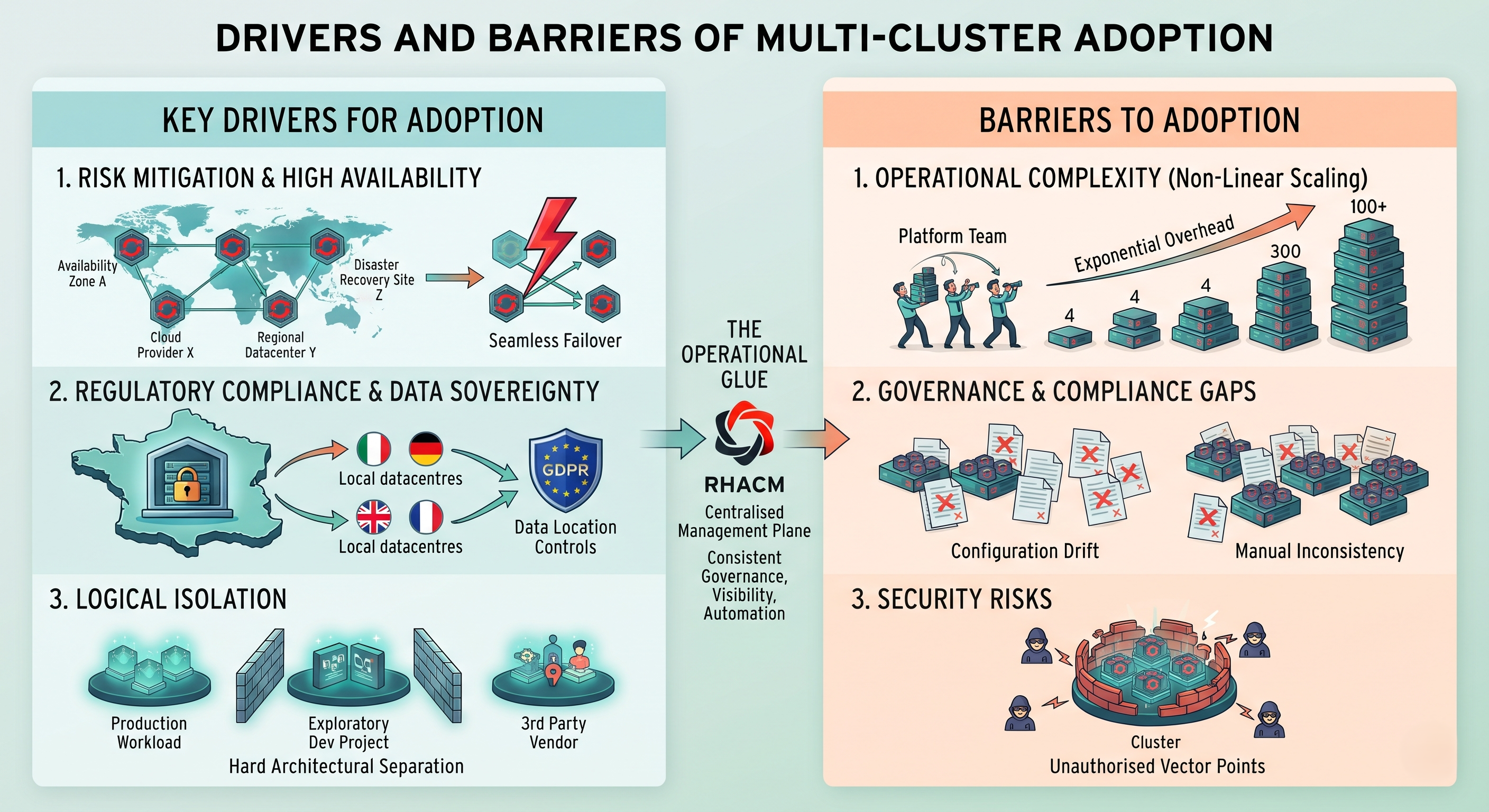
There are many good operational, financial and regulatory reasons for organisations to use multi-cluster environments. And risk mitigation and high availability are at the top of the list. An enterprise distributes workloads across multiple independent clusters in multiple availability zones, cloud providers or geographic regions. This way, a local outage – failure of physical infrastructure, a misconfiguration, or a regional network disruption – doesn’t take the application down entirely.
Another key driver is regulatory compliance and data sovereignty. Regulations such as the General Data Protection Regulation (GDPR) and local laws on financial data protection stipulate that specific user data must remain within a specified geographical boundary. You can provision OpenShift clusters in your country or regional datacentre of choice so that workloads process and store data locally within compliant boundaries and avoid cross-border data transfer violations.
Multi-cluster architectures also enable organisations to maintain strict logical separation. Running mission critical production workloads, exploratory development projects or 3rd party vendor integrations in a multi-tenant capacity in a single cluster sometimes poses security boundaries or resource contention risks. Dedicated clusters provide hard architectural walls that separate resource consumption, network traffic and security contexts.
These are strategic benefits but running a multi-cluster fleet is a lot of overhead. The number of clusters is related to the operational complexity in a non-linear way. Platform teams should be able to deal with lifecycle updates, health metrics, security patch syncs and application delivery without linearly scaling their operations headcount. This reality demands a centralised management plane that treats infrastructure as a single fleet, not a series of separate silos.
Multi-Cluster Management – Architectural Overview
The first step to successful multi-cluster management is to establish a clear topological hierarchy. An organization typically has one main control center, called a hub cluster, that controls and monitors several satellite endpoints, called managed clusters. This architecture is built around Red Hat Advanced Cluster Management (RHACM) for Kubernetes to offer the unified control plane for managing a fleet of distributed clusters.
The hub cluster is the business ecosystem’s admin brain. It provides the controllers, databases and user interfaces to manage the whole cluster lifecycle. The central console provides administrators the ability to provision new clusters on different underlying infrastructures, bring existing clusters from anywhere and enforce policies globally. Managed clusters, however, run the workload applications and send telemetry, compliance status and health metrics back to the hub over secure, bidirectional communication channels.
The hub must securely communicate with the managed clusters. Managed clusters can be behind corporate firewalls, in air gapped data centers, or in disparate public cloud virtual private clouds (VPCs) and therefore a resilient and safe communication protocol is a must. Encrypted, authenticated control signals are provided by mutual TLS (mTLS) encryption and agent-based operators running on each managed cluster, disabling unauthorised vectors of intrusion.
Cluster Lifecycle Management & Scale-Provisioning
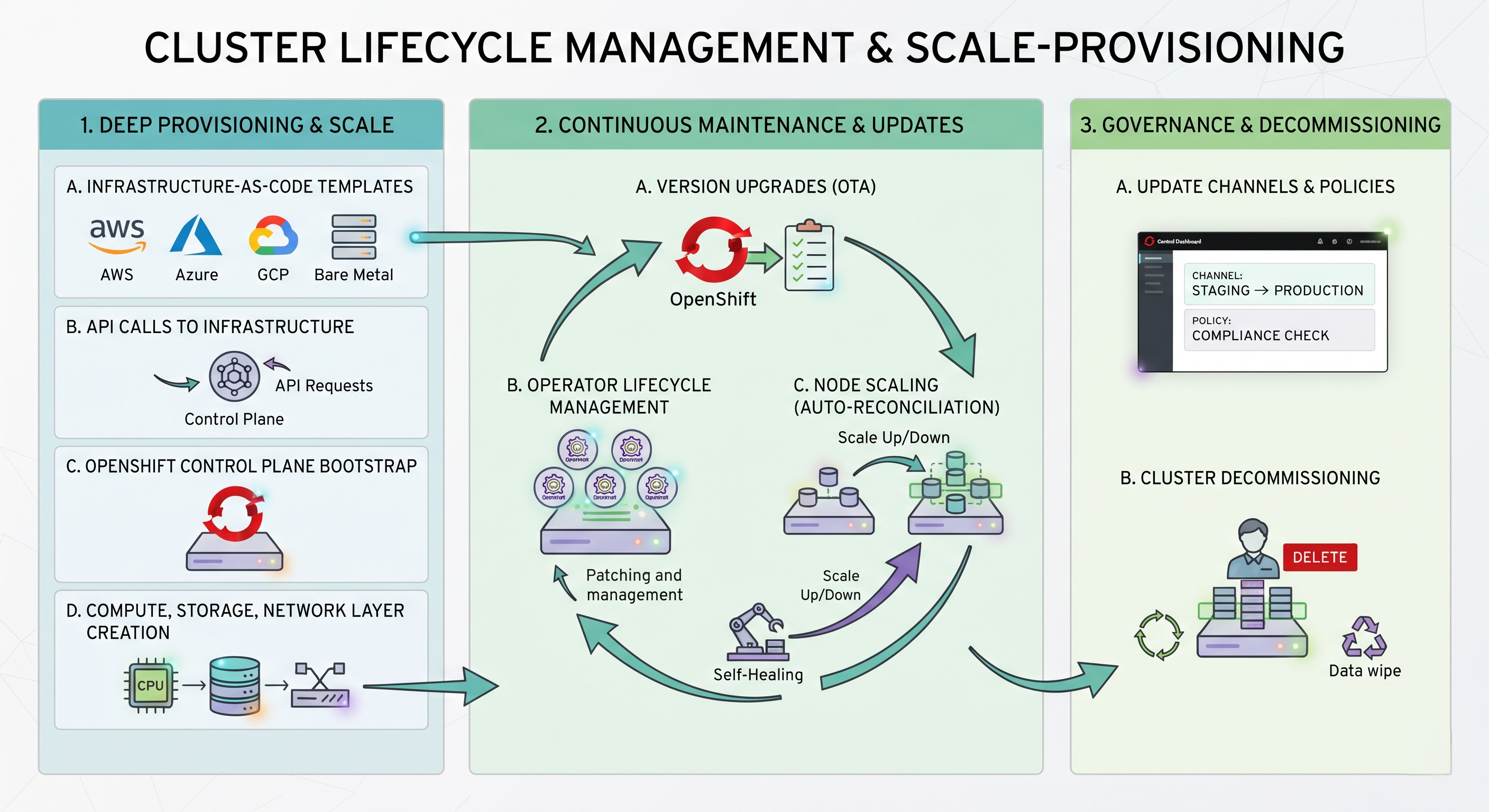
In the past, to build and run enterprise clusters of Kubernetes you had to write manual bootstrap scripts, complex infrastructure-as-code templates and spend a lot of time tweaking configurations. However, this manual approach does not scale with a multi-cluster setup. The OpenShift ecosystem tools centralise management, making the cluster lifecycle easy from birth to decommissioning.
Declarative templates allow administrators to consistently provision new clusters across multiple cloud providers and bare-metal environments. OpenShift can be deployed on AWS, Microsoft Azure, Google Cloud Platform or enterprise hypervisors, where the provisioning engine will directly call infrastructure APIs to spin up the compute, storage and networking layers and then bootstrap the OpenShift control plane.
Once the cluster is up and running the lifecycle moves to continuous maintenance work like version upgrade, scaling of nodes etc. OpenShift manages Over-The-Air (OTA) updates with smart operator lifecycles. In a multi-cluster environment you can group update policies into channels. Platform engineers can deploy to non-production clusters to test application compatibility before rolling out updates to mission-critical production clusters. If a cluster is not in the desired state, or a node becomes degraded, automated reconciliation loops either invoke self-healing protocols or notify administrative personnel.
Due to the need for special expertise in operator lifecycle management as well as automated reconciliation loops, engineers stand to gain tremendously from having proper open shift training regarding cluster management and scaling.
Multi-Cluster Application Delivery with GitOps
We need to move from imperative deployment scripts to declarative, GitOps driven workflows so that we can reliably deploy applications across a heterogeneous fleet of clusters. GitOps uses Git repositories as the single source of truth for the desired state of systems. All the application manifests, configurations and infrastructure setups are version controlled, auditable and can be easily rolled back.
Red Hat OpenShift GitOps is based on Argo CD and natively fits into multi-cluster management architectures. Definitions of application deployments are stored in a central or distributed Git repository in the model. When a developer pushes code changes or config updates, the GitOps engine sees the change and synchronises the target clusters to match the desired state declared in Git.
In a multi-cluster environment, rules are critical for application placement. Enterprises might want to deploy certain applications to certain clusters at certain geographic locations, or distribute workload dynamically based on available cluster capacity. With advanced placement policies, the administrator can decide where an application workload is placed, using cluster labels, environmental tags, or geographical location. If a managed cluster goes down or is running slow, application workloads can be automatically rescheduled on a healthy cluster elsewhere in the fleet, ensuring uninterrupted availability of services and continuous business operations.
Governance, Risk and Compliance (GRC)
The more clusters you have, the more difficult it is to consistently enforce security and regulatory compliance and it grows exponentially. Manual security audits and ad-hoc configuration fixes lead to human error and security blind spots. This is where multi-cluster management systems come in, letting you separate the definition of security policy from its enforcement in each cluster.
Security engineers can declare compliance policies in a declarative manner, stating desired configurations, security constraints and operational standards. Policies are written at the hub-cluster level and then propagated to the fleet’s managed clusters. For example, a policy may enforce that certain Role Based Access Control (RBAC) rules are enforced, or that all persistent storage volumes are encrypted at rest, or that certain network policies deny unauthorised east-west traffic flows.
The system is always checking for compliance and if a user or automated process attempts to modify a cluster configuration in a way that would violate security baselines, it automatically remediates the configuration to the compliant state, or fires an urgent security alert to catch drift. Security teams can have real-time dashboards of the security posture of each cluster across the enterprise by embedding compliance operators and vulnerability scanning tools directly in the multi-cluster management plane.
Centralised Telemetry & Observability
Without centralised observability, managing a multi-cluster environment is like flying an aeroplane in thick fog without instruments. In a hybrid cloud setup where applications are running across multiple clusters, you want one telemetry pipeline to monitor performance bottlenecks, discover latency issues and error logs.
Centralised observability sends metrics, logs and traces from all managed clusters to a centralised analytics engine. Each cluster has a prometheus based monitoring stack and key performance indicators are sent to the hub. Advanced Dashboards provide a single pane of glass for metrics. Platform operators can see CPU usage, memory pressure, network throughput and storage usage across the entire enterprise fleet from a single pane of glass.
The alerting mechanisms are also centralised. Rather than notification fatigue from multiple clusters firing off duplicate or fragmented alerts, a multi-cluster management platform de-duplicates, groups and routes alerts by severity and ownership. Integration with enterprise incident management systems helps direct alerts to the appropriate on-call engineering teams and helps reduce mean time to detection (MTTD) and mean time to resolution (MTTR) for incidents with mission-critical infrastructure.
Network Topologies and Inter-Cluster Connectivity
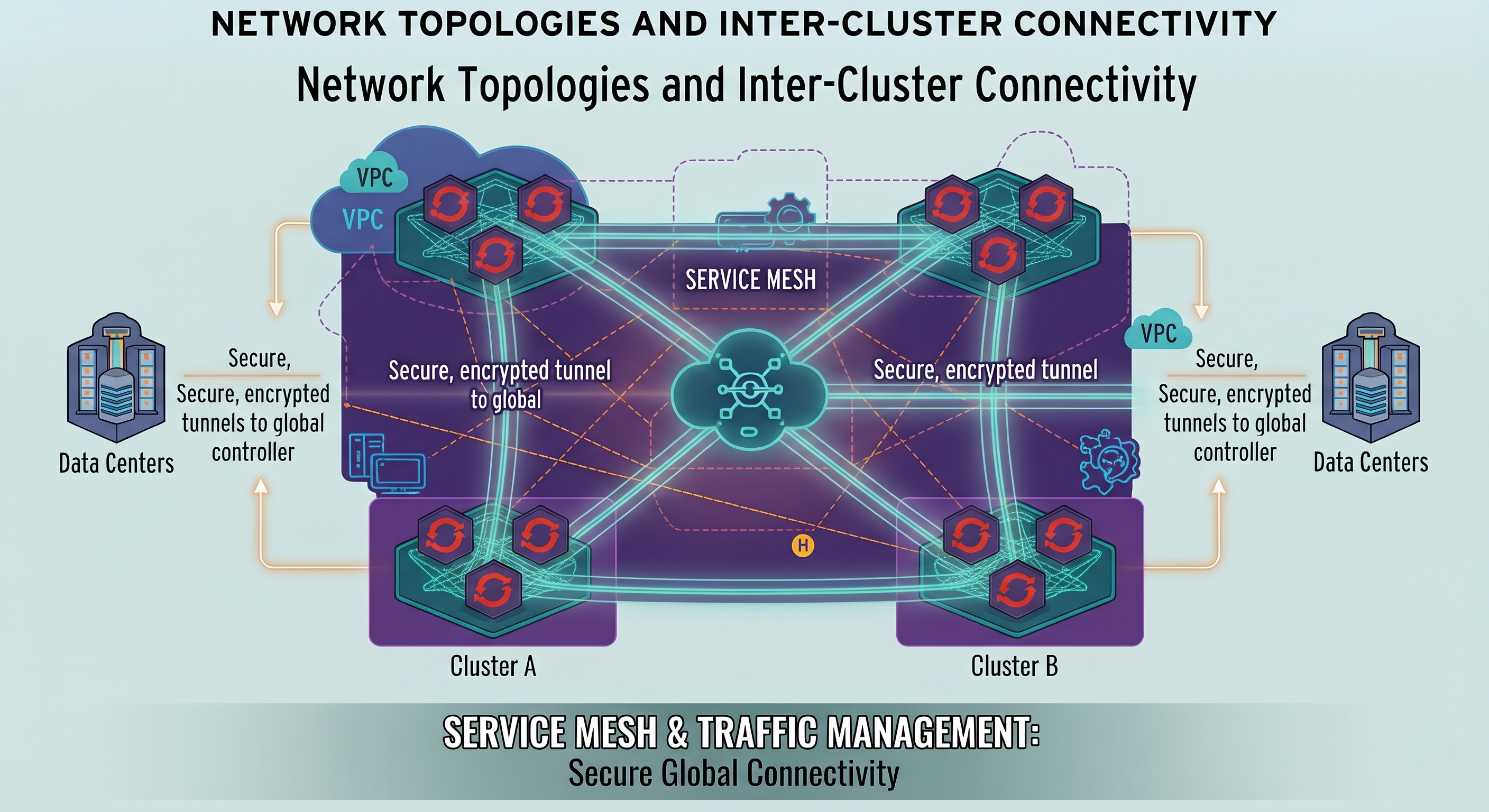
Networking in a multi cluster environment poses its own set of challenges, especially when it involves service discovery and communication across cluster boundaries. Traditional Kubernetes networking is built on a flat network inside a cluster. Network segmentation, different virtual private clouds and different IP address allocations all come with multi-cluster environments.
Enterprise OpenShift architectures address these gaps with some of the most advanced multi-cluster networking techniques including sophisticated service mesh implementations. Multi-cluster service mesh enables service-to-service communication, traffic management and observability across clusters. This allows microservices running on Cluster A to discover and connect securely to microservices on Cluster B as if they were on the same local network, hiding the complexity of the underlying networks.
We also need global orchestration of traffic management of ingress and egress traffic. Global Load Balancing Global load balancing mechanisms direct incoming user requests to the closest or healthiest OpenShift cluster, to maximise user satisfaction and provide seamless failover during regional outages. The network policies are strict across the fleet to ensure tight control over lateral movement between clusters to protect sensitive internal data flows from unapproved access.
Decentralisation Edge Computing & Fleet Management
Large-scale OpenShift clusters run in traditional data centers and public clouds, but today’s enterprise needs are driving to the extreme edge – retail stores, manufacturing plants, telecommunications towers and remote field locations. Edge environments typically suffer from a lack of on-site technical personnel, intermittent network connectivity, and resource constrained hardware.
Managing multi-cluster environments at the edge requires zero touch provisioning (ZTP) and robust capabilities for operating in a disconnected state. Central management tools can predefine cluster images and deployment blueprints for platform teams. When edge hardware is powered on at a remote location, it automatically connects to the central management plane, pulls its configuration, provisions itself, and reports ready without any physical intervention locally.
Also Edge clusters must support standalone mode in case of network unavailability. If the central hub is offline, workloads must continue to run locally and telemetry must be cached locally until the network is back online. Multi-cluster management platforms can operate these intermittent network problems without a snag, offering high whack and resilience even in the most remote operating surroundings.
Organisational Alignment and Best Practice – Operational
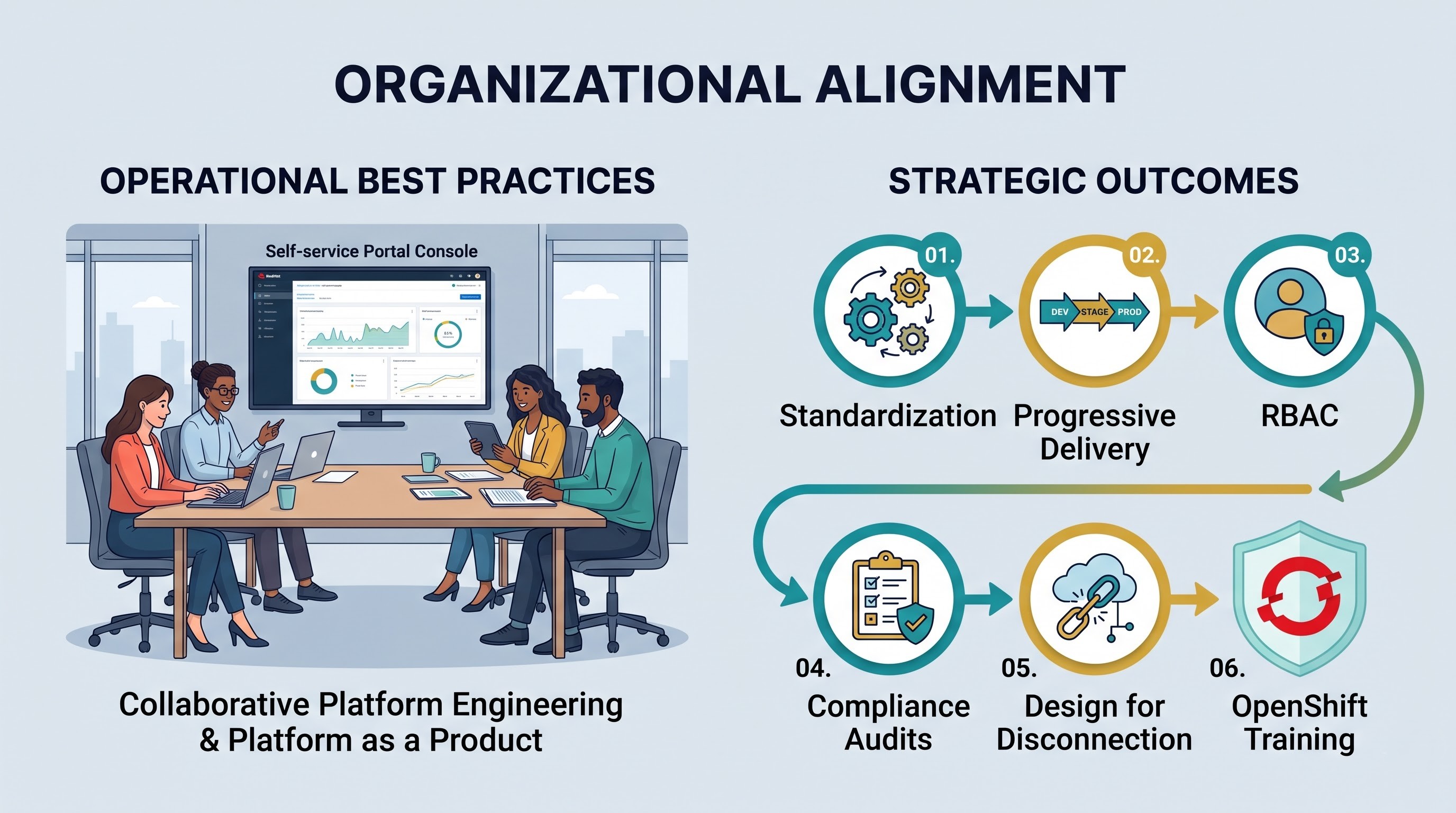
But successful execution of a multi-cluster OpenShift strategy requires more than just the right technical tooling; it involves careful organisational alignment and the adoption of operational best practices. Platform engineering teams should think of themselves as product teams with internal developers as their customers, and deliver self-service capabilities that abstract the complexity of the underlying infrastructure.
The following strategies can be implemented effectively by teams that have extensive hands-on knowledge about enterprise orchestration systems. People who wish to learn about such skills usually sign up for openshift training.
Best Practices to Remember:
Standardise Cluster Baselines Declarative templates and GitOps to enforce a baseline configuration across all clusters to reduce configuration shift.
Use Progressive Delivery. Automate release channels to slowly promote applications from dev to staging to production across regions.
RBAC should be applied on the multi-cluster management plane where developers are granted access to relevant namespaces and clusters using least privilege access control.
Automated Compliance Audits Continuous analysis of cluster configurations is carried out in order to meet the security requirements of the industry and organizational compliance policy.
Design for Disconnection: Enhance resilience in edge and multi-cloud architectures by allowing clusters to operate autonomously during temporary network disruptions.
Conclusions
Containerisation and hybrid cloud architectures are the building blocks of modern enterprise agility. As organizations’ digital footprint expands to meet the needs of a global customer base, a single Kubernetes cluster is no longer a practical boundary for modern workloads. Today’s enterprises operate in heterogeneous environments—from on-premises core data centers, to multiple public cloud providers, to the far-flung nodes of edge computing environments. Red Hat OpenShift’s approach to multi-cluster orchestration transforms a complex, distributed reality that was once an overwhelming operational burden into a scalable, secure and highly automated enterprise capability.
The key to this change is the move from manual imperative cluster management to centralised declarative management. A strong container platform with unified management engines allows platform engineering teams to manage a large fleet of clusters as a single unified ecosystem and not a collection of isolated silos. The centralised command layer simplifies the entire enterprise infrastructure lifecycle from zero touch provisioning and automated over-the-air updates to fine-grained security audit and compliance enforcement. Instead of dealing with configuration drift and security blind spots in a variety of different environments, admins can set desired states once and push them securely to the entire fleet.
GitOps is also a game-changer for application delivery in multicluster architectures. Fast, repeatable, and fully auditable modern software delivery Organisations can deploy in a version controlled, traceable and easily reversible way by using Git repositories as a single source of truth for infrastructure configurations and application manifests. Smart placement policies can route workloads by geographic availability, regulatory compliance boundaries, and resource consumption to run applications where they deliver the most value. If there is a regional outage or hardware failure, workloads can failover to healthy clusters elsewhere in the enterprise, providing continuous business resiliency and high availability for end users.
Multi-cluster OpenShift environments provide distributed enterprises with the ability to break down traditional data silos with full observability and unified networking. Centralised telemetry brings together metrics, logs and traces from across the entire enterprise architecture and presents them in a single pane of glass. With this deep visibility, operations teams can find performance bottlenecks, analyse traffic patterns and resolve incidents with unprecedented speed. Advanced multi-cluster service meshes and global traffic management provide secure, encrypted communication flows across cluster boundaries, connecting private virtual clouds and disparate network topologies, all while maintaining internal security postures.
A centrally managed multi-cluster approach is also a profound shift in the governance, risk and compliance paradigm. Security isn’t some boring manual chore or something you do as an afterthought before audit cycles. Declarative compliance policies are continuously enforced across each managed cluster, automatically remediating configuration drift and keeping an audit-ready posture 24x7. “The automated governance helps secure sensitive corporate data, comply with strict regional data sovereignty laws and defend the enterprise from emerging cyberattacks.
The workloads of enterprises are growing and are deployed in a wider range of environments—from high-performance core servers to resource-constrained edge devices in remote field locations. One of the main differentiators is the management of multiple OpenShift clusters. The organisations that can harness this technology are rewarded with a rare trifecta of enterprise agility that accelerates time-to-market, architectural resilience that provides constant service and uncompromised security that builds trust for the long haul in the digital era.
For businesses and engineers who want to establish themselves and show their skills in the realm of hybrid cloud technology, there is an opportunity to accelerate their proficiency through openshift certification training.