
Mastering ServiceNow: Admin, Dev, Workflows & Integration
Last updated on Oct 21, 2026
There have been innovations and advancements in IT service management by evolving the use of the ServiceNow platform as the best cloud computing tool that will facilitate digital enterprise processes worldwide. The Now Platform is used by companies in areas such as finance, healthcare, technology, retail, and government to bring together their disparate systems, automate their operations, and improve employee and customer experience. With the high demand for talents in the enterprise industry than in the job market, learning about ServiceNow can give you a very viable, exciting and dynamic career in enterprise technologies.
For any type of training of ServiceNow, it is important for the user to acquire knowledge about something beyond just navigating through the ServiceNow administrative portal. Extensive knowledge is required about the following topics: ServiceNow Architecture, Database Management, Workflow Management, Security Management, and Interaction of various enterprise modules of ServiceNow. In order to get practical experience according to the industry standards, you can enroll in a ServiceNow online course from OnlineITGuru.
1. Principles of Architecture for ServiceNow Platform
A well-structured ServiceNow course syllabus starts with the basics of ServiceNow and goes on to discuss more complex logic. In order to understand the right way of using ServiceNow platform, one needs to first understand the basic principles of its architecture.
In order to learn the right way on ServiceNow platform, one must learn architecture principles of this platform. Lack of such information about the way of building, indexing, and making cloud architecture on ServiceNow can result in problems like technical debt, poor performance, and vulnerability.
Single Architecture Multi-Instance Model of ServiceNow
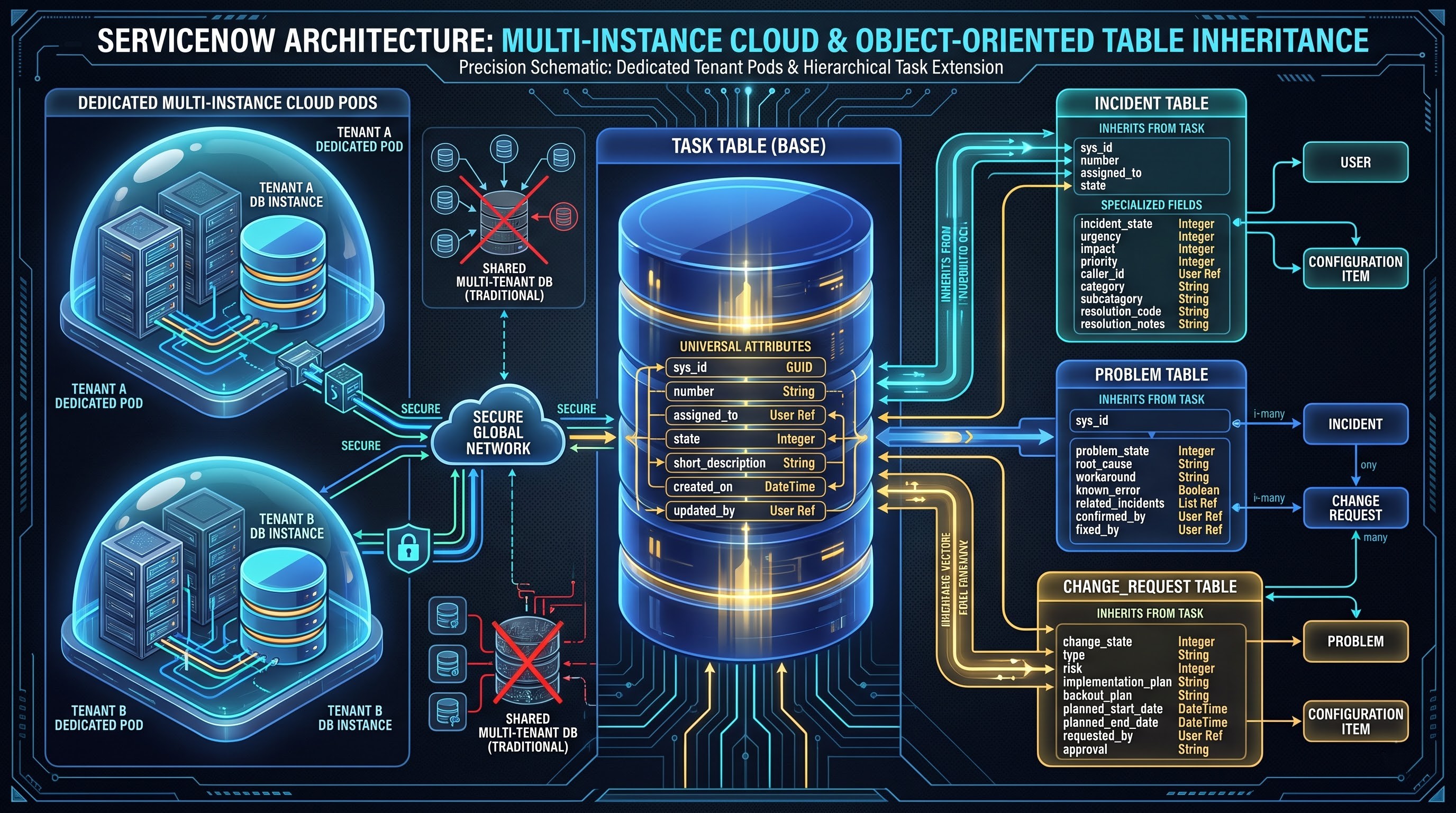
First of all, one must understand what makes architecture of ServiceNow unique compared to other multi-tenant platforms. One needs to understand that ServiceNow uses multi-instance model where each customer has its own database instances, application layer, and volume of storage. Such architecture makes enterprise release cycle, data cloning process, database encryption and upgrade processes unique to this platform.
Relational Database Model and Schema
The thing is that ServiceNow is relational database with relational schema which is reflected through user interface and metadata dictionary. In order to get to know ServiceNow, one must be aware of relational model:
The Tables of Root System: The root folder system with basic record tables as the foundation from where most IT resources stem.
The Sys ID: The understanding of the unique thirty-two characters long hexadecimal value which acts as the unique key for all records, scripts, metadata properties, and users defined in the system.
Field Types and Referencing: The difference between primitive data types of fields (numbers, string, boolean), choices, referencing (foreign keys), and the document IDs that point to polymorphic records.
Table Inheritance: The inheritance of fields and other table properties from its parent table. Table inheritance is an important concept since ignorance of table inheritance is the root cause of many reinvented wheels.
User Interface Mechanisms and Navigation
Basic training includes navigation within the basic user interface of the platform, workspace design in the Next Experience and customized employee portals. User interface mechanisms like lists, forms, filter bread crumbs, personalized lists layout, context menu, platform search engines, and platform wide global settings are studied by students. The fundamental level provides the knowledge about Update Sets – a means to capture, preview, validate, and migrate administrative configuration from the development, test, and production platforms.
Fundamental Administration and Security Governance
Having learned the basics of user interface layout, the students move on to governance of the platform.
Identity, Groups, and Roles Management
In the ServiceNow environment, permissions are given to users depending on the role-based access control model. The training highlights that permissions should never be given to individuals, but always through:
Users: Managing user account configurations, user authentication methods, time zones, and profiles.
Groups: Grouping users into logical groups based on departments, functions, regions, and management structures.
Roles: Assigning permission rights ranging from readonly incident permissions to system administrator permissions.
Inheritance Ladders: Automatic inheritance of credentials via nested groups and roles.
Contextual Security and Access Control List
The important aspect to cover in the administrative class on security would be the Access Control List engine. Access control facilitates enforcing data governance at two different levels-access to tables and access based on conditions and attributes in fields. Students are made aware of the process followed by the engine in determining the permissions based on four processes-create, read, write, and delete.
Ideally, the class should give the correct sequence in which the security rule engine determines the permissions-wildcard permissions to tables, table permissions, fulfilling the conditions, checking the role and contextual security permissions. This way, no disastrous data leakage occurs and the operations team is not locked out of their crucial incident queues.
No-Code UI Configuration and UI Policies
Modification of the user interface of ServiceNow without coding can be achieved. The above topics are covered in the lessons:
UI Policies: Policies that can be used to make the form fields required, read-only, or visible depending on the field selections done in real-time.
Data Policies: Data integrity policies on the server-side that will make sure that the data entered into the system is complete, irrespective of how it got into the system. It could be through the normal user form, scripts, web services or even spreadsheets.
Form Layout and Form Design: Organizing of attributes using sections, annotations, splits and related lists to minimize the mental strain of the operation agent.
Data Management, Import Sets and Transform Maps
Firms often have old records, regular asset inventories and even data from third parties. The above is the framework for data ingestion according to the syllabus:
Import Sets: Process of bringing data into the temporary staging structure.
Transform Maps: Moving data from temporary staging structure to the final production table using field mapping.
Coalescing Logic: Conditions upon which the incoming record will either update an existing record or create a new one.
Core Business Modules
Though there could be an option for endless customization possibilities, even in such cases the old-fashioned software pieces play the major role in companies’ choice of such approach. An industry-specific service was incorporated in the service now syllabus program and covers the most popular suites of enterprise software.
Even when offered an unlimited number of customization possibilities, the standard software is the major rationale behind enterprises using ServiceNow. Syllabus sufficiently complete will cover the most common product lines in enterprises.
IT Service Management
IT Service Management represents the core of ServiceNow. All the students should know how to use service lifecycle approaches to develop workflow applications:
Incident Management: The application designed to bring the enterprise services into operational mode. Within the syllabus, students learn how to enter incident records, categorize incidents, identify the priority matrix by impact and urgency, perform assignment lookups, build parent-child incidents, launch the resolution workflow and automate the closure.
Problem Management: The module devoted to the structured approach to finding the root causes of problems to prevent incidents. Here, the students learn the concepts like root cause analysis record, known error database, workaround record and problem ticket association with incidents.
Change Management: The module dedicated to change management in enterprise's critical infrastructure without outages.
Request Management and Service Catalog: Helps end-users to place requests for predefined devices, software licensing, and access privileges. Topics covered include developing modular catalog offerings, defining variable sets, setting up shopping-cart features, and implementing execution plans.
Knowledge Management: Organization of the company documents, technical workarounds, and public self-help content using versioned approval processes and contextual searches.
Strategic Portfolio Management and IT Operations Management
In terms of the relationship between tactical support services and strategic thinking and IT infrastructure, there are advanced classes, providing operational and portfolio views:
Configuration Management Database: The primary repository holding all the data related to digital infrastructure of an enterprise. Here, students are taught about hardware servers, cloud clusters, applications, databases and network switches as Configuration Items, their dependencies on each other in terms of upstream/downstream relationships, and how such dependencies are resolved using the Identification and Reconciliation Engine.
Discovery and Service Mapping Overview: The automated discovery of resources in an infrastructure by agents having no installation at all, feeding information into the configuration database and creating a service map of an enterprise to show what consequences infrastructure problems may have for people.
Strategic Portfolio Planning: Demand management, resource allocation pipeline, agile planning, and financial tracking.
Customer Service Management and HR Service Delivery
The workflow solution can also be useful for other departments than IT. Curriculum shows us how to extend the platform functionality in these instances:
Customer Service Management: Implementation of workflow for external customers, business accounts, product contracts, resource allocation, and interaction through all available channels.
HR Service Delivery: Creation of confidential HR processes such as new-hire onboarding, benefits queries, and workplace accommodations, and application of strict data privacy policies to ensure that personal data of employees cannot be accessed by technical support employees.
Platform Automation and Workflow Engines
Automation of workflow process converts the reactive document management platform into the proactive productivity platform. The curriculum in question pays much attention to process engines.
Flow Designer
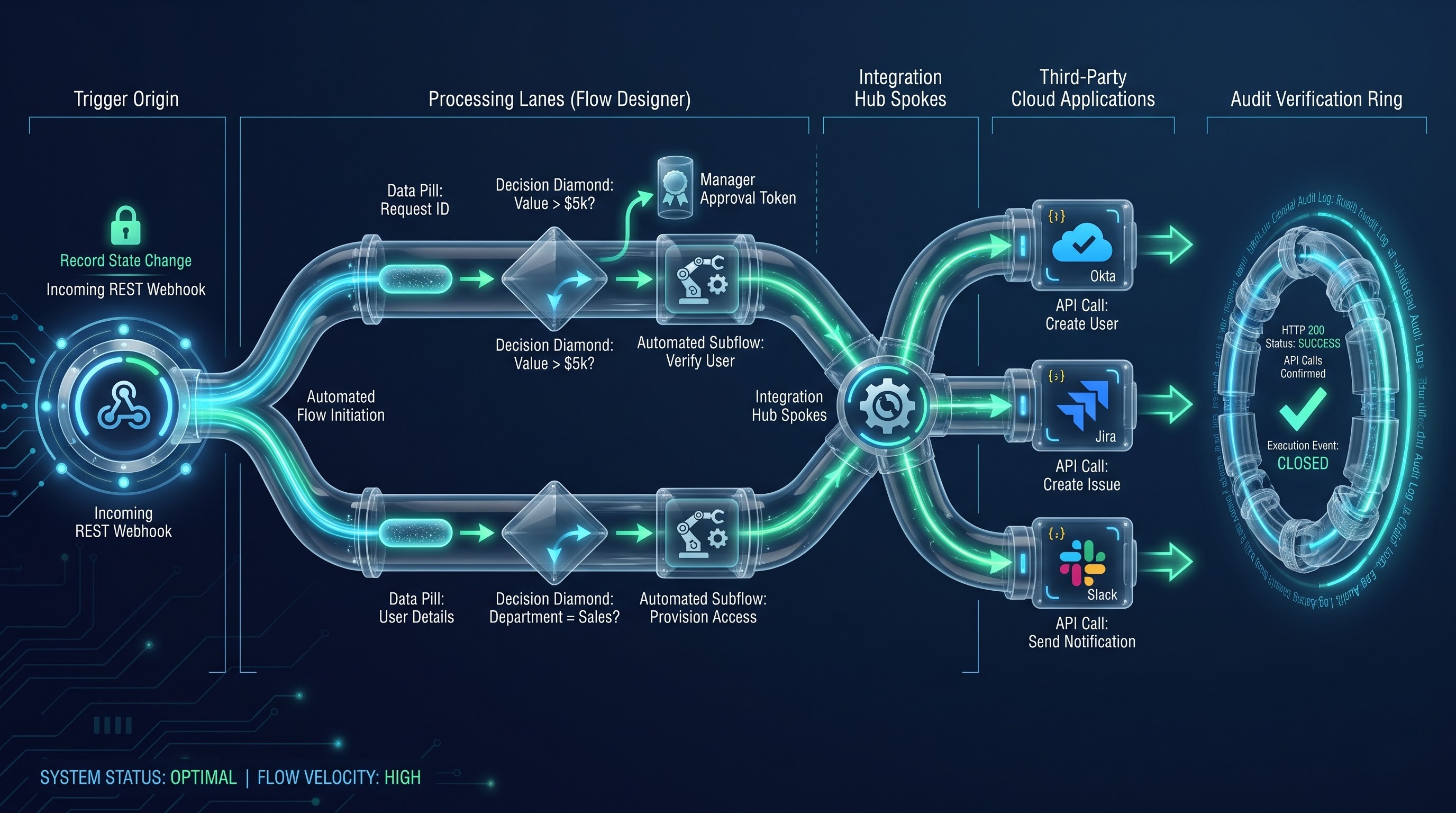
Flow Designer is the cloud-based workflow design solution of ServiceNow. With Flow Designer, the platform users can create complex workflows using natural language building blocks.
Students will cover:
Triggers: The actual triggers used for initiating the workflow process, including record-based, time-based, and REST webhooks from other external systems.
Actions and Subflows: The sequence of actions needed for carrying out a workflow process, such as updating records, approvals, sending template emails, tasks creation, and interactions with external systems.
Data Pills and Flow Logic: The process of passing data from one action to the next in a flow process, which can involve branching logic, parallel actions, and looping.
Process Automation Designer and Playbooks
For complicated enterprise processes involving numerous business units and requiring lots of time, such as onboarding employees or processing claims, students will review the Process Automation Designer. In this lesson, students will learn how to categorize various flows into phases. Students will also learn how to visualize these higher-level phases to the agents in the form of playbooks.
Management of service levels
The contracts lay down expectations for business activities. The students learn about configurations of Service Level Agreement, Operational Level Agreement and Underpinning Contracts. The concepts which play an important role in this case are the setting of criteria for initiation, suspension, cessation and resetting of the agreements; calculation of schedules based on local working hours; the setting of warning threshold; and coordination of the process of automatic escalation in cases of breaches of deadlines.
Platform Development and Programmatic Customization
Although the no-code and low-code options provided by the tool enable the handling of routine administrative tasks, the enterprise-level customization requires programming skills. In the platform development part of the course, the administrator will become a software developer who will be able to customize the platform's functionality.
Client-Side and Server-Side Scripting Paradigms
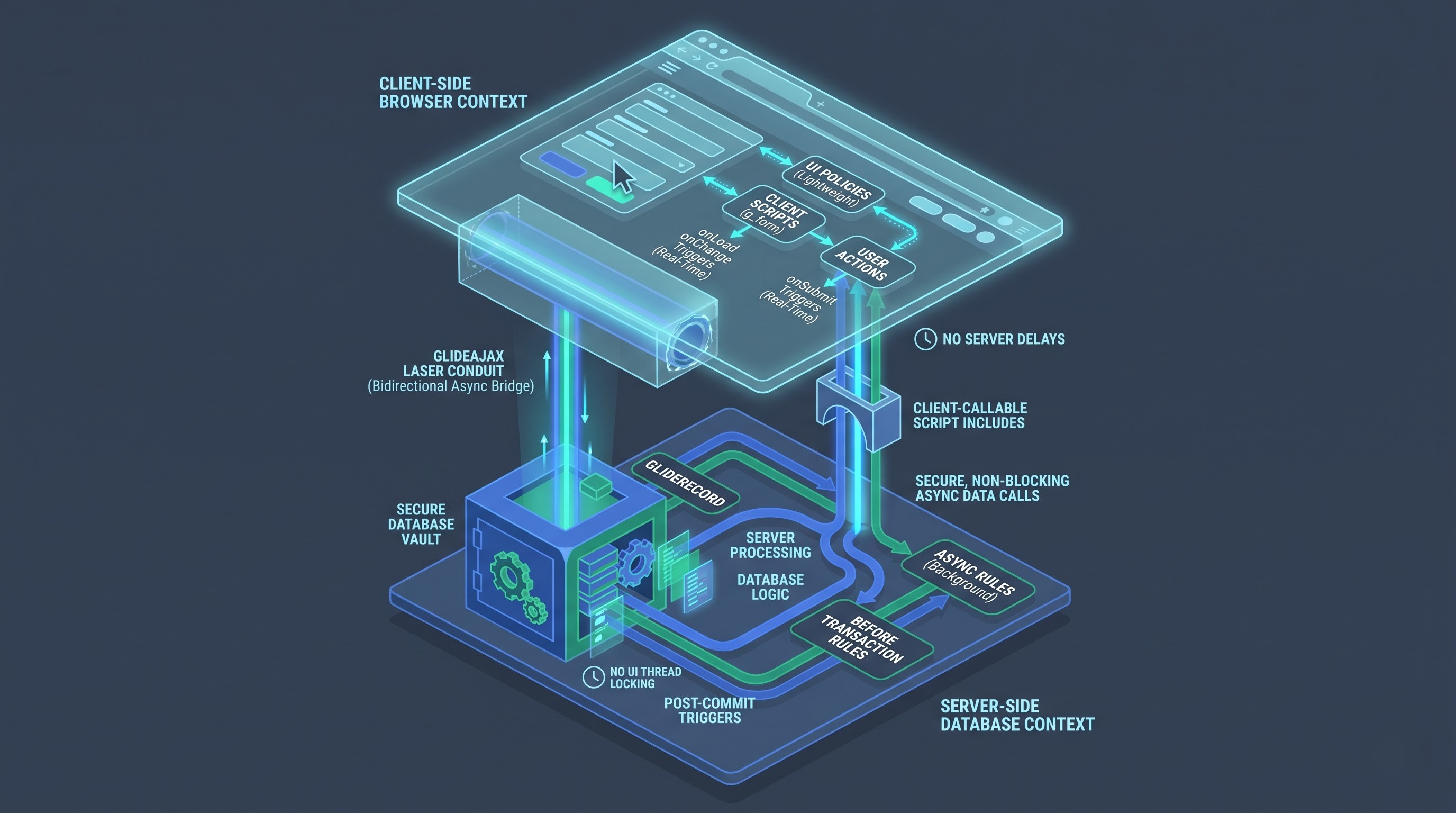
The first principle of developing ServiceNow is the knowledge of execution context. It is necessary for the developer to understand the difference between the processes which occur in the user's web browser and in the cloud server database.
Client Scripts: Performing instant logic in reaction to intervention of a human in the browser window. The lessons include understanding the four major event scripts that occur in the client side: the actions performed when a form is being loaded, actions performed while changing field values by a human, actions performed after a record has been submitted for storage, and actions performed whenever cell values have been changed in the multiple records listing view.
UI Scripts and Catalog Client Scripts: Expanding client side logic to the public service catalogs, self-service portals, and customized application pages.
Server Side Programming: Performing complex computations, data base queries, batch updates and evaluations that can not be performed from the client’s browser.
Business Rules
Business rule refers to the core server-side record processing engine of the system. The lessons cover the creation of business rules that will monitor the database activities in four crucial locations:
Before Rules: Monitoring the change before its storage in the database. Very crucial in validating the field values, implementing business logic, or cancelling a transaction.
Post Commit Rules: Calling logic after a successful commit of the record to the database, ideal for the update of related records and for starting new processes.
Async Rules: Shifting the processing of the intensive logic to the background queue, thus enabling users to feel a quick turnaround time by skipping the secondary workflow completion.
Display Rules: Offering the operational data from the server side to the client side interface as the form loads, thereby skipping round-trip from the network.
Script Includes and Object-Oriented Programming Patterns
To avoid falling into the pitfall of spaghetti programming and logic duplication, it becomes necessary to follow the object-oriented programming paradigms of today. Included in the syllabus are:
On-Demand Script Includes: Making server-side classes/functions accessible from multiple business rules, workflows, and integration processes.
Client-Callable Script Includes: By virtue of the asynchronous communication between the browser and the server, the client-side script can query the database without locking the user interface.
Scripted Extension Points: Development of the extension point architecture in order to enable additional functionality without any modifications to the core code.
Data Integration and Interoperability
There is no standalone enterprise application software nowadays. A quality ServiceNow course invests much time explaining how the Now Platform can integrate with other cloud systems, ERP software, communication systems, as well as custom-built databases.
Methods of Communication Between Web Services
The students learn about communication methods that allow connecting different platforms together:
Inbound REST and SOAP: Setting up ServiceNow to receive transactional data, status updates and perform administration tasks.
Outbound REST Integration: Performing HTTP request and configuring payload as well as managing JSON responses for synchronization of distributed databases.
Integration Hub: Using pre-configured low-code connections (Spokes) in order to connect ServiceNow workflows to popular enterprise systems for user identity management, file storages and chats.
Authentication and Security Handshakes
Security of connections is an integral part of integration process. The training courses on ServiceNow demonstrate how to configure mutual transport security, basic authentication, API keys and OAuth handshakes.
Analytics, Dashboards and Artificial Intelligence
The data collected during the process would not carry much weight unless the organization management can interpret the information through insights. The course gives learners the necessary skills to analyze their data.
Reporting Engine and Interactive Dashboards
The student will learn how to generate reports in different ways such as graphs, trend, pie chart and several pivot tables. But in addition to the mentioned above, the following topics are covered in the syllabus:
Reporting scheduling: Delivery of the report automatically in PDF or via email to the organization management.
Interactive filtering: Generation of interactive controls of the dashboard that will assist team leaders to filter the reports based on department, date or operation teams.
Principles of dashboard design: Proper arrangement of workspace without performing database queries.
Performance Analytics
Besides giving an analysis of the current status in terms of the operational queues, performance analytics will give analysis of trends, speed and projections. The topics covered in the syllabus include:
Indicators: Finding automated operational indicators such as the average amount of time required for solving critical problems.
Breakdowns: Breaking down information about indicators depending on groups of employees, geographic location, or used technology.
Data Collectors: Setting up automated overnight processes in the back end that allow seeing the evolution of the issue to determine the progress and to evaluate the improvement and see which operations have been bottlenecked during months and years.
Generative AI and Platform Intelligence
Built-in machine learning and generative artificial intelligence technologies are currently utilized by ServiceNow platform in its services. Curriculums include:
Predictive Intelligence: Using historical information about the resolution of issues for feeding the machine learning algorithm with data for automatically classification, prioritization, and assigning of tickets to appropriate people.
Virtual Agent: Developing a dialogue tree for the virtual agent, which will be guiding users to the automation of their problems on corporate websites and collaboration sites.
Capacities of Generative AI: Using the generative capacities of the platform for generating history data, drafts for service desk personnel, and code for software engineers, increasing productivity significantly.