
Navigating Workday HCM: Core Architecture to Workday Illuminate
Last updated on Oct 5, 2026
In the modern workplace, people are increasingly looking to their human capital management (HCM) solutions to be more than just an HRIS. For multinational corporations juggling a global talent pool, distributed operations, and ever-changing regulations, traditional software is often insufficient to the task of rapid reporting or streamlined operations.
In the modern economy, companies are turning to Workday HCM to provide new levels of insight, flexibility, and control over their workforce. This leading cloud-based enterprise solution offers strategic hires and continuous planning in the fields of compensation, operations, recruitment, and overall talent management. Those looking to get certified in Workday or move into a leadership position within their organization’s human capital management operations are encouraged to learn the basics of the cloud-based platform’s architecture and latest innovations. This guide is designed to serve as the ultimate resource for learning about the Workday ecosystem.
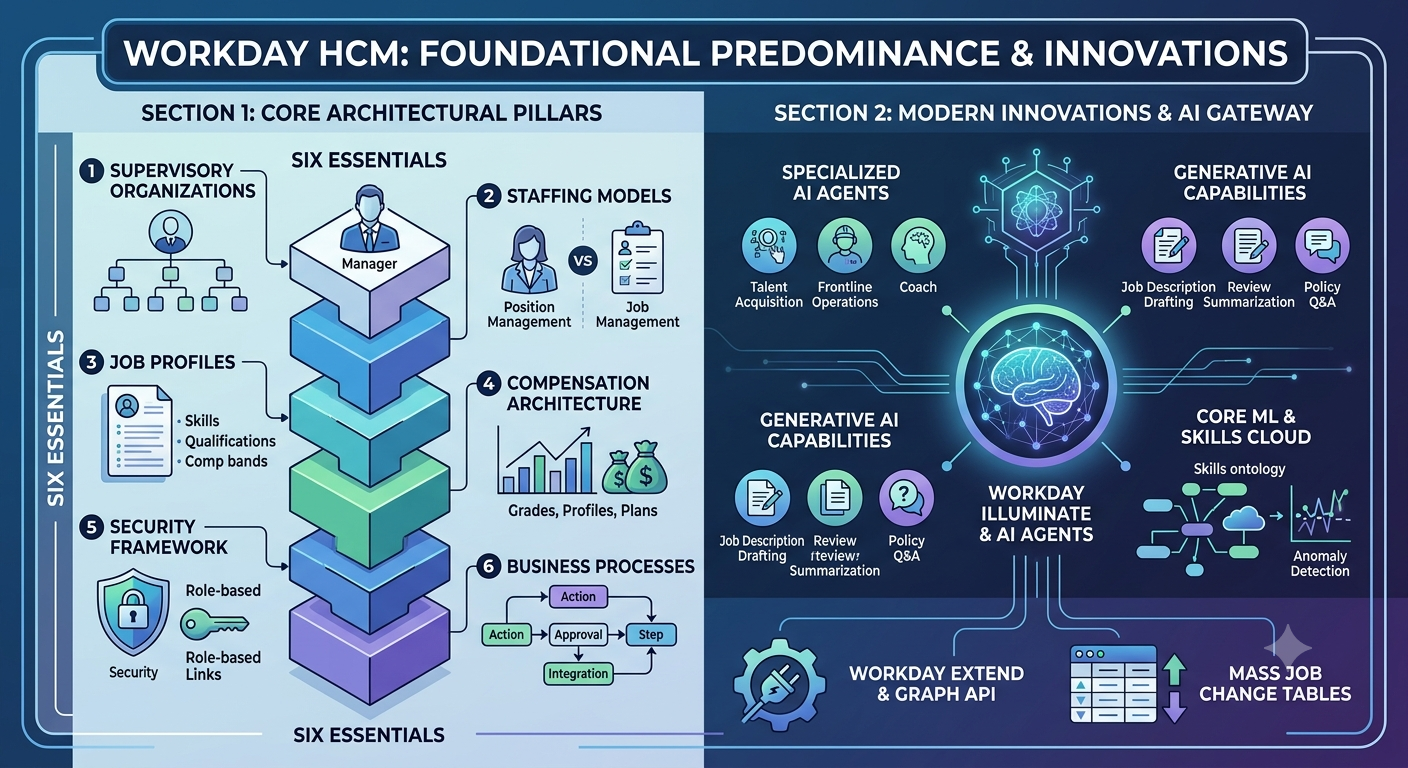
Workday HCM: Six Elements
The first thing that can be said about the architecture of Workday is that it is fundamentally different from the traditional database-driven ERP systems. Unlike conventional systems that use relational databases and foreign keys, Workday is built on an in-memory object-oriented architecture. To put it another way, all components of the system from workers, processes, positions, and roles are stored as objects with relationships.
To fully understand the Workday HCM, it is essential to remember that everything in it is connected to a single point. That is, to work with this program, one must know the six key elements that together make up the whole system. It is these six elements that define the data flow in the application, define the processes taking place, and clearly separate responsibilities in terms of authority.
Supervisory Organizations: The Foundational Skeleton
The Supervisory Organization or Sup Org is the core building block in Workday HCM. It is not like systems that arrange employees based on fixed things like cost centers, legal entities, or office locations. Instead, Workday uses organizations to connect people, roles, and processes through a dynamic reporting structure. A supervisory organization shows who reports to whom. Every employee in Workday must be part of an organization. Every supervisory organization must have a manager or a supervisory role assigned to it. This ensures lines of authority and reporting across the organization.
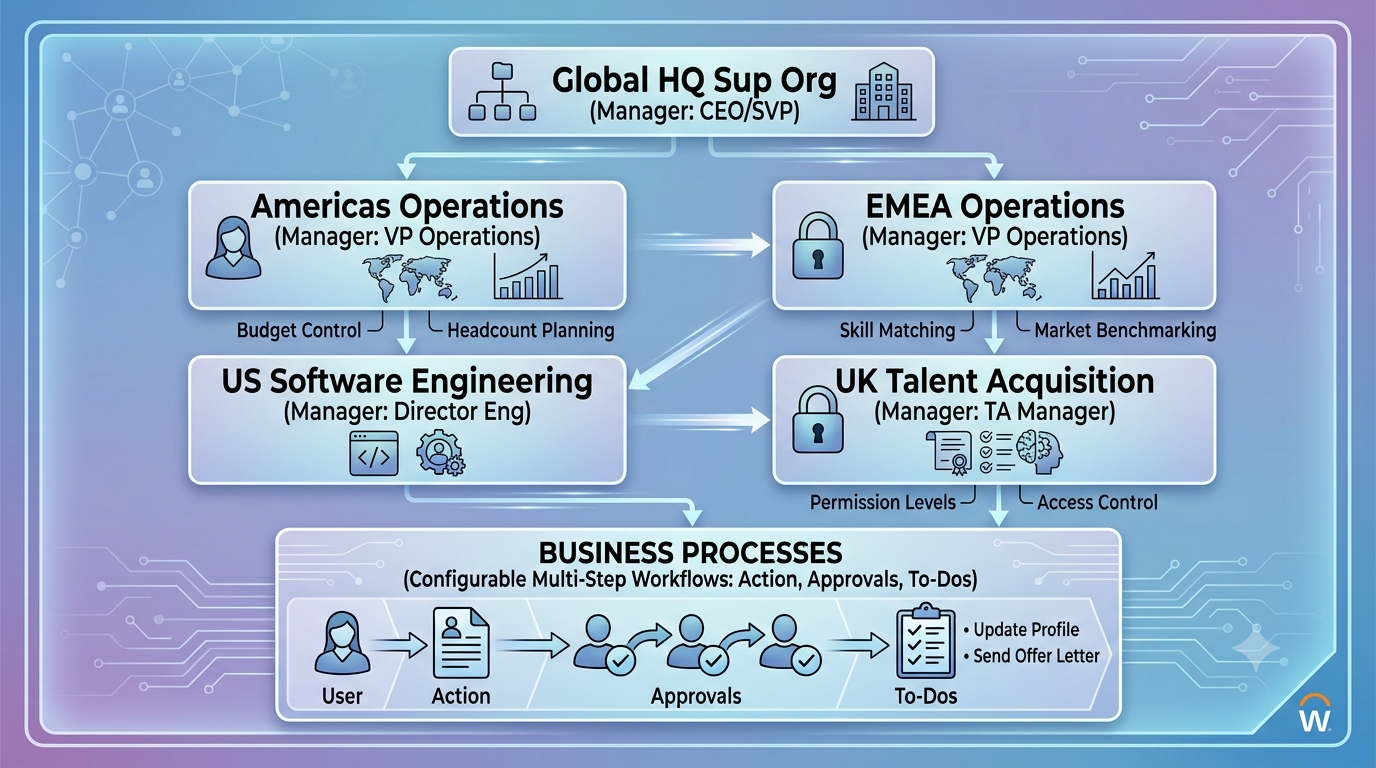
Thus, supervisory organizations manage the reporting hierarchy and therefore control behaviors across the company:
Workflow Approval Routing: When someone submits a request (for example, for vacation, a pay change, or a lateral transfer), the system will use the supervisory organization hierarchy to send the request for approval to the correct manager.Role-Based Security Inheritance: Rights given to a manager at a certain level in a supervisory hierarchy are automatically passed down to all lower-level supervisory organizations. This makes security management easier and more consistent. Lowers the chance of problems.
Headcount and Budget Tracking: Open positions and the total number of employees are directly connected to organizations. This helps finance and HR teams keep track of staff spending compared to budgets over time.
When professionals take a Workday HCM course online they learn that creating an organization structure is the most important part for the setup for the platform.. Once the structure is set any changes require major reworking, in event management and system adjustments.
Staffing Models: Governing Workforce Expansion and Budget Control
Staffing models dictate how the need for personnel is defined, authorized, budgeted, and staffed in a supervisory organization. Workday HCM software provides two staffing models for selecting and hiring candidates for filling vacancies based on the specific needs of the business:
Position Management
Job Management
Position Management
In a Position Management model, positions are to be created and approved before they can be put on a budget and filled with candidates. In other words, every vacancy is a position with a 1:1 relationship between a worker and a staffing position. For example, if a software engineer leaves the company, there will still be an open position waiting to be filled by a new worker.
This staffing model is best suited for enterprise corporate management, government sectors, and other fields involving highly structured salary positions.
Job Management: Using a Job Management model, there is no need to create specific positions that need to be filled with the workers. Instead, the hiring limits are set for all jobs at the level of the supervisory organization. For instance, if a manager wants to hire five retail associates or customer service reps, he/she does not have to create five separate positions and fill them with workers. The first five available seats in the given job category will be occupied by the new hires. On the contrary, when a worker leaves, his/her position is no longer available.
Such a staffing model is more flexible and better suited for call centers, seasonal workforces, high staff turnover industries, and other fields involving a high volume of contractors. The choice between Position Management, Job Management, and a combination of both for different business divisions falls under the responsibilities of workday training and professional development.
Job Profiles: Standardizing Roles and Skill Taxonomy
A Job Profile defines the non-person-specific characteristics of a job role in the enterprise. It sets the requirements and responsibilities, and establishes compensation bounds and regulatory categories for any positions created with its use. Job profiles separate worker-specific details from the job roles that the same person can perform. The same job profile, such as a Senior Data Analyst, can be used for dozens and hundreds of individual worker positions in dozens of supervising global organizations.
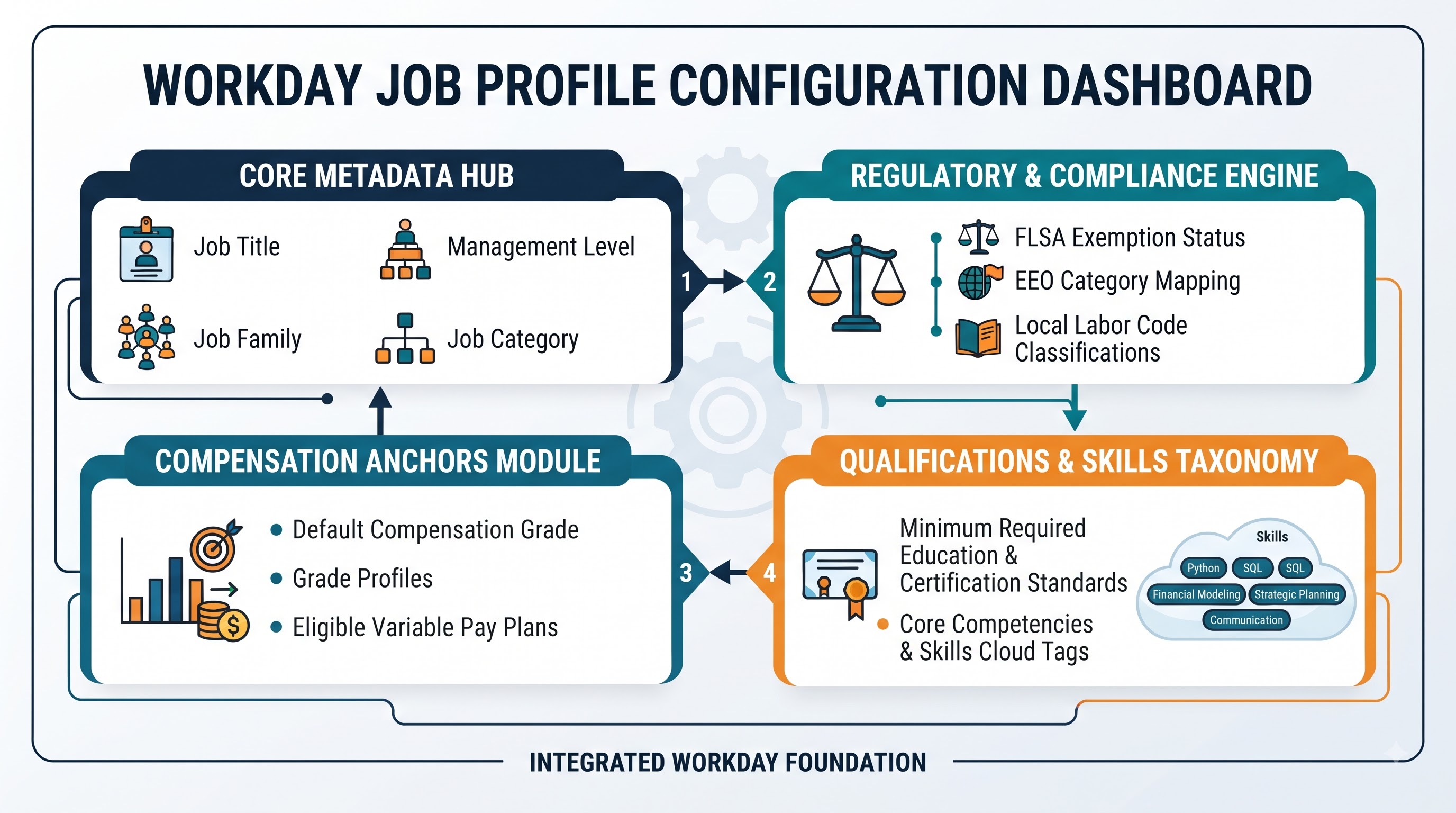
The key elements defined in Workday Job Profile are:
When a position is established by Human Resources staff under Position Management, the relevant job profile is automatically applied to the position to ensure that the position is characterized by the same set of attributes. This feature assures uniformity among the job families and lessens the efforts needed to complete information about each position.
The software offers a compensatory mechanism that is needed for creating corporate compensation structures, including international salary scales, variable pay, geographical differences, and other compensation forms used in multinational companies. What differentiates Workday from other systems is that it does not connect compensation data to the employees’ database. The compensation model is divided into a number of modules which makes it easier to handle.
Compensation Structures: The overarching framework that encompasses the specific grades, profiles, and plans that are available to employees within a given business sector, subsidiary, or worker group.
Compensation Grades and Grade Profiles: Compensation Grades define the appropriate pay bands (minimum, midpoint, maximum) by job level.
Grade Profiles let organizations adjust pay bands based on local labor costs without creating separate compensation grades for each city. For instance, a single Grade 8 Senior Engineer classification can include varying Grade Profiles for San Francisco (+25%), London (Base), and Bangalore (-30%).
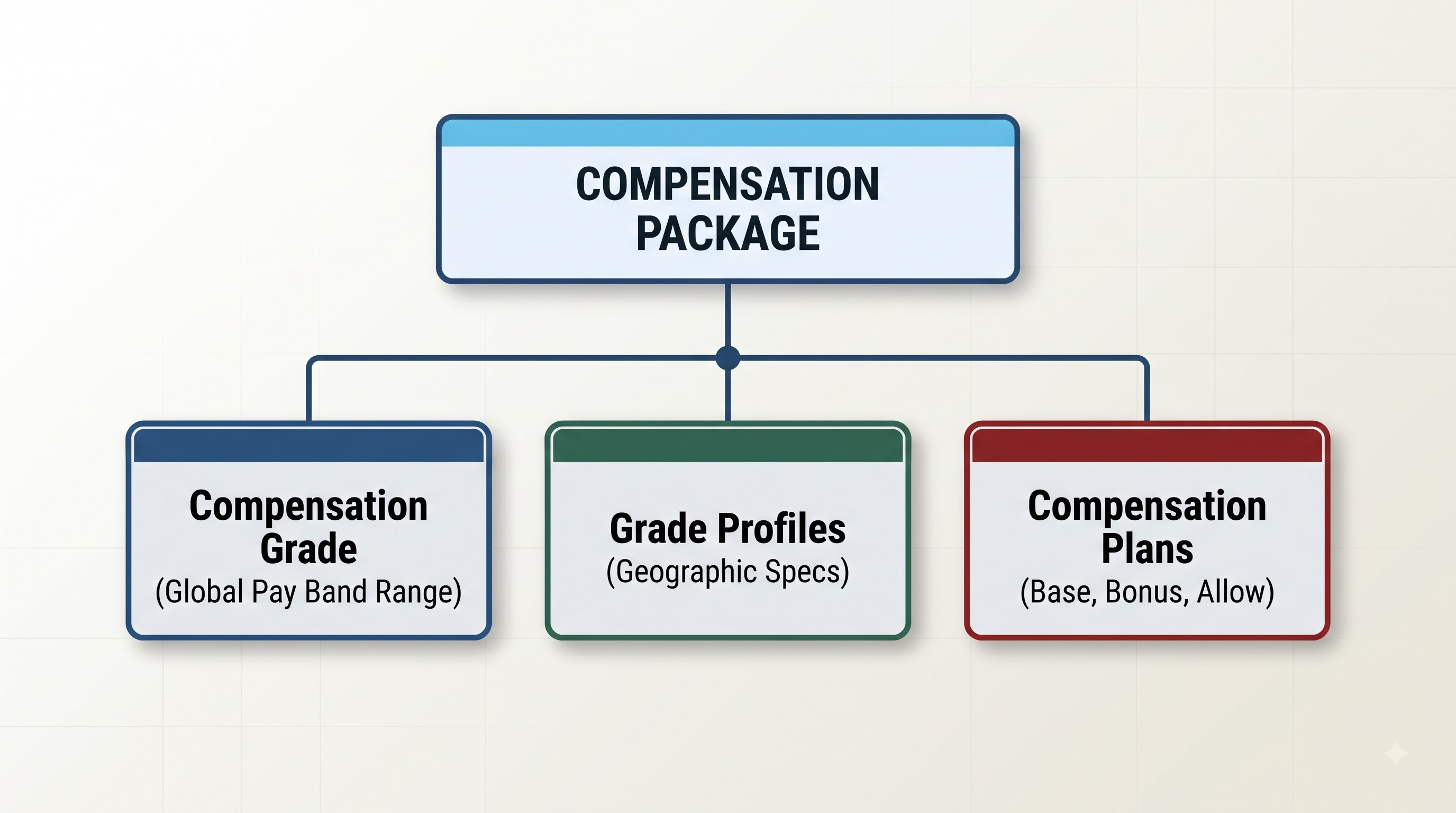
The individual components of pay that go into creating total pay are referred to as Compensation Plans and there are different types supported by Workday:
Base Pay Plans: Payment is either on a salary or hourly basis.
Bonus Plans: Variable compensation that is contingent on individual or corporate performance target achievement (either based on predetermined amount or percentage of base pay).
Allowance Plans: Non-performance payments such as housing allowance, commuting stipend, or mobile phone allowance.
Merit & Stock Plans: Equity awards, stock units, and yearly merit reviews.
By separating compensation structures into modular parts organizations can quickly run merit reviews. They can also change salary bands in geographic regions. Additionally they can enforce pay‑equity rules, across large international workforces.
The Security Framework: Protecting the Governance of Enterprise Data
As Workday HCM compiles many types of sensitive personal, financial, health, and operational data, its security framework must ensure strong access limitations with smooth user experience. Workday uses security measures based on a combination of the role-based and the group-based access systems working on the basis of two basic principles: Security Groups and Security Policies.
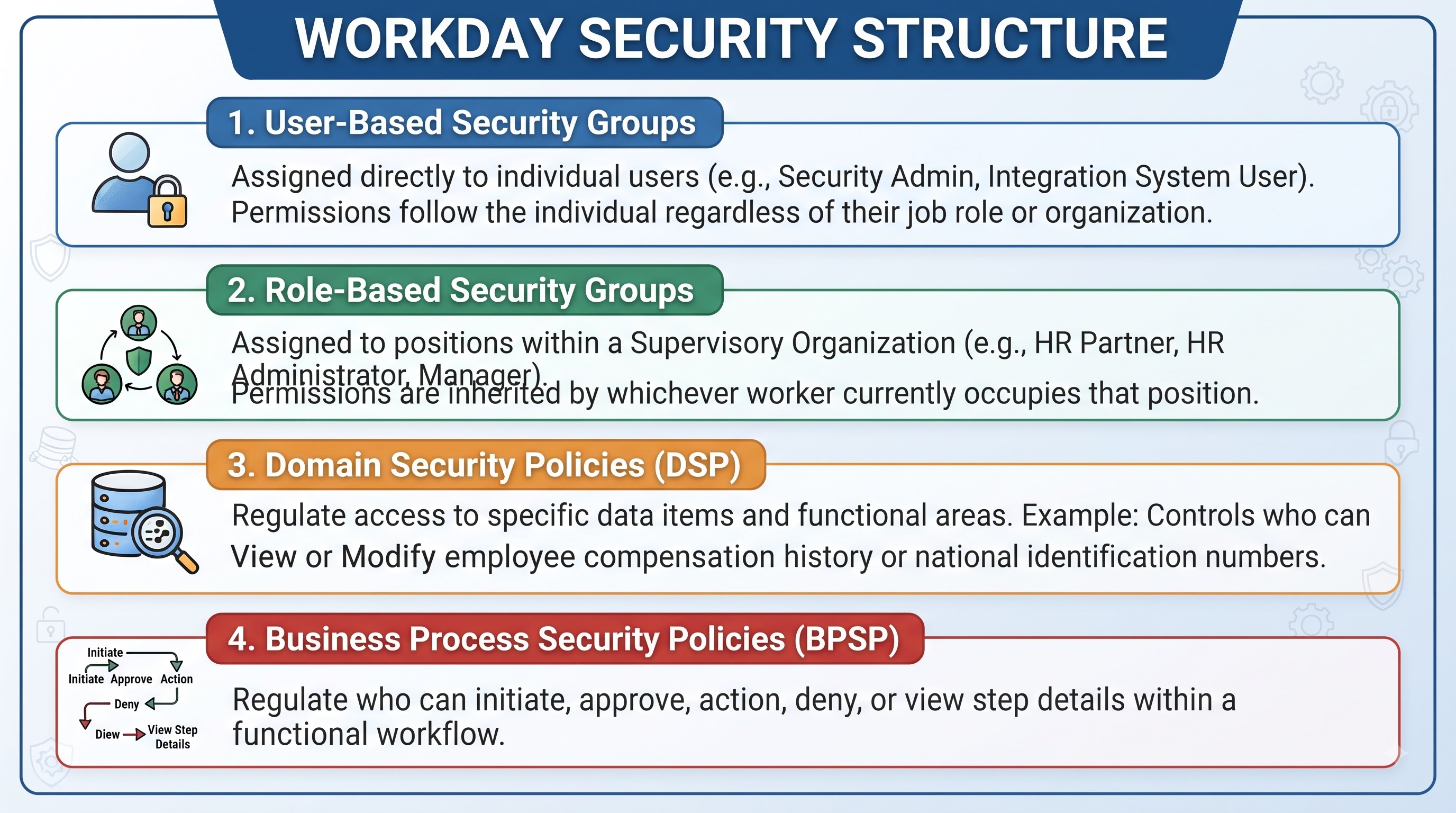
The security model adopted by Workday enables it to automatically update data accessibility according to employees’ role changes. Therefore, once a manager shifts to another department, their rights to access their previous team’s information are immediately taken away, and in addition to that, the manager is assigned the new access rights for the new department.
Business Process Management (BPs): Setting Up Workflow Processes
A Business process in Workday’s Human Capital Management is a custom-defined automatic step that is aimed at achieving a goal, such as hiring a new worker, modifying a compensation plan, appraising performance, etc. Due to its business process model, Workday allows human resources executives to create complex workflows by simply dragging components onto the screen without writing any code.
The various stages present in a Workday Business Process can be configured in such a way:
Action Steps: Steps involving regulatory actions (for instance, gathering personal data or deciding compensation amount).
Approval Steps: Steps where people such as executives, managers, or HR partners must validate and review the process
Service Steps: Steps when the automated backend tasks must be put into play (for instance, creating IT identity records or sending the API payload).
To-Do Steps: Steps which include regulation that will require internal people (for instance, providing security cards).
Integration Steps: Steps where some number of actions must be executed automatically (for instance, providing background checks).
Workday HCM allows for the implementation to utilize those key components: - Supervisory Organizations, Staffing Models, Job Profiles, Compensation Packages, Security Frameworks, and Business Processes thus giving organizations the opportunity to manage human resources processes in the right manner.
Part 2: New Innovations and Concepts in Workday HCM of Today.
Although the six basic principles are the basis of Workday HCM, the platform constantly develops and improves, getting updates once every six months (R1 and R2). The latest innovations include the use of smart automation instead of manual batch processing, real-time changes in organizations, machine learning in talent discovery, and the use of artificial intelligence.
Workday Illuminate and Integrating Enterprise AI
The main technological breakthrough of modern Workday HCM is the introduction of Workday Illuminate, which is the embedded AI technologies of the platform. The major contrast between Workday and traditional enterprise software is that while in the latter, the external solutions are added, in the former, the technology is integrated into the memory architecture of the application. It utilizes Workday’s massive global transactional dataset – analyzing over 800 billion business transactions annually – to provide highly secure context-aware intelligence without needing to send corporate data outside within public large language models.
Workday Illuminate offers three levels of AI for HCM functions:
Level 1: The Core ML Engine
The Core ML Engine works beneath the interface to learn from transactions in the system.
The Core ML Engine drives Skills Cloud to pull skills from any text on resumes, jobs or projects.
The Core ML Engine recognizes patterns in time entries to flag charges before the pay period closes and calculates Retention Risk Scorecards using compensation trends, role tenure, time in role and internal mobility.
Level 2: Generative AI Co-Pilots
Generative AI Co-Pilots focus on speeding up time-consuming tasks.
The Job Description Generator scans selected fields in a Job Profile. Produces compelling copy for the job with no bias. The Performance Review summarizer compiles peer evaluations year-end objectives, self-rating and project progression into a manager’s draft review during talent planning conversations. The Generative AI Co-Pilots answer employee questions about benefits, parental leave or other policies by pulling information from the company’s knowledge bases in natural language conversation.
Level 3: Specialized Generative AI Autonomous Agents
Specialized Generative AI Autonomous Agents are the advanced type of AI-driven HCM automation that configure themselves to a specific set of tasks work with a person or execute them independently:
The Talent Acquisition Agent evaluates candidates against skills in a target job profile and recommends who to interview, when to schedule those meetings based on hiring managers’ availability and who to recommend for hire. The Frontline and Operations Agent manages shift-trading requests. Adjusts schedules for coverage in retail, hospitality and healthcare settings. The Manager Coaching Agent coaches line managers on their teams’ compensation, workforce planning and skill needs during planning reviews.
Workday Skills Cloud: The AI-Focused Talent Ontology
Traditional systems of human resources regard skills as fixed datasets that have to be entered manually in someone’s resume or talent profile. The presence of the fixed-form data leads to the creation of duplicate and dubious taxonomies (for example, “Python 3,” “Python Programming,” and “Scripting in Python” are taken as entirely different and unrelated skills).
Workday Skills Cloud resolves this issue thanks to AI technology employed in the universal skills ontology. It ensures the creation of a unique online platform for continual update of more than 75,000% standardized skills by means of machine learning, which analyzes and combines various skills from the global workforce.
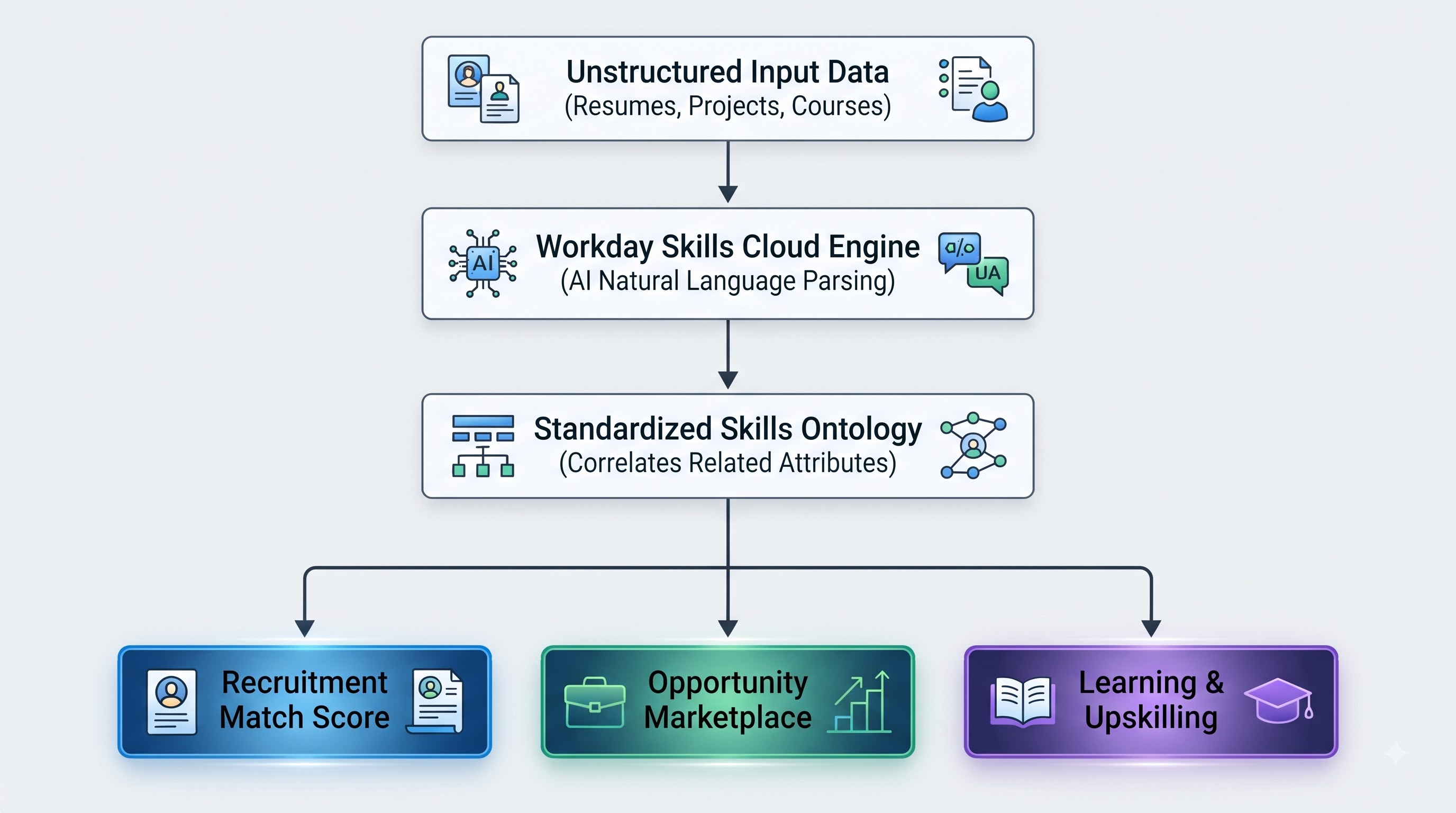
The Skills Cloud system function through three main mechanisms:
Skill Extraction: It uses automation technology to scan job applications, LinkedIn profiles, gig assignments, and training certificates and identify employee competency without the intervention of human resource personnel.
Contextualization of Work Skills: The system notes that employees well versed in Data Science likely also know Statistics, Data Visualization, and SQL, thus achieving implicit match scores. Internal Marketplace of Opportunities: The Skills Cloud platform links employee skill profiles with company vacancies and other opportunities like temporary project assignments and mentoring programs, thus encouraging mobility among employees and preventing their turnover.
Mass Job Change Tables: Efficiency in Enterprises in Restructuring
HR departments in big enterprises are always dealing with major restructurings, like transferring a great number of employees to a new organizational entity, changing pay and pay structures, and changing titles in different organizations after M&As. In previous versions, admins were using manual Mass Action tables and spreadsheets. New Workday HCM allows mass job changes occurring directly in the work area.
Workday Extend and the Graph API
As organizations build customized employee experiences they often need to extend Workday’s native applications. Workday Extend offers a low‑code/no‑code development platform that lets internal developers create custom HR applications that run natively within the Workday UI. These applications store data inside the Workday cloud boundary.
To power these custom extensions Workday provides Graph API capabilities. Of using traditional REST endpoints that require many slow REST calls to gather data the Workday Graph API lets developers query deeply nested HCM object graphs—such as retrieving a worker’s profile, manager chain, benefit plans and skill cloud tags—in a single API request payload.
Part 3: Strategic Value of Formal Workday Training and Certification
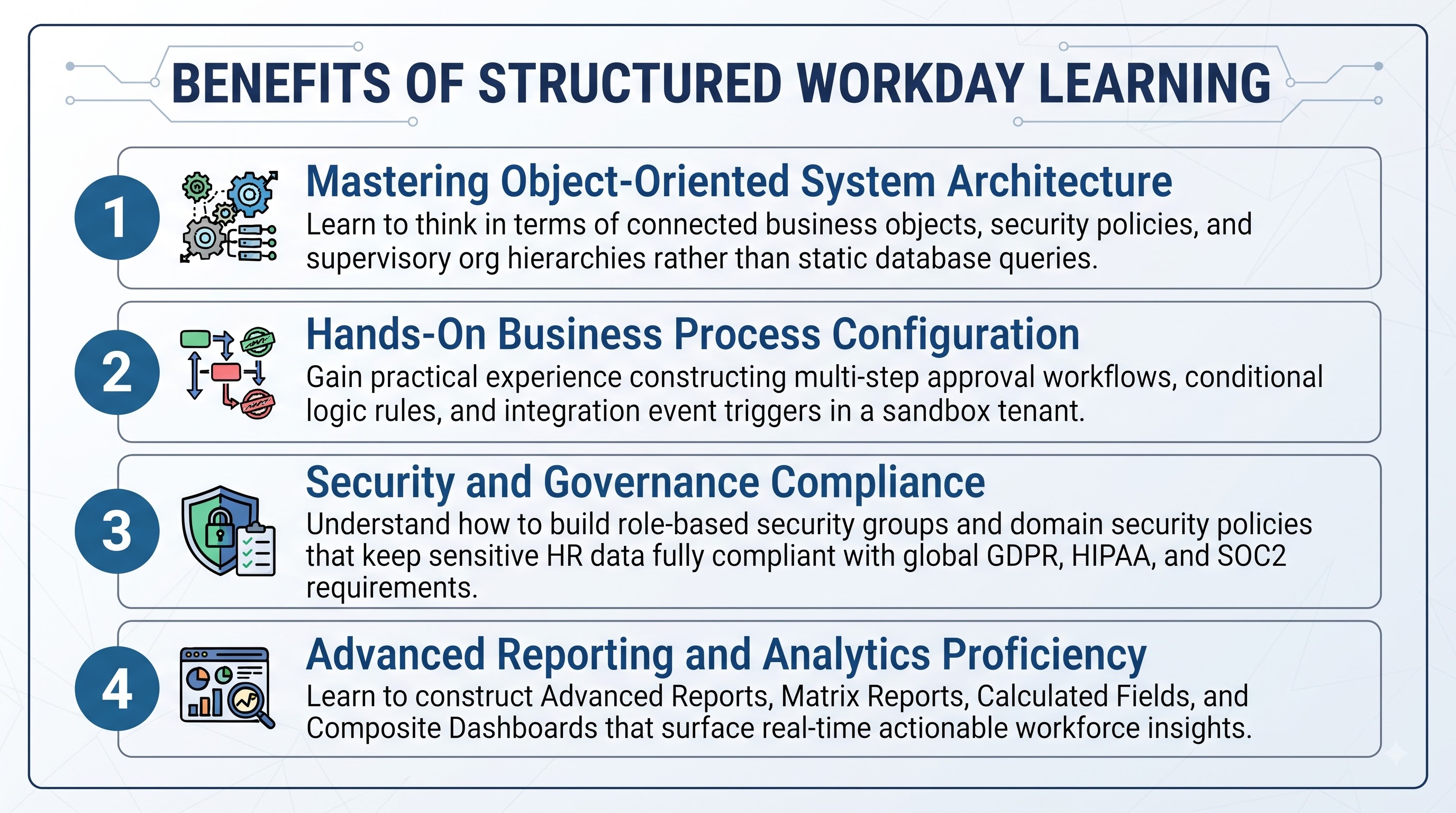
As Workday continues to grow its enterprise presence in markets the need for skilled Workday administrators, functional architects, integration specialists and business analyst professionals has risen quickly. Because Workday updates its architecture twice a year and does not rely on legacy on‑premise database customizations keeping operations in sync requires structured upskilling. Enrolling in structured online Workday training offers benefits, for HR professionals functional analysts and IT systems administrators:
Part 4: Comparative Breakdown of Workday HCM Functional Modules
To conclude this architectural overview, the table below illustrates how Workday’s core concepts, business process framework, and AI capabilities integrate across the broader Workday HCM application ecosystem:
Talent. Recruiting: This module delivers candidate sourcing and onboarding solutions by managing Candidate Profiles, Job Requisitions and Offer Letters. Key business processes like creating a requisition approving offers and starting the onboarding process are made smoother with Workday’s AI software. The AI helps generate job descriptions score candidates against job requisitions and schedule interviews at stages—all without requiring human input.
Compensation & Benefits: This area handles total compensation packages, compensation grades, benefit groups and coverage types. Essential business processes include compensation change requests, open enrollment and global merit reviews. Advanced algorithms detect pay equity issues and forecast salary bands helping to prevent pay practices. Automation of benefit setups across countries reduces the chance of mistakes.
Performance Management: This module oversees employee development and succession planning through performance reviews, goal sheets and succession plans. Important business processes are performance discussions, individual development planning and talent calibration meetings. Workday AI supports conversations by summarizing feedback from many sources and finding skill-based career paths through internal transfers. As a result managers need direct oversight because tasks are automated.
Workday Learning: This part tracks employee learning records such as courses and digital campaigns to support skill development. Actions like course completions, external certifications and mandatory training are automated. The AI analyzes skill. Suggests relevant learning steps to meet the organization’s strategic goals.
Time. Attendance: This module supports workforce time management with functions like timecards shift patterns, overtime approvals and absence types. Processes such, as timecard entries, shift swaps and absence requests are automated to prevent errors. The machine learning feature of the software identifies trends in time and attendance data helping to catch time theft and reduce overtime.
Navigating the Future of Workday HCM
The evolution of Workday HCM from a HR information system into an AI-powered workforce platform shows a big change in how companies manage their work. At the heart of the platform the strength still comes from six parts Supervisory Organizations, Staffing Models, Job Profiles, Compensation Packages, Security Frameworks and Business Processes. These main parts help companies build a structure to handle complicated global work, make sure data is managed properly and change when rules change.
At the time new ideas like Workday Illuminate, the Skills Cloud taxonomy and AI agents show how machine learning can make daily work easier and give real-time information about the workforce. By adding things like making content, finding skills on its own and spotting unusual things in the data right inside the normal work, Workday helps HR leaders stop doing just the usual tasks and start working on better talent plans and making the company more flexible.
In the end getting the most out of Workday HCM means finding the mix of strong structure and learning all the time. Whether by making the work better using new tools, like the Graph API or taking structured workday training online , companies and HR people who understand both the structure and the new AI features will be ready to lead the future of how companies work.