
OpenShift Backup and Disaster Recovery: Best Practices for Administrators
Last updated on Oct 16, 2026
The introduction of container orchestration platforms to the industry has revolutionized how businesses operate. Specifically, it has facilitated the better deployment of various microservices and distributed systems. The most distinguishable participant in this sector is Red Hat OpenShift, a well-known Kubernetes platform known for its automation tools, developer solutions, and security attributes. For IT professionals and system administrators wishing to excellently grasp the intricacies of operations from A to Z, taking a dedicated openshift online course will give them practical experience in cluster architecture, automatic scaling, and production-grade security.
Nevertheless, there are challenges involved in running important services on OpenShift. For example, the dynamic architecture of this platform has resulted in businesses believing that recovery from any possible threat is an easy process. In reality, organizations forget about the possibility of losing some data and affecting cluster performance.
When it comes to backing up OpenShift data and ensuring disaster recovery, the level of preparation differs enormously from various types of backup strategies. There is a need to understand the very nature of OpenShift deployment, which involves the combination of control characteristics and steward configuration combining with numerous other factors. In this sense, achieving positive results requires a different strategy that is clearly outlined and analyzed further.
Understanding the OpenShift Failure Surface
In order to create a successful resilience approach, the first thing administrators need is to analyze cubes in the OpenShift deployment. One of the most common problems which occur in disaster recovery plans is focusing on OpenShift as a whole and backing up the virtual machine disk only, while not considering the database snapshots. However, the operational state of OpenShift is separated into various parts.
The first part of the state is the state of the control plane, which exists in a big part in etcd. Being the distributed key-value store of the platform, etcd contains the truth about the cluster – API resources, namespaces, security context constraints, role bindings, cluster operators, and the details about services.
The second layer is made up of core configuration resources and cluster infrastructure. These can be regarded as declarative manifests, which define the infrastructure in question from machine sets, ingress controllers, network operator configurations, and authentication providers to storage classes and certificate authorities. While some modern businesses aim to keep these definitions stored in declarative Git repositories, in practice clusters undergo dynamic configuration changes, create secrets from scratch and constantly change different states.
The third layer includes Custom Resource Definitions, application manifests, and operator state. For cloud-native applications, there are many controllers as well as operators needed to service the lifecycle, from deploying databases to configuring service meshes. The problem of application backup is that it implies not only a deployment manifest but many other things as well, like ConfigMaps, Secrets, PersistentVolumeClaims, ServiceAccounts, and state managed by an operator.
Finally, the fourth layer is persistent storage. Ephemeral containers write durable data of the app to Persistent Volumes, which are supported by block, file, or object storage systems such as Ceph, cloud-managed disks, and enterprise storage area networks. In the case of missed, inconsistent backups of this persistent data, there will be only empty containers following the recovery.
Grasping the coupling of the layers permits the administrators to pattern multi-level recovery frameworks that deal with realistic failure domains as opposed to equivocal edge cases.
Central Pillars Of The OpenShift Backup Architecture
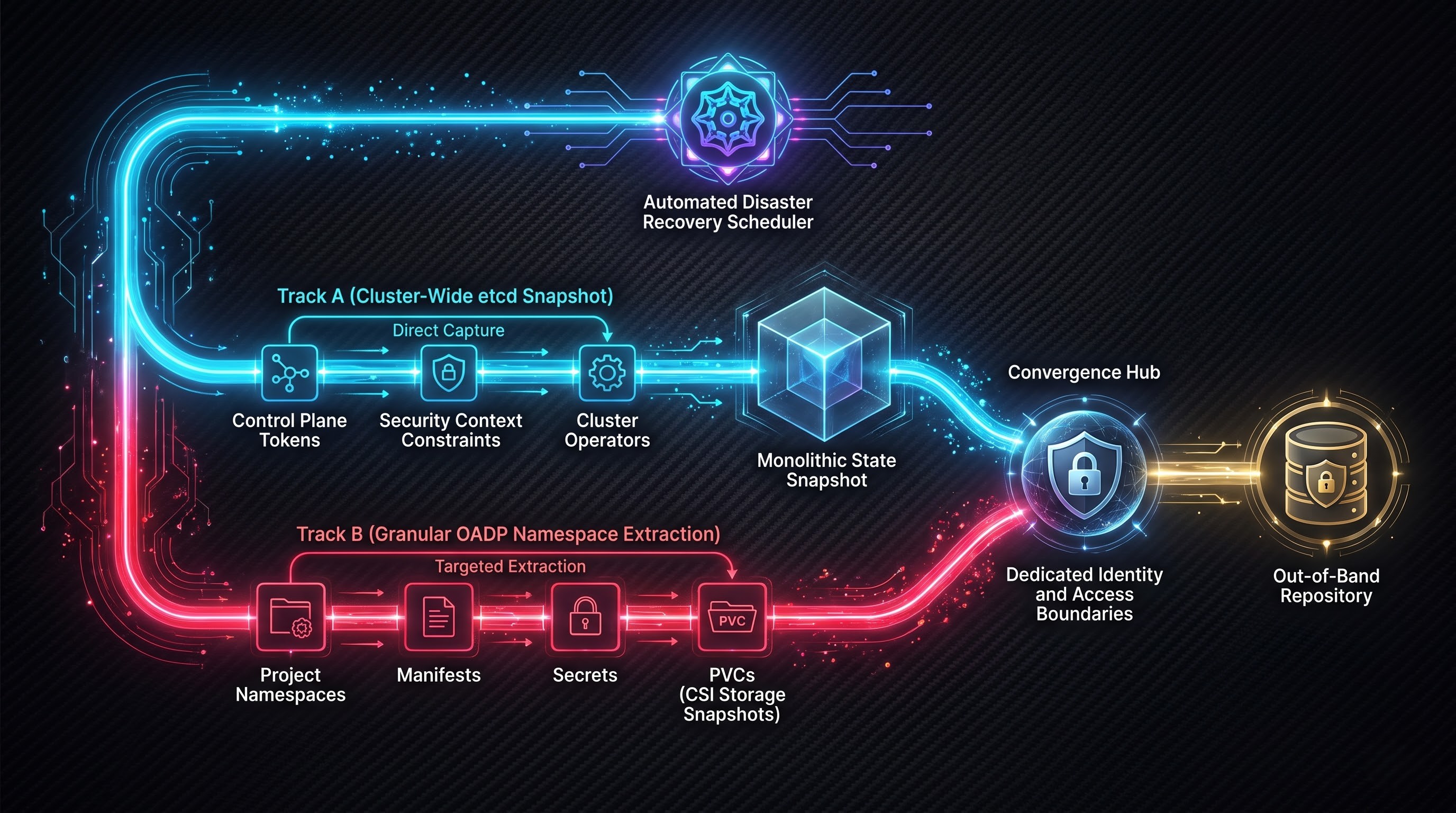
An enterprise backup framework for OpenShift operates on two tracks: platform protection and workload protection. The confusion between these two ways creates a serious blind spot in the operational perspective. Platform protection involves recovering cluster operations after total control plane loss, while workload protection involves granular application portability and recovery across namespaces.
1. Control Plane And Etcd Snapshot
The integral etcd backup utility of OpenShift forms the bedrock of the safety net to fall back on for the recovery after control plane disaster. An etcd snapshot takes a faithful picture of the whole of the cluster resources at a given point in time.
It is the responsibility of the system administrator to ensure automatic etcd snapshooting by using either platform cron or independent operators. The frequency of these back-ups is critical and should be done often, particularly before significant maintenance events, upgrades, or changes to operators. Since etcd keeps track of every state change constantly, the back-ups must be uploaded immediately to secure, immutable object storage server or other external storage separate from the infrastructure on which OpenShift cluster works. Keeping the etcd backups in the control node will not add any security to the data during complete demise of the hypervisors, runs and nodes.
The encryption and governance of access of the etcd backups should be scrutinized carefully. Because etcd stores every token and secret used in the cluster, unencrypted or compromised back-up shows an immediate risk on security level. Thus, make sure that the data is always encrypted at rest and that proper security measures are taken during its transmission as well.
2. Workload Protection and Namespace Preservation with OADP
Though etcd records everything in the cluster, it is basically an all-or-nothing recovery tool. Restoring an etcd backup means going back in time for the whole cluster and losing every project, credential, and resource created after it. It is obviously impossible to bring back just the one deleted namespace, to restore an overwritten database or to transfer an app from the testing system to the production system.
To ensure the accurate safeguarding of workloads, OpenShift API Data Protection (OADP) must be put into place by the administrators. OADP is founded on reliable open-source code and operates entirely within OpenShift to ensure that backups and recovery can be done with respect to the applications. The knowledge and use of the declarative API for backups, namespace migration, and storage hooks is one of the main aspects included in thorough openshift certification training.
OADP allows administrators to make full backup copies of entire applications by combining Kubernetes manifests, secrets, configuration data, and persistent volumes into single backup objects. With labeling and namespace scoping, it is possible for teams to create the backup plans based on the importance of applications used.
3. Strategies for Protecting Persistent Volumes
Persistent Volumes are important for data-driven applications in businesses, but knowing how to take snapshots of those volumes does not mean that one also knows how to take snapshots of their physical disks. When administrators use OADP to back up Persistent Volumes, they have two main options: create storage snapshots or use filesystem replication.
The ideal snapshot option for performance-driven enterprises is the use of the container storage interface or CSI. By using the CSI snapshot feature, OADP instructs the disk subsystem itself (which could range from Red Hat OpenShift Data Foundation to enterprise storage arrays and public cloud services) to create a snapshot. This takes a few seconds and transfers the entire data creation burden to the disk subsystem, leaving the OpenShift nodes free for any other tasks.
In cases when the storage driver does not support CSI snapshots, or when the administrator needs to achieve portability between different storage mediums, he can still utilize file-level copying instead.
Describing RPO and RTO
Each recovery system and backup system should be created based on two essential business parameters - Recovery Point Objective (RPO) and Recovery Time Objective (RTO). Failure to approach the project of creating an OpenShift environment with set RPO and RTO parameters will lead to either unnecessary over-engineering of simple infrastructures or significant under-protection of technologies.
The Recovery Point Objective refers to the acceptable limit of data loss expressed in time. In the situation when the system has an RPO of fifteen minutes, the infrastructure has to backup the changes every fifteen minutes or utilize close to continuous replication. Achieving RPO for stateless microservices is fairly simple, while fulfilling RPO conditions for stateful distributed databases implies the need for synchronous replication and continuous transaction-log streaming.
The RTO or Recovery Time Objective refers to the allowable time for service disruptions before services are restored. RTO explains how disaster recovery plans work. To give an example, if RTO is needed within thirty minutes for a multi-node failure, a cluster will not be rebuilt from scratch. An active-passive cluster with data already synchronized would be required here. However, if the internal staging will have an RTO of 48 hours, then a cold-recovery pipeline would work just well.
Administrators should divide applications across the cluster according to defined service levels:
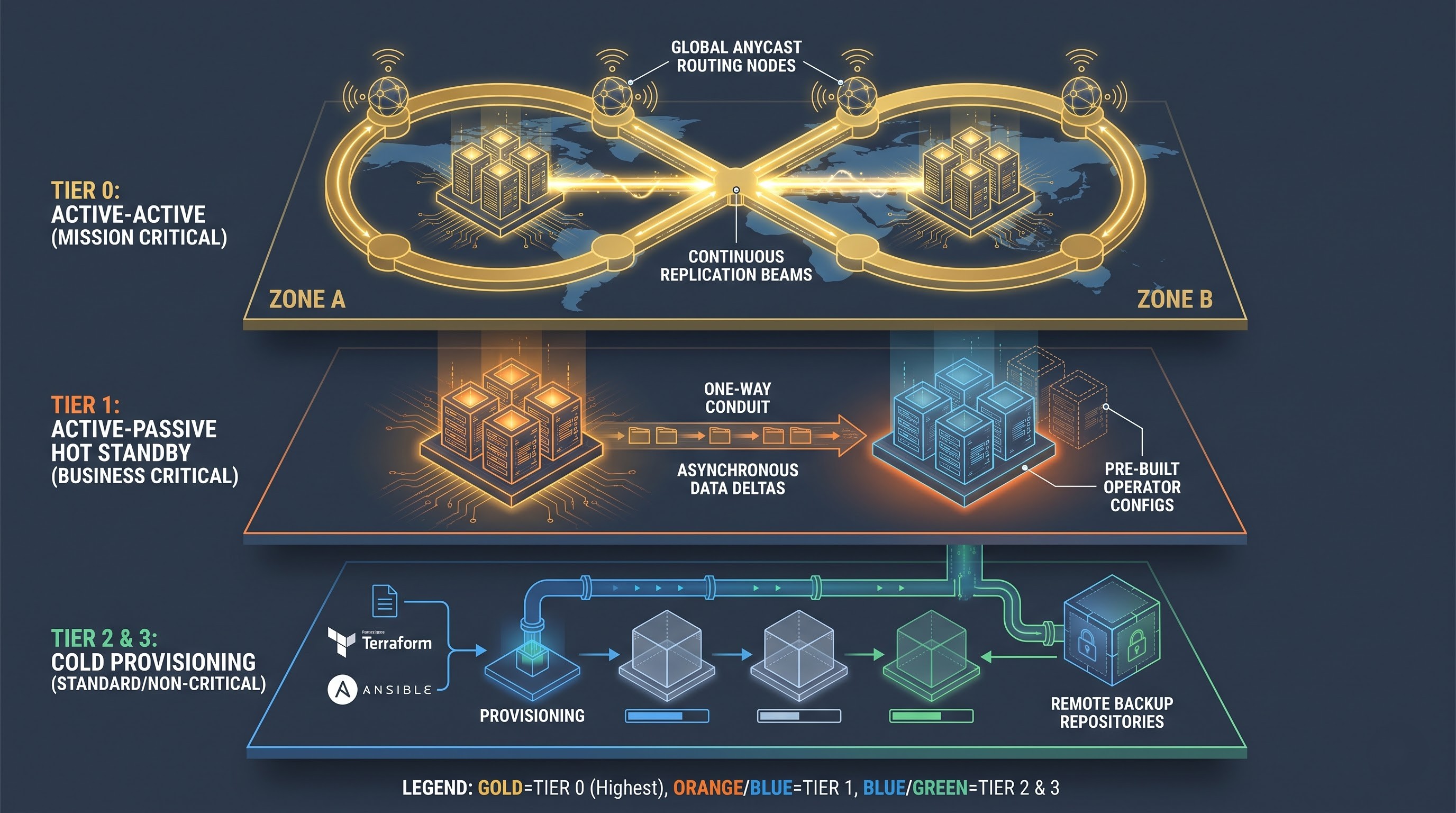
Tier Zero (crucial applications): RPO and RTO almost zero, architecting systems based on active-active or hot-standby solutions with permanent replication of data across sites.
Tier One (business operators): RPO is less than one hour; RTO equal to four hours with regular tasks performed automatically.
Tier Two (companies’ internal needs): RPO equals RTO value; backup is made with daily processing.
Tier Three (developmental and testing): stateless systems requiring repositories but without persistent volumes.
Disaster Recovery Topology Models
The choice of appropriate disaster recovery topology is highly dependent on the application architecture, the distance of the data storage, distributed applications, and the budget. OpenShift implementations use three main topologies in enterprise production.
Active-Active Multi-Cluster Architecture
In this topology, two or more completely independent OpenShift clusters operate in different geographic areas or data center sites, handling live traffic simultaneously. Global traffic management solutions including intelligent Domain Name System or anycast routing distribute the incoming traffic to different locations based on latency, health status, and processing capacity.
Data replication in the active-active design is the most challenging part. Having an active-active topology requires either distributed databases with multi-region consensus capabilities or distributed storage systems that synchronize on low-latency links. Thus, while this model achieves the shortest possible RTO and RPO, it consumes large amounts of resources, follows strict requirements for latency, and may require a complicated architecture of applications built on top of it.
Active-Passive Hot Standby
A hot standby active/passive configuration comprises a fully functional OpenShift cluster in a standby location that does not experience the current application workload. The cluster’s infrastructure is built up in advance, including operator configurations and networking connections that match the primary cluster.
The applications and persistent volumes are continuously copied from the primary to the standby environment. In case of total failure at the primary site, the traffic is redirected to the hot standby and the work is resumed in the standby node. This technique eliminates the slow process of building up the infrastructure in case of disaster and reduces RTO to minutes or hours.
The process of cold disaster recovery involves only a primary cluster that carries out the work for the application. The standby site has only the required computing and storage capabilities; otherwise, there are just top-level cloud account spaces in the cloud with no use.
The continuous stream of the stateful data, configurations, manifests, and the backups of the etcd takes place from the primary cluster toward the remote storage site. In times of emergency, an automated provisioning tool like Terraform or Ansible will create a brand new instance of the OpenShift cluster and lead to the OADP restoration processes.
Although this method requires a minimal investment in maintaining the operating systems, the recovery time for such systems is rather significant. Setting up the OpenShift control plane, configuration of all workers pulling the images through the global network and performing the recovery of a huge volume of persistent storage by the automated tools would require hours. Such a process is very suitable for the situation where long downtimes are allowed.
Importance of GitOps in Disaster Recovery
Modern engineering culture suggests that configuration management is one of the core lines of resilience in technology to be enhanced by GitOps systems.
With the help of tools such as Red Hat OpenShift GitOps (based on Argo CD), it becomes easier to manage cluster state, where all configuration items—from defining namespaces and NetworkPolicies to creating storage classes and configuring cluster monitoring—are stored in a Git repository with versioning enabled. As a result, the Git repository serves as the ultimate source of truth concerning the expected operational state of the platform.
In case of a disaster, such clear-cut differentiation helps speed up recovery:
Declarative Platform Reconstruction: Instead of trying to work through complicated cluster-wide manifests recovered from a backup, GitOps technologies automatically reproduce the target cluster based on the information in the Git repository, reconstructing networks, security requirements, and application definitions almost instantaneously.
Decoupled Storage and State Recovery: Thanks to clear recovery of the infrastructure and application manifests using GitOps, data backup technologies (for example, OADP) can concentrate on what they do best—data recovery of persistent volumes and databases.
This hybrid model eliminates any configuration drift, prevents silent corruption of the cluster, and keeps a detailed log of every single change that was made to the environment.
Pre-Backup Quiescence and Application Consistency
One of the most dangerous misconceptions when it comes to formulating disaster recovery plans is that just taking a storage snapshot is sufficient for ensuring that the database can be recovered. Taking a snapshot while the database is actively writing data means that the image created is in a crash-consistent state which is similar to powering off a physical server improperly. Even though new transactional databases have recovery mechanisms, they should not be relied upon when disaster recovery operations are already undergoing, since this can lead to database corruption, transaction failures, and unbootable DB pods.
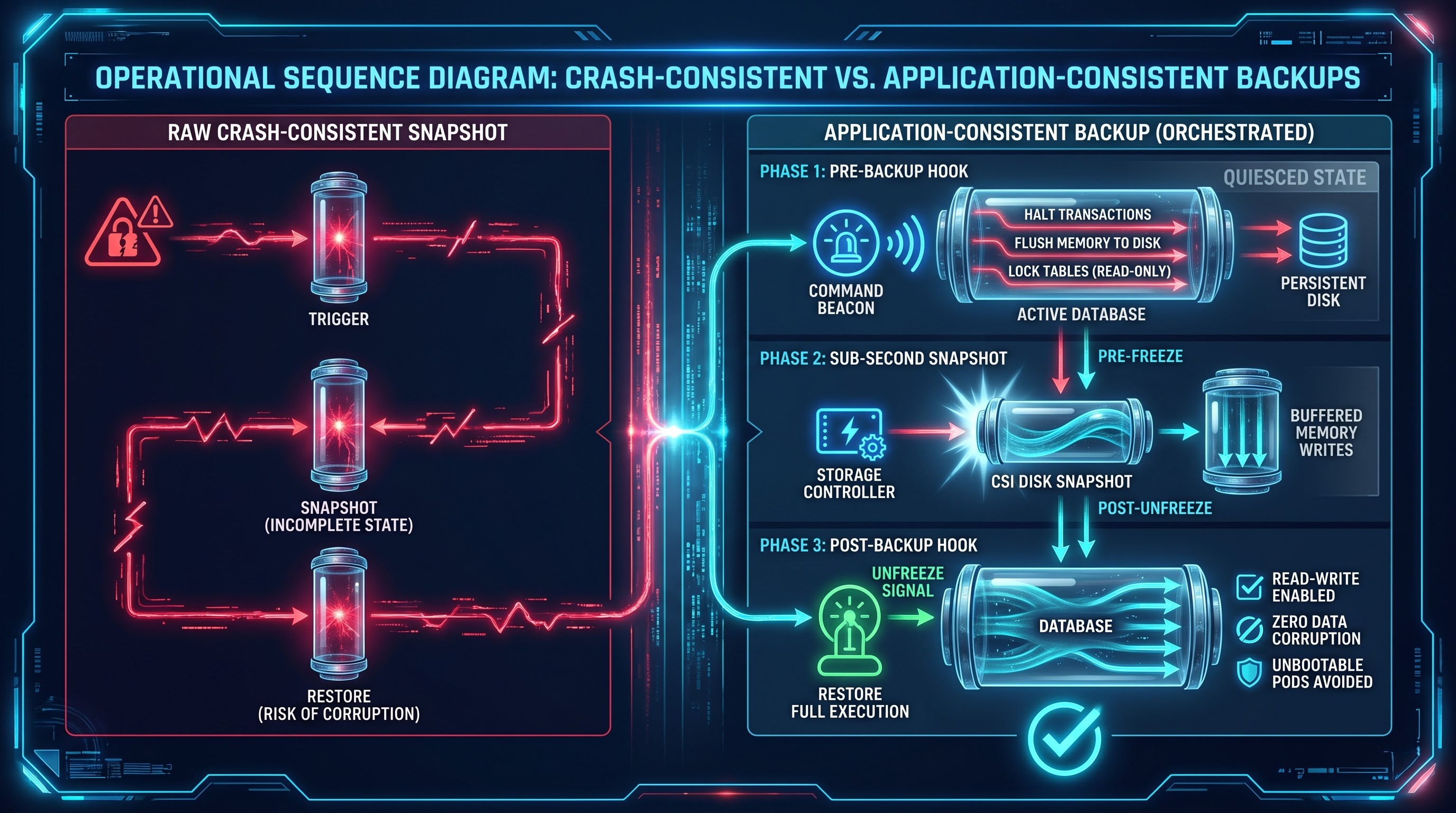
In order to have application-consistent backup, administrators need to employ pre-backup and post-backup lifecycle hooks.
Pre-backup hook is executed right prior to taking volume data persistence snapshot or file system copy. The command acts upon the running application informing it to suspend all ongoing disk writes, trigger in-memory data to be flushed to the disk, and lock the tables in the read-only mode. When the snapshot is initiated this process takes only a fraction of a second, and is followed by the execution of a post-backup hook.
Administrators need to closely cooperate with application development teams to find the relevant database engines and heavily loaded tasks throughout the cluster so that customized backup definitions contain appropriate freeze, flush, and unfreeze commands.
Security, Access Governance, and Immutability
Backup repositories are the main target for cybercriminals. When a ransomware operator or unfortunate insider gains access to cluster credentials, the next action is to locate the backups and remove them from the system, depriving the organization of the possibility of recovery without paying the ransom.
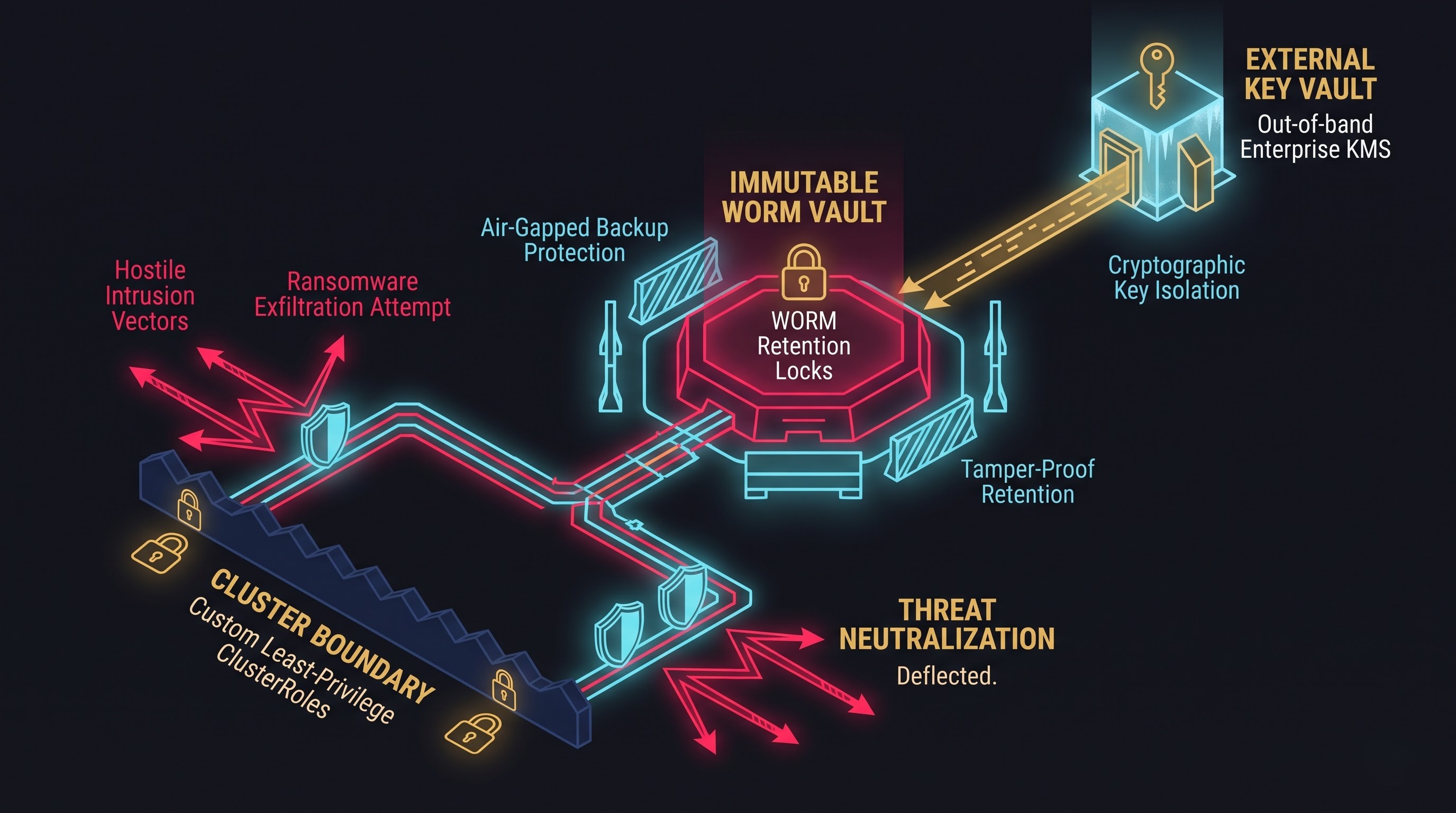
The backup architecture should be protected with defense-in-depth:
Isolated Backup Repositories. Backup repositories must be beyond the control boundary of the OpenShift cluster administration. If OpenShift runs in either public or private clouds, backups should be saved in isolated cloud accounts or in separate storage arrays with their own identity and access management systems.
Unalterable Storage Equipment & Object Locking. Use Write-Once-Read-Many (WORM) storage policies and object locking features for object storage buckets. After the backup has been created, the retention policy should ensure that no one can change it or delete it — not even the cluster administrators — until the time defined already has passed.
Least-Privilege Service Accounts: Backup operators and controllers operating in OpenShift need some sort of elevated access to view namespaces and mount volumes. It is very crucial for organizations to restrict access by implementing custom ClusterRoles and avoid misuse of backup service accounts for lateral movement or executing code on other worker nodes.
Encryption Everywhere: Backups will have to be encrypted during transit using current transport security technology and at rest with unique, client-controlled encryption keys. It is also necessary for backup organizations to have enterprise key vaults located outside of OpenShift to store encryption keys.
Establishing the Resilience: Testing, Drills, and Verification
Disaster recovery is nothing but a hypothesis if it is not tested. Many organizations find out that their backup strategies do not function properly after the primary failure happens, which leads to corrupted backups, lost dependencies, expired certificates, and altered encryption keys.
Companies need to think of ways to convert disaster recovery testing into an ongoing process rather than one-time activities they conduct annually.
Automated Backup Verification
The involvement of human administrators in backup verification can prove to be inconsistent and complicated because of the presence of uncertainties in manual operations. Modern resilience engineering requires utilizing automated backup verification techniques. Platform teams can develop automated steps that regularly establish an isolated staging namespace or a temporary testing cluster, complete the restoration of the latest application and disk snapshots, run virtual smoke tests to confirm the integrity of the database and the reactivity of the service, and shut down the testing environment. In case the restore fails or validation results show an unsatisfactory score, the alerting mechanisms will let the administrators know about it long before situations occur in the production environment.
Simulated Failures and Chaos Engineering
Failure simulation drills should take place on a regular basis in regard to both primary and auxiliary environments. The drills have to target particular failure domains:
Unexpected depletion of a full worker node group.
Unexpected crash and deterioration of control plane nodes.
Overall elimination of out-of-band data storage connection.
Presumed regional cloud breakdowns that demand the DNS switching to alternative disaster recovery clusters.
Drill signifies trouble spots that one never finds in the documentation: old external DNS addresses, forgotten static IPs, secret key absence during deploying.
Documentation As a Dynamic Asset
The documents stating disaster recovery processes should be considered as rigorously as it is done for the code of a product application. Always refrain from unclear and generalized recommendations. Each runbook has to specify all actions to be undertaken step by step, escalation paths, the commands that are to be employed, results expected, criteria for a rollback.
Runbooks should be available in version control repos external to the core OpenShift environment to allow engineers to access them whenever they need.
Establishing a Culture of Platform Resilience
The protection of an OpenShift enterprise ecosystem is not an operational task of secondary importance. With the growth of containerization technology and its ability to support distributed data stores, complex application architecture, and machine learning workflows, the impact of a failure of any component of the infrastructure is notably high.
A robust OpenShift platform is the result of the right engineering principles: making etcd snapshots resistant to control plane crashes, using OADP and CSI snapshots for recovering workloads effectively, keeping GitOps principles for the maintenance of declarative architectures, and using application-consistent pre-freeze hooks. By employing both immutable storage targets and skilled platform teams engaged with automated recovery testing, users can effectively eradicate panic operations. If your team and individual engineers wish to acquire firsthand expertise in handling everything from etcd restoration to GitOps deployment pipelines, enlisting your personnel in an industry-standard openshift full course is an ideal way to prepare your resources for the design of highly resilient and vital infrastructure.