
Red Hat OpenShift: Unpacking Hybrid Cloud & Modern Platform Engineering
Last updated on Sep 10, 2026

Enterprise software infrastructure has reached a pivotal junction. A decade ago, moving workloads to the cloud was seen as the end-state destination for digital transformation. Today, IT leadership recognizes that the cloud is not a single location—it is an operating model. Modern enterprises operate in complex, fragmented environments comprising public cloud providers, private data centers, edge computing locations, and specialized bare-metal hardware.
Managing application deployments across these disparate environments creates immense operational friction. Development teams often find themselves rewriting configuration scripts, adjusting security postures, and re-architecting delivery pipelines every time an application shifts from an on-premises data center to a public cloud environment. Vanilla Kubernetes solved part of this challenge by providing a universal container orchestration engine, but open-source Kubernetes alone is not an enterprise operating system. It requires extensive piecing together of networking layers, ingress controllers, monitoring stacks, security controls, and CI/CD tools before it is production-ready.
This fundamental gap between raw container orchestration and enterprise-grade operational needs is where Red Hat OpenShift takes center stage. By building an integrated enterprise Kubernetes platform equipped with automated lifecycle management, developer-friendly workflows, and unified security, OpenShift acts as the cohesive abstraction layer for modern hybrid cloud architectures.
Beyond Vanilla Kubernetes: What Makes OpenShift an Enterprise Application Platform?
To understand OpenShift, one must first look at the boundaries of vanilla Kubernetes. Open-source Kubernetes excels at managing the lifecycle of containerized workloads—scheduling pods, monitoring node health, handling basic service discovery, and scaling resources based on demand. However, operating Kubernetes in production demands far more than just scheduling containers.
In a raw Kubernetes setup, system administrators are responsible for selecting, integrating, and continually patching dozens of separate open-source tools to build a functional platform. You need a container registry, an ingress controller, a Service Mesh, monitoring dashboards, telemetry collectors, identity management, and persistent storage abstractions. Every upgrade cycle becomes a delicate balancing act, as a version update in one component can unexpectedly break another.
OpenShift transforms this assemble-it-yourself engine into an out-of-the-box, enterprise-ready platform. Red Hat packages core Kubernetes with enterprise-grade networking, baked-in Prometheus and Grafana monitoring, integrated image registries, ingress routing, and hardened Linux foundations via Red Hat Enterprise Linux CoreOS (RHCOS).
The key architectural differences focus on operational overhead and developer experience:
Automated Cluster Upgrades: OpenShift utilizes automated Over-The-Air (OTA) updates, upgrading the underlying operating system and Kubernetes control plane simultaneously without service downtime.
Integrated Developer Workflows: Rather than forcing developers to write complex Dockerfiles and YAML manifests from scratch, tools like Source-to-Image (S2I) allow teams to point directly to application source code and automatically build secure container images.
Unified Web Console: OpenShift provides specialized dual-perspective consoles—one tailored for cluster administrators managing infrastructure, and another designed for developers focusing on deployment topologies and application health.
Engineers and system architects looking to transition from raw container management to enterprise hybrid cloud operations can build practical hands-on skills through an immersive openshift training online program.
Developer Velocity and Platform Engineering: Source-to-Image and Automated CI/CD
One of the largest hurdles in adopting microservices architectures is the burden placed on software developers. In traditional DevOps implementations, developers are frequently forced to act as infrastructure engineers—writing Dockerfiles, managing container image layers, configuring ingress rules, and troubleshooting deployment scripts. This cognitive overload slows down feature delivery and increases the likelihood of security vulnerabilities slipping into production container images.
OpenShift reframes the developer experience through integrated Platform Engineering principles. The goal is to provide a self-service internal developer platform (IDP) that abstracts away raw infrastructure details while enforcing organizational security standards behind the scenes.

Central to this experience is OpenShift Pipelines and OpenShift GitOps. Built on top of cloud-native open-source projects like Tekton and Argo CD, these tools provide fully declarative, event-driven CI/CD directly inside the cluster.
Key platform features driving developer velocity include:
Source-to-Image (S2I) Framework: S2I takes application code directly from a Git repository, injects it into a curated, pre-tested builder image, and produces a ready-to-run container image automatically. Developers never have to write or maintain a raw Dockerfile.
Declarative GitOps Delivery: By leveraging OpenShift GitOps, the desired state of the entire application cluster is stored in Git. Any commit to the repository automatically triggers cluster state synchronization, ensuring that staging and production environments remain completely drift-free.
Serverless and Event-Driven Runtimes: Built on Knative, OpenShift Serverless enables applications to scale down to zero when idle, saving compute costs while dynamically scaling up to handle incoming web traffic spikes seamlessly.
For software engineering teams aiming to modernize legacy monolithic applications into cloud-native microservices, completing an industry-aligned openshift online training course provides a direct path to mastering these deployment workflows.
Enterprise Security and Governance: Enterprise Security Context Constraints and Zero-Trust
Security in containerized environments requires a complete departure from traditional perimeter-based security models. In a multi-tenant enterprise cluster where hundreds of microservices run across shared worker nodes, a single compromised container could potentially allow an attacker to gain root access to the host node or spy on adjacent container traffic.
Red Hat OpenShift is engineered with a default-deny, enterprise-first security posture. While standard Kubernetes historically allowed containers to run with elevated privileges unless restricted by policy, OpenShift enforces strict security boundaries out of the box through Security Context Constraints (SCCs).
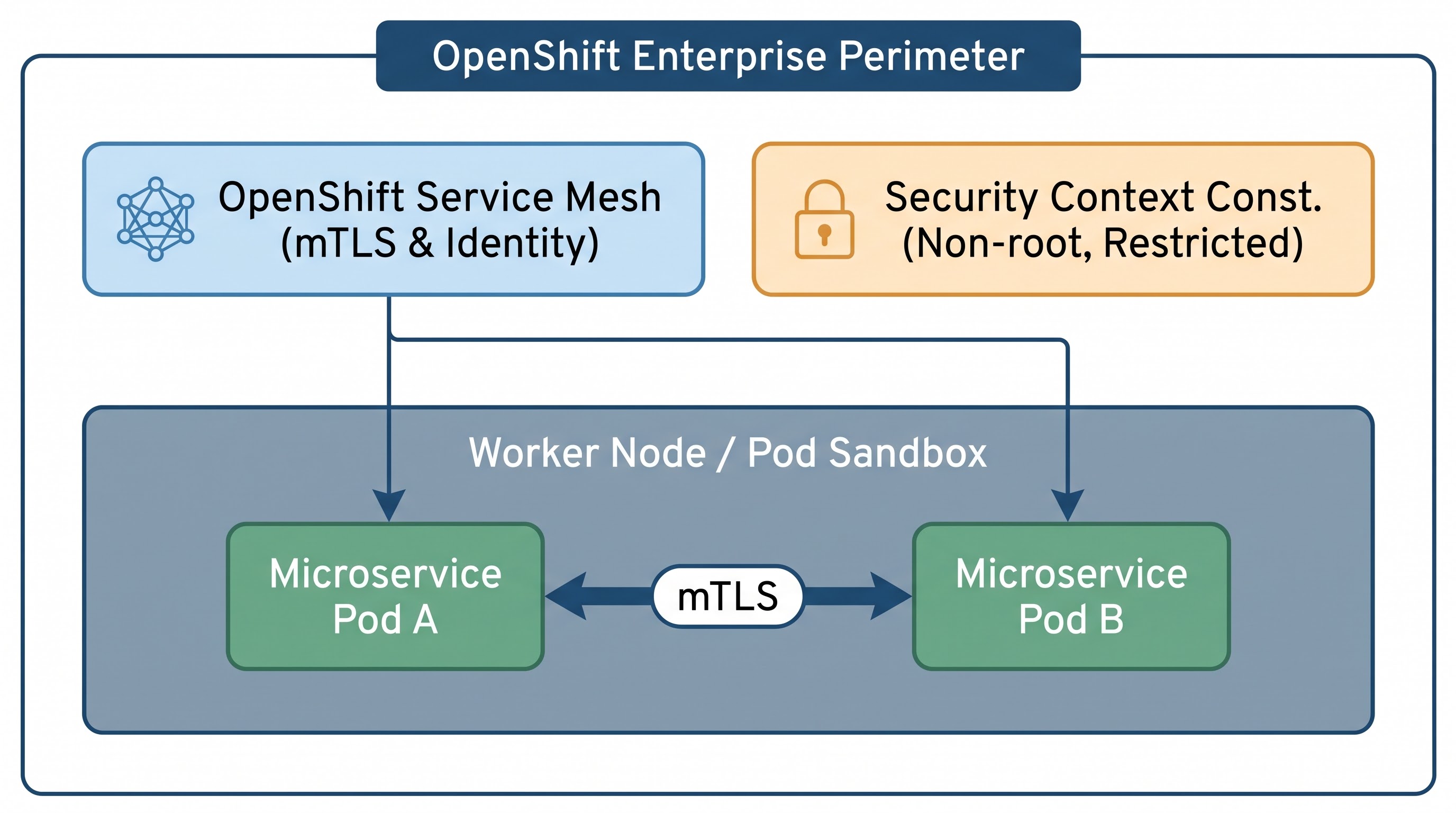
Security enforcement inside the platform operates across several core layers:
Non-Root Container Execution: OpenShift blocks containers from running as the root user by default. Every pod is automatically assigned an arbitrary, unprivileged User ID (UID) upon creation, drastically mitigating container breakout risks.
Integrated OpenShift Service Mesh: Based on Istio, the Service Mesh encrypts all pod-to-pod communications using mutual TLS (mTLS) automatically, while enforcing fine-grained traffic policies and microsegmentation.
Advanced Identity Provider (IdP) Integration: Out of the box, OpenShift integrates seamlessly with enterprise identity solutions such as Active Directory, Keycloak, OAuth, and Okta, enabling Role-Based Access Control (RBAC) at scale.
Automated Vulnerability Scanning: Integrated registries scan container images continuously for known Common Vulnerabilities and Exposures (CVEs), blocking vulnerable images from ever being deployed to worker nodes.
IT professionals, cloud architects, and security specialists seeking to master enterprise cluster hardening and multi-tenant isolation should consider enrolling in a comprehensive openshift course online to gain practical expertise.
Hybrid Cloud and Multi-Cluster Orchestration: Red Hat Advanced Cluster Management
As enterprises expand their footprint, managing a single OpenShift cluster gives way to managing dozens—or even hundreds—of distinct clusters across disparate environments. A global organization might run production clusters on AWS and Azure, compliance-restricted workloads on-premises via VMware or bare metal, and localized processing nodes at edge locations.
Operating multiple distinct Kubernetes clusters manually introduces significant operational complexity, audit difficulties, and configuration drift. Red Hat addresses this multi-cluster reality through Red Hat Advanced Cluster Management (RHACM) and Red Hat OpenShift Data Foundation (ODF).
RHACM acts as a centralized control tower for an entire Kubernetes estate, offering unified visibility and automation across three main domains:
End-to-End Cluster Lifecycle Management: Administrators can provision, upgrade, and decommission clusters across public clouds and bare-metal environments from a single unified pane of glass.
Policy-Based Governance and Compliance: Security teams can define governance policies (such as forcing encryption at rest or requiring specific RBAC roles) once, and RHACM will automatically enforce those compliance standards across every connected cluster worldwide.
Application Lifecycle Management: Operators can deploy application stacks across multiple clusters based on placement rules—automatically shifting traffic or scaling applications based on regional capacity or cloud availability.
Additionally, OpenShift Data Foundation provides cloud-native, software-defined persistent storage that moves transparently with applications, enabling seamless workload migration and disaster recovery across hybrid cloud boundaries.
Modernizing Legacy Workloads: OpenShift Virtualization (KubeVirt)
While cloud-native microservices represent the future of enterprise software, the reality inside most corporate data centers is that legacy virtual machines (VMs) still handle critical core operations. Historically, organizations were forced to maintain two completely separate operational silos: traditional hypervisor infrastructure for monolithic VMs, and modern Kubernetes platforms for containerized applications.
Maintaining these dual infrastructure stacks incurs massive software licensing fees, requires duplicate operations teams, and creates complex integration hurdles between legacy backends and modern frontends. OpenShift Virtualization, powered by the open-source KubeVirt project, solves this problem by allowing virtual machines to run natively inside OpenShift clusters alongside containers.
By bringing VMs into the Kubernetes control plane, enterprise teams gain significant operational benefits:
Unified Networking and Storage: Virtual machines connect directly to OpenShift Software-Defined Networking (SDN) and persistent storage volumes, allowing pods and VMs to communicate at ultra-low latency without traversing external firewalls.
Single Operations Pipeline: System administrators use the exact same GitOps pipelines, monitoring stack, and RBAC policies to manage both legacy virtual machines and modern microservices.
Gradual Monolith Refactoring: Teams can migrate a legacy VM directly into OpenShift, place a modern API gateway in front of it, and slowly break out services into microservices over time without changing underlying infrastructure platforms.
The Path Forward for Modern Infrastructure Engineers
Red Hat OpenShift has evolved far beyond a simple container management wrapper. It stands today as a unified hybrid cloud application platform that bridges the gap between legacy virtual machines, modern microservices, and edge computing workloads. By providing automated lifecycle operations, built-in security, and developer-first workflows, OpenShift eliminates the operational friction that plagues raw Kubernetes deployments. For IT professionals, system administrators, and software architects, mastering this enterprise platform is one of the most effective strategies for advancing a career in modern cloud engineering, platform engineering, and hybrid infrastructure management.
Navigating the Paradigm Shift: From SysAdmin to Platform Engineer
The rise of enterprise Kubernetes platforms has fundamentally altered the role of infrastructure professionals. Traditional system administration—focused on manually provisioning servers, configuring static networks, and managing isolated hypervisors—is no longer sufficient for cloud-native organizations. Today’s infrastructure engineers operate as Platform Engineers, responsible for building internal developer platforms (IDPs) that turn raw computing resources into frictionless self-service environments.
Mastering OpenShift enables engineers to operate at this higher level of abstraction. Instead of treating infrastructure as a series of individual servers, engineers manage complete environment topologies declaratively using code. This shift unlocks significant operational advantages:
Infrastructure as Code (IaC) Mastery: Defining entire cluster configurations, security policies, and application routes through declarative custom resource definitions (CRDs).
Operational Resilience: Transitioning from reactive troubleshooting to proactive site reliability engineering (SRE), relying on automated health checks, operator-led self-healing, and dynamic resource rebalancing.
Business Alignment: Direct connection between infrastructure operations and developer velocity, directly impacting how quickly features reach production securely.
Conclusion: Future-Proofing Your Career in a Hybrid Cloud World
The enterprise tech ecosystem is moving toward hybrid, multi-cloud reality. The future does not belong to a single public cloud vendor or a isolated private data center, but to the operational layer that connects them securely. OpenShift provides this unifying foundation—allowing organizations to innovate fast without sacrificing control, security, or legacy infrastructure investments.
For IT professionals and software engineers, investing time in mastering OpenShift is more than learning a single cloud tool. It is an investment in understanding modern cloud-native architecture, automated operational governance, and scalable platform design. By grounding your expertise in these core principles, you build a future-proof technical foundation capable of driving digital transformation across any enterprise landscape.