
ServiceNow AI Agents: The Future of Enterprise Workflows
Last updated on Oct 7, 2026
The current enterprise technology situation is unprecedented. For the last thirty years, the baseline for digital transformation has been limited to digitization, involving the transfer of paper records and analog processes into relational databases that are in turn structured through workflows and operated manually by users through the graphical interface. Among them are enterprise resource planning, customer relationship management, and IT service management systems that allowed for data processing but did not address the root cause of operational inefficiency. Human professionals were still acting as the glue that ensures the connection between isolated databases, handovers between departments, and the use of unlinked software.
The rise of generative artificial intelligence has initially brought in conversational interfaces, summarizers, and digital assistants. These interfaces allowed employees to draft emails faster, summarize incident logs, and search knowledge bases with ease. However, the previous generation of digital assistants did not solve the central enterprise issue. In the assisted assistant format, human presence is required in every loop of operation: the assistant makes a suggestion, and humans still need to make the choice and manually enter everything.
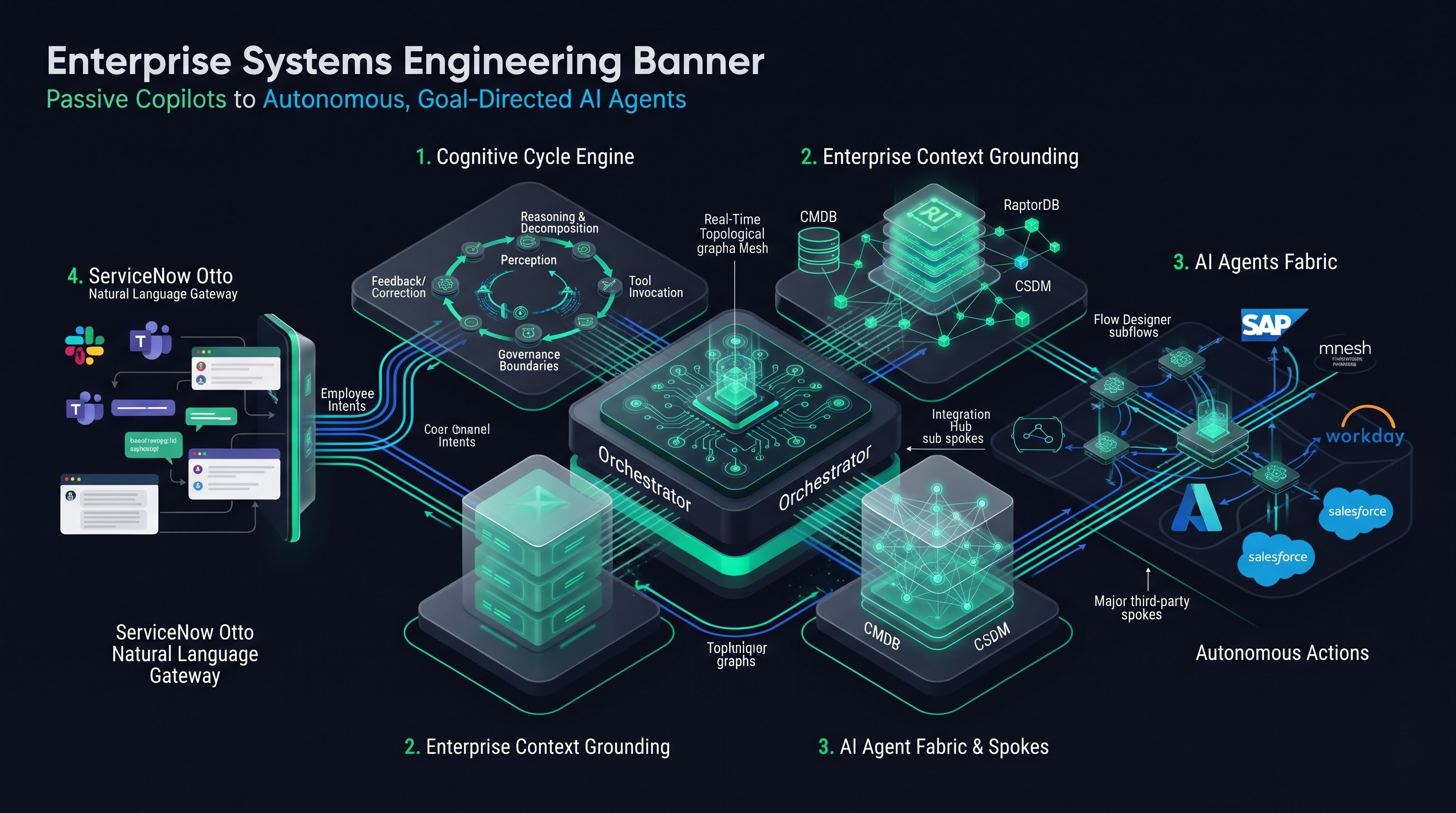
ServiceNow has embarked on a new structural paradigm by inventing and implementing autonomous AI Agents. This introduction of ServiceNow AI Agents marks the start of the age of the agentic enterprise, in which autonomous digital workers perform various actions. These agents can understand complex environments, consider multi-step operational issues, act across organizational borders, take platform-level action and improve their performance based on the feedback they receive.
Servicenow has transformed enterprise software from a passive tool to an active one through the use of autonomous agents in key IT functions like customer service, HR, and governance, making it necessary for users to go through servicenow online training programs in order to effectively utilize the platform.
Improvements of enterprise automation: from rigid rules to autonomous agents
To understand the changes caused by autonomous agents, it is proposed to consider the drawbacks of the workflows used in the previous two decades.
The Age of Deterministic Scripts and Static Processes
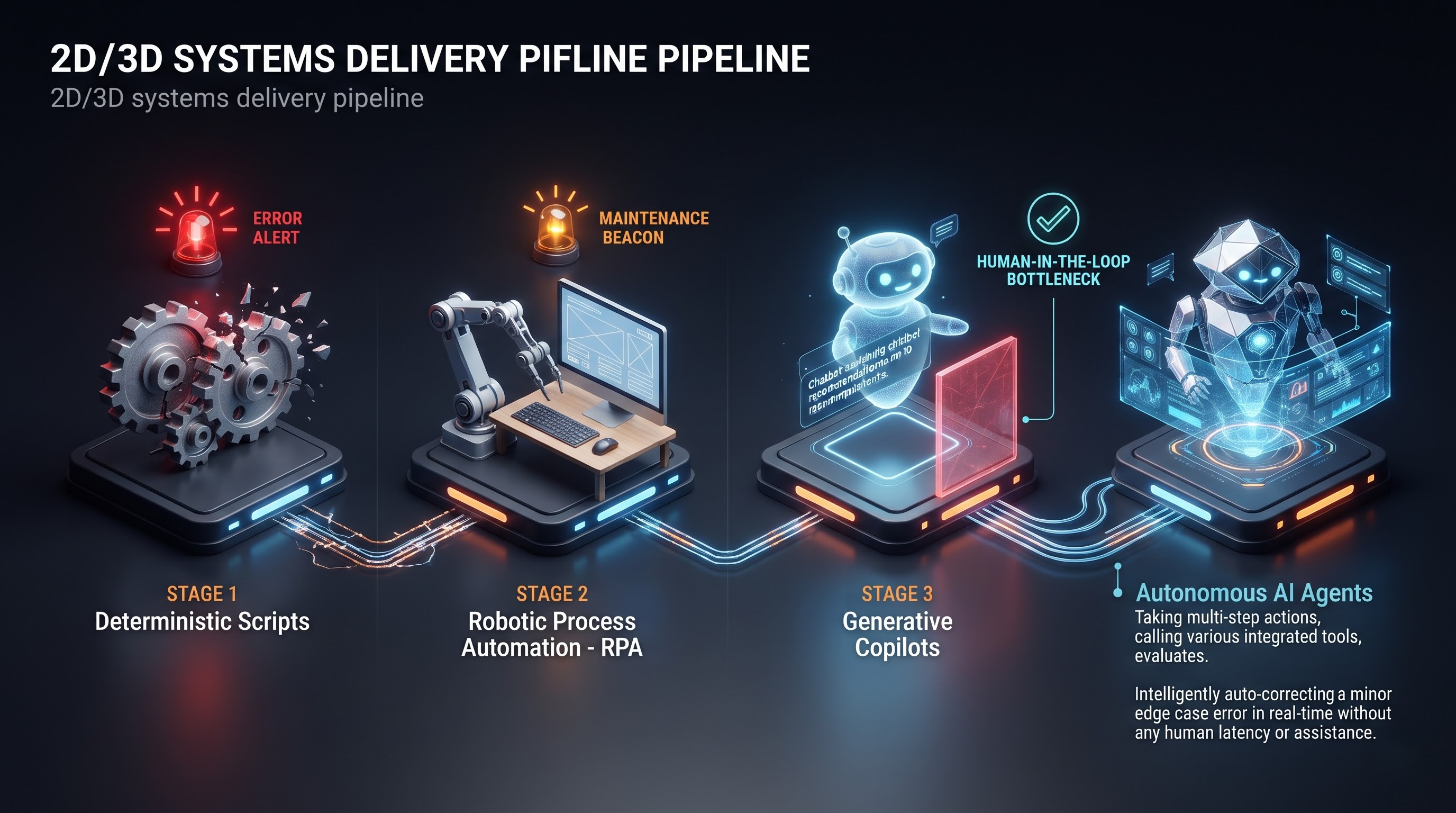
In the early era of enterprise IT automation, operations were performed solely using deterministic rule-based scripting. As an example, whenever a server went over a certain value regarding its memory usage, an alert was triggered to issue a shell script to delete the temporary files. The same holds when an employee makes an onboarding request in which a sequential process triggers predetermined tasks from a service catalog.
While deterministic automation allows it to be predictable in terms of structure, it is actually very fragile. Administrators must think in advance of every possible scheme of action, conditions, and points of failure while designing the system. Once an unexpected situation occurs, such as a user describing his problem in an unclear manner, or an undocumented middle failing, or an external cloud service presenting a new error code, the rule-based engine breaks down causing the system to stop and putting the transaction to manual queue for processing.
The Emergence of Robotic Process Automation
Robotic process automation originated as a solution for connecting various legacy systems by imitating human behavior at the front-end level. Thanks to the possibilities of screen scraping, keyboard macro recording, and surface-level automation, it became possible for organizations to transfer information from older mainframe systems to newer web applications without the need for any changes to existing networks.
Unfortunately, robotic process automation suffered the same limitation that made deterministic scripting tedious. Any minor update in the interface of the application being processed, network speed fluctuations, and unpredictable data formats could easily make it impossible for the software robot to carry out its assigned functions. The amount of required maintenance work increased dramatically, and robotic process automation completely lacked cognitive abilities. While the robot was capable of transferring the data from one screen to another at high speed, it did not possess the skills necessary for understanding the meaning of the data, verifying its authenticity, or making decisions in case of exceptions.
The Age of Generative Copilots and Passive Helpers
When large language models entered the world of business, developers initially decided to focus on implementing conversational copilots. The first versions of Now Assist on the ServiceNow platform resulted in the significant increase in productivity as they converted overflowing conversation threads into brief summaries, wrote the first knowledge base articles based on solved incidents and gave conversational answers to questions asked via the self-service portal.
However, copilots could not change the cost structure of business because they had a major design shortcoming: reliance on humans for execution of operations. Every task required a person to read the recommendation, verify the facts, press the confirmation buttons, and perform the necessary updates in the system. Although productivity of a person improved, collective business velocity was still limited by the scope of human availability, fatigue, and the need to switch from one context to another.
The Age of Ambivalency: The Intelligent Agent
Ambivalence has nothing in common with passive cognitive assistance. An AI agent is neither a reactive chatbot waiting for the commands nor a tight script acting according to preprogrammed code. It is an autonomous goal-oriented entity that has five major features:
Perception refers to the capability of ingesting and processing structured relational records, non-structured human communications and streaming events and telemetries.
Reasoning and decomposition refer to the brain’s capacity to understand the general business goal, measure the actual constraints of the environment, decompose the goal into steps and to modify the step priorities based on desynchronized information.
Tool invocation refers to the ability to perform actions on the platform as the native authority and at the same time to use the abilities of different programming interfaces to work with databases and discover knowledge.
Governance awareness refers to the organism’s adherence to security policies of the organization and to the policies of access management.
Feedback means the ability to evaluate results of actions against payment goals and understand whether the result of the operation was reached or not and to fix problems in case of errors and to forward the problems to human specialists if the problem is unsolvable.
Unlike traditional messaging, ServiceNow’s AI Agents not only recommend what actions should be undertaken by a human employee in order to fulfill a task but rather act as a separate workforce ready to fulfill complex business operations end-to-end.
Architectural Foundations: What Makes ServiceNow Different?
Technically speaking, running autonomous software agents within the enterprise is a different business compared with the implementation of consumer-oriented agents. In enterprise applications, system malfunctions can affect billing processes, security breaches can lead to legal implications, and automated processes should be thoroughly audited for compliance purposes.
ServiceNow can boast about its successful implementation of AI agents partly due to the fact that it is embedded within the structure of the company. It is built into the multi-instance structure of the ServiceNow platform, its integrated data model, and well-defined business logic.
AI Agent Studio: Design, Rules for Use, Skill Mapping
It is necessary to have a very simple and strictly monitored administration interface for making enterprise class agents. With servicenow training on tools such as Flow Designer subflows, REST APIs and Integration Hub spokes, the users will learn to use the tools properly and thus effectively define skills and responsibilities.
Within AI Agent Studio, agents are developed along four preset architectural dimensions:
Role and Identity: Administrators set the agent's identity, scope of operations, and area of specialization. An agent can be given a name like "Access and Identity Governance Specialist" or "Exception Handler for Order Processing."
Formulating Objectives: The system architect does not hard-code explicit steps rather he/she expresses the final target achieved by the machine using structured natural language along with rules and regulations. The agent knows the destination but is free in its operations.
Available Resources: The agent cannot execute unrestricted and uncontrolled code. It gains access to tools that it is authorized to use. These include Flow Designer subflows, Integration Hub spokes, REST API, and database search terms. The system makes sure that every action is correctly executed.
Agent's Operations Boundaries: The administrator sets semantic limitations for the agent, redaction of the information, maximum iteration, and fallback/default requirements.
AI Agent Orchestrator – An AI Tool for Planning and Executing Services
ServiceNow’s AI Agent Orchestrator serves as the backing technology behind the agent. Whenever there is an event, incident, employee order, or customer inquiry received by the platform, the Orchestrator assumes the role of the operation manager.
Different from traditional workflow systems that can only assess certain if-then parameters, the AI Agent Orchestrator employs advanced reasoning models to dynamically plan the necessary actions.
Here’s how the Orchestrator processes the incoming event:
It assesses the received event based on past results, current business data, and details about the company.
The next step taken by the Orchestrator is creating the so-called execution plan—a dependency graph.
The last step of the Orchestrator is delegating each small subtask to the relevant digital agent.
Finally, it closely monitors the progress of the workflow, and in case of an error with a tool that is used, the Orchestrator does not stop the workflow but rather finds a way of fixing the problem.
Enterprise Context Grounding: CMDB and RaptorDB
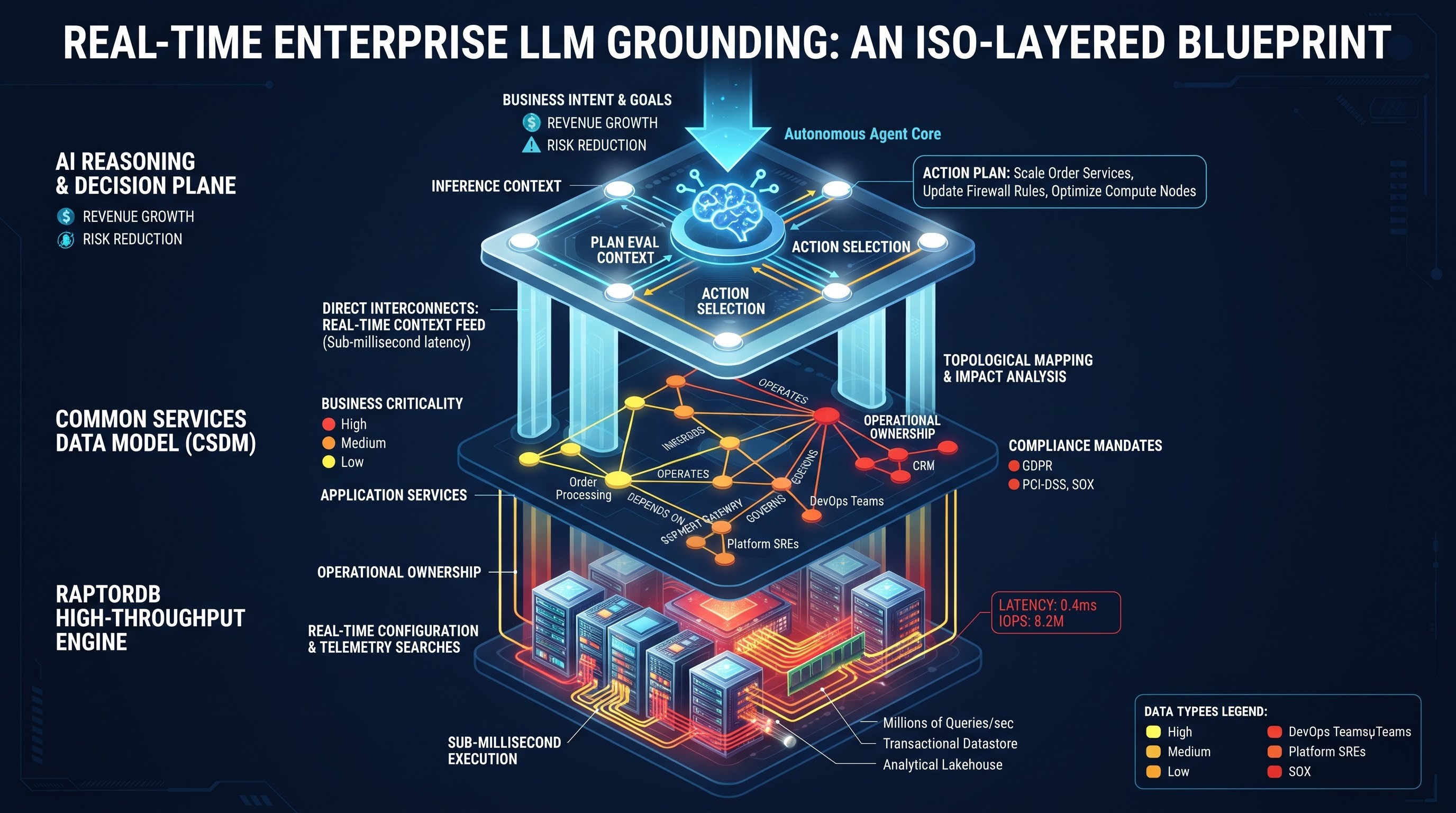
An advanced reasoning engine is of no use without an enterprise context. Ordinary fundamental models are defeated by corporate IT and operational environments because they don’t understand the company topology: which virtual machines are behind customer payment gateways, which employees report to which organization heads and which business impact levels apply to certain operational assets.
ServiceNow offers an incredible advantage in grounding AI. This advantage is Configuration Management Database (CMDB) and Common Services Data Model (CSDM). When an AI Agent is trying to solve an infrastructure failure or an operational inquiry, it will have full topological awareness and will be able to do the following:
- Query the CMDB for dependencies between infrastructure components, microservices, databases, and customer-facing business services.
- Use CSDM to assess business criticality, ownership chains, and regulatory compliance requirements.
- Powered by RaptorDB, ServiceNow’s proprietary high-throughput and low-latency database engine meant for enterprise transactional and analytical workloads, the agents will be able to perform millions of searches of configuration items, historic incidents and real-time telemetries in milliseconds providing full situational awareness before the action takes place.
The agent is less likely to make irrelevant assumptions and perform irrelevant interventions because its judgment is based on the immediate enterprise configuration data.
AI Agent Fabric and Ecosystem Interoperability
The present-day global companies are extremely diverse in terms of their software applications they deal with. ServiceNow is a leading enterprise that provides its solutions on top of the richest platforms like SAP, Workday, Salesforce, Microsoft Azure, Amazon Web Services, and many custom platforms.
In order to get rid of these operational silos, ServiceNow developed AI Agent Fabric which takes the function of a secure intermediary layer which allows ServiceNow agents to establish partnerships with the external software as a service providers, language models and agents.
By virtue of the application programming interfaces, communication protocols and Integration Hub spokes, an agent has created a sequence of actions where it can interpret the inventory ledger from the SAP system, check the employee profile within the Workday, change the account status in Salesforce, and provision resources at Azure. ServiceNow is recognized as the leading control system for agent's work across the platforms.
ServiceNow Otto: The Comprehensive Natural Language Interface
Even though autonomous agents solve problems seamlessly, human users still need a way to interact with a digital workforce without any obstacles. ServiceNow Otto is the one.
It can be used in mobile applications, on the web, in business communication apps such as Slack and Microsoft Teams, and in self-service tools. It works as an interface that collects intents. When a company employee has a certain request, such as asking for project environments, reporting application performance problems, or starting complex vendor onboarding, Otto makes sense of the request, collects information about it, processes it via the AI agent orchestrator, and informs the user about the performance during the whole process.
Multi-Agent Systems in Action: Collaboration of Digital Workforces
In traditional automated software architecture, one script or agent is expected to control the whole workflow from beginning to end. However, this approach does not work in complex businesses where the use of one agent is not functional.
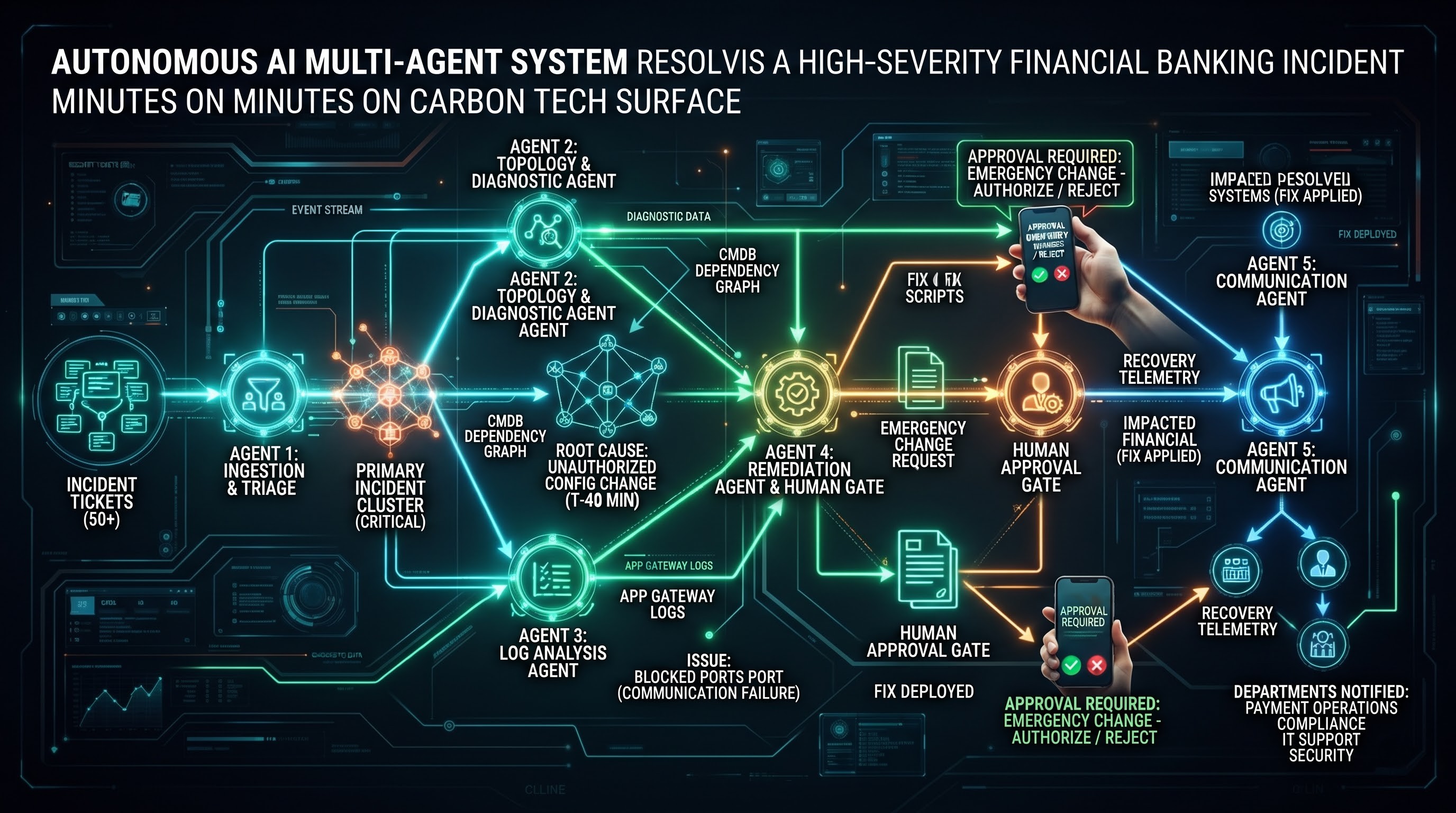
ServiceNow employs Multi-Agent Systems (MAS). Instead of depending on a single comprehensive agent, it utilizes different agents possessing specific skills that work cooperatively.
Agents in the system come with specific operational areas, uncovers optimal context windows, and limited capability of analytical instruments. The messages between the agents are carried out through structured event messages provided by the AI Agent Orchestrator.
Take into account the way multi-agent systems manage an incident of a significant scale occurring in a financial enterprise:
For a start, the Ingestion and Triage Agent catches sight of an unusual number of tickets claiming issues with transactions recorded through an online banking portal. It groups all of the tickets and finds out that these were going through the infrastructure issues and thus, eliminates the confusion absorbing fifty incidents in the process of solving one main incident.
Next, the Topology and Diagnostic Agent comes into play. It reviews the affected banking service and uncovers its intricacy in terms of relationships in the CMDB and service dependencies available within the microservice and cloud networks. It manages to identify that a setting change was made to the system application about forty minutes ago.
The Diagnostic Agent sends its telemetry results to the Log Analysis Agent. This specialized agent analyzes the logs from the application gateway and matches the error traces with the vendor’s technical guidance and in-house knowledge, thus concluding that the configuration change has inadvertently blocked a vital inter-service communication port.
The Remediation Agent now takes over. As changing security settings within the production environment carries some business risks, it does not implement changes on its own. It collects the findings of the Diagnostics Agent, prepares an Emergency Change Request, attaches a verified remediation script, and sends a high-priority notification to the mobile device of the on-call Security Operations Manager regarding the request.
Once the human manager taps the “Approve” button, the Remediation Agent resumes its operations. It connects to the deployment process, implements the configuration fix, collects real-time telemetry concerning payment transactions for five minutes to ensure that the errors are gone, finishes the Emergency Change Request, solves the main incident, and instructs the Communication Agent to send notifications to the impacted divisions to confirm that everything is back to normal.
As the lifecycle progresses, specific agents operate in harmony. Each digital employee executed tasks that correlated with their field of expertise. Human input entered the process only where a business risk occurred. An operation that took four hours and included persistent coordination of multiple teams now only requires a few minutes of machine activity.
Enterprise Transformations Based on Domains
The operational effectiveness of the AI Agents of ServiceNow can be best demonstrated by their impacts on the various economic activities of every company making part of the corporation’s segments – operations, customer care, human resources, and security management.
Operations and IT Management
IT departments encounter the challenge of digital availability maintenance combined with operational cost management. Typical teams are often overwhelmed with requests of the help desk, alarm sounds, and long triage processes.
Autonomous Request Handling: Everyday admin needs like resetting passwords and supplying software come with an end-to-end settlement. The agent assembles information about the role in a given project, determines if there are enough licenses, gets approval from the manager, connects the identity group with Integration Hub, and gives out credentials in less than two minutes without processing tickets.
Predictive and Self-Healing AIOps: Extending telemetry with autonomous actions enables the agent to find unusual trends before breaking happened. For example, if an enterprise database comes close to hitting connection limits, the agent could identify the problem and install more instances or close existing sessions.
Technical Debt Clearance: The agents work on the cleanliness of the Configuration
Management Database by resolving unmapped items, finding orphaned entries, and clearing up outdated knowledge base articles.
End-to-End Problem Resolution: In case an enterprise client requests information regarding a delivery which has been delayed, the agent verifies the user, checks the warehouse systems, determines if the shipment is being held in customs, makes necessary arrangements with the delivery operators, applies billing credits based on the given regulations and informs the client about the new terms of shipment.
Omnichannel Context Continuity: The agents ensure that all conversations are saved and use both data and emotions coming from the clients.
HR Service Delivery
Disconnected internal portals often complicate straightforward employee requests. HR Service Delivery AI Agents work as a single concierge providing unified services.
Autonomous Onboarding: The onboarding agent coordinates procurement of equipment, access to the workplace, necessary permissions for systems, and the first dates for training sessions.
Confidential Policy Guidance. In case the matter is rather sensitive like parental leave, bereavement or retirement, the agents provide the accurate information according to the local legislation and the employee's duration of service.
Cyber Threats and Basic Security
Threats from cyber criminals work quickly, so manual checks cannot keep risk levels low. ServiceNow Security Operations and Governance, Risk and Compliance functions provide an automated defense system:
Immediate threat response: When it detects a sign of unwanted activity, ServiceNow collects data from different identity logs, inspects process trees, and checks network traffic. If it establishes that the activity was malicious, ServiceNow takes steps to stop the use of endpoints, closes cloud sessions, and resets user credentials.
Constant compliance checks: Instead of waiting for regular audits, ServiceNow works all the time performing compliance checks, validating security configurations, monitoring access rights, initiating automated processes when deviations occur.
Getting Ready For the Agentic Age
The shift towards automation by the autonomous agent will lead to the demand for certified developers and administrators competent to use the modern ServiceNow ecology increasing. Sign up for industry-expert-led service now training online at OnlineITGuru to master real-time configurations, instance management, and automation.