
ServiceNow Is No Longer Just About Tickets It Is Changing How Work Moves Through a Business
Last updated on Sep 3, 2026
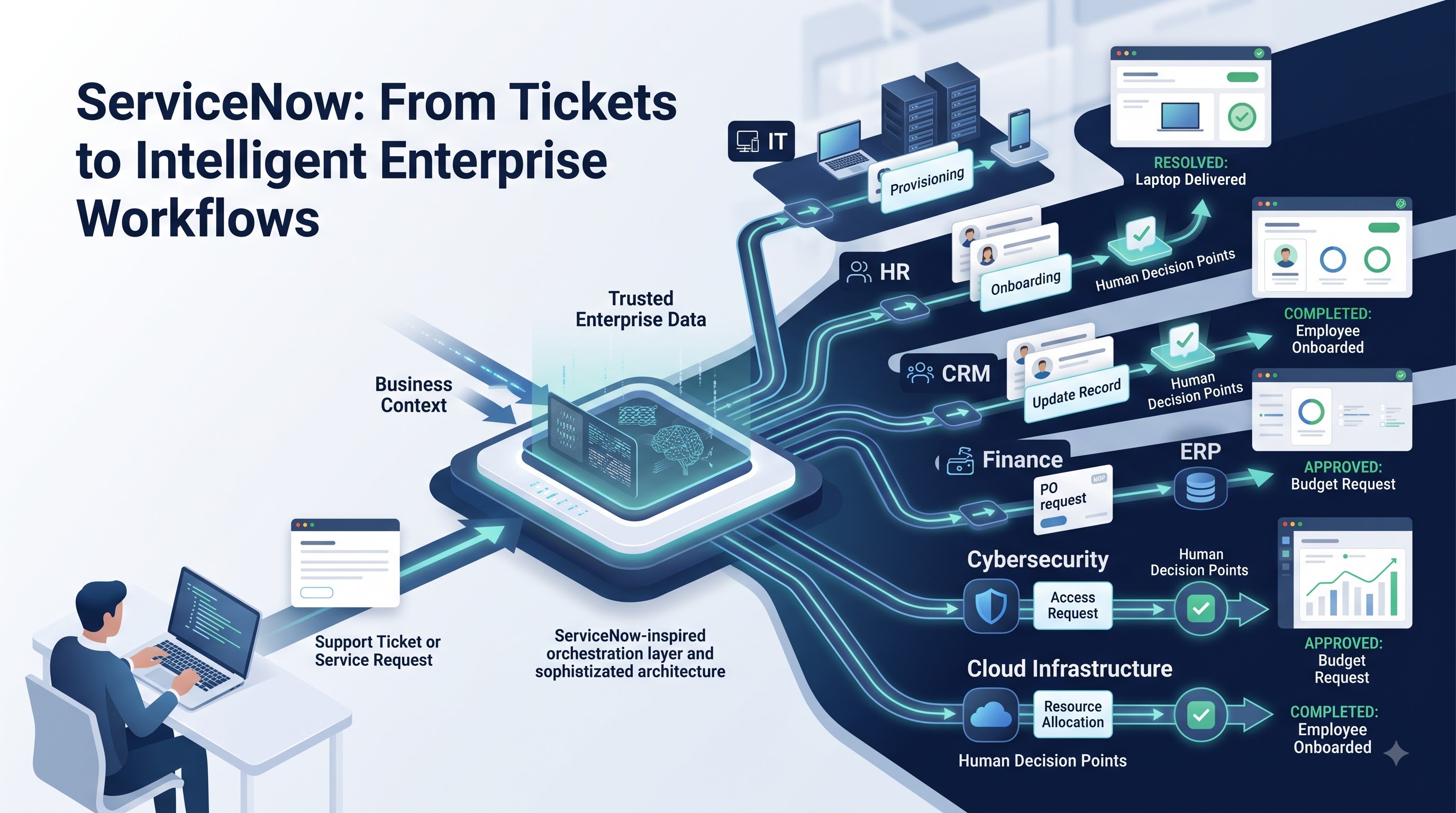
For years, the easiest way to explain ServiceNow was to call it an IT service management platform. Someone had a technical problem, they created a ticket, the ticket reached the right team, and eventually the issue was resolved. It was practical, structured, and far better than managing enterprise requests through endless emails and spreadsheets. But that description is becoming increasingly incomplete.
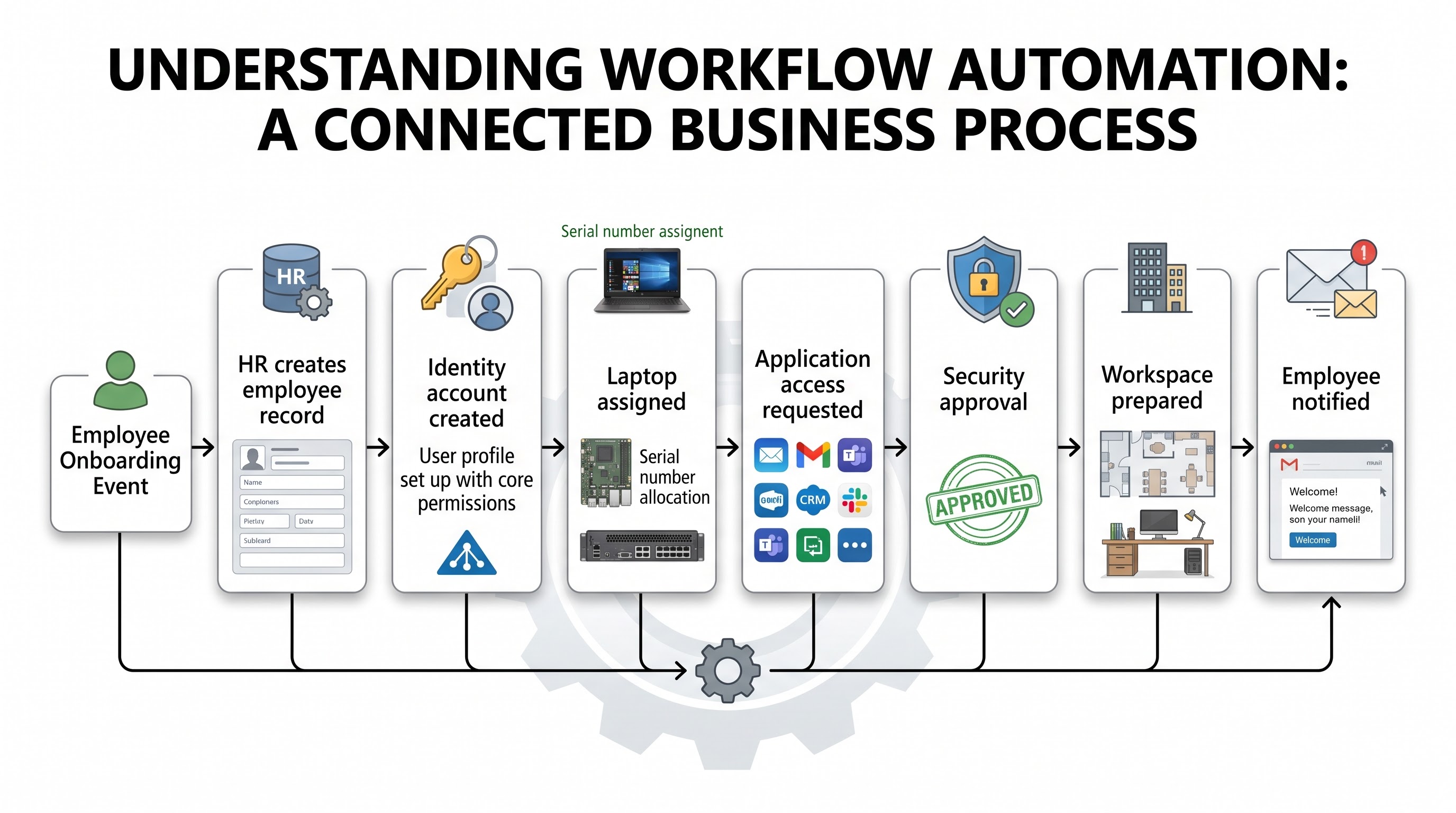
Think about what happens when a new employee joins a large organization. Their arrival may trigger activities across HR, IT, security, finance, facilities, payroll, identity management, and several business applications. The employee sees one experience: “I have joined the company.” Behind the scenes, however, dozens of systems and teams have to coordinate to make that experience work. This is where ServiceNow becomes more interesting.
The platform is increasingly being positioned around workflows, data, automation, artificial intelligence, integrations, and enterprise-wide experiences rather than only traditional IT ticket management. ServiceNow's AI Platform brings together AI, data, and workflow capabilities across areas such as IT, CRM, employee experience, risk, security, and application development. The real story, therefore, is not simply that ServiceNow is adding AI.
It is that ServiceNow is moving closer to becoming a place where organizations can understand work, coordinate it, automate it, and increasingly allow intelligent systems to act on it. And that changes the way we should look at the platform.
The Problem Was Never Really the Ticket
A ticket is only the visible beginning of a much larger business process. Imagine an employee cannot access an application they need for their job. They open a request, explain the issue, and wait. The support team checks the employee's identity, department, role, existing permissions, application requirements, and approval status. Someone may contact the manager, another person may check security rules, and a system administrator eventually grants access.
From the employee's perspective, it was simply an access request. For the organization, it was a chain of decisions and actions involving people, policies, data, and multiple systems. This is the fundamental challenge inside modern enterprises. Business processes rarely belong to a single department anymore.
A request that appears to belong to IT may depend on HR data. A customer issue may require information from finance and logistics. A security incident may involve infrastructure, identity, compliance, and legal teams. The ticket is therefore not the real unit of work. The workflow is.
ServiceNow's workflow capabilities are designed to connect tasks, approvals, systems, and business rules so that work can move from one stage to another without requiring someone to manually coordinate every transition. That sounds technical, but its business impact is much easier to understand.
When work moves automatically, employees spend less time asking who owns the next step. Teams have better visibility into what is happening. Managers can see where processes are getting stuck. And organizations can begin measuring the entire journey instead of measuring isolated tickets. That is a much bigger idea than ticket management.
What Happens When Software Starts Understanding the Journey?
Traditional enterprise software is very good at storing information. An HR system knows who an employee is. A CRM knows who a customer is. An ERP knows about financial transactions. An IT platform knows about incidents, assets, requests, and configuration items. But knowing something happened is different from understanding what should happen next.
This is where workflow automation becomes powerful. Consider employee onboarding again. Once HR creates a worker record, the organization may need to determine which laptop the person requires, which applications should be available, what access permissions are appropriate, whether additional approvals are necessary, and which departments need to be informed.
Without workflow automation, people coordinate these activities manually. With a well-designed workflow, one event can trigger a sequence of actions across multiple systems. The important point is that automation does not simply make individual tasks faster. It connects tasks that previously existed as separate pieces of work.
That is why a workflow platform can become strategically important. It creates a layer between the organization's systems and the people using them, allowing information from one process to trigger action in another. Once that layer exists, the organization can start asking much more interesting questions: Which steps genuinely require a human? Which approvals are unnecessary? Where does work repeatedly get delayed?
Organizations can also examine which requests can be resolved automatically and where a lack of information prevents a decision. And perhaps most importantly, they can ask where intelligence can improve the process instead of simply accelerating it. That last question leads directly to AI.
AI Changes What Automation Can Actually Do
Automation itself is not new. Organizations have been automating repetitive processes for decades. A simple rule can send an email, update a record, create a task, or route a request to a particular team. The limitation is that traditional automation usually depends on clearly defined instructions. If this happens, do that. If the request belongs to this category, send it here. If the employee has this role, give them this access. These rules work extremely well when the situation is predictable. Real business conversations, however, are not always predictable.
An employee might write, “I am moving to another location next month and need everything updated before I start working there.” That sentence does not look like a conventional form submission. It contains intent, context, timing, and an implied set of actions. This is where AI can add a new layer to enterprise workflows.
Instead of requiring every request to be translated into a rigid set of fields before the system can understand it, AI can help interpret natural language and identify what the person is actually trying to accomplish. ServiceNow's AI capabilities are designed to bring generative AI and AI agents into enterprise workflows, allowing systems to work with organizational data and take action within business processes.
That creates a progression worth noticing. Traditional automation asks “Which rule applies?” AI-assisted automation can begin asking “What is this person trying to accomplish, and what needs to happen to achieve it?” That is a very different way of thinking about enterprise software.
The Real Promise of AI Agents Is Not Conversation
AI assistants are useful because they can communicate naturally. But conversation is not the most important part of an enterprise AI agent. Action is. Imagine an employee tells an internal assistant that their laptop is repeatedly disconnecting from the company network. A conventional chatbot might provide troubleshooting instructions or point the employee toward a knowledge article.
An AI agent connected to enterprise workflows could potentially do considerably more. It could understand the problem, retrieve relevant information about the employee and device, consult available knowledge, determine whether the problem matches a known issue, initiate an appropriate workflow, update the case, and escalate it when human intervention is required. ServiceNow describes AI agents as systems capable of planning and carrying out tasks across workflows and enterprise functions rather than simply generating conversational responses.
That distinction matters because businesses do not ultimately need another system that talks. They need systems that help work get completed. A conversational interface may be the front door, but the workflow behind it is what creates the actual business value.
The future experience may therefore feel remarkably simple to the employee: they explain what they need, the system understands the intent, the relevant information is gathered, the appropriate workflow begins, the work progresses, and the employee receives the result. Behind that simple experience, however, there may be a complicated network of policies, integrations, approvals, data sources, and automated actions.
That complexity does not disappear. It simply becomes less visible to the person who needs the outcome.
Intelligence Is Only Useful When It Has the Right Context
Enterprise AI has a major, easy-to-overlook problem. An intelligent model can still make a poor decision if it does not have reliable business context. Suppose an employee asks whether they should have access to a financial application. General AI knowledge cannot answer that question safely.
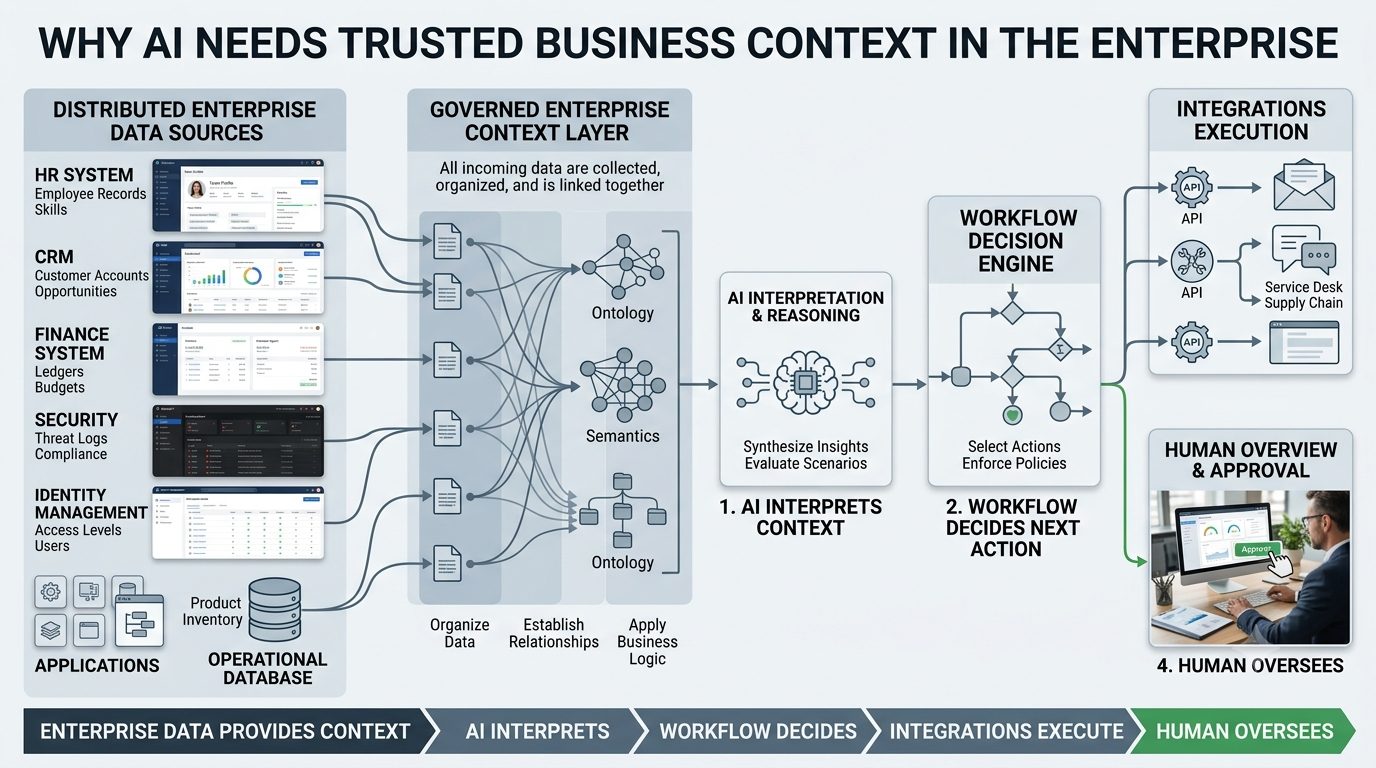
The correct answer depends on the employee's role, department, location, responsibilities, security policies, approval requirements, and current permissions. The answer lives inside the organization's data. This is why data connectivity is becoming just as important as AI itself. ServiceNow's Workflow Data Fabric connects enterprise data across systems and provides business context for workflows and AI while incorporating governance and data lineage. This creates an important relationship between the major pieces of the platform.
Data provides context. AI interprets the context. Workflows determine what should happen. Integrations connect the systems. Governance determines what the system is allowed to do. Without those pieces working together, enterprise AI can become impressive in demonstration but unreliable in production. That is why the future of ServiceNow is not simply about adding larger language models to an existing platform. It is about connecting intelligence to trusted enterprise context and executable business processes.
Why Integration May Be the Most Underrated Part of ServiceNow
There is one fact about enterprise technology that never really changes: organizations rarely operate from a single system. A company might use one platform for HR, another for finance, another for customer management, several cloud environments, identity systems, security tools, databases, legacy applications, and dozens of specialized services. Replacing all of these systems with one platform is neither realistic nor necessarily desirable.
The challenge is making them work together. This is where ServiceNow's integration and automation capabilities become important. Its Integration Hub and Automation Engine are designed to connect applications and automate actions across enterprise environments.
Consider a simple employee request. The employee exists in an HR system, their identity may be managed elsewhere, their device information could be stored in an asset management system, their application permissions may live in another platform, and their manager approval may happen through yet another workflow. ServiceNow can sit in the middle of this process and coordinate the movement of information and actions.
That makes integration more than a technical feature. It becomes part of the organization's operating model. The more systems a company has, the more valuable coordinated workflows become. And as AI agents begin interacting with those workflows, the quality of those integrations becomes even more important.
An AI agent cannot meaningfully complete a task if it cannot reach the systems where the task actually needs to happen.
The New ServiceNow Skill Is Bigger Than Configuration
This evolution also changes what it means to work with ServiceNow. Learning how to create forms, configure tables, manage users, build workflows, and customize applications remains important. Those are foundational platform skills. But they are no longer the entire picture.
A strong ServiceNow professional increasingly needs to understand the business process behind the technology. Why does this request exist? What triggers it? What information is required? Who should approve it? Which parts can be automated? Which system owns the required data? What happens when an exception occurs? Where should a human remain involved? How should success be measured?
These questions require more than technical configuration. They require process thinking. This is one reason a servicenow course should ideally be approached as more than a collection of platform tutorials. The most useful learning experience connects configuration with real business scenarios, workflow architecture, integrations, automation, and problem-solving.
Someone who only knows where to click may be able to build a workflow. Someone who understands why the workflow should exist can help improve the business process itself. That distinction becomes increasingly valuable as ServiceNow moves deeper into enterprise automation and AI.
Automation Should Not Mean Removing Every Human
Whenever AI and automation enter the conversation, there is usually a familiar concern: if systems can do more work, where does that leave people? The answer depends on what we choose to automate. Consider an IT support team that spends a large portion of its day handling password resets, repetitive access requests, standard device questions, and routine incidents. Automating those activities does not necessarily eliminate the value of the team. It can change where the team's time goes.
Instead of spending hours processing predictable requests, professionals can investigate difficult incidents, improve infrastructure, analyze recurring problems, strengthen security, and work on projects that require judgment. The same principle applies to HR. If routine employee requests can move through workflows automatically, HR professionals can spend more time on organizational development, employee relations, workforce planning, and complex situations. The objective should therefore not be “How many people can automation replace?”
A more useful question is “How much higher-value work can people perform when routine coordination is handled by the system?” That shift matters because good automation does not simply remove human involvement. It redirects human attention toward work where human judgment creates more value.
Governance Becomes More Important as AI Becomes More Capable
There is an important difference between an AI system that generates an answer and an AI system that can change something in an enterprise environment. An incorrect answer can be corrected. An incorrect action can create a real business problem. Imagine an automated agent incorrectly changing a user's permissions, closing a critical incident, approving an inappropriate request, or exposing information to someone who should not have access to it. The more capable automation becomes, the more important boundaries become.
Organizations need to define what an AI system can access, what actions it can perform, which decisions require approval, and when a human must intervene. ServiceNow's AI platform direction includes governance, security, and controls alongside its AI and workflow capabilities, reflecting the fact that enterprise AI cannot be separated from questions of trust and accountability.
This is an important principle for anyone working in the space: Autonomous does not mean unrestricted. The goal is not to create systems that can do anything. The goal is to create systems that can do the right things within clearly defined boundaries.
That is what makes enterprise automation sustainable.
ServiceNow Training Needs to Evolve With the Platform
As the platform expands, the way people learn it also needs to change. A traditional learning path may focus heavily on navigation, administration, configuration, modules, and certification objectives. Those foundations are useful, but they do not completely prepare someone for an environment where workflows are connected to enterprise data, integrations, automation, and AI.
Modern servicenow training should encourage learners to think through complete business scenarios rather than isolated features. For example, instead of simply learning how to configure an incident, a learner could explore an end-to-end situation in which an employee reports an issue, the request is classified, relevant asset information is retrieved, knowledge is consulted, an automated action is attempted, the incident is updated, the employee receives communication, the issue is escalated if automation fails, and the organization measures the outcome.
That kind of scenario teaches something much more valuable than memorizing configuration steps. It teaches how the platform participates in work. The technology will continue changing, AI capabilities will evolve, interfaces will change, and new integrations will appear. But the ability to understand a process and translate it into an effective, governed workflow will remain relevant.
What Does ServiceNow Become When the Interface Starts Disappearing?
For years, enterprise employees had to learn the software before they could get something done. They had to know which application to open, which menu to choose, which form to complete, which field to select, and where to submit the request. AI introduces another possibility.
The employee can simply describe the outcome they need. Instead of searching through a service catalog, someone might say: “I am moving to a new office next month. What do I need to update?” The system can potentially interpret the request, identify relevant processes, retrieve the employee's context, and guide or initiate the appropriate actions.
This does not mean every business process will become completely conversational overnight. But it does suggest a gradual change in how people interact with enterprise software. The interface becomes less about finding the correct function and more about expressing the desired outcome.
That is a subtle but significant shift. It means the complexity of enterprise systems can increasingly exist behind the experience instead of being pushed onto the employee. And when that happens at scale, software starts feeling less like a collection of applications and more like an organizational service layer.
The Future of ServiceNow Is About Outcomes, Not Modules
One of the easiest mistakes is to think about ServiceNow through its individual products and modules. ITSM, customer service, HR service delivery, security, risk, operations, and application development are useful categories for understanding the platform, but they can also hide the bigger picture.
The common thread connecting them is work. An employee needs something, a customer reports something, a security team discovers something, a manager approves something, an application generates an event, or a business process reaches a particular stage. Each event creates work.
The platform's broader opportunity is to connect the data, people, decisions, and actions required to move that work toward an outcome. This is why ServiceNow's expansion into AI, data fabric, workflow automation, and AI agents matters.
The platform is increasingly trying to bring the pieces required to move from information to action into a connected environment. That is a much more powerful proposition than simply managing tickets.
The Real Transformation Is Happening Between the Systems
The most interesting part of ServiceNow may not be any single feature. It is what happens between systems. An employee record triggers an access workflow, an access workflow interacts with identity management, identity information influences security decisions, security information affects application access, an application event creates an incident, the incident triggers an automated remediation, and the result is recorded and communicated back to the employee.
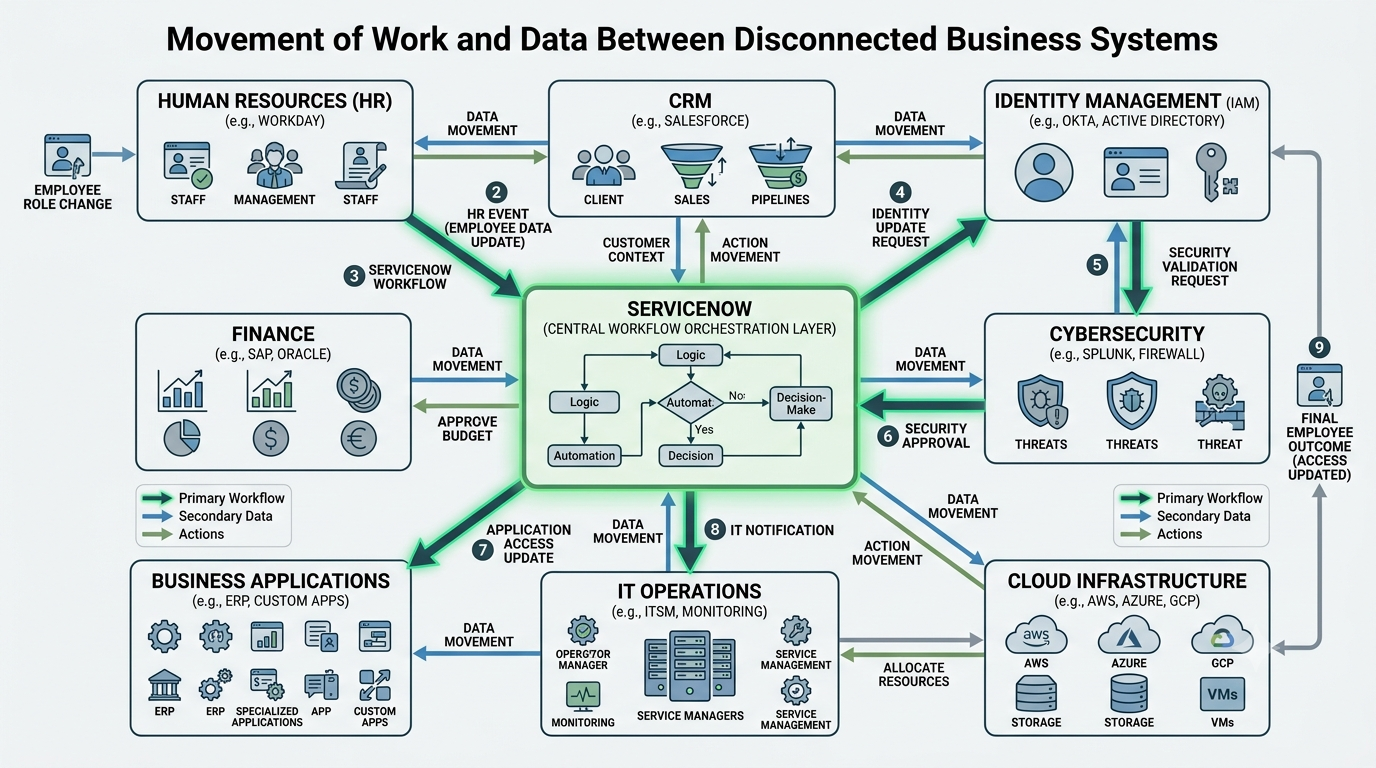
None of these activities belongs entirely to one application. They form a chain. And the ability to coordinate that chain is where workflow platforms become increasingly important. This also explains why ServiceNow's future cannot be separated from integration and data. AI may provide the intelligence to interpret what is happening, but connected systems provide the information and execution capabilities required to actually do something about it.
The strongest enterprise platforms will therefore not simply be the ones with the most impressive AI demonstrations. They will be the ones that can connect intelligence with trustworthy information and real business action.
ServiceNow Is Moving From “What Happened?” to “What Should Happen Next?”
This may be the simplest way to understand the platform's evolution. Traditional systems are often built around recording events: an incident happened, a request was submitted, an employee was created, a customer contacted support, or a vulnerability was discovered. ServiceNow has historically been very good at organizing those events into structured processes. The next stage is more ambitious. When something happens, the system can increasingly help determine what does this mean, what information matters, what should happen next, can the next step be automated, does someone need to approve it, and what happens if the normal path fails?
That is where AI and workflow automation begin to reinforce each other. AI without workflow can produce an answer but struggle to create an outcome. Workflow without intelligence can execute efficiently but struggle with ambiguity.
Together, they can create systems that are both context-aware and action-oriented. That combination is what makes the current ServiceNow evolution worth watching.
What This Means for the People Building Their Careers Around ServiceNow
The opportunity is not simply to learn another enterprise platform. It is to understand a changing category of work. Organizations will continue to need people who can translate business requirements into technology. They will need professionals who understand workflows, integrations, data structures, security, automation, user experience, and increasingly AI.
The strongest professionals will probably not be the ones who know every feature by memory. They will be the ones who can look at a complicated process and identify where technology can remove friction without creating new risks. They will understand when automation makes sense and when human judgment is necessary.
They will know that connecting two systems is not enough if the underlying process is poorly designed. And they will recognize that AI should not be introduced simply because it is available. It should be introduced when it improves the outcome.
That mindset is much more durable than any individual platform feature.
The Question Is No Longer “What Can ServiceNow Automate?”
ServiceNow started from a world where organizations needed a better way to manage IT work. That problem has not disappeared. But the world around it has changed. Businesses now operate across enormous collections of applications, data sources, employees, customers, cloud environments, security systems, and digital processes. The challenge is no longer just recording work. It is coordinating work across all of those moving pieces.
AI adds another dimension. It can help systems interpret requests, understand context, summarize information, identify patterns, and potentially take action through connected workflows. But the real opportunity comes when those capabilities work together. Trusted data gives the system context. AI provides intelligence. Workflows provide structure. Integrations provide reach. Governance provides control. And humans provide judgment where it matters most.
That is why the future of ServiceNow is much bigger than another generation of ticketing software. The platform is moving toward a world where employees may not need to understand the complexity behind enterprise systems. They may simply need to explain what they are trying to accomplish, while the platform coordinates the work required to make it happen. The transformation, then, is not really about replacing the ticket. It is about replacing the friction surrounding the ticket. And eventually, the most successful ServiceNow experience may be the one where the employee barely notices the platform at all.
They ask for something, the organization understands, the work moves, the right people step in when judgment is required, and the outcome arrives. That is a very different vision from the ServiceNow many organizations first adopted. It is also the reason the most important ServiceNow skill of the future may not be knowing where every button is. It may be knowing how work should move—and how technology can make that movement smarter, faster, and more meaningful.