
ServiceNow Provides a Unified Platform Automating Workflows Across Enterprises
Last updated on Aug 22, 2026
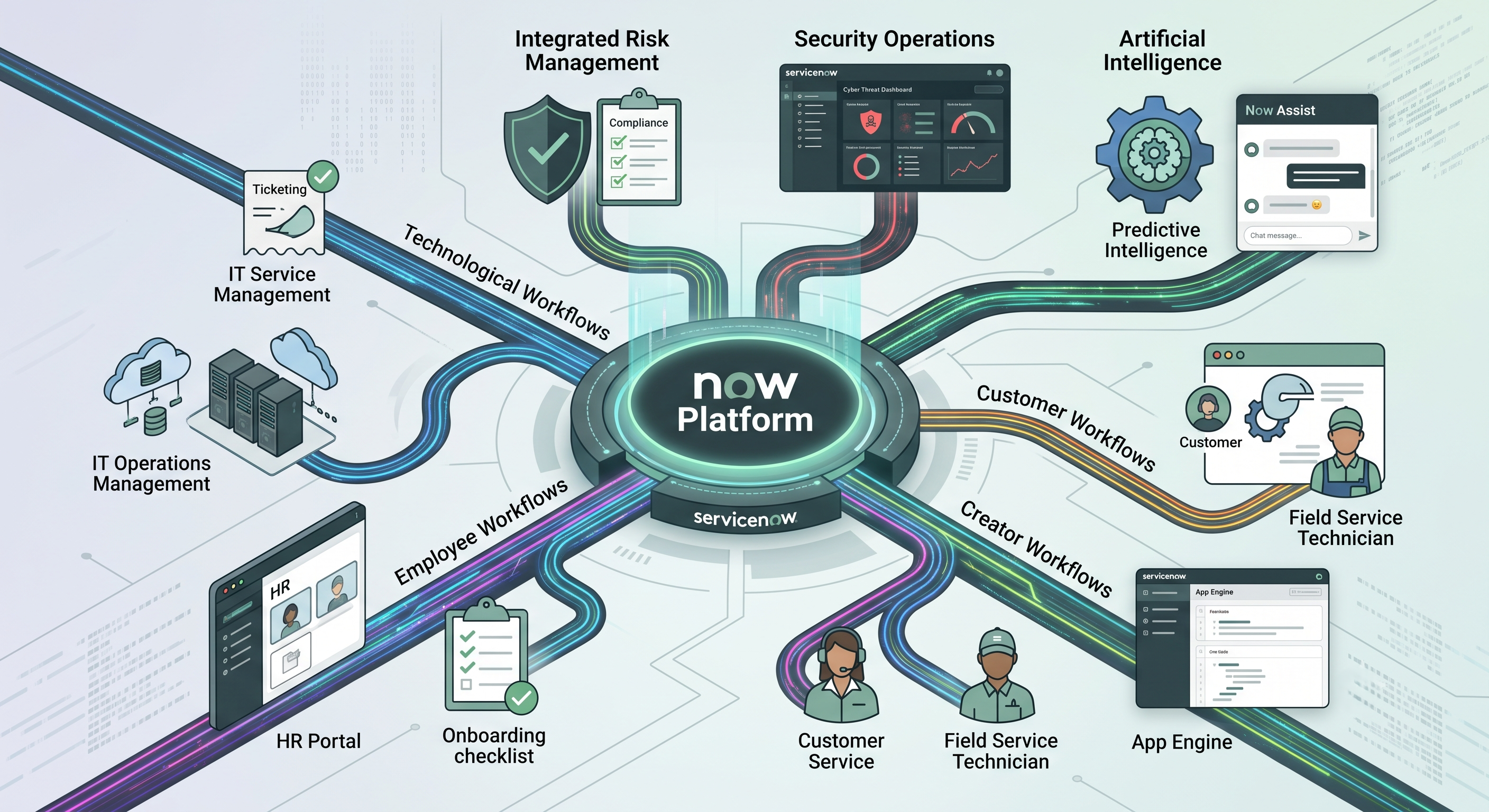
In today’s business climate, firms find themselves operating in a completely new environment where they must form an environment that fosters quicker digital transformation, minimizes friction, and guarantees harmonious experiences for employees and clients. For decades, enterprise technologies evolved in silos: the finance department used specific types of ledgers, human resources used special systems of managing employees and the service department used separate ticketing systems. Thus, this decentralized ecosystem gave rise to friction in enterprises, where interdepartmental processes failed to happen due to several incompatible databases among which there would be some mishandling of things that required people to communicate through different channels.
ServiceNow entered the scene as the most effective solution to the described problem. Thus, it positions itself as a universal platform and is responsible for virtual presentation of complicated workflows at many levels. In other words, the system creates the necessary environment for the handling of the issues with all operations happening, which is much easier when using simple legacy systems.
The Birth of the Company and its Progression
Fred Luddy, a seasoned technologist, started ServiceNow in 2004 after realizing a significant issue in enterprise software design: the tools developed for business processes are very rigid, challenging to update, and unfriendly to end-users. With this knowledge in his pocket, Luddy set out to create a flexible cloud-based solution that would allow any person, without an engineering background, to automate workflows without any problems.
To start with, the company concentrated on the IT Service Management (ITSM) market. During the period in question, existing ITSM systems represented highly customized and, hence, quite ineffective solutions that required substantial hardware as well as long-time installations. ServiceNow managed to win this battle with a pure SaaS solution that could be deployed quickly with automatic upgrades.
As enterprise IT organizations adopted ServiceNow to handle incident, problem, and change management, a broader realization emerged: the structural logic used to resolve an IT ticket (intake, classification, assignment, routing, tracking, escalation, and resolution) applies to virtually every cross-functional task across a company. Whether an employee requests parental leave, a facilities team repairs physical infrastructure, or legal reviews a vendor contract, the fundamental workflow pattern remains identical.
Capitalizing on this insight, ServiceNow systematically expanded beyond IT into human resources, customer service, security operations, governance, risk and compliance, and custom application development. The business grew organically and by means of targeted acquisitions in the fields of automation, artificial intelligence and analytics, from help desk software to enterprise workflow engines.
The Architectural Structure of the Now Platform
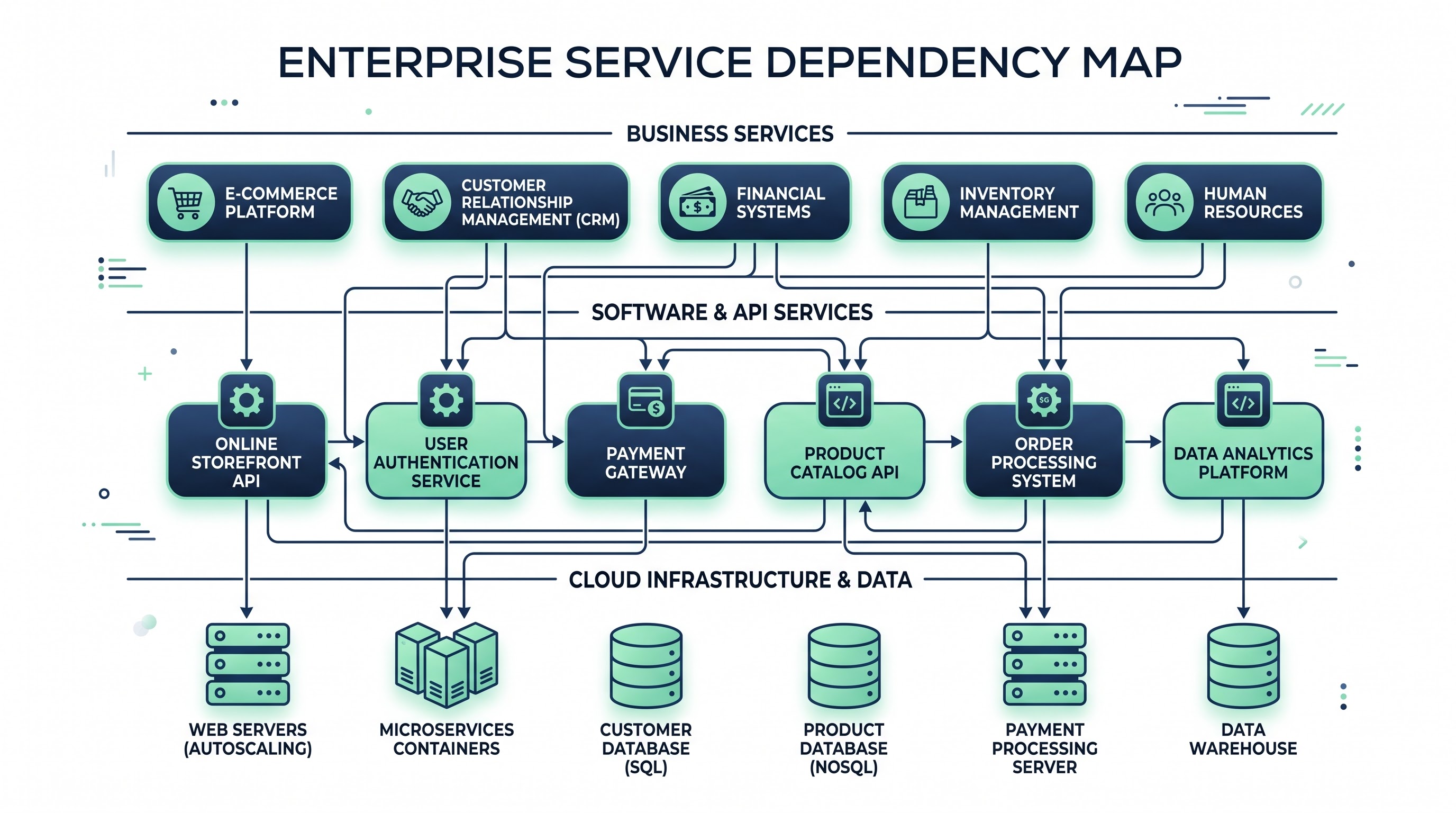
At the heart of the ServiceNow’s leading position in the market is its unique architectural structure called the Now Platform. Unlike software companies that create their enterprise suites via various acquisitions and combine them with proprietary APIs, the Now Platform has been developed using a single code base and unified data model.
Multi-Instance Architecture
Most public SaaS platforms function according to the multi-tenant model, where different client companies are using a single application package and a common database with logical separation among them through access restrictions. ServiceNow is different due to its multi-instance architecture.
In this architectural model, each business customer has its own, logically isolated app and database instances. This choice provides numerous benefits for businesses:
Protection and Safety of Information: Essential organizational data is kept separate physically at the level of the database that makes it possible to comply with the laws concerning data protection and privacy.
Separate Lifecycle for Updates: Companies can perform updates of software and new features whenever it is convenient for them.
Modification without Breaches: Extensive changes and customization of workflows do not result in disruption of the common infrastructure of the platform.
CSDM and CMDB
The main component of data organization in ServiceNow is the Configuration Management Database (CMDB) which is based on CSDM.
CMDB serves as a single source of truth regarding all the digital and physical assets of an organization, known as Configuration Items (CIs). Configuration Items in this context can mean the following: servers, cloud technologies, databases, software licenses, network devices, business applications, and microservices. The database is not just a comprehensive list of all items but it also demonstrates their interdependence and relations. For example, it indicates what cloud database is responsible for a certain billing API that subsequently helps provide a customer with an external portal.
The Common Services Data Model establishes consistent definitions and relationships across the configuration management database (CMDB). It provides common terminology to both the technical infrastructure teams and business stakeholders to ensure that the platform knows the specific business service or revenue stream affected in the event of a problem happening with technology.
Integration Frameworks
Enterprise solutions cannot operate alone without communicating with earlier ERP systems, collaborative tools, public clouds, and specific databases. ServiceNow resolves this issue with the help of Integration Hub and different layers of API.
In particular, the Integration Hub offers existing connections (known as Spokes) so that admins can make data flows between the external systems with the help of plain phrases and modular units. ServiceNow serves as an ergonomic layer based on well-known REST, SOAP, and webhooks protocols.
Fundamental Operational Workflows
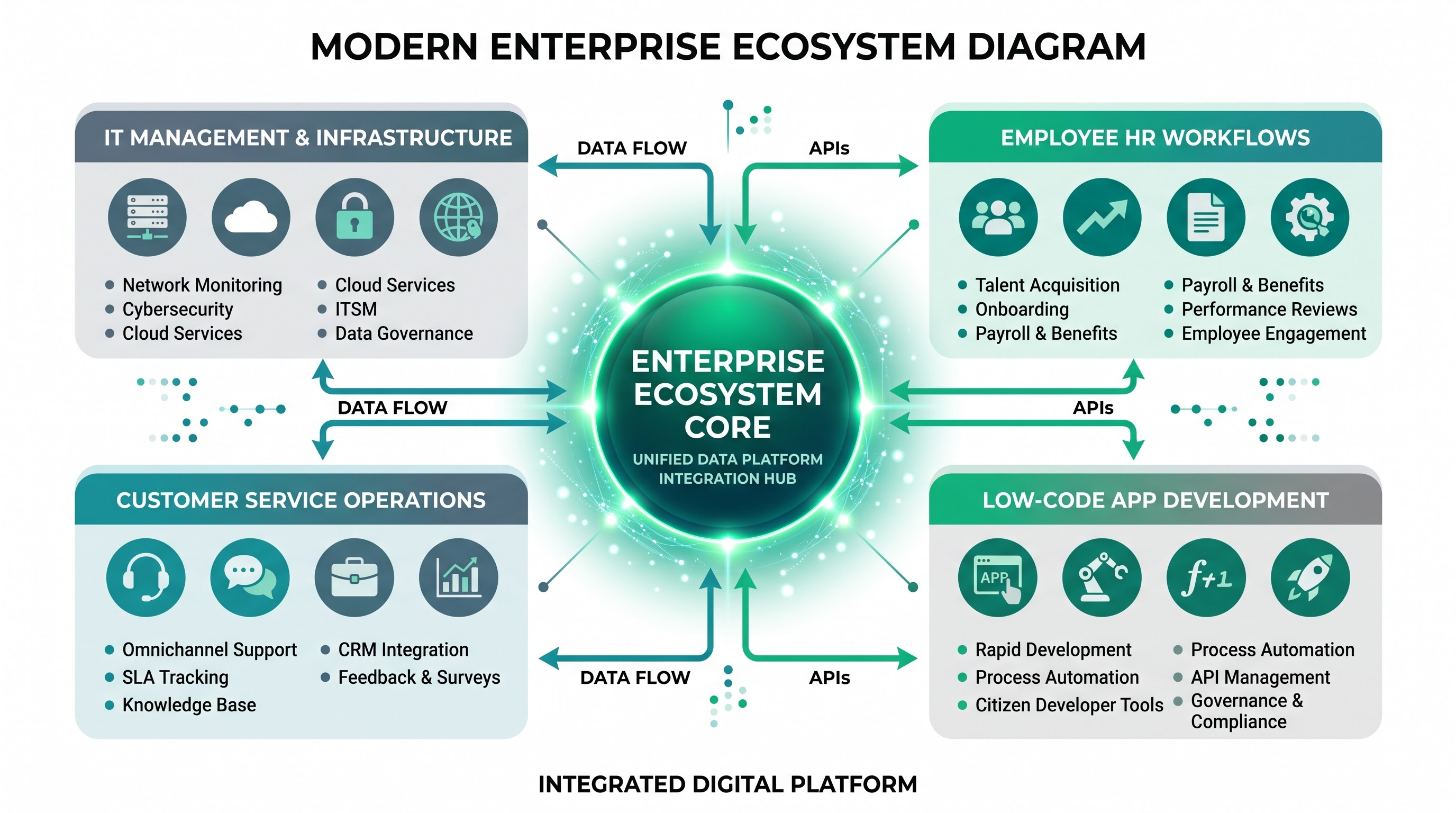
The Now Platform classifies the functioning of enterprises into several categories of workflows. Each of these categories solving specific operational difficulties has a common data infrastructure created by the native platform.
Technological Workflows
Technological Workflows are acknowledged as the core domain of ServiceNow, which includes all aspects of enterprise IT life cycles such as strategy development, infrastructure management, and providing services.
IT Service Management
IT Service Management is responsible for updating IT assistance to the employees. It enables the standardization of main processes defined by the Information Technology Infrastructure Library (ITIL), which consists of:
Incident Management: To restore business routines within the shortest time, the technology allows for recording, classifying, and directing disturbances occurring in technological processes.
Problem Management: Definition of the cause of permanent issues to avoid catastrophe in technological operations of the enterprises.
Change Management: Evaluation of the potential risks, organization of approvals, and implementation of changes without major interruption in the processes.
Request Management: Creation of user-friendly service catalogs that help employees acquire certain hardware, software systems, and services.
Management of IT operations (ITOM)
The role of ITOM is to focus on system operations as opposed to active user requests managed by ITSM. Main elements consist of the following:
Discovery and Service Mapping: A system that identifies network-connected hardware and software and maintains up-to-date information in the configuration management database (CMDB).
Event Management: A process of collecting large volumes of information from monitoring systems, filtering meaningless bits of data, and turning discovered events into alerts.
Cloud Operations: Managing resource management, cost management, and compliance within the environment of multi-cloud computing.
Asset IT management (ITAM)
The purpose of ITAM is to keep track of different assets in technology investments, including equipment that includes HAM, which manages assets from purchase to disposal, SAM which supervises software licensing, and EAM which manages other assets in different operations.
Strategic Portfolio Management (SPM)
Previously known as IT Business Management, SPM couples investments in technology with enterprise-wide strategy. Through SPM, executive leaders can manage business cases, allocate funding for projects, manage technology resources, and keep track of project progress with traditional or agile approaches.
Employee Workflows
Modern organizations understand the role of seamless employee experiences in enhancing productivity and employee retention. ServiceNow Employee Workflows helps to manage the different stages of life cycle of employees in different internal departments.
HR Service Delivery (HRSD)
HR departments devote much time to fielding basic questions, including issues related to benefits, payroll, and policy. Under the HRSD system, uncoordinated email communication has been eliminated in favor of centralized service portals for employees. Employees can now use these integrated service centers to get information, ask questions, and manage service requests.
Introduction To Cross-Functional Enterprise Onboarding
Onboarding is arguably one of the most difficult processes faced in any organization and requires the simultaneous coordination of human resources (for contract signature), IT (for equipment procurement and access permission), facility (for security badge and parking), and finance (for payroll arrangement).
Using ServiceNow, all these various tasks are connected together into a seamless end-user experience. By merely defining onboarding activity, dependent tasks are generated automatically across each department, making sure the deadlines are strictly maintained and keeping both hiring manager and employee fully informed about the process.
What is Workplace Service Delivery?
Workplace Service Delivery is related to challenges encountered in hybrid working environments. It allows employees to reserve their desks, conference rooms, and different equipment, but at the same time gives facility managers information about office space usage, lease optimization, and maintenance processes.
What is Customer Workflows?
Customer Workflows brings together front-office customer engagement channels and back-office operational resolutions.
Customer Service Management (CSM)
Traditional customer relationship management software is primarily known for maintaining sales leads but lacks its ability to connect operationally to troubleshoot complicated engineering issues. ServiceNow has developed CSM to give it the capability of connecting the helpdesk with the operations teams such as engineering, quality assurance, invoicing, shipping etc. For example, if a customer calls with a complaint about product malfunctioning, the customer service agent can connect with the engineering department and track the progress of repair work right away.
Field Service Management (FSM)
In industries like utilities, telecommunications and manufacturing where technicians provide support on-site, FSM helps manage operations by dispatching technicians. The system assigns technicians their jobs automatically based on real-time mapping technology, certification, equipment and availability. Technicians get the work orders on their smartphones while working in the field.
The Concepts Behind Creator Workflows and Low-Code Development
Every organization finds itself inundated with custom applications, which is something that traditional IT departments simply do not have time to handle. Creator Workflows makes software creation available to everyone thanks to the App Engine.
Since App Engine is a low-code/no-code development platform, it allows business analysts and operations staff to build their applications. As a result, this means that nowadays completing a detailed servicenow course is one of the main tasks for new software developers. People who do not have any technical knowledge are able to visualize data models, configure user interfaces, and create logic trees without doing any programming.
This unique low-code actually operates within the framework of governed IT, where the central IT maintains the control over the security roles, integration rights and data validation, providing full safety to the IT.
Security Operations, Governance and Risk Management
As cyber threats become more common and sophisticated, security operations centers (SOCs) are suffering from alert fatigue and poor tool integration. ServiceNow brings together security processes with enterprise infrastructure data.
Security Operations (SecOps)
ServiceNow SecOps connects external security monitoring services (like SIEM, SOAR, and endpoint detection systems) directly to the CMDB. Once the system detects a threat or risk, SecOps enhances the alarm with business context. As a result, security specialists can understand if the affected IP belongs to a closed testing environment or a payment system server.
The solution executes automated response plans, enabling specialists to isolate infected devices, close malicious IP addresses, and invalidate compromised credentials right from the workflow interface.
Integrated Risk Management (IRM)
IRM enables continuous, real-time risk monitoring instead of manual compliance auditing, and previously existed as Governance, Risk, and Compliance (GRC). Through IRM, companies can:
Flowchart regulatory systems such as ISO, SOC2, HIPAA, GDPR and the organization’s internal controls.
Automate compliance checking and evidence gathering across business units.
Monitor vendors’ risk levels using third-party risk management algorithms.
Constantly analyze operational, financial, and security risk across the organization.
Artificial Intelligence and Intelligent Automation
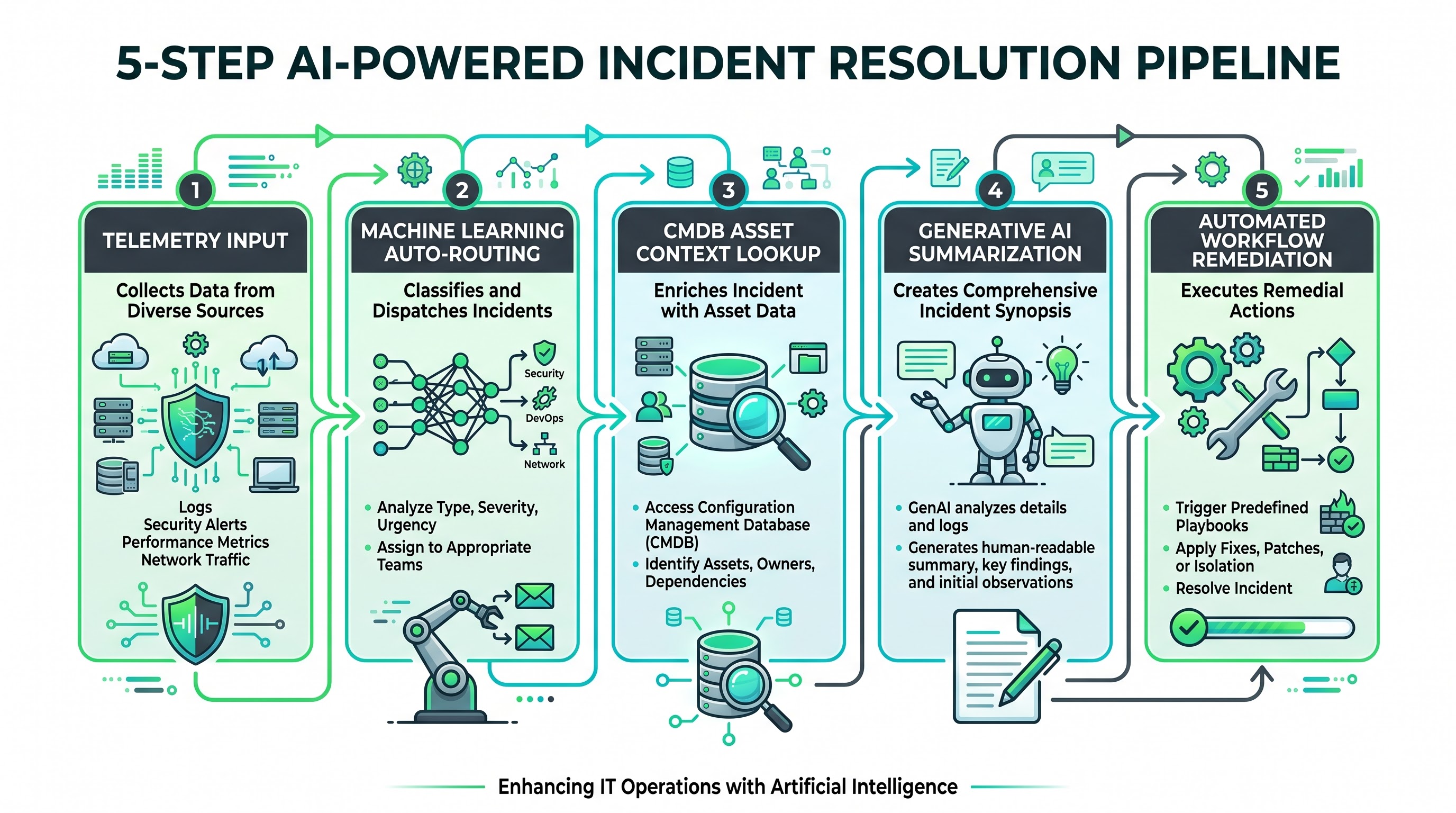
The roles of artificial intelligence and automation have shifted from being experimental approaches to becoming the basis of the Now Platform. The multi-layer AI architecture created by ServiceNow allows for the elimination of repetitive tasks, optimizing routing, and data deriving.
Predictive Intelligence and Machine Learning
Machine learning technologies deployed by ServiceNow enable efficient operation using actual data from the past.
Automated Categorization and Routing: The platform employs computer-assisted models for analyzing texts in order to identify the category of the request, its urgency, and the group responsible for handling the request, eliminating the need for any manual operations.
Anomaly Detection: The technology recognizes unusual behaviors and informs engineers about possible service degradation instances before users of the service have the opportunity to experience problems.
Similar Incident Clustering: The system groups incident tickets connected to infrastructural catastrophes and assigns the same team to work with several hundred affected users.
Virtual Agents and Natural Language Understanding
The platform has virtual agents based on natural language understanding, which allows users with problems to communicate through natural language via web portals, mobile devices, or corporate messengers. A “virtual agent” is able to solve a half of users' problems without transfer to a human agent.
Generative AI and Now Assist
With the establishment of its proprietary Now Assist functionality, ServiceNow has implemented generative AI into all workflow platforms.
While consumer AI solutions can function without considerations of enterprise parameters, Now Assist operates under the safe shelter of the noteworthy individual of the client’s exclusive instance, under strict regard for enterprise data privacy and access rights. The main generative AI features in the context of enterprises can be expressed as:
Incident and Interaction Summarization: When an incident is transferred through support levels or finalized as solved, Now Assist completes quick technical summaries that may reduce tens of hours of administrative work.
Generative Code and Flow Creation: With the help of practical servicenow online training, low-code developers can acquire practical knowledge that allows them to describe business processes in human language and use the platform’s auto workflow and script creation capabilities
Contextual Knowledge Creation: Virtual assistants combine complicated policy guidelines, manuals, and past solutions to answer user questions instead of providing a list of links.
Business Value of Enterprise Companies and Strategic Return on Investment
In order to successfully implement an enterprise solution of the size and capability of ServiceNow, an organization must make big financial and internal commitments. Companies are able to obtain the benefits of such a large investment through tangible multi-faceted returns from their operations.
Erasing Tool Clutter and Duplicate Licensing
As companies grow, they tend to acquire many overlapping standalone solutions for ticketing, tracking assets, managing projects, and providing customer service. The adoption of ServiceNow allows businesses to eliminate the need for multiple legacy platforms and significantly reduce the costs arising due to software licenses, maintenance contracts, and minimum internal operational overhead.
Increasing Operational Velocity
Manual handoffs via email between departments are slow and carry a threat of errors. By replacing manual processes with automated operations, the use of ServiceNow leads to the significant reduction of Mean Time to Resolution (MTTR) for customers as well as employees.
Improved Visibility of Enterprises and Decision-Making
When operations are performed in isolated spreadsheets and separate areas of departments, executive leadership does not have a clear insight into operational performance. ServiceNow aggregates enterprise-wide process data and creates performance analytics dashboards in real-time. Executives obtain valuable visibility of major bottlenecks in processes, failures in resource allocation, vulnerabilities in infrastructure, and signals of customer satisfaction.
Compliance with Rules and Requirements
Without an audit trail, businesses could face severe penalties for non-compliance. As processes are standardised in the Now Platform, authorisations, confirmations of solutions and data changes will all be properly recorded via immutable audits. There is no need to get worried about audits anymore thanks to built-in governance.
Best Practices and Possible Mistakes in Implementation
Although ServiceNow is a powerful platform, implementing such a wide solution poses certain risks and challenges. The only way to gain maximally valuable outcomes through ServiceNow is to follow proper principles of architecture and change management.
The Risks of Excessive Customization
The flexibility of the Now Platform presents its biggest advantage and biggest operational risk. Historically, several companies have tried to duplicate their old, customized manual processes by customizing ServiceNow and writing custom scripts. Too much customisation will result in technical debt, thus complicating future platform upgrades and making the system less efficient . The best performers use the first approach out of the box, where business processes are tailored to industry norms before any customisation scripts are applied.
Significance of CMDB Maintenance and Governance
The efficiency of ServiceNow deployment is determined by the quality of data in the CMDB. When organisations don’t have good governance in place for the solution they lose data. To keep a CMDB running, you need continuous infrastructure discovery, data hygiene, and compliance with CSDM requirements.
Strategy and Governance across Various Departments
Since ServiceNow influences sectors like financial, HR, security, IT, etc., platform governance cannot be exclusively used by the IT department. In successful companies, a centralized Center of Excellence and Innovation is formed, which is a governance entity that performs functions like prioritizing backlog tasks, forming platform architecture standards, approving custom apps, etc.
Organizational Change Management
The main reason why enterprise solutions are not effectively utilized is that users do not adopt the technology well. The transition from the established workflows to the new ones based on digital technology requires the usage of certain change management tools. For organizations to successfully implement self-service portals, it is important for them to invest in service-specific servicenow training, efficient communication, and feedback processes.
The future of ServiceNow and enterprise workflow
As businesses deal with a gradually complicated macroeconomic landscape and the new rise of cyber threats and fast development of AI, the significance of ServiceNow keeps on increasing as well.
Autonomous workflow processes in enterprises represent the future of business operations. Intelligent systems deploy automatic workflows aimed at accomplishing defined tasks and actively working to prevent failures, shifting resources as required, and optimizing corporate processes in a timely manner. ServiceNow maintains its dominant position in business automation with its continuous integration efforts.
It now provides service now training online from experts and it enables IT professionals and businesses to gain an understanding of the digital nervous system.