
The Architecture of Enterprise Flow: An In-Depth Examination of ServiceNow
Last updated on Sep 16, 2026
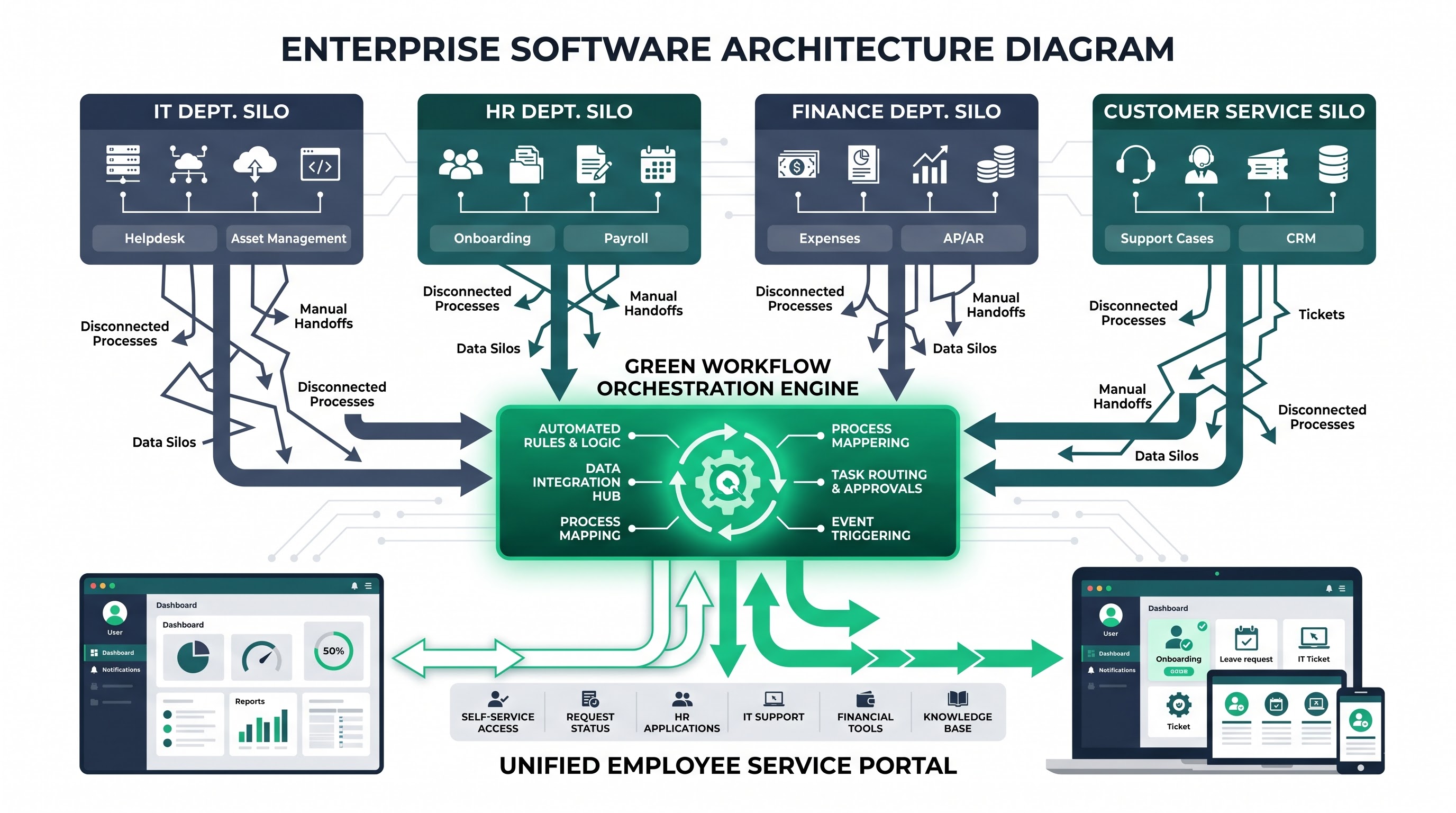
Present-day businesses function in a backdrop of exceptional tensions. Within the last thirty years, companies added layers of applications for immediate requirements. Human resources applied language-specific solutions for talent management, finance utilized specialized systems for resource management, customer care implemented unique platforms to handle service requests, and information technology established sets of utilities for monitoring and maintenance.
All of these combined together created unconnected digital horizons. Information could not move between departmental borders, which resulted in slowing down processes. This led to the emergence of mundane activities, like employee onboarding, server provisioning, problem-solving, and investment transactions.
ServiceNow emerged and became a prophetic answer to the operational divide. Instead of being just an additional isolated program of keeping records, ServiceNow is a program built as a network of programs, a connecting workflow mechanism.
ServiceNow began as a cloud-based IT service desk and became an all-inclusive platform for enterprises. ServiceNow manages customer service, employee experience, financial processes, risk assessment, and artificial intelligence management. To comprehend the current infrastructure of business operations, one needs to know how ServiceNow organizes, processes, and expedites operations.
ServiceNow Foundational History
Fred Luddy started Glidesoft in 2004, which later developed into ServiceNow. Before founding Glidesoft, Luddy worked as a chief technology officer at Peregrine Systems, a pioneer of enterprise software. He witnessed a pattern of corporate system failures during his professional years there: enterprise software was unsophisticated, hard to configure, dependent on expensive equipment, and inconvenient for people without technological education.
After Peregrine went under in the early 2000s, Luddy embarked on a mission to create a system that will allow users to develop business applications without coding using the web interface. He understood very quickly that a combination of web browser and a robust multitenant architecture will remove the bulkiness of on-premise deployment.
Luddy moved to San Diego and worked on workflow automation. The first concept was pretty straightforward: workflow in the office should happen as intuitively as consumer experience on the internet. If people can make purchases, follow the status of deliveries, get notifications online, then the internal processes of a Fortune 500 company should operate in a similar manner.
The first software became popular among IT Service Management solutions (ITSM). At that point, dominant players like BMC Software, Hewlett-Packard, and CA Technologies ruled the market with sophisticated client-server applications, which took several months or years to deploy and upgrade.
The difference was that ServiceNow provided customers with a pure SaaS solution that promised quick deployment, web-based management, and continuous updates. Thanks to its strong position in the IT department, ServiceNow has access to the corporate data and infrastructure of enterprises.
Architectural Pillars: The Now Platform
ServiceNow is quite distinguishable from its rivals due to its unique conventional platform called Now Platform. Unlike other firms which built the enterprise software from several independent components, ServiceNow obtained its growth from its unified metadata structure and single database outline.
The Single Data Model
The single data model used in ServiceNow links various divisions together, i.e. regardless of whether it is IT, HR, or any other area. When one of the employees is reporting an IT outage, applying for parental leave, or signing an agreement with the company, they will always make use of the same page.
Such use of the same data model eliminates possible discrepancies in synchronization.
Multi-Instance Architecture
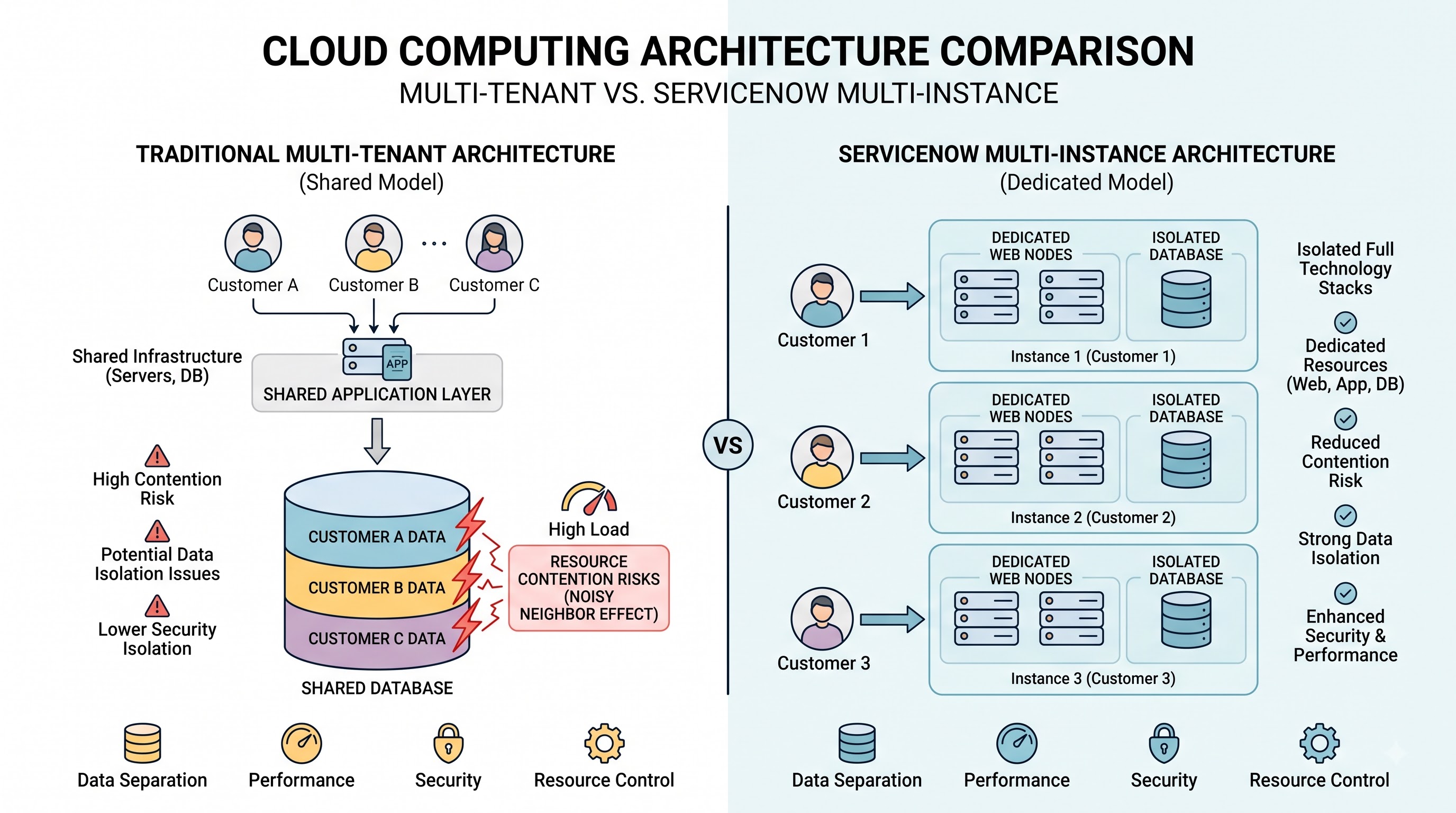
Virtually all cloud solutions in enterprises run on a multi-tenancy model, which involves that many customers should utilize the same database and application server group with the separation made by means of software permissions. Thus, most beneficial for vendors, this technology might include a deterioration in performance because of noisy neighbors consuming significant resources without a right. In addition, it creates problems with governance problems.
ServiceNow has decided to go away from the typical approach, which has resulted in the creation of multi-instance architecture. Each customer is given different web servers providing logical separation of databases.
The difference of this organization can lead to the following benefits:
Maintenance periods can be set independently of the whole company.
Changes can be tested in a sandbox environment before going live.
There is no distribution of confidential regulatory info within the database level without compliance with all specific regulations in healthcare, defense, and banking.
The Configuration Management Database (CMDB)
The heart of the Now Platform constitutes the Configuration Management Database, which is considered the foundation element of operation of the company. The purpose of the CMDB goes beyond the catalog of immobile hardware of the company; it also helps establish relationships, interdependencies, and states of work of all entities used in a company.
That is how entities, known as Configuration Items, can include:
- Physical servers with virtual machines and storage systems,
- Networking devices, subnets, and routers,
- Software and application,
- Business services and owners.
Thanks to its dynamic model based on dependencies, an IT manager can precisely understand which server is used for providing services in Frankfurt. If the database server fails to operate, the relational graph of ServiceNow will identify affected services and allow the process of recovery to take its course.
The Common Service Data Model (CSDM)
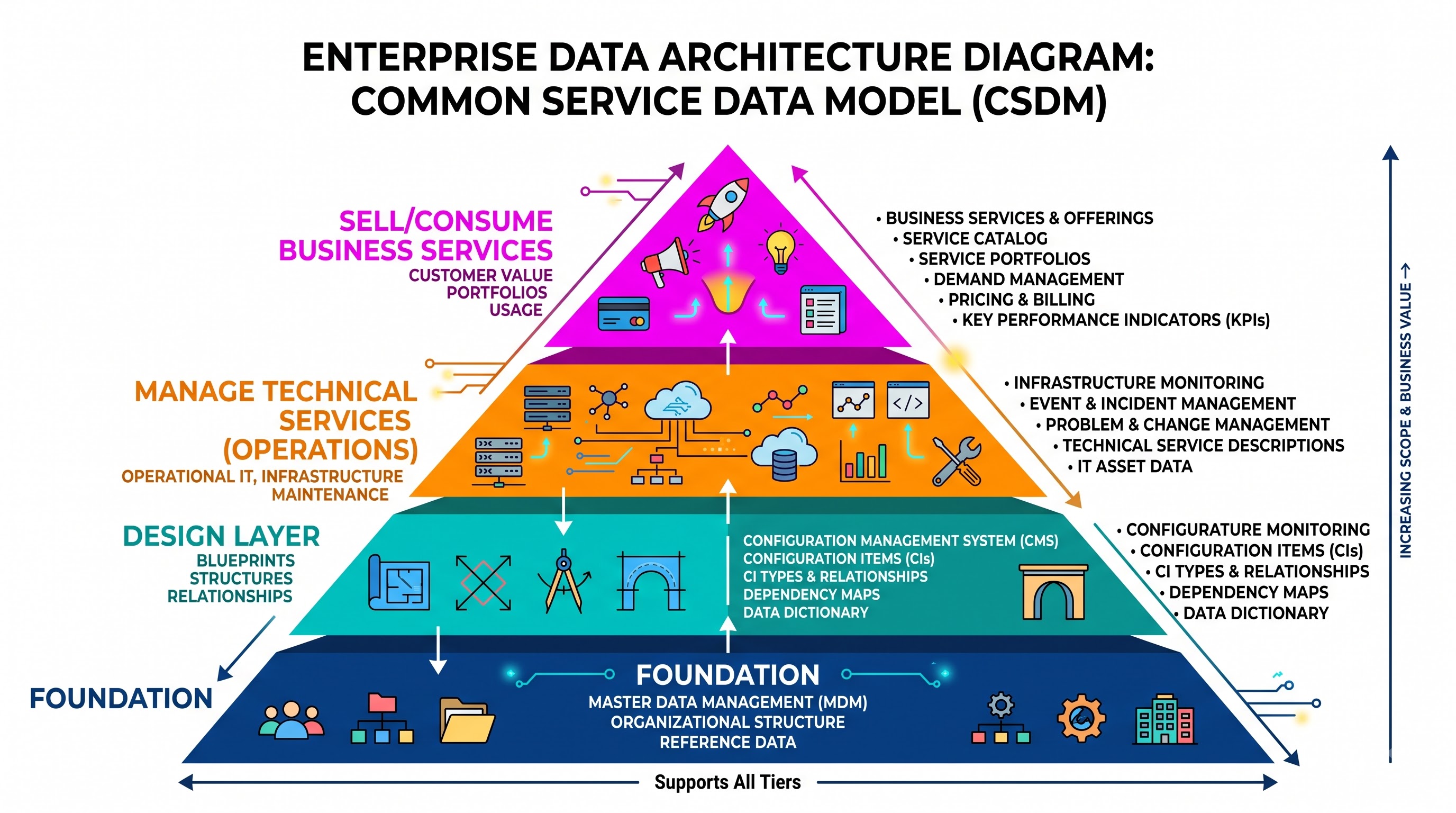
In order to keep organizations from structuring their CMDB in arbitrary ways, ServiceNow created the Common Service Data Model. The CSDM is a prescriptive and standardized framework that breaks down all Configuration Items into four domains: Foundation, Design, Manage Technical Services, and Sell/Consume.
This common grammar allows ServiceNow to eliminate the semantic gap between technical infrastructure teams and business executives. Digital products connect with infrastructure components of technology that ultimately link with enterprise portfolios of business, thereby allowing senior management to understand both technological costs and risks behind any capability.
The Core Product Families
Although the Now Platform carries the basic orchestration, database and automation mechanisms, the company derives its value from the core product suites developed by this company in several operational areas.
IT Service Management (ITSM)
IT Service Management is the service point of ServiceNow and remains the leading aspect of its operations. ServiceNow ITSM is based on the concept of ITIL (Information Technology Infrastructure Library) system of operation, which allows the company to optimize the functioning of the life cycle of technology services.
Incident Management delivers the necessary means for the quick reception, categorization and routing of technology problems. The service desk agents gain all the required context-related information such as the records of previous solving cases and asset states in order to achieve minimum mean time in case of doing it.
Problem Management allows analyzing the root of the reoccurring incidents. Rather than treating ten connected failures of workstations separately, the system aggregates them together and allows engineers to detect the corrupt firmware patch and fix this vulnerability across all workstations.
Change Management regulates the changes that are made to the production environment. ServiceNow employs automated risk-scoring algorithms to evaluate whether scheduled updates to the network will interfere with the quarter-end financial close through analysis of dependencies in the CMDB. The result is automatic approval routing of complex requests without having to get approvals from an employee.
Request Management provides an online catalog to the employees for ordering laptops, mobile devices, access, or software licenses and automatically initiates processes of automating requests.
Due to the fundamental importance of Incident Management, Problem Management, and Change Management in the platform, specialists wishing to learn these workflows usually take an all-encompassing servicenow course from OnlineITGuru.
IT Operations Management
ITSM handles requests made by users for help while IT Operations Management handles the backend infrastructure. IT Operations Management makes the operations from reactive to proactive.
Discovery enables automatic scanning of networks, data centers, and cloud footprints for detecting active hardware, virtual resources, and running applications and updating CMDB.
Service Mapping adds additional value to Discovery by understanding the flow of traffic among processes, creating a map that shows what infrastructure components are related to which applications.
Event Management system collects telemetry, logs and notifications from internal monitors and third-party applications. It eliminates unnecessary data, correlates relevant alerts into single actionable notifications and detects possible root causes based on its pattern recognition logic.
Cloud Operations facilitates governance, provisioning and cost tracking across major public cloud providers and hence allows to avoid cloud sprawl and ensures compliance with infrastructure-as-code rules.
Strategic Portfolio Management (SPM)
Previously called IT Business Management, Strategic Portfolio is capable of aligning IT investments with the corporate strategy.
It helps chief information officers and business executives in getting information about:
Project and portfolio management monitoring deadlines, project status and resources limitation for the projects.
Demand management that helps to collect the incoming business proposals and score them against the budget limitations as well as against business value.
Agile and hybrid delivery methods that allow classical waterfall ICT infrastructure projects to be blended with modern sprint-based software development.
Application Portfolio Management (APM) estimates business value and technological risk as well as operational costs of every application in the enterprise and identifies duplicate software licenses that can be decommissioned.
Management of Customer Services (CSM)
Enterprise customer service is often in trouble because the service personnel facing the customer are separated from the rest of the process. ServiceNow The Customer Service Management system solves this issue in structure.
When a customer complains about delivery damage or service outage, CSM links the case directly with the workflow of field services, logistics, and engineering on a single platform.
Benefits of CSM include:
The use of omnichannel communications including customer portals, chat programs, telephone connections, and emails.
Deflecting cases with self-service customer portals based on knowledge bases.
Proactive notifications to clients so that the clients are aware of possible disruptions before they start calling.
HR Service Delivery (HRSD)
Human resources departments are constantly inundated with repetitive and mundane inquiries about things like benefits and payroll. But HR Service Delivery helps to consolidate those services through its user-friendly employee portal.
Employee Center is an employee-only intranet that enables personnel to manage their business operations without having to deal with complicated systems of human capital management (HCM).
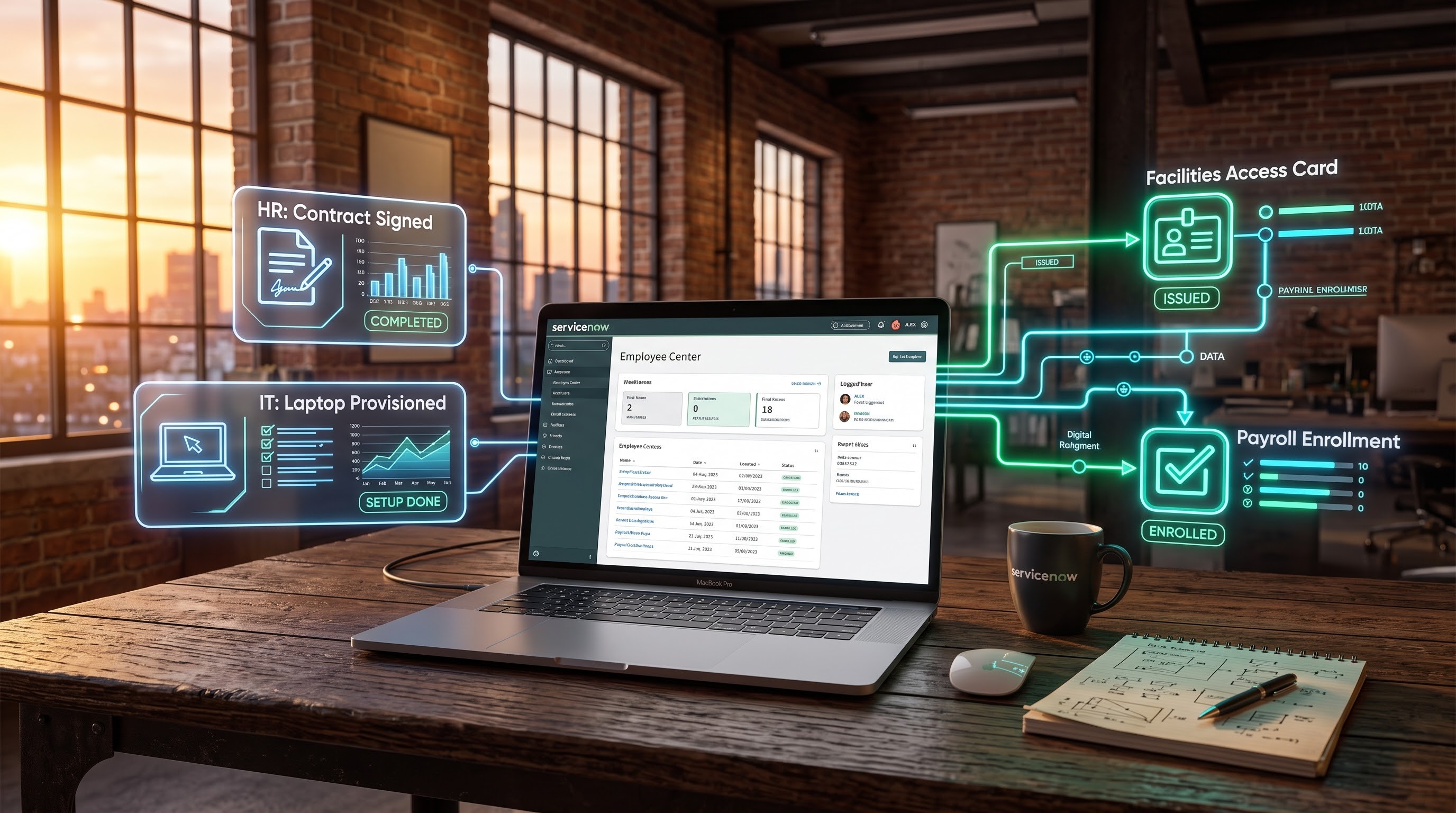
Lifecycle Events is responsible for carrying out a complicated process involving human resource changes across various departments. For example, the arduous process of onboarding an executive (who must go through HR for background checks, IT for laptop loan arrangements, office staff for access cards and facilities, and finance for payroll enrollment) becomes a smooth and fast-operating process thanks to the system's coordination.
Employee Relations oversees management of sensitive workplace claims and ensures confidentiality thanks to separated access to sensitive information.
Security Operations (SecOps) and Governance, Risk, and Compliance (GRC)
New security and compliance environments are faced with serious alert fatigue together with stringent regulatory scrutiny. The portfolio of security and risk services of ServiceNow connects risk frameworks with real-life technical controls.
Security Incident Response (SIR) works together with Security Information and Event Management (SIEM) systems to receive security alerts. Such alerts are enriched automatically with necessary threat intelligence and tasks are automatically assigned to infrastructure engineers based on the asset ownership information obtained from the CMDB.
The Vulnerability Response system relates the national databases of vulnerabilities to the inventory of software and hardware available in the company. This system analyzes the vulnerabilities based on their importance allowing the company to prioritize the bugs in its customer-facing transactional servers over the bugs in isolated non-important laboratory environments.
Integrated Risk Management (IRM/GRC) is the solution that turns the high-level corporate frameworks, including ISO certificates, NIST standards, SOX requirements etc. into the policies of continuous monitoring for compliance. The failure of the backup or exposed firewall port is reported immediately without recourse to retrospective audits.
Extending the Platform: Integration, App Engine, and Automation Engine
The enterprise platform always needs to be integrated with another platform as using it alone may not be productive. If we talk about the dominance of ServiceNow in the market, we may say that one reason for this is the fact that ServiceNow can be easily integrated into the previous system in the company without any significant change to the previous platform.
Integration Hub
It is important to mention Integration Hub, which allows developers and also non-technical specialists such as business analysts to connect the data from the external platforms without much hassle. The integration is done by using Speaks, which allows ServiceNow to work with other systems, such as SAP, Workday, Salesforce, Microsoft Teams, and Jira.
Due, to the use of a single workflow, ServiceNow is able to process the requests of the customers, check the information in the ERP database, conduct a transaction using a payment system, and notify all the people from the company via the message in Slack without any need for someone’s help in programming.
Achieving multi-directional data exchange with external platforms like SAP, Workday, and Jira necessitates the provision of practical lab sessions. This explains why future programmers seek the various servicenow online training on OnlineITGuru to acquire proficiency in Integration Hub spokes and the latest REST configuration.
The App Engine and Low-Code Movement
As the worldwide shortage of professional software developers continues, the ServiceNow committee vests heavily in the App Engine. This system uses visual low-code development environments allowing the so-called citizen developers (business analysts, head of the department, representatives of operations) to build custom made applications for their departments.
Thanks to the graphical interfaces, users build their own database tables, user interfaces, assign role-based access, and set business rules without writing code. Besides, professional developers are available to the JavaScript runtimes and platform APIs, which enables the IT department to set the rules while delegating the workflow creation to the business departments.
Organizations depend more and more on structured servicenow training from the institution of OnlineITGuru, which bridges the divide in the way technical governance operates and departments carry out their work, allowing business analysts and developers to develop dependable custom applications while avoiding architectural waste.
Robotic Process Automation (RPA) and Document Intelligence
Although the current application programming interfaces (APIs) are the best way to integrate systems, many organizations still rely on their old programs, which do not have modern endpoints. ServiceNow covers this hole with its Automation Engine, which includes the traditional RPA (Robotic Process Automation) and advanced optical character recognition.
In essence, software robots repeat keyboard and mouse actions, as they extract data from very old terminals and feed it into the latest Now Platform records. The system works with the help of the optical character recognition technology and machine learning, which allows the system to recognize unstructured invoices, identity cards, medical forms, and extract important key-value pairs, which trigger the corresponding digital approvals.
Artificial Intelligence and the Generation of New Things: The Now Assist Ecosystem
The evolution of artificial intelligence has moved the ServiceNow product into a completely new direction. Instead of simply adding a chat platform to the ServiceNow platform, the firm decided to reinvent its product by making it more intelligent.
The Now platform had already offered some predictive capabilities from the beginning.
However, in recent years, the company has approached the market with a new artificial intelligence solution.
Large Language Models Engineered Specifically for Particular Domains
Whereas most companies utilize predominately standardized generic foundational models, ServiceNow created unique domain-oriented LLMs designed for enterprise processes. With their training involving comprehensive collections of IT setup, business procedures, programming constructs, and operational information, this brand of internal models achieves lower latency, cut costs, and greater accuracy in a defined domain when compared to other universal LLMs.
The system has integrated some dynamic routing capabilities which empower customers to take advantage of ServiceNow’s internal models to carry out secure operations tasks but at the same time utilize the services of commercial external models for the queries of public nature.
Applications of Generative AI
Generative intelligence is used in many daily user and administrator applications with some important functions:
Incident Summary: When a service desk worker takes an incident that has been moved through various levels of support with many technical notes, Now Assist makes a brief summary of the situation by describing the main issue of the incident, actions taken, the current state, and actions to be taken, helping to decrease cognitive load.
Virtual Agent Communication: Before, chatbots relied on strict and rigid decision trees. Modern virtual agents can understand spoken queries, interpret the meaning of vague texts, analyze complex messages, and provide the contextually correct answer based on trusted corporate knowledge materials.
Knowledge Article Automation: After the issue resolution of a new technological incident, the platform automatically creates a structured knowledge article based on the notes of the solution. This way, important information is stored and employees are not burdened with writing articles.
Text to Workflow and Text to Code Generation: In software development platforms, system architects can create working scripts or full business operations automatically by typing their ideas in plain English.
Practical Applications in the Real World
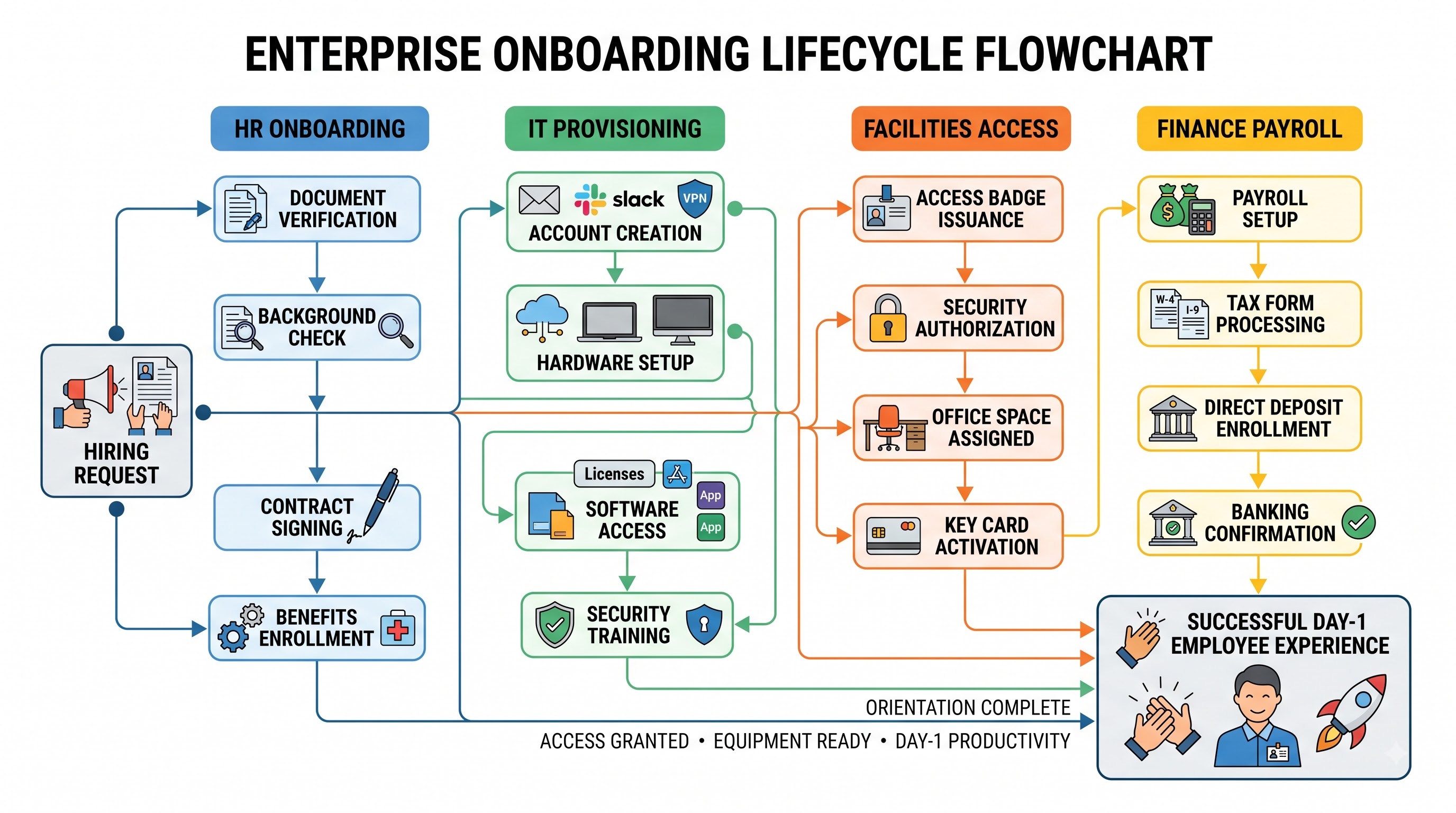
The real potential of ServiceNow can be understood from how the solutions provide help with the challenges that are common in different departments of an organization.
Onboarding Employees at a Corporation
In a non-coordinated corporation, the process of employing a new person will cause different departments of the company to work separately from one another, as follows:
1. Human resources creates a profile for the worker on a main human capital management system.
2. Facilities assigns a desk, gives a pass for parking, and makes a keycard that grants access to the office.
3. Information technology orders a laptop, prepares credentials for cloud email, gives the person a mobile connection, and gives permissions from the security group.
4. Corporate security checks the history of a person according to the documents.
5. Finance adds all the information to the bank account of the person and prepares taxes.
When done manually the process is likely to fail. Employees start their job on the first day being met with missing tools of the trade, not functioning accounts and unassigned security permissions.
In ServiceNow the manager submits a simple request for hiring one new employee and the platform separates this transaction into different dependent work streams.
Good news! All the information concerning the hardware is forwarded to the warehouse queues; the information about the identity is processed via Integration Hub and sent through directories; security clearance information goes to compliance departments; and facility management receives the requests about the office space occupation.
The new employee follows the process on a simple mobile app before starting working while the company has a complete and stamped history of the work performed.
The Stability and Major Incident Resolution
Think of a bank in this country that has experienced a sudden crash of its mobile banking application at the busiest time of the day.
The first sign appears when the telemetry monitors show an unusual increase in the timeout of the connection to the databases. The ServiceNow Event Management system processes thousands of raw alerts from different systems, cleans them from redundant diagnostics, and finds the cause of the failure.
At the same time, the Customer Service Management system ties a large number of customer complaints with the current logic alert. The system creates the Major Incident Management entry automatically.
An automatic bridge for collaborative work is created.
All main engineers responsible for the solution, owner of service and administrators get notifications through the automated paging system.
The banner explaining the problem appears on the site preventing lots of calls to the support.
Only after the engineers have initiated a rollback of the configuration does the overall transaction volume revert to normal operating levels. The system sends an automatic notification to the incident manager indicating that a post-incident report is ready to be published. As part of this process, the system aggregates information such as timing records of the incident, diagnostics, activity of concerned parties, and some recent configuration changes.
Developing Relevant Capabilities via the Platform
While businesses are establishing ServiceNow as their top operating support base, the demand for certified administrators, implementation experts, and workflow architects has surged globally. Attaining skillfulness in ITSM, CMDB, Flow Designer, and App Engine can only be accomplished through aspectorial real-time exposure. Attending structured service now training online with OnlineITGuru helps ambitious professionals get both project-based exposure and certification preparation for creating, maintaining, and developing advanced business instances.