
The Complete ServiceNow Ecosystem Guide: Certifications, Code, and AI
Last updated on Jul 9, 2026
The speed at which enterprise technology advances has never been faster due to cloud architecture, low code development, and the explosion of artificial intelligence (AI). Within this new environment, very few software platforms can boast such a vast and fortified market position as ServiceNow.
Having started as just another niche tool aimed solely at IT ticketing systems, ServiceNow has become the true "platform of platforms," that acts as a hyper-automated, cloud-based orchestration layer that integrates enterprise workflows across IT, HR, customer service, security operations, and custom application development.
Thanks to ServiceNow's swift adoption among all large global enterprises, there is an unparalleled market demand for specialists with ServiceNow skills, including system administrators, application developers, technical consultants, and enterprise architects.
This article will serve as an ultimate guide to the whole educational ServiceNow ecosystem. It will describe the basics of ServiceNow platform architecture, the certification programs within the official Now Learning ecosystem, as well as advanced programming paradigms and the integration of artificial intelligence.
1. What Is ServiceNow? The "Platform of Platforms"
In order to be able to make sense of the material you will be learning from a systematic servicenow online training, you need to understand what the platform does. In the corporate environment, data and processes have always been compartmentalized. There is an ERP system that is used by the finance department, there is a separate CRM system for customer support, there is another HR information management system in which human resources stores all their data, and there is yet another monitoring engine that is used by the IT security department.
And when a multi-stage business process needs to be coordinated between all these disparate systems—in case of onboarding a new employee who would require the HR department to fill out his employment forms, the IT department to provide him with hardware, finance to create payroll, and security to clear him for the network access—the whole process becomes stalled because of the broken handovers, emails, and siloed tracking systems.
ServiceNow solves this problem by building an automation layer on top of these existing enterprise applications.
There are three structural components that ensure the uniqueness of the underlying architecture:
Everything is a Table: The very essence of ServiceNow lies in its reliance on the relational database architectural model where anything from an active security incident to a user profile, knowledge base article, or a system property is recorded in a table format. It allows for a very consistent way of performing data cross-referencing across the whole platform.
Consistent Data Model: Due to the consistency of the underlying data model across various applications, the IT service desk specialist, the HR generalist, and the customer support engineer all interact with the same data objects. It eliminates any unnecessary data transformation.
Extensive Scripting Engine: Although ServiceNow provides very sophisticated low-code/no-code design tools for visual configuration, it also comes up with a very customizable scripting engine which allows for writing of extensive business logic in the form of JavaScript code.
2. Core Architecture: The Technical Anatomy of the Now Platform
A professional training course takes you through the technical details of the architecture of the platform. Knowledge of the system’s architecture is essential to develop effective and scalable solutions.
The Relational Database Layer
Everything on the ServiceNow is represented through tables, records (rows), and fields (columns). Here we can distinguish between two kinds of tables:
Core Tables: This refers to built-in tables which represent the base of the platform (e.g., User [sys_user] table, Task [task] table).
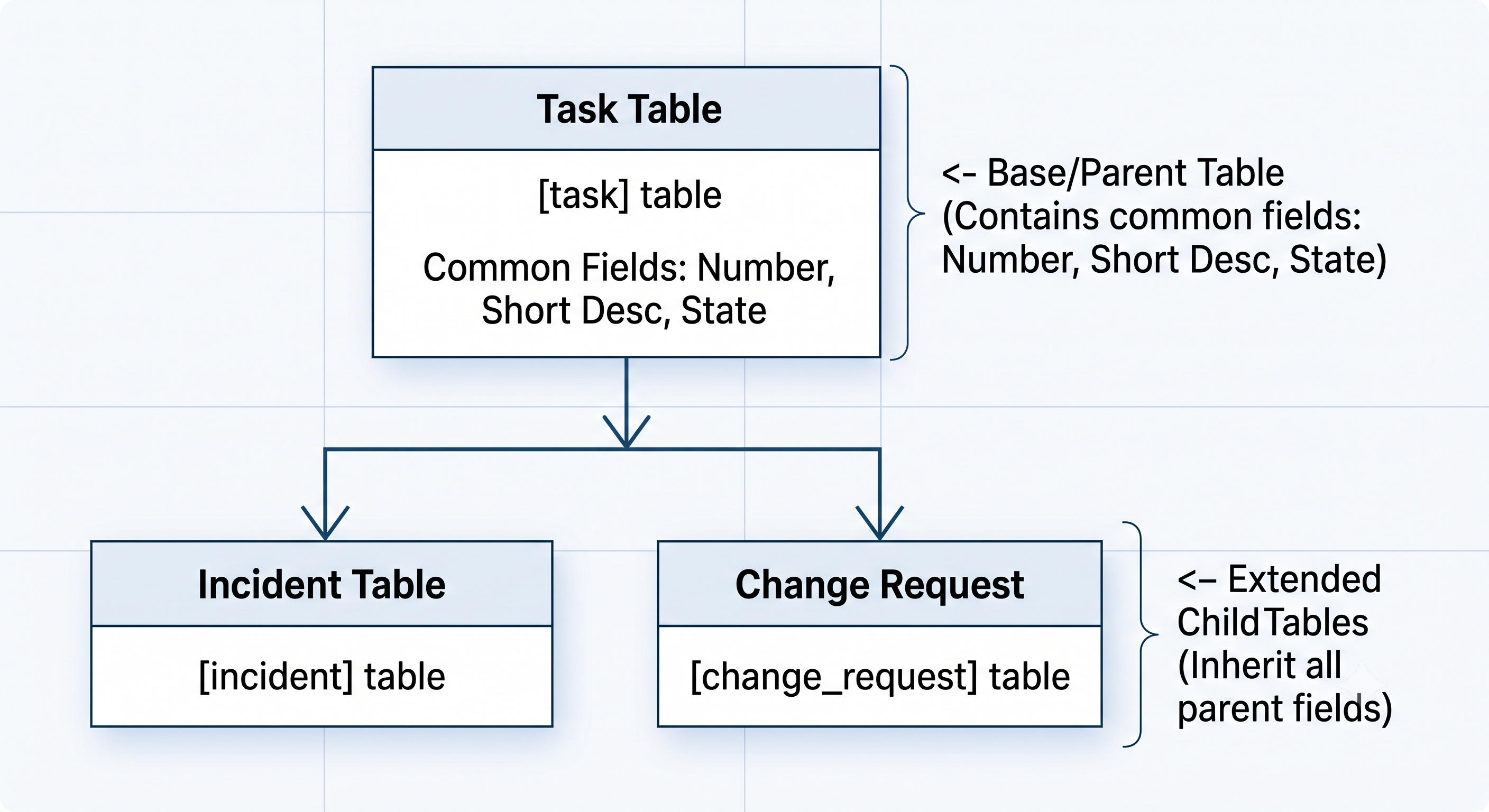
Extended Tables: Extended tables contain all the fields and architecture of a parent table and at the same time have some particular fields of their own. For example, the Incident [incident] table and the Change Request [change_request] table are extended tables of the basic Task table.
The Configuration Management Database (CMDB)
CMDB is the analytical basis of the knowledge base of ServiceNow's infrastructure. In the database, Configuration Items (CIs) are stored. These are the physical, digital or conceptual pieces of the organization's tech footprint, including anything from bare-metal servers to cloud containers, software licenses, network routers, and logical business services.
In its essence, the CMDB does not serve as an inventory tool alone. Rather, it accounts for complex webbed relationships and dependencies of these components. With the help of the CMDB, an engineer would know precisely what web applications, payment gateways, and departments are affected by an enterprise router problem.
System Security and the Access Control List (ACL)
Data security in multi-tenant enterprise environments is achievable only through strict access control. This is implemented at ServiceNow through the Access Control List (ACL), a rule-based security engine.
Access control strictly follows hierarchical structure: User , Role , Group. Permissions are not assigned to a user directly. They are assigned to certain roles, grouped together into operational groups ("Database Administrators", "HR Case Handlers", etc.), and then particular individuals are added to these groups.
At the time the user tries to access, modify, delete or add information into the record, there is a systematic examination done on three different levels of criteria:
Access Granted = Role Evaluation ^ Conditional Expression Evaluation ^ Scripted Logic Resolution
If any of the above components fails, then the transaction is blocked by the system, guaranteeing data confidentiality and compliance with regulations for the entire organization.
3. The Official ServiceNow Certification
While signing up for structured servicenow online training in order to acquire your educational material, it is important that you align your own learning process with the certified learning process.
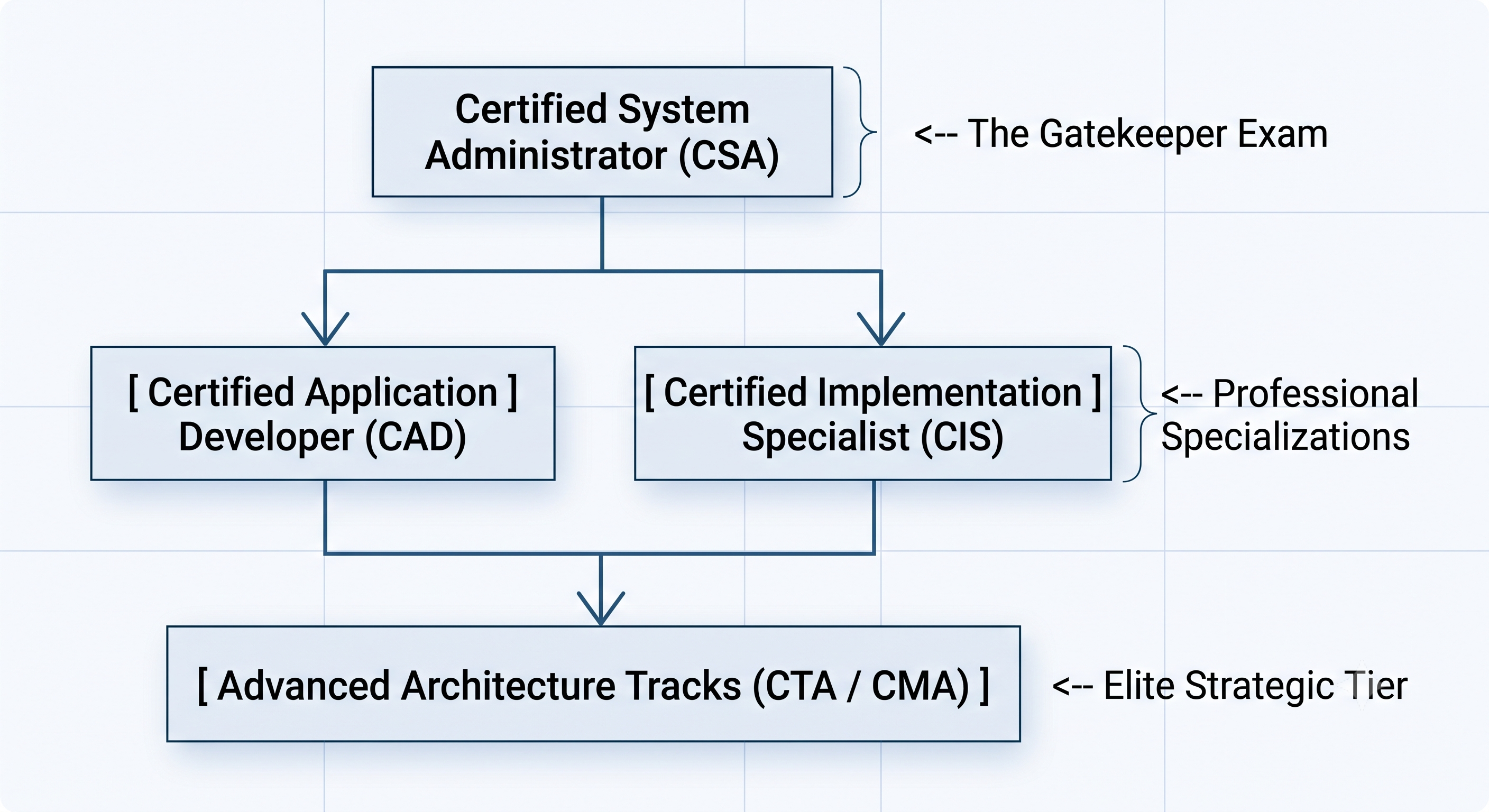
Level 1: The Base – Certified System Administrator (CSA)
The CSA is the ultimate starting point and mandatory requirement for growth. This course of study is dedicated entirely to configuring the system and not script writing. Students learn all about configuring the system from user interface changes, user security management, list and form administration, data importing techniques, and basic automation.
Target Audience: IT support personnel, System Admins, Business Analysts, and Tech freshers.
Preparation Period: 4 to 8 weeks of intensive study combined with intense lab work.
Key Skill: Management of daily operations of the platform, data reporting, and basic schema changes.
Level 2: The Engineer – Certified Application Developer (CAD)
This training program takes a complete shift in perspective from the configuration to development of custom applications on the ServiceNow system. This is a very technical course which requires strong programmatic thinking ability. It covers application scoping, Client/Server side scripting, data privacy sandboxing, and ATF design.
Target Audience: Software Developers, Application Engineers, and JavaScript Programmers.
Preparation Timeline: There is preparation time between 6-8 weeks where you can gain the development phase and development efforts.
Key Skillset: you can gain you personal style from software with no templates.
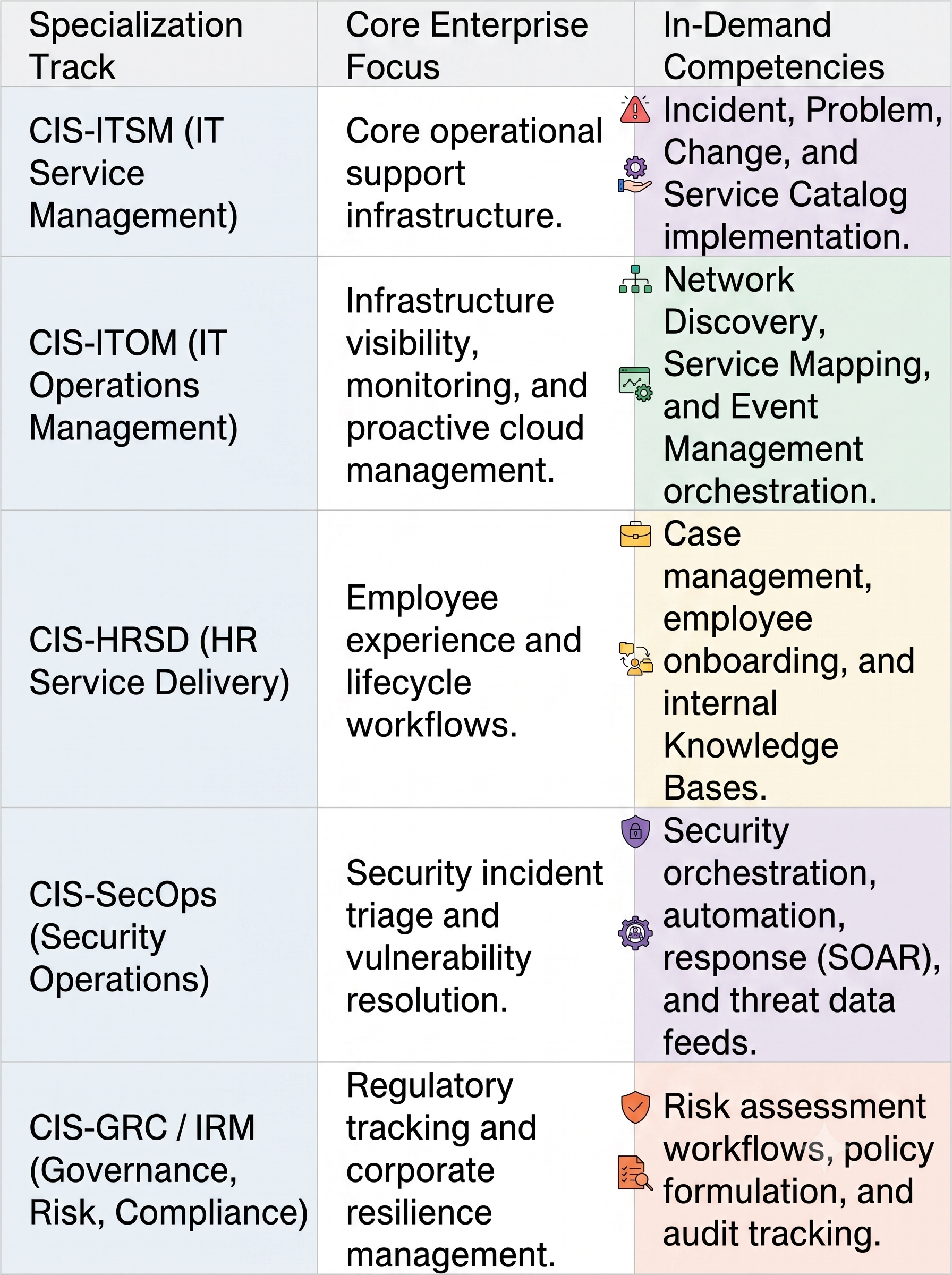
Tier 3: The Specialist – Certified Implementation Specialist (CIS)
ServiceNow is a very modular platform, consisting of different workflow suites. After learning how to administer the platform and getting familiar with basic developer principles, one proceeds to specialize themselves further by earning their CIS designation. Some of the key implementation specialties are:
Tier 4: The Strategic Peak – Certified Technical Architect (CTA) & Certified Master Architect (CMA)
This tier consists of highly exclusive and very stringent programs aimed at senior level executives involved in overseeing large digital transformation projects. These programs deal with enterprise integration designs, global scale governance models, technical optimization, and high-level stakeholder management.
4. Operational Workflows: A Deep Analysis of Modules
An efficient training program considers each of the fundamental business model modules as a separate discipline in its own right. Let us analyze some of the operational modules that you would be dealing with while undergoing your training.
IT Service Management (ITSM)
ITSM is generally the primary implementation module for most global organizations and constitutes the base for most baseline training programs. It is almost identical to the ITIL (Information Technology Infrastructure Library):
Incident Management: Workflow designed to restore regular service operation as quickly as possible after an unexpected disruption, causing minimal damage to the company’s activities.
Problem Management: Analysis of the root cause behind repeating problems. By addressing and correcting the underlying issue, one prevents future interruptions.
Change Request Management: Strict and well-controlled procedure that allows implementing changes to the company’s production environment (like updating database schema or uploading the code on the server) without any additional unexpected downtime.
Request Management & Service Catalog: The front end interface, which allows users to select services among the available standard list of corporation services (e.g. order of the new monitor or access to some software). In the backend, there is a set of automated workflows for approval and task allocation.
IT Operations Management (ITOM)
Whereas ITSM deals with human interaction and tickets processing, ITOM is focused on the direct monitoring and management of the digital environment. Its main objective is to turn chaos into clear and valuable visibility:
Discovery: The automated scans of the enterprise’s network that go through all the IP addresses to determine all the routers, virtual machines, software installations and database instances. This avoids the problem of incorrect inventory management and ensures the up-to-date status of the central database.
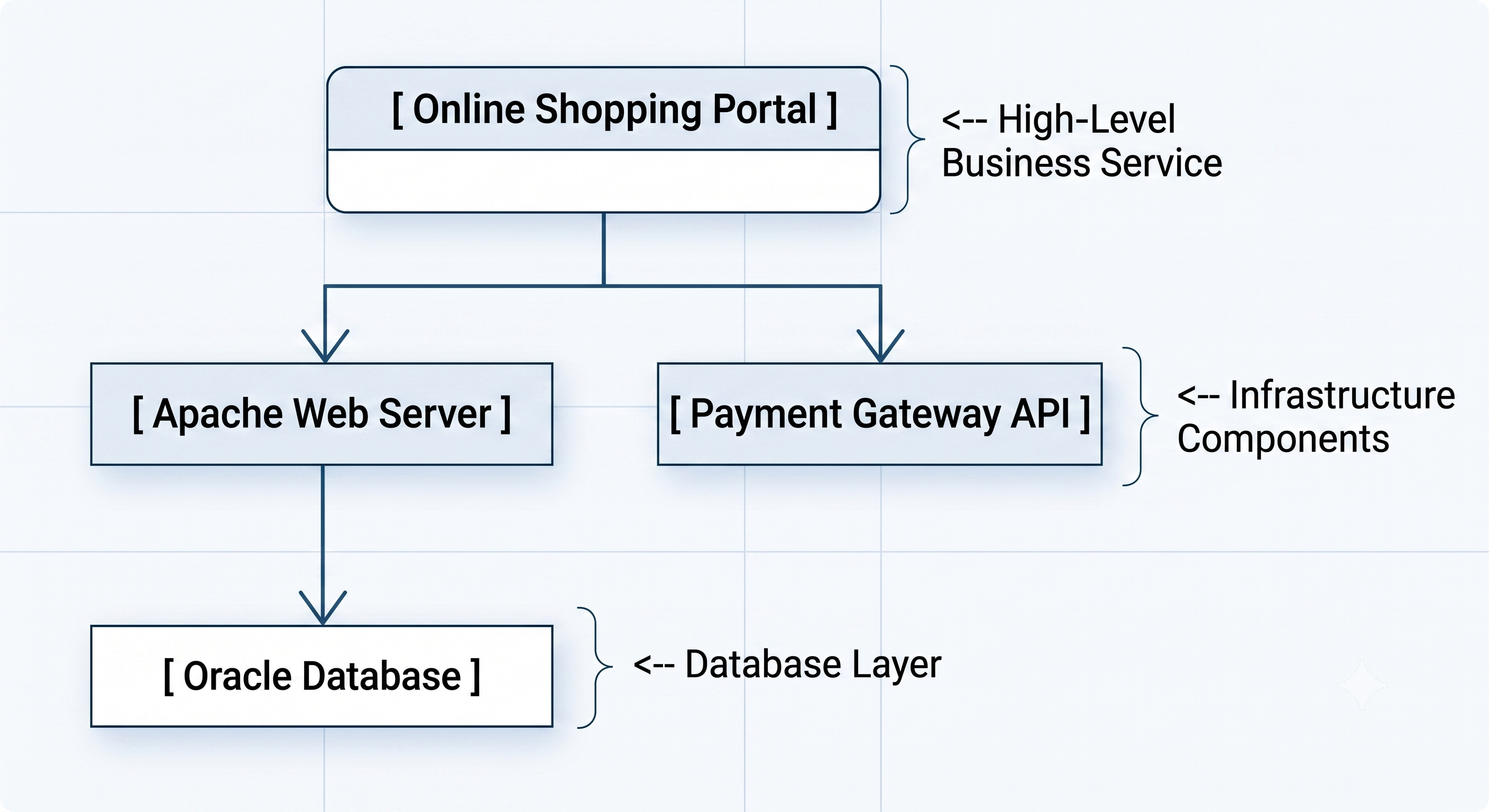
Service Mapping: Process of tracing top-down dependencies between business services and their software/hardware infrastructure.
Event Management: Collects streams of operational logs and alert signals from the external monitoring system and uses AIOps (Artificial Intelligence for IT Operations) technology to filter out noise, correlate similar problems, and automatically raise support tickets before service failures occur.
5. Principles of Development: Techniques of Automation and Scripting
There is a considerable amount of programming involved in training related to ServiceNow at advanced levels. To facilitate the development of the workflow, coders must work in two environments for coding.
Client-Side Scripting (Browser-Level Scripts)
Client-side scripts run on the client computer inside the browser or mobile app. They are mostly used to control the user experience, validate user input data, and control the layout of user interfaces.
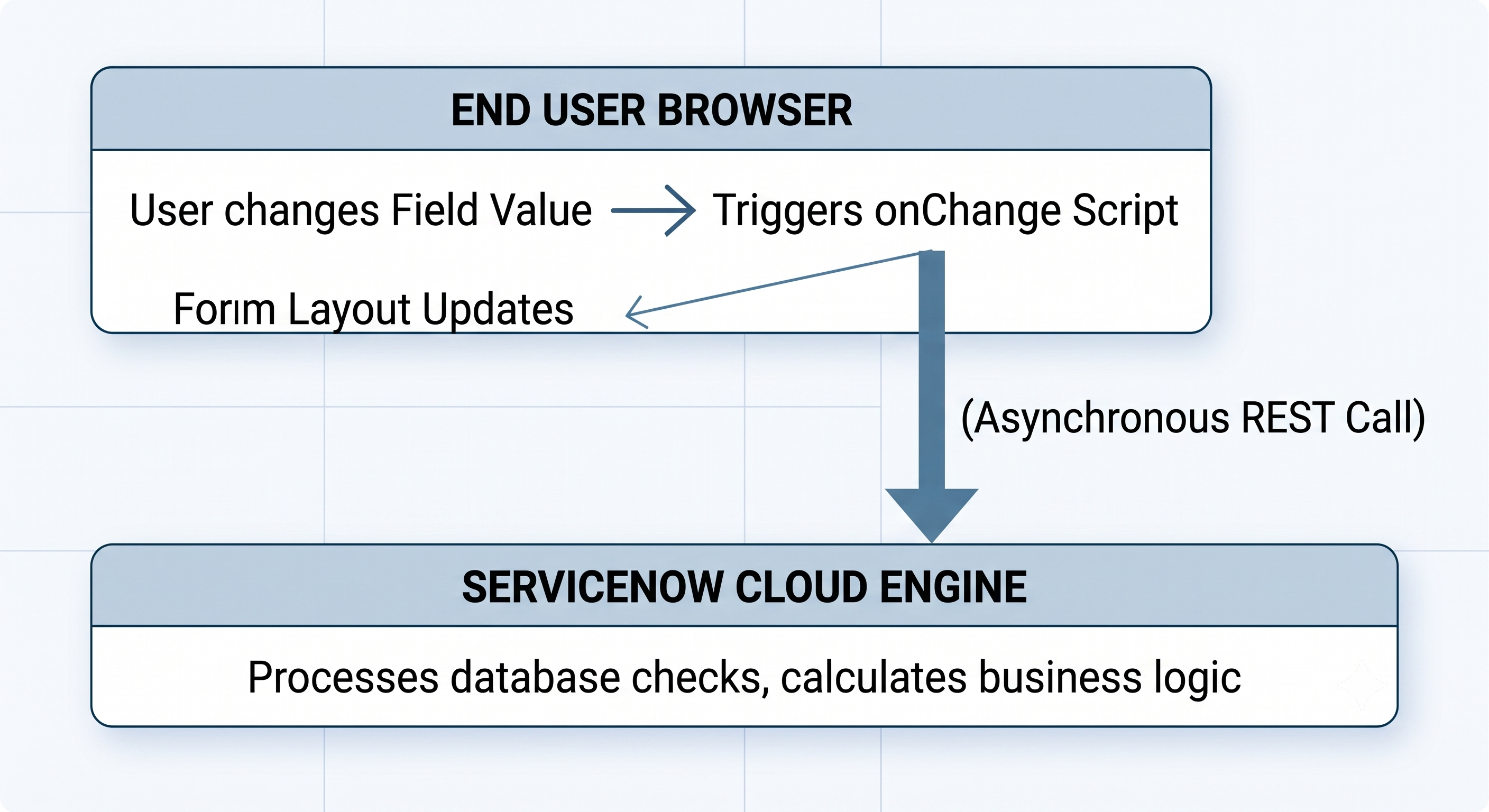
Client Scripts: Code loops tied directly to explicit browser events: onLoad (at the start of form rendering), onChange (changes made to a field value), and onSubmit (commitment of form submission).
UI Policies: A quick way to dynamically change forms in a low-code way as compared to client scripts to make some fields mandatory, hidden, or read-only through field evaluation.
Server Side Scripting (Cloud Engine Layer)
Server-side scripts work securely within the ServiceNow cloud environment, directly communicating with the database engine.
Business Rules: Scripts that run automatically depending on whether data is written to, updated, or deleted from a database table. It can run either before committing the data (for validation purposes) or after committing the data (for cascading the update of data across the linked tables).
Script Includes: Object-oriented modular JavaScript code which is reusable and encapsulates business logic. It can be cleanly invoked by other server scripts or invoked asynchronously from the web browser using AJAX.
Data Manipulation and the Glide API
Platform data manipulation is done using special JavaScript framework abstractions called the Glide API. These two fundamental classes include:
It is the main class of database abstraction for performing Create, Read, Update and Delete data operations without the use of raw SQL.

Contains important system utility functions which include such operations as logging diagnostics information, verifying permissions of active user role, calculating dates and accessing properties of global system.
Low-Code Visual Automation: Flow Designer
In modern enterprise development, minimization of custom scripts footprint in order to prevent the creation of technical debt is highly appreciated. This is achieved by ServiceNow via Flow Designer – visual drag-and-drop tool for workflow orchestration.
Flow consists of Trigger (event that initiates process execution – e.g. record status change) and Actions (e.g. notifications, updating database records and approvals).
Through IntegrationHub, Flow Designer has the ability to extend its functionality beyond the boundaries of the platform using pre-integrated connectors, called Spokes. That way, without any coding, non-developers are able to construct automated pipelines that directly communicate with external software solutions such as Slack, Microsoft Teams, Azure Active Directory and Jira.
6. The Modern Era: Now Assist and Agentic Workflow Automation
Artificial intelligence implementations are one of key focus areas in ServiceNow training courses. Generative AI was integrated into the ServiceNow core engine through Now Assist architecture.
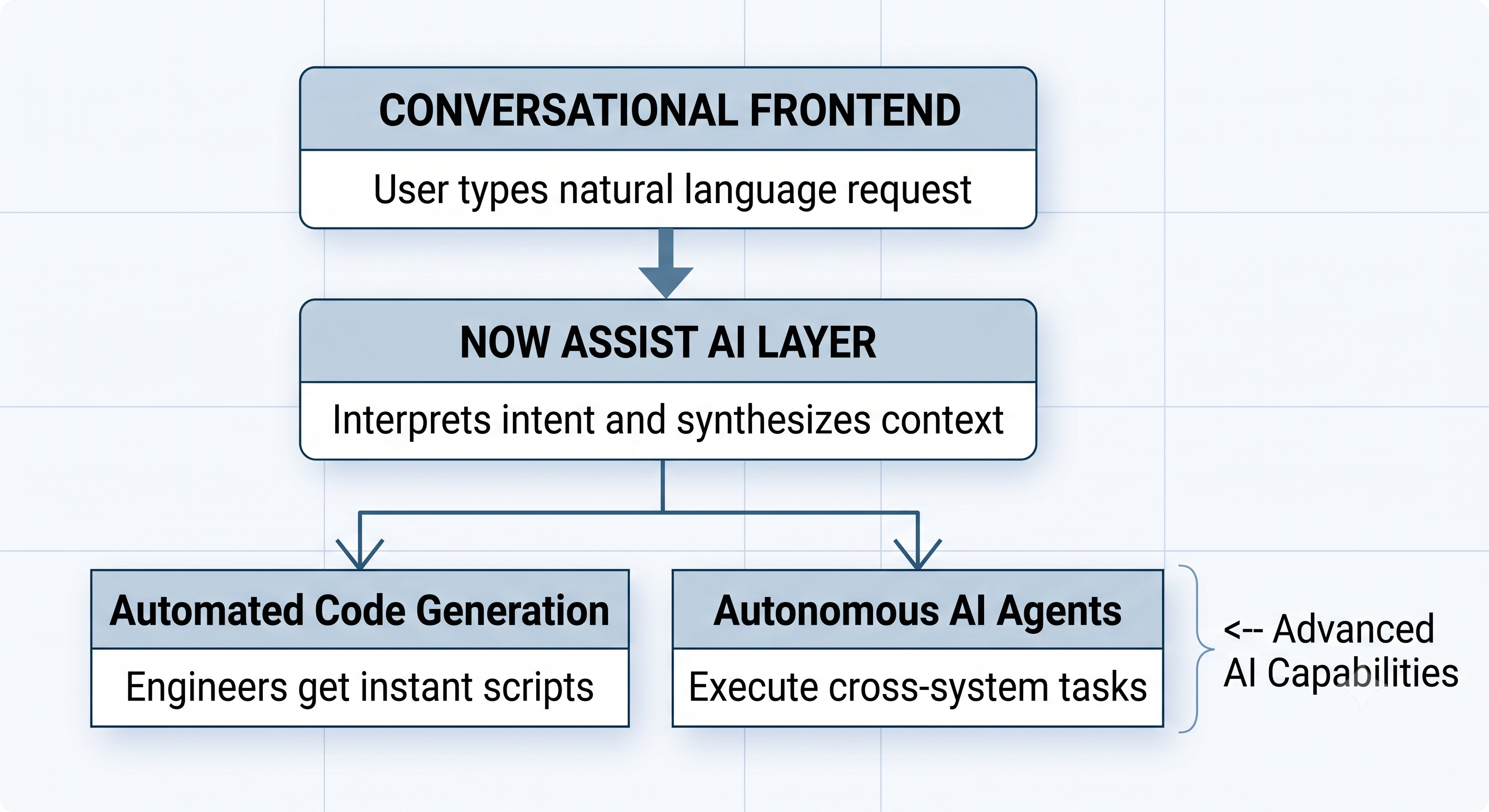
Search Within Context and Virtual Agent Dialogs
As opposed to the manual process, the user interacts with the Virtual Agent of the enterprise. Leveraging the Large Language Models (LLMs) that are trained specifically for the corporate processes, the Virtual Agent engages in conversation and provides documentation, solutions, troubleshoot responses, and logging in a natural way.
Automated Code and Workflow Creation
From the perspective of the application developers, Now Assist acts as an intelligent pair programmer. Inside the developer's studio, the developer types a comment written in natural language for creating a specific feature:
"Write an asynchronous server-side script to identify all the idle asset records, change their status to 'In Stock,' and send the digest message to the inventory management team."
The code generation tool instantly creates the syntactically correct JavaScript code based on valid APIs.
Case and Incident Summarization
When an incident gets escalated through a series of complicated teams, the agent spends a lot of time analyzing the history of notes to find out what has been done. Now, Assist can read hundreds of tickets, log text and summarize the whole thing into one action paragraph.
Autonomous AI Agents
ServiceNow technology allows for autonomous AI agents running on background workers. Instead of being stuck in pre-programmed if/then scenarios, the agents make use of semantic analysis to analyze complicated tasks, orchestrate calls to APIs between systems, analyze business patterns, and act on their own, safely working within company boundaries.
7. Practical Implementation: Building Your Career Path
In order to be able to penetrate the market, it is important that you have a plan on how you want to learn and position yourself. Although undertaking full service now training online is going to give you the technical fundamentals, you have to put your knowledge into practice. Below is the approach you should follow.
Create a Personal Developer Instance (PDI)
ServiceNow should be learned not only theoretically but also practically. Go to the developer portal and get a personal sandbox environment called the Personal Developer Instance (PDI). In this personal environment, you will have all the permissions necessary to make changes and write your own code without breaking anything.
Create Your Portofolio
In order to impress the employer, create projects and document them in your Personal Developer Instance. Some good examples of portfolio applications are the following ones:
Room Reservations Application: Develop a scoped application with custom tables and forms for reservations, with specific rules of booking and automated email confirmations using Flow Designer.
Integration With Public Weather API: Using Integration Hub create an outbound REST integration which polls the public weather data source and creates location updates automatically based on JSON responses.
IT Equipment Loaner Application: Build an automated catalog request application where employees can borrow IT equipment using a multistep approval loop and automated reminders about returning the equipment.
Beware of Common Pitfalls of Beginners
Building within the Global Scope: It is common for beginners to develop a custom project within the global scope of an application, which can lead to damage of system settings. Always develop your work inside a dedicated Scoped Application.
Over-Scripting the Solution: Do not use custom JavaScript code where a problem can be solved using configuration options such as UI Policies and Flow Designer. Reduced amounts of custom code make the platform much easier to update.
Not Focusing on the Labs: Viewing tutorial videos or practicing questions will not result in true mastery of the platform. You need to spend most of your learning time working with your PDI.
8. Conclusion: Pick Your Way Forward
ServiceNow has become a pillar in the operation of enterprises. If you have chosen to specialize as an administrator who works with access controls, developer creating custom integrations, or implementation specialist implementing AI-powered workflows, you can follow a structured, certified learning path.
In order to make this theory a lucrative career for oneself, the next step is taking up a course on servicenow where one can learn everything from basics to how to become industry-ready. With a combination of service now training online taught by experts and practice in one’s Personal Developer Instance, one will be able to get complete mastery over the system.
Lastly, by combining one’s learning objectives with professional certification in servicenow through servicenow online training, one will always be in sync with industry standards and trends.