
The Evolution of Cloud-Native Infrastructure and OpenShift
Last updated on Aug 25, 2026
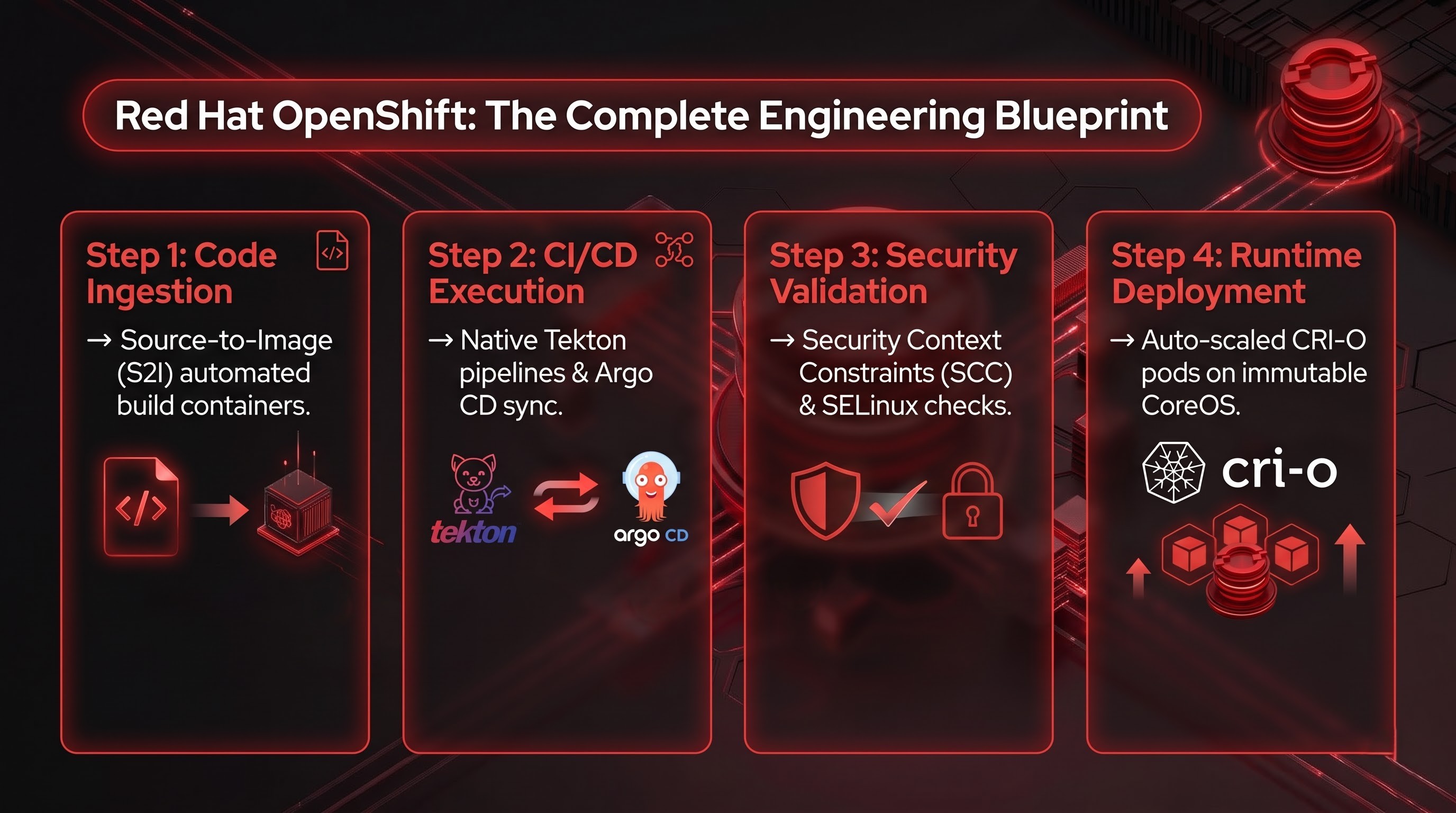
Over the last 20 years, enterprise computing has changed in a way that has led to a continuous effort to balance being agile with the need for governance. In the times of heavy applications and bare-metal datacenters, software deploying was a careful, rigid, and slow process. Delivery of infrastructure took weeks or months of coordination across different departments and configuration mismatches caused by unintentional drifts in development and production environments led to serious failures in deployment processes.
The introduction of hardware virtualization brought some relief as it enabled converting hard assets into virtual chunks. However, the effectiveness of virtualization was offset by the increase in calculation and memory costs. The rise of microservice architecture made containerization more favourable as it was a new phase in packaging, distributing, and running software. Containers made it possible to deliver self-contained programs together with the required supporting units for execution.
The use of isolated containers on a large scale brought forth a significant operational challenge: coordination. The management of thousands of different distributed containers across different clusters required automated scheduling, dynamic scaling, fault tolerance, load balancing, and secure multi-tenancy. Kubernetes, which was released by Google as an open-source project, quickly became the industry standard container orchestration engine. Unfortunately, the basic version of Kubernetes thus remains an orchestration kernel rather than a complete enterprise solution. It doesn't address the critical aspects of container management, such as container image registries, integrated CI/CD solutions, strict access management, automated OS patching, integration with enterprise storage systems, and multi-tenant layer security.
This was an important reason for the development of Red Hat OpenShift. Based on Kubernetes and an unmalleable operating system, OpenShift is an integrated hybrid-cloud application platform. It solves the gap between the pure container orchestration and real enterprise operations. OpenShift provides what developers need regarding experience and security, streamlines the entire application management process, and ensures the teams enrolled in an openshift course can create secure and stable operational environments.
Construction Foundations and the Basic Operatives
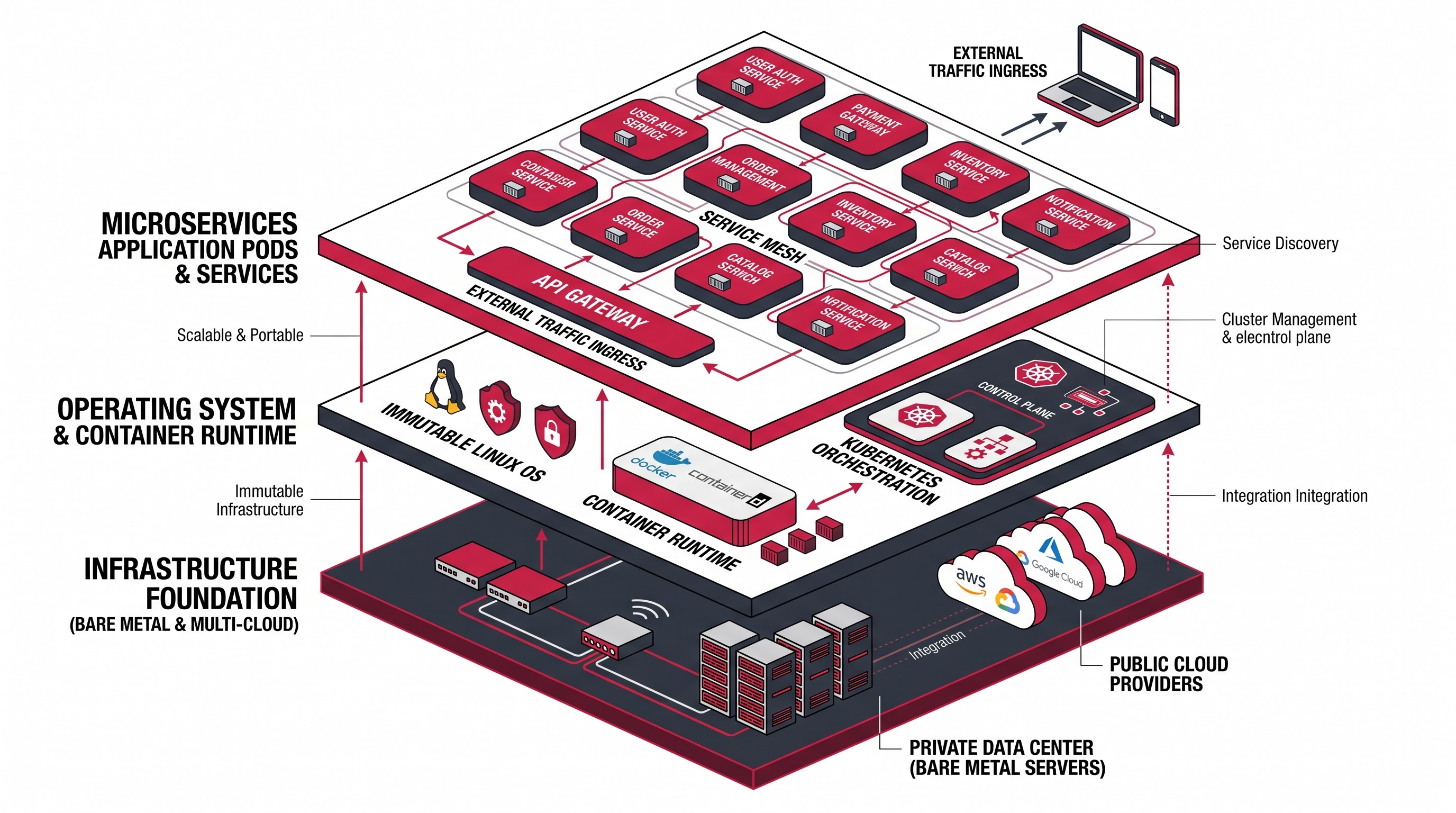
Knowing what OpenShift is means knowing how it turns normal Kubernetes elements into a hardened self-managing OS for enterprise systems. Although common Kubernetes possesses core APIs that allow the processes of delivering pods, controlling deployments, and maintaining services, OpenShift encompasses them into a well-organized, operator-driven architecture.
The Immutable Operating System Layer: Red Hat Enterprise Linux CoreOS
The basis of every OpenShift cluster is Red Hat Enterprise Linux, known under the name of RHCOS. In usual management of the server, operating systems are installed and reconfigured by mutable managing processes leading to configuration drift, not patched vulnerabilities, and all kinds of snowflakes in worker nodes. CoreOS proposes a different approach to host management formed by the strategy of immutability.
Rather than treating the operating system as a series of package updates performed as needed, CoreOS sees it as a single immutable system image that is published as an ostree commit. Administrators do not log in via SSH to use any manual package management or configuration modification but declare all necessary modifications like kernel configuration, certificates, systemd unit definitions, etc., as custom resources in Kubernetes so the Machine Config Operator can manage them centrally. Once an update to the OS or a change in settings is made, CoreOS performs an atomic update (of the OS) in the currently inactive partition, performs a graceful shutdown of the workloads, reboots the OS, and checks the health of the system after reboot before putting the node online again.
Container Runtime: CRI-O
OpenShift does not resort to using general-purpose and heavy container runtimes, but chooses CRI-O, a type of container runtime specifically designed to meet Kubernetes Container Runtime Interface requirements. CRI-O was developed explicitly to allow Kubernetes kubelet to interact with open-source runc execution engines.
By removing many functions that have nothing to do with Kubernetes specifications, CRI-O considerably reduces its host footprint and scope of vulnerability. It connects directly to the host security features such as SELinux and AppArmor, thus not allowing any container process started by CRI-O to escape from its restricted Linux namespacing, control grouping or mandatory access control features.
Operator Framework and Automated Processing
The very foundation upon which OpenShift’s latest versions are built has been the Operator Framework. An Operator is a special type of controller that combines the configuration and operational skills that have been acquired by human systems engineers with actuated software in order to help expand the Kubernetes API.
With OpenShift, the entirety of the cluster is made from a collection of numerous interconnected Platform Operators. The layers responsible for networking, storage provisioning, API routing, authentication, logging, and image registry management are all composed of different Operators. By working on the basis of the compared information about its component and the desired state that has been specified with custom resource manifests, the Operator is always capable of running a comparative check of its component. Whenever any equipment goes out of order, is damaged, or is not functioning properly, it is the responsibility of the Operator to take necessary actions, which would not require human effort.
This operator-led design goes beyond the Day-1 operational phases and includes Day-2 lifecycle management. Upgrading the entire OpenShift cluster, including the operating systems of many physical machines as well as control plane components and platform add-ons, is performed by making a declarative update to the Cluster Version Operator and leveled with the update process that causes a number of sequential rolling upgrades while keeping applications running smoothly, enabling constant monitoring of API compatibility, and stopping automatically whenever a worker node displays any abnormalities in the metric profiles.
Structured redhat openshift training provides adequate training on advanced cluster update loops and automated reconciliation routines, making it easier for engineers to operate in realistic environments.
Developer Experience, Work Efficiency, and the Inner Loop
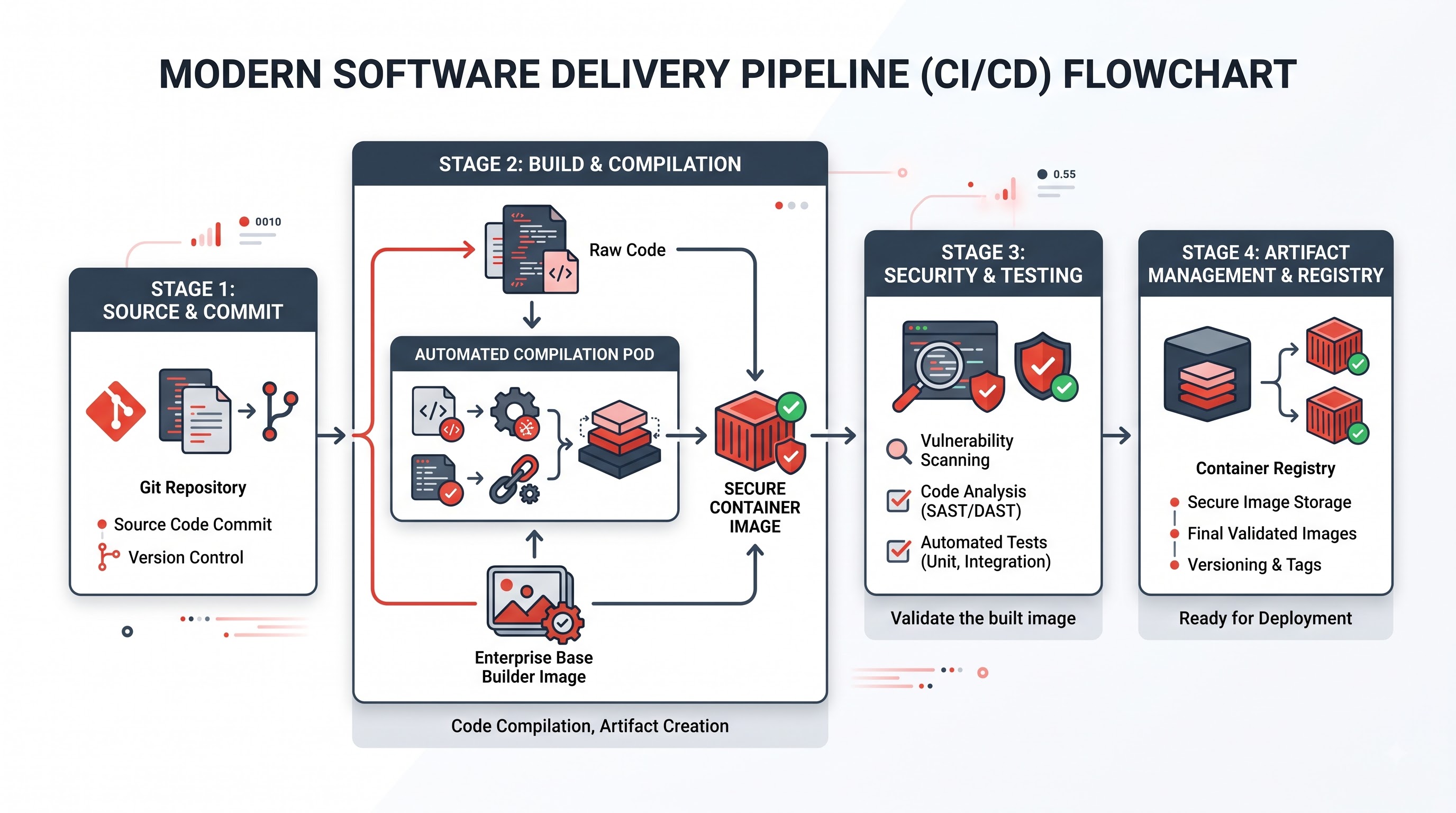
The reliability of the operation allows us to consider the platform resilient but business efficiency on the enterprise level is defined solely by the speed of the developers performing their tasks. OpenShift solves the problem of developer productivity by removing infrastructure complexities while retaining the needed flexibility for developing new software solutions.
Source-to-Image and Automated Artifact Creation
The inability of developers to create and manage Dockerfiles was one of the barriers preventing the adoption of containers in the past. Developers need to possess particular skills to create a good and safe container, taking into account multi-stage caching, isolating users’ permissions, and minimizing layers. The development team often makes mistakes when using insecure images from untrustworthy sources and visiting build tools in the runtime.
The Source-to-Image method was developed by OpenShift, which is a structured process uniting raw code from the repository with a trusted builder image and creating a ready-to-use container image. Source-to-Image regulates software packaging for enterprises. The system defines which images are to be used in the programming language (e.g. Java, Python, Node.js, Go). Thus, security patches and company libraries are used. Once developers change the code, the platform automatically creates an image.
It is easy to learn how to make the most out of secure building strategies and to automate deployments with the help of openshift training online.
OpenShift Pipelines: Cloud-Native Continuous Integration
When the domain of continuous integration has turned towards the Kubernetes-native methods, traditional external CI servers based on dedicated static worker virtual machines are becoming operational bottlenecks. OpenShift runs OpenShift Pipelines developed with the open-source Tekton framework aimed to provide scalable container-native continuous integration.
In OpenShift Pipelines, all build pipelines, tasks, and steps run as standard Kubernetes pods. There are no idle worker agents taking resources for computation when pipelines are not active; resources are dynamically scaled down to zero and launched right as the code push happens. Since tasks are defined as standard Kubernetes custom resources, pipeline definitions live with application code in the version control system, which ensures that delivery lifecycles can be repeated, transparent, and auditable.
OpenShift GitOps: Declarative Infrastructure and Continuous Delivery
OpenShift GitOps, which utilizes Argo CD, governs application delivery and cluster configurations throughout a number of environments. The framework of GitOps is such that a single source of truth in terms of configuration is obtained through versioning from Git.
In GitOps, the continuous delivery pipeline is not given the capability to write to the production cluster. Instead, an in-cluster GitOps operator keeps polling the Git repository. In case any change happens in the repository, the GitOps engine reconciles the state of the cluster with the repository. As a result, there is an audit trail and a record of all changes made to the infrastructure.
Development Tools, Web Consoles, and Serverless Execution
OpenShift has its own unique interfaces which cater to various types of users. The Developer Perspective in OpenShift's Web Console gives developers a graphical topology view of microservices. Developers can track their application interdependencies, watch live pod logs, scale their workloads live, check the routes, and add their environment variables without having to learn the low-level command-line options.
OpenShift Serverless, which runs on Knative, allows the applications to scale based on live HTTP requests or asynchronous events in today’s event-driven architecture. It makes the applications scale down to even zero instances when there are no requests, hence freeing the expensive computing, memory, and licensing resources from the shared cluster before being able to scale up in a matter of milliseconds after receiving a request.
Security of Enterprise, Identity, and Governance
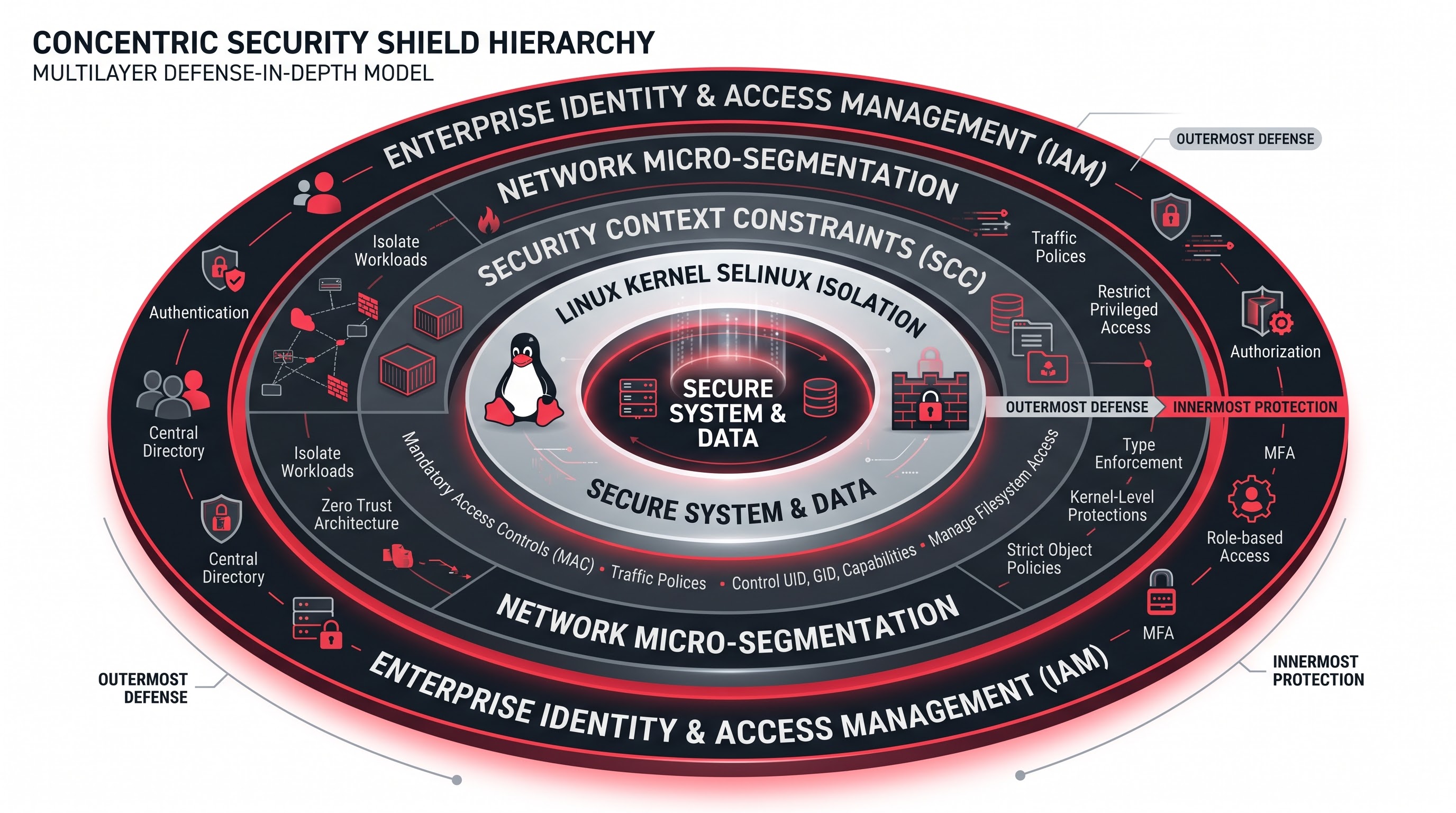
In contemporary business systems, the issue of security should not only be regarded as an addition to business processes or as only adequate to the outer shell of an organization. OpenShift provides a universal concept of security which includes strong boundaries plus rules of constant compliance and access control in any stage of operations.
Principles of Security Context Constraints and Isolation of Users
Historically, the usage of Kubernetes by default has been based on the notion of running containers with root access unless otherwise said in terms of either policies of the pod security or in any processes related to the approval of the admission. This approach presented dramatic consequences because if the hacker broke into the container due to a kernel vulnerability, he automatically received root access to the host machine.
The manner in which OpenShift deals with this vulnerability standard is Security Context Constraints. Security Context Constraints are specified security admission controllers that accept each pod creation before the request reaches the scheduler. OpenShift does not allow containers to run as a root user. Instead, OpenShift automatically assigns an identifiable group id to every namespace. OpenShift complies every container with an unprivileged random user ID. In addition to this, containers have restrictions imposed on leveraging privileged host directories, working with specified network interfaces or increasing the privileges during its work, which comes as a solution for many possible container breakout attacks.
In accordance with the Mandatory Access Control using SELinux
Not only does OpenShift provide the system’s user isolation, but it also implements the mandatory security system of Security-Enhanced Linux on the system kernel level. Using Multi-Category Security and Multi-Level Security policies, CRI-O and CoreOS are able to automatically assign unique labels to each container and the associated storage volume.
Even with the presence of processes that does not belong to authorized containers, bypassing the filesystem limits and accessing the host’s hardware and systems are limited by the process management of the SELinux subsystem. In this case, the access control systems of the host’s operating system terminate any illegal processes that could have been run by those unauthorized processes. The mandatory access control utilized on host level by SELinux makes it possible to create several different isolated environments that offer complete isolation and encryption for competing companies that share the physical computing power of the same infrastructure.
Identity management, role-based access control, and security compliance
Enterprises usually don’t have their identity management systems located in total isolation. OpenShift includes its own OAuth server that interacts directly with the corporate identity provider’s systems, such as LDAP, OpenID connect, SAML, and OAuth2.
Once identity verification occurs, the RBAC system of OpenShift starts implementing strict regulations on the organizational hierarchy of permissions present in the system.
OpenShift uses a Compliance Operator to cater for external compliance regulations such as PCI-DSS, HIPAA, FedRAMP, and CIS benchmarks. Compliance Operator regularly checks the performance level of CoreOS hosts, platform operators, and container configurations against the hardened forms of security being used, generating a list of necessary remediation actions just like a report.
Networking Architecture and Traffic Management
Networking architecture must be reliable and efficient. It understands how to move data packets between tens of thousands of ephemeral endpoints constantly moving among physical servers and data centers.
OVN-Kubernetes: Software-Defined Networking Fabric
OpenShift uses OVN-Kubernetes as its standard software-defined network. OVN-Kubernetes enables advanced networking capabilities which are meant for highly dense multi-tenant enterprise clusters.
OVN-Kubernetes additionally supports dual-stack IPv4/IPv6 networks and automated management of egress IP addresses and hybrid SDN topologies. Moreover, it is important to note that OVN manages East-West traffic between pods with the help of Open vSwitch accelerated flows thereby successfully reducing CPU overhead and network latency.
In OpenShift, network policies give permission to application teams and administrators to practice micro-segmentation of the given platform. By default, pods communicate openly within a project but administrators can apply specific ingress and egress rules based on pod labels, CIDR blocks or namespace selectors. This configuration blocks the front-end web tier from making unapproved network connections.
Ingress, Edge Termination, and OpenShift Routes
In order to bring external North-South traffic into a cluster, there is a need for powerful ingress traffic controllers. While Kubernetes makes use of ingress resources, OpenShift extends this idea with the use of the route resource enabled by powerful HAProxy edge router technology.
OpenShift Routes guarantee enterprise-level traffic management from the first use. They consist of various TLS termination methods, such as Edge termination (when TLS is converted to clear text at the router and forwarded inside without further operations), Passthrough termination (when the secure TLS traffic is routed straight to the application container with no decryption done in between), and Re-encryption (when the router converts the traffic to plain text for the purpose of path-based routing analysis and subsequently encrypts it again with the help of an internal certificate and passes it). In addition to this, Routes are capable of performing split-traffic weighting by bypassing the necessity to do the calculations manually to perform canary deploying, blue-green releasing, and releasing new versions of applications without any downtime.
OpenShift Service Mesh
For complicated microservice architectures which require sophisticated observability, mTLS encryption, and distributed tracing OpenShift incorporates OpenShift Service Mesh which is built on Istio, Envoy, and Kiali.
Service Mesh is a technology that inserts an Envoy sidecar proxy into the applications containers without disrupting its operation and provides a communication pipeline for all the inter-service requests. The service mesh provides mutual TLS encryption for all the microservices connected in the service mesh network thus ensuring secure communication between the applications without the need to write the whole cryptography code in the application itself. Furthermore, the service mesh provides for distributed tracing capabilities, allows the implementation of circuit-breakers in case of a failure in the downstream part of the network, and provides fault injections for the purpose of testing applications resiliency.
Storage Architecture and Data Persistence
Containerization was originally thought of as a technology applicable only to stateless web applications but today enterprises make use of it in workloads that involve stateful databases, message queues, ML, and analytic applications. OpenShift offers robust, enterprise-level storage architecture for the purpose of providing data storage that is reliable and scalable enough to meet the needs of applications that require high volume of data processing.
The Container Storage Interface and Dynamic Provisioning
OpenShift has adapted the Kubernetes Container Storage Interface standard, allowing it to work in conjunction with virtually every backend storage technology used in enterprises, such as SAN, NAS, block storage systems hosted in the cloud, and object storage systems.
The storage is represented through Persistent Volume Claims and Storage Classes. Developers don’t need to know any details about the storage, including the details about the physical storage; they simply need to give a storage request with information about the required capacity, access (such as Read Write Once, Read Write Many), and performance characteristics of the storage. After the application sends the storage request, the dynamic storage provisioning system in OpenShift will communicate with the underlying storage controller, create a required physical or cloud volume on demand, and connect it to the host where the application is scheduled.
OpenShift Data Foundation
When it comes to conditions where users have to consider a harmonized storage platform based on software and operating on heterogeneous infrastructures, OpenShift Data Foundation (previously called OpenShift Container Storage) comes to the rescue. OpenShift Data Foundation is based on three systems: Ceph, NooBaa, and Rook. All of these components are used to create a unified infrastructure, using local storage devices of all nodes in one virtual IT environment.
The system can offer three types of storage, all controlled from one administrative panel:
Block Storage refers to fast and non-late volumes created for databases, key-valued stores, and transactional engines.
File Storage allows the use of multi-writer file systems, complying with POSIX to enable applications to write/read concurrently in common directories using various computing nodes.
Object Storage uses object data storage that fits into the S3 compatibility for cloud applications, casual information platforms, backups, and analytical lakes.
Since OpenShift Data Foundation is a software-defined element, it assures the same storage API wherever the cluster is located. The manner of applications using storage is the same, meaning there is no risk because of different clouds and the data recovery configuration process is much easier.
Successful implementation of unified storage, hybrid cloud implementations, and multi-tenant security policies is well covered in openshift online training for cloud architects and DevOps engineers.