
The Silent Architect: Why OpenShift is Essential for Modern DevOps
Last updated on Sep 4, 2026
In the early days of enterprise software, deployment was a ritual of patience and prayer. System administrators spent days or weeks provisioning physical servers, configuring operating systems, setting up dependencies, and tuning network rules. If an application crashed at 2:00 AM, it usually meant someone was driving to a data center or wrestling with remote SSH connections in the dark.
As virtualization took hold, we shaved days off the provisioning process, but the core issue remained: software was still tightly bound to the underlying infrastructure. The arrival of Docker containers radically simplified how we package code, ensuring that what ran on a developer’s laptop would run reliably in production. Yet, containers introduced their own secondary crisis. Running ten containers on a single server is straightforward; managing tens of thousands of containers across multi-cloud environments—handling auto-scaling, networking, storage, security, and zero-downtime updates—is an operational nightmare.
Enter Kubernetes. Developed by Google and handed over to the Cloud Native Computing Foundation (CNCF), Kubernetes quickly became the undisputed standard for container orchestration. It provided the basic primitives for keeping containerized applications alive and scalable. However, for large-enterprise engineering teams, raw Kubernetes felt like being handed an engine block, a transmission, and four tires, then being told to build a commercial airliner. It lacked built-in developer pipelines, strict enterprise security defaults, unified monitoring, and streamlined route management out of the box.
This operational gap is where Red Hat OpenShift found its purpose. Rather than replacing Kubernetes, OpenShift builds upon it, providing an enterprise-grade, opinionated platform that turns raw orchestration into a cohesive, developer-friendly ecosystem. It bridges the divide between the developers who write application code and the operations teams responsible for keeping systems stable, secure, and resilient.
Understanding the Engine: Core Architecture and Ecosystem
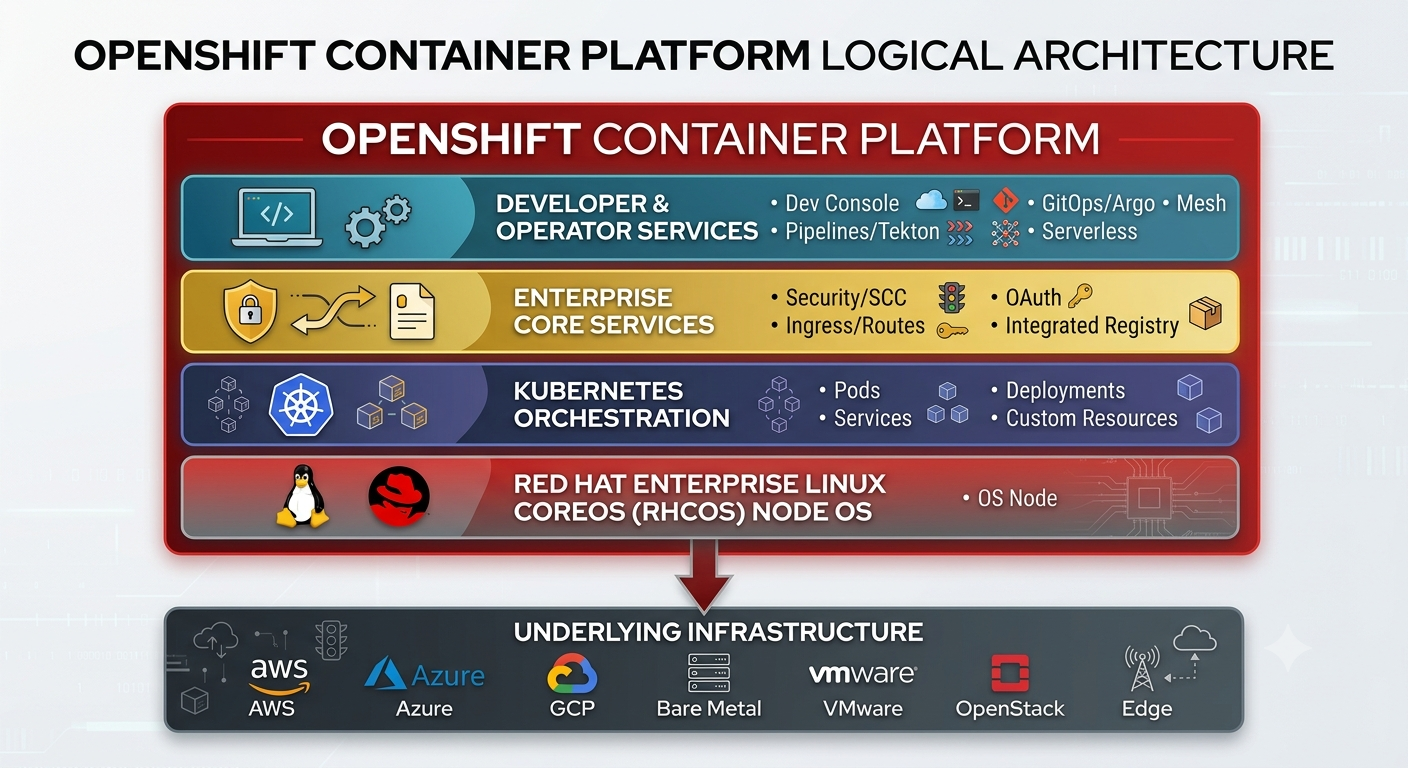
To understand why OpenShift has captured such a significant share of the enterprise market, one must look closely at how its architecture builds upon standard Kubernetes primitives. Standard Kubernetes provides fundamental resources: Pods, Services, Deployments, and Ingress. OpenShift takes these components and wraps them in an integrated operational layer designed for enterprise scale.
The Foundation: Red Hat Enterprise Linux CoreOS (RHCOS)
At the lowest layer of an OpenShift cluster sits Red Hat Enterprise Linux CoreOS (RHCOS). Unlike traditional Linux distributions where admins manually patch and configure system packages, RHCOS is an immutable, container-optimized operating system. The operating system itself is managed directly by OpenShift Operators. Updates to the OS are delivered as container images and applied atomically. If an update fails or causes instability, the node can automatically roll back to its previous known-good state. This design eliminates configuration drift across thousands of nodes and ensures the host environment remains strictly aligned with cluster security requirements.
Operators: Automating Operational Knowledge
The concept of Kubernetes Operators was originally introduced by CoreOS (later acquired by Red Hat), and it serves as the beating heart of OpenShift’s management model. An Operator is a custom controller that encodes human operational knowledge into software code.
In a standard Kubernetes cluster, upgrading the control plane, database instances, or monitoring stack requires complex manual intervention or fragile automation scripts. In OpenShift, Operators constantly watch the actual state of the cluster and compare it to the desired state defined in configuration files. If a database pod fails, an Operator recovers it; if a security configuration slips out of compliance, the Operator corrects it; when a platform upgrade is triggered, Operators coordinate the rolling update of every component from the underlying OS to the high-level routing services without downtime.
Simplified Networking and Ingress via Routes
In plain Kubernetes, exposing an application to external traffic requires configuring an Ingress controller, defining Ingress resources, and setting up external DNS and TLS certificates. OpenShift simplifies this workflow through its native Route resource. A Route exposes a Service at a public URL by integrating directly with the platform's built-in HAProxy-based router (or modern OVN-Kubernetes CNI). Developers can secure traffic with edge, passthrough, or re-encryption TLS policies simply by declaring them in a YAML manifest or clicking a toggle in the web console. The platform handles certificate management, load balancing, and traffic distribution automatically.
Built-in Container Registry and Build Systems
Standard Kubernetes relies entirely on external third-party container registries (such as Docker Hub, Quay, or cloud-provider registries) to fetch images. OpenShift includes an integrated, enterprise-grade container registry out of the box. Furthermore, OpenShift features built-in build capabilities like Source-to-Image (S2I). S2I allows developers to push raw application source code (such as Java, Python, Node.js, or Go) directly to the cluster. The operational gap represents the shedding of light into the function of Red Hat OpenShift. OpenShift never seeks to replace Kubernetes; instead, it expands on it by offering a robust and opinionated solution which transforms bare orchestration into a coherent developer-friendly ecosystem. As a result, it provides a bridge linking developers who write application code on one side and operations teams responsible for maintaining the stability, security, and resiliency of environments on the other.
Understanding the Engine: core architecture and ecosystem
In order to understand why OpenShift occupies such a prominent stake in the enterprise market, it is necessary to understand how it builds its architecture over standard Kubernetes primitives. In fact, standard Kubernetes provides the smallest building blocks, namely Pods, Services, Deployments, and Ingress. OpenShift embraces these elements of the platform and wraps them into the integrated operational layer meant for enterprise usage.
The Underpinning: Red Hat Enterprise Linux CoreOS (RHCOS)
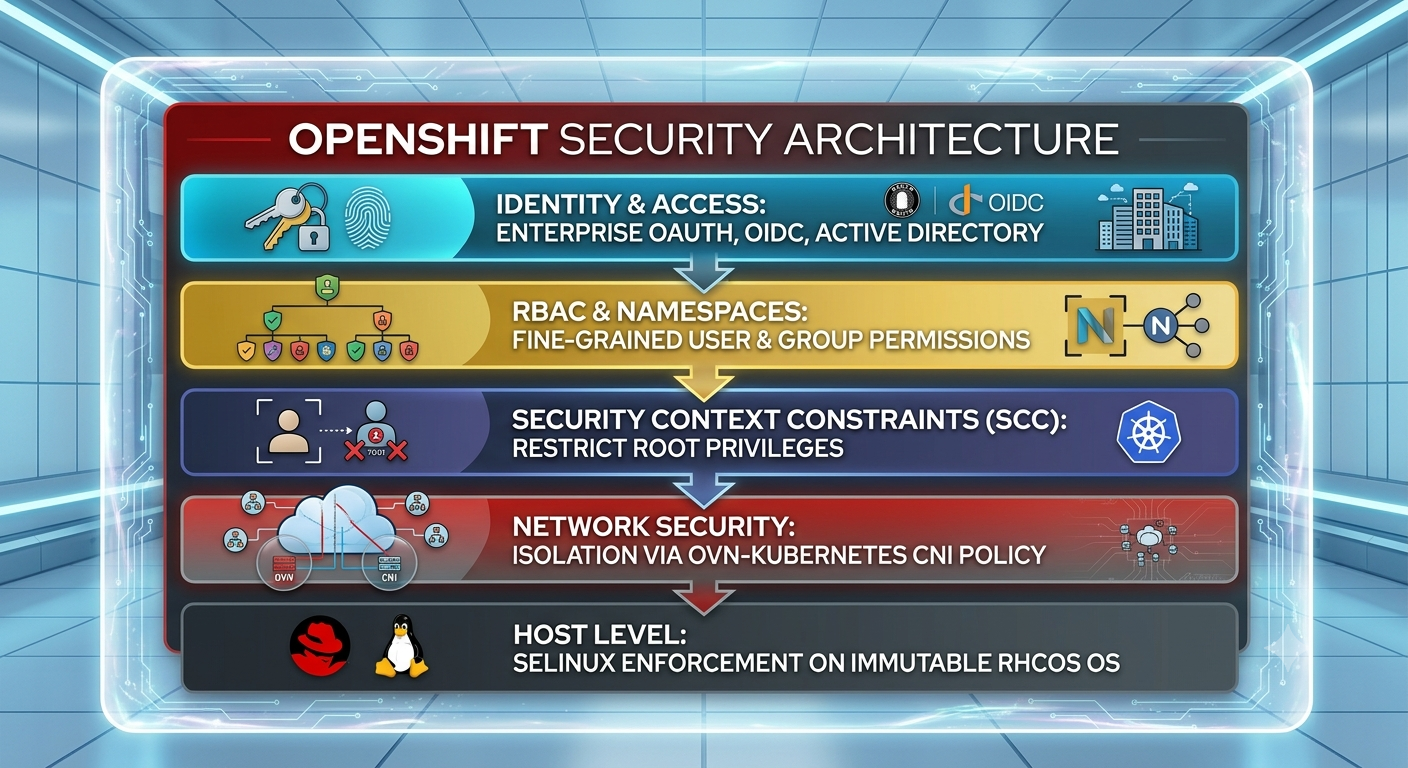
RHCOS represents the lowest level of OpenShift cluster architecture. Different from many other standard Linux distributions, RHCOS is an immutable container-centric operating system, where all updates are conducted by OpenShift Operators. OpenShift uses the restricted-v2 SCC for any workload belonging to the users by default. The restrictions entail several important stipulations:
No Root Execution: The container cannot run as user ID 0, also called root. OpenShift will, therefore, assign a unique non-root UID range to each project namespace.
Privilege Escalation Prevention: Containers are not allowed to request elevated privileges (allowPrivilegeEscalation: false) or run privileged processes that directly communicate with the host kernel.
Volume Restrictions: The use of host paths (hostPath volumes) is fully prohibited for normal users, thus protecting them from using containerized applications to spy on or tamper with host node's filesystem.
Capabilities Drop: The default Linux capabilities are dropped (this includes NET_ADMIN, SYS_ADMIN, etc.) and, as a result, neutralized common vectors for container escape exploits.
Integrated Identity and Role-Based Access Control (RBAC)
Although Akubernetes typically delegates authentication to assorted identity providers and simple client certificates, OpenShift comes equipped with its built-in OAuth server. Because of this, OpenShift is able to connect conveniently and effortlessly to enterprise identity systems such as Active Directory, LDAP, Keycloak, and OpenID Connect (OIDC). Permissions in OpenShift are allocated using an elaborate and multi-tenant RBAC framework organized around Projects (OpenShift’s enhanced equivalent of Kubernetes Namespaces). Projects contribute enterprise metadata, self-service provisioning practices, as well as limit approvals quotas, thus guaranteeing isolation of teams in joint cluster ecosystems.
Isolation of Network and Depth of Defense
Using Open Virtual Network (OVN) Kubernetes container network interface (CNI), OpenShift provides built-in isolation between various projects. Network policies explicitly allow administrators to block network flow such that, for instance, public front-end application running in Namespace A cannot communicate with the internal financial application in Namespace B, except when security policy allows for such communication.
When combined with mandatory enforcement of SELinux (Security-Enhanced Linux) at the host kernel level, OpenShift is able to create defense-in-depth architecture. Even if an attacker comes up with a zero-day bug in a library, they may escape from the container runtime but will not be able to attack host OS because of the use of SELinux and SCC rules.
Bridging the Gap: Developer Experience and Operations
A platform may have top-notch security features, but if it makes life difficult for developers, teams will look for alternative solutions. OpenShift provides a solution for this issue by offering dedicated interfaces for developers and platform engineers.
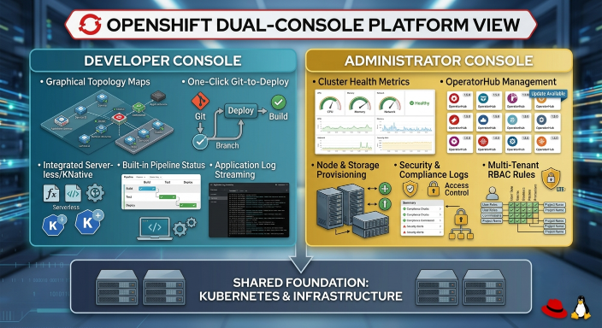
The two perspectives of the OpenShift web console
The OpenShift web console comes with a special Developer Perspective and an Administrator Perspective. From the Developer Perspective, it doesn't show complex YAML manifests anymore but uses visual topology maps instead. Now engineers can see their app building blocks, can check the health of their pod in real time, look through the logs of their builds, and see flows of networking between microservices.
The use of CI/CD in modern cloud-native system engineering.
Modern cloud-native engineering is based on the implementation of continuous integration and continuous deployment. OpenShift is developed with the support of two major CNCF projects for the goal of delivering software:
OpenShift Pipelines (Tekton): This is a cloud-native CI/CD platform that executes pipeline operations in separate and temporary containers. Tekton differs from traditional Jenkins servers because it reduces its resources and goes idle if no processing requires.
OpenShift GitOps (Argo CD): Changing of the cluster properties and apps is maintained in the Git database according to GitOps regimes. Argo CD constantly monitors the database and makes sure that any changes are reflected in the OpenShift cluster thus making changes to infrastructure auditable and reproducible in their nature.
Advanced Workload Management
OpenShift goes beyond merely working with stateless microservices and brings the support for a range of different workloads:
OpenShift Serverless (Knative): This solution allows applications to shrink down to no replicas when they are inactive to let them save computing resources and scale up any time they receive an incoming request via HTTP or any triggering event.
OpenShift Service Mesh (Istio & Kiali): This feature makes the communication between microservices possible with the help of mutual TLS (mTLS) encryption, canary releases traffic splitting, distributed tracing (Jaeger), and graphical dependency mapping.
OpenShift Virtualization (KubeVirt): This feature enables companies to utilize classical virtual machines and modern containers running on one and the same bare metal OpenShift cluster thus eliminating the need for using older hypervisor technology while applications are transitioning to microservices architecture.
The Significance of Obtaining Skills and Gaining Professional Experience
As companies from varied fields like finance and banking, healthcare, telecom industry, and public sector are observing rapid migration towards hybrid cloud ecosystems, the demand for engineers who are skilled in container orchestration has never been this high. It takes a lot of effort to learn enterprise Kubernetes thoroughly, and learners should go through a structured learning path which includes obtaining practical experience in operations deployment, security hardening, continuous integration, and troubleshooting clusters. Aspiring learners opt for getting enrolled into openshift online course programs in order to gain practical exposure at the hands of industry experts.
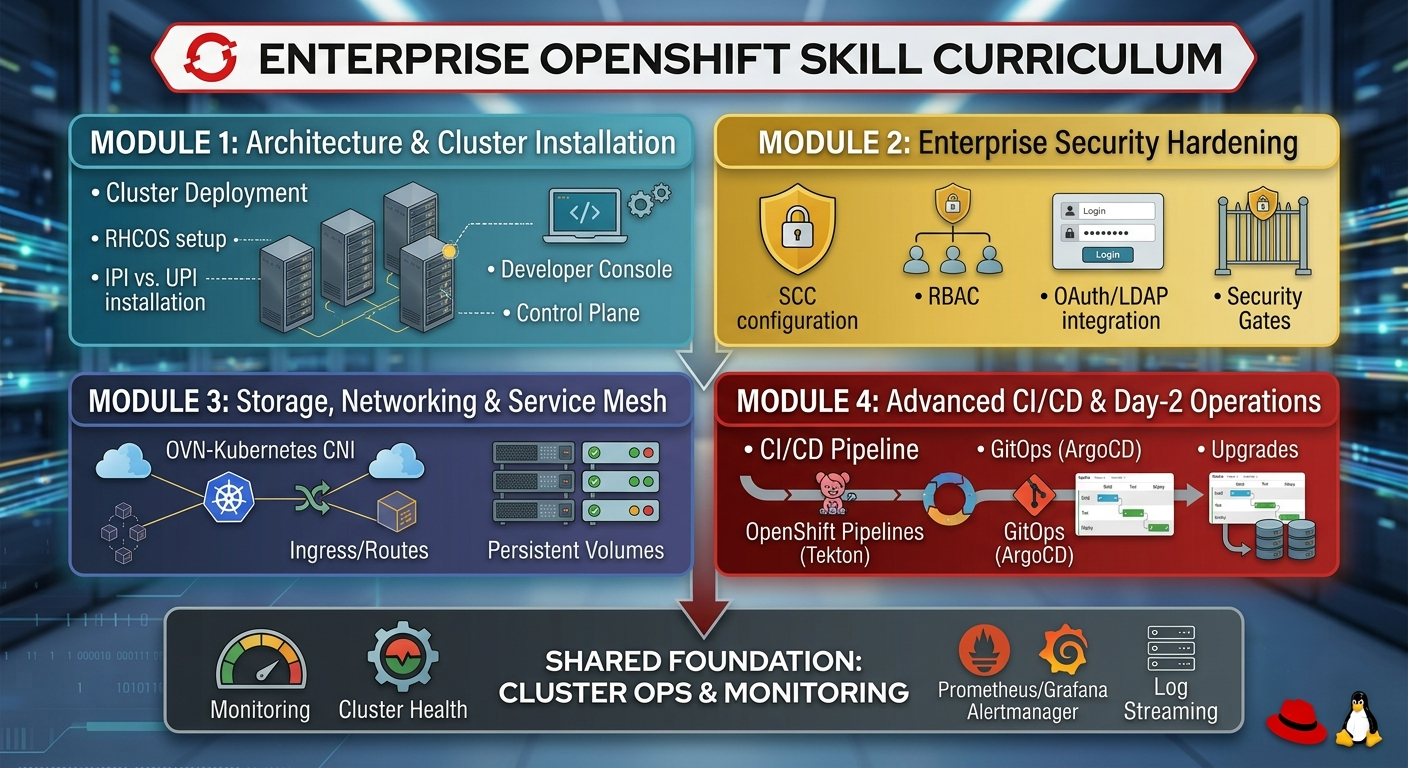
System administrators and platform engineers frequently pursue a redhat openshift course to validate their expertise in managing enterprise-grade hybrid cloud infrastructure and passing industry-standard certifications.
Real-World Implementation Examples and Edge Computing To appreciate the effectiveness of OpenShift, it is critical to examine its usage in real-world environments. Today’s enterprise infrastructure is unlikely to reside in any single cloud environment and is likely to contain parts in the private data centers, public cloud instances, and multiple edge locations.
Hybrid and multi-cloud approach Companies often run workloads online in different environments to avoid the risk of vendor lock-in, meet regulatory requirements, and optimize costs. OpenShift provides representation of cloud infrastructure through IPI (installer-provisioned infrastructure) and UPI (user-provisioned infrastructure) tools.
Thus, environment does not matter: whether OpenShift is running on AWS or GCP, or on VMware Virtualization, or even on physical hardware, the outcome is the same. The platform team writes and uses the application in various environments without changing anything regarding the deployment of the project.
Edge Computing and Single Node OpenShift In the case of retail shops, manufacturing factories, telecommunications stations, or remote locations, it is impossible to use the classic architecture of three control planes and worker nodes, due to constraints in computing resources.
Red Hat managed to solve the problem by developing Single Node OpenShift and Remote Worker Nodes (RWN):
Single-Node OpenShift (SNO): Packs the control plane and worker capabilities onto a single physical server, bringing full enterprise Kubernetes features to small footprints where power, space, and compute are strictly limited.
MicroShift: An ultra-lightweight distribution of OpenShift designed specifically for embedded devices and Internet of Things (IoT) hardware, allowing developers to use the exact same APIs and deployment manifests from the central cloud data center all the way to tiny edge devices.
Infrastructure for AI and Machine Learning (OpenShift AI)
According to enterprise organizations, integrating AI and machine learning into numerous business processes is challenging since they face difficulties managing the hardware acceleration such as NVIDIA graphic processing units. OpenShift AI is a dedicated platform for data science that is built on OpenShift technology. This technology enables data engineers and machine learning teams to create and manage Jupyter notebooks quickly, train the models on distributed GPU clusters, and deploy microservices for inference on a large scale with the help of Knative and Istio. The work on the GPU driver installation and allocation of resources is automated, which allows data scientists to concentrate on the model performance.
OpenShift and the Vanilla version of Kubernetes: A Comparative Study of the Differences
When looking into various platform alternatives, teams that deal with engineering often have conflicting opinions regarding whether to create specific orchestration pipelines from scratch, through upstream Kubernetes, or take the already existing solution provided by OpenShift.
While upstream Kubernetes leaves room for unlimited flexibility, there is a disadvantage to this in that teams that need to install the platform must choose among a wide array of open-source tools for tasks like logging, security, ingress, metrics, or build automation, and integrate them into the architecture of the platform. Meanwhile, OpenShift takes care of this issue by providing all the tools out of the box in a single system and delivers it to customers as a product that has successfully passed testing and is ready for customers who want to receive official technical support.
Day-2 Operations: Maintenance and Support
Setting up the cluster on Day 0 and installing applications on Day 1 are only two stages of the platform lifecycle. The main challenge for enterprise platforms comes when their Day 2 comes, which is the stage when organization learns how to support the cluster. disaster recovery.
Automated Upgrades through Cluster Version Operator
Upgrading a production cluster in vanilla Kubernetes involves several steps, including updating kubelet binaries, draining nodes, performing kubeadm commands, and checking the deprecations of the API version mentioned in all manifest files. Unlike vanilla Kubernetes, OpenShift has simplified this process by means of Cluster Version Operator (CVO). When Red Hat releases a new cluster version, CVO takes care of the update process, downloading the release payload (in other words, container images for every platform component, including RHCOS) and carrying out a rolling update of the cluster:
Control plane nodes are updated step by step, thus ensuring API availability during the whole process.
Machine Config Operators cordon and drain nodes one by one.
The node operating system is updated (rebooted) and comes back.
Applications are scheduled on healthy nodes without downtime.
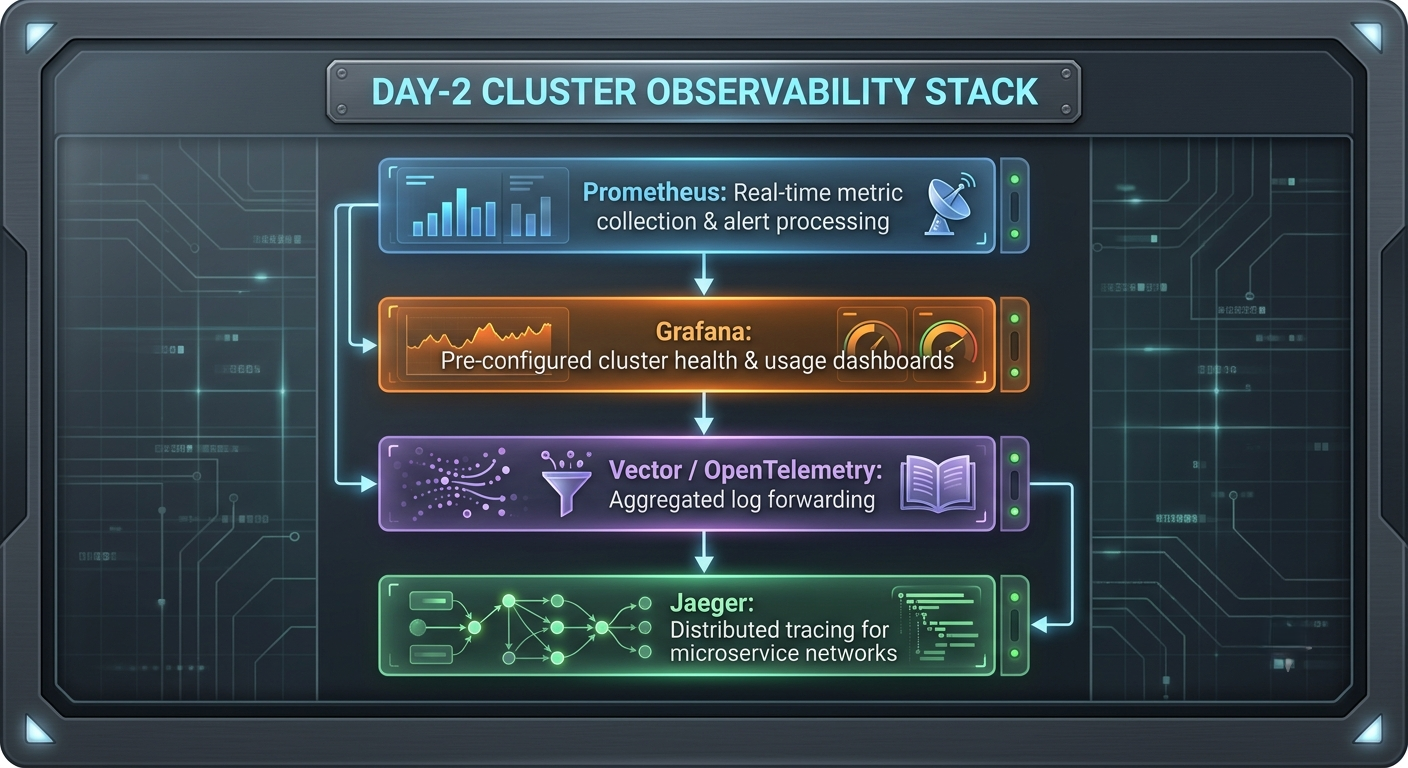
Integrated Observability: Detecting problems when traversing numerous transient containers necessitates an extensive observability framework. OpenShift is pre-loaded with an end-to-end, fully functional enterprise-level monitoring platform.
Metrics: Constructed on the basis of Prometheus, this solution enables the collection of performance data pertaining to CPU, memory, networking, and storage from every node and workload.
Visualization: With Grafana, it’s possible to build a visual representation of the node health status, control plane speed, amount of resources consumed in the project.
Logging: Cluster Logging Operator collects application logs, infrastructure logs, and audit logs from the infrastructure using either Vector or Fluentd, and forwards them to an internal storage or SIEM methods, such as Elasticsearch, Splunk or Datadog.
The Growth of the Cloud-Native Framework
With the ongoing influence of software on the world's economy, it can be expected that there will be continued evolution of the layers separating application development from hardware in the future. OpenShift by Red Hat can be considered one of the most advanced implementations of Kubernetes due to its introduction as a complete infrastructure for hybrid cloud computing built of various orchestration components.
The platform eliminates the operational brainwork regarding the implementation of security features, OS updates, routing as well as the use of CI/CD processes, which allows engineers to concentrate on the tasks important for the business. No matter if OpenShift is applied for internal banking applications, scaling commercial platforms, or collecting real-time data at remote sites, it is evidently one of the stages in the establishment of a contemporary enterprise cloud infrastructure