
What Is Pega? A Complete Beginner’s Guide to Pega Platform
Last updated on Oct 29, 2026
In the world of enterprise technology today, all enterprises are continuously searching for some sort of tools that will help them eliminate inefficiencies, engage with their customers effectively and speed up the process of digital transformation. One such tool is Pega Platform, which is an enterprise low code application development platform for creating intelligent and strong applications. It doesn’t matter whether you are a business analyst, developer, IT professional or a person who simply loves enterprise software; what matters here is that you know about the Pega platform because it will allow you to automate your business processes.
Here is everything about the Pega platform, including what is Pega, features, architecture, use cases, and much more, because Pega happens to be one of the best enterprise software development tools.
Pega assists businesses in developing apps that are very complex ten times faster than normal development due to the gap that it closes between the business end and the coders. In case you are interested in learning about low-code development, then the ideal choice is for you to enroll in pega training.
What Is Pega Platform?
Pega is a set of software offered by Pegasystems, which is the American software company founded by Alan Trefler in 1983. The Pega Platform is the flagship product by Pegasystems, which is the enterprise low code development platform developed with the help of Java-based rules architecture.
Prior to that, the development of enterprise software was a task requiring months or even years because of the need to write thousands of lines of very complex code written in several programming languages and check all possible combinations. The answer to this problem was found in the unique methodology offered by Pega called Model-Driven Development. Using flowcharts and other high-level configurations, the software is developed in graphical form by developers and business architects and is immediately transformed into code by the Pega engine.
It makes the development of the application 10 times faster compared to coding by creating an interface between business and developers.
Philosophy: "Build for Change"
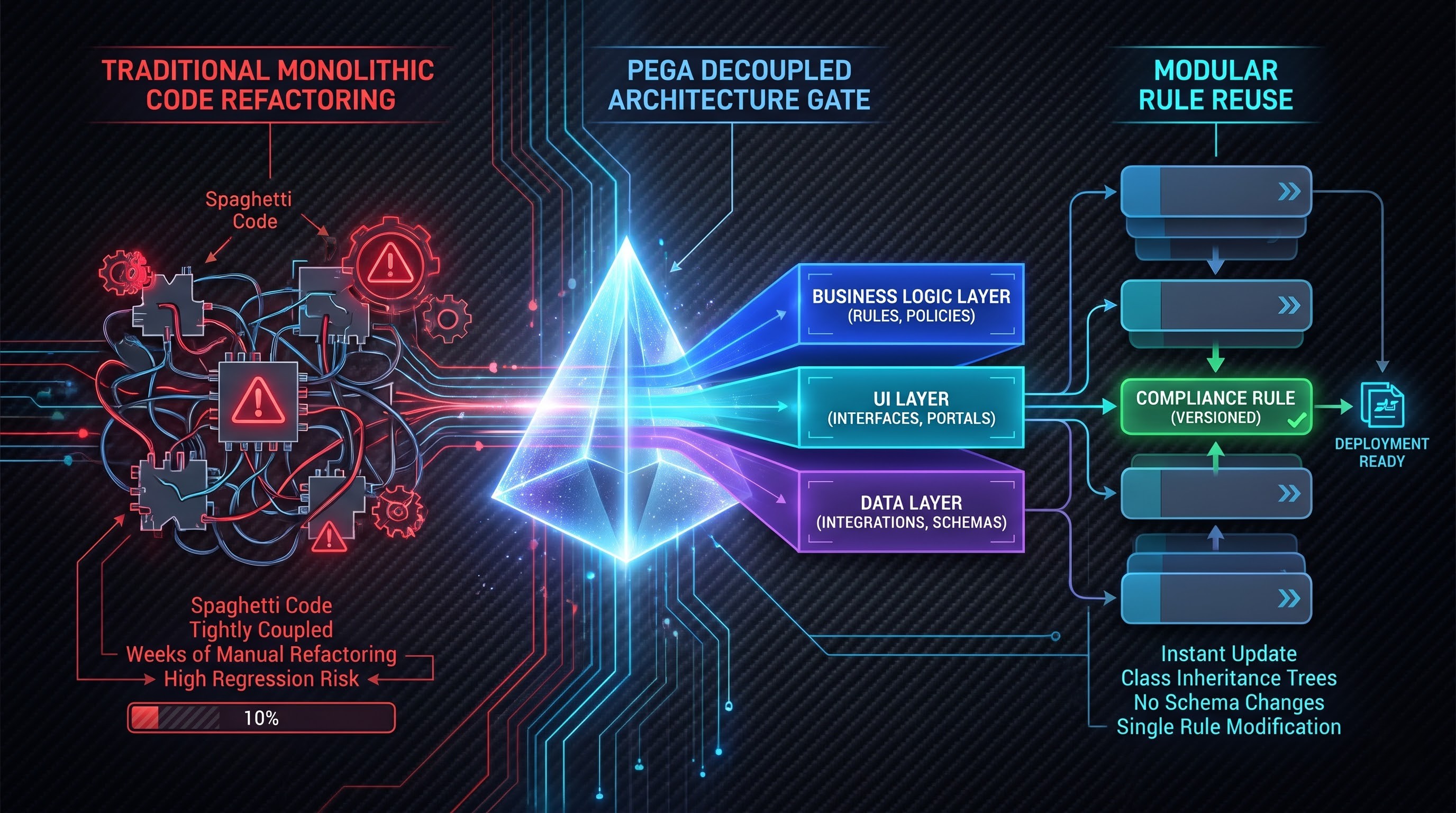
The idea of "Build for Change" can be considered one of the key principles of Pegasystems. The current business environment is very dynamic and flexible: the legislation changes, needs of clients change, market situation changes and processes get constantly improved.
In the conventional environment of software development, the change of a business rule or workflow takes weeks of refactoring of the code, testing and deployment of the change.
Separation of Concerns: There is a separation of concerns between the business logic layer, the user interface and the data layer in Pega. In case any modification is required for the compliance regulation then the administrator will only have to change the rule associated with the compliance regulation and not the user interface and underlying database.
Reuse: Pega is built on an object oriented architecture. Rules, components, processes and UI fragments can be created once and can be reused in many enterprise applications.
Collaborative Effort: As Pega involves using visual diagrams such as the flow charts of the business process diagram then the business analyst/subject matter expert can collaborate with the technical developer to build the application.
Three Pillars of Pega Platform
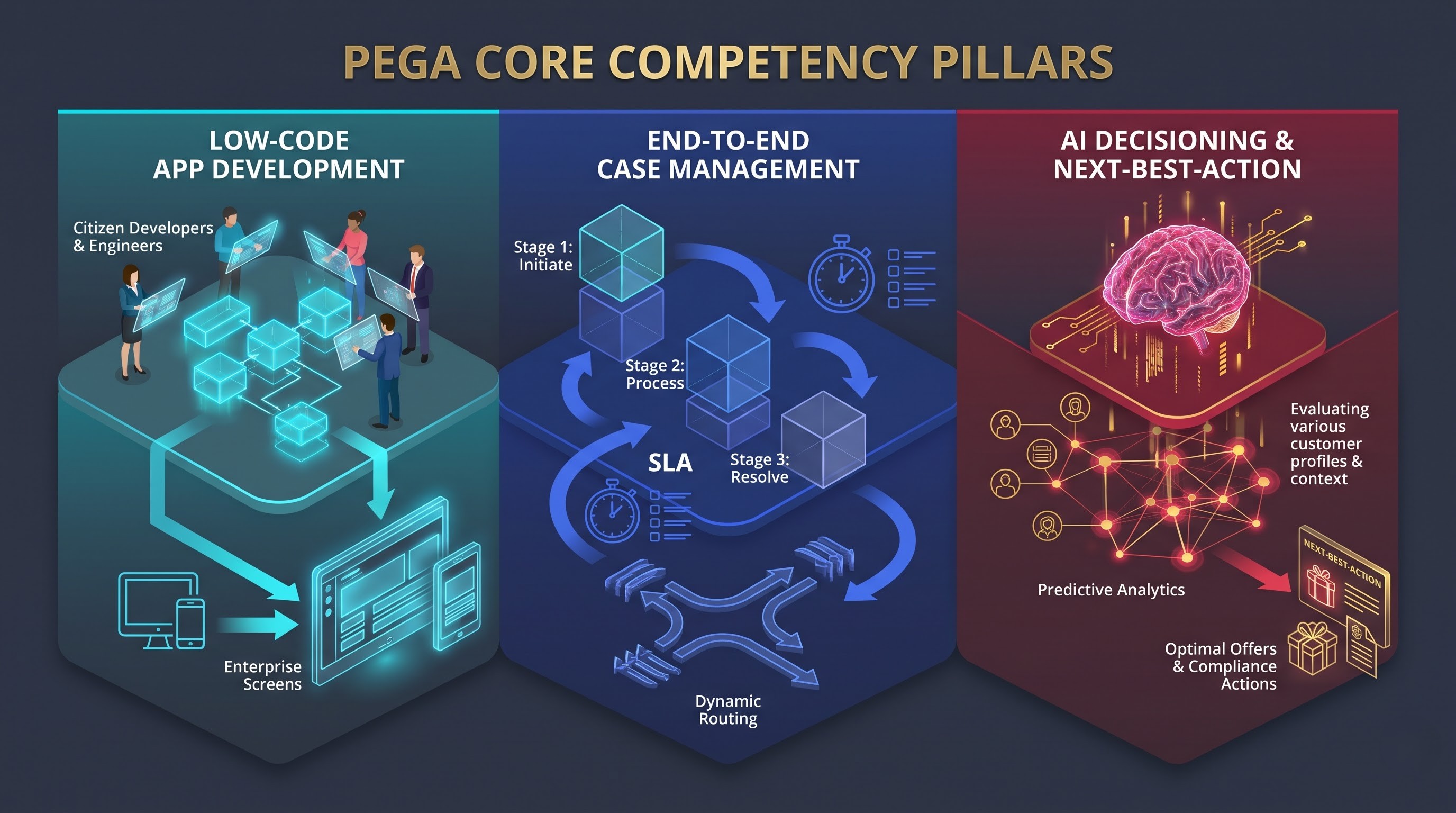
In order to understand the features of Pega, the core competencies of Pega must be known. The Pega platform is the combination of many advanced technologies in one environment:
A. Low-Code Application Development
Pega offers the programming environment which can be used both by citizen programmers as well as professional software engineers to build the business processes, dynamic screens for the users and external databases.
B. Case Management
Case Management is yet another feature offered in a number of Pega Applications. While workflow applications concentrate on the process itself, the process in Pega applications is called "case" and encompasses the entire transaction along with its origin, phases, and destination.
It can be an insurance claim, onboarding of a new client, loan application or IT service request.
These transactions' information, communication, audit, SLAs, and routing processes are analyzed at all phases of transaction using the case management system of Pega.
C. Artificial Intelligence and Decisioning (Pega Customer Decision Hub)
Artificial intelligence decisioning functionality within Pega Applications is enabled by Pega AI.
Next-Best-Action Decisioning: The Pega AI analyses historical data, context, and business rules in just a few milliseconds once the customer interacts with the brand via call center, mobile app, or website and provides the best offer, action or message for that particular customer.
Predictive and Adaptive Analytics: Pega AI learns from customer interactions and adjusts the predictive models autonomously.
D. Robotic Automation (RPA) and Workforce Intelligence
The other issue that the company faces is the lack of integration through APIs of the legacy system. The technology used by Pega Systems to solve the problem is called robotic automation (RPA).
Robots can emulate the interactions of humans with the legacy system and perform millions of repetitive tasks, such as data entry, screen scraping, and file transfer, without making mistakes.
Using robotic automation and robotic desktop automation, Pega will provide an opportunity to automate the activities of human employees right at their workplaces, which will decrease the average handling time and operating costs.
E. Unified Integration Architecture
Enterprise applications are seldom created as individual products. Interaction with legacy mainframe systems, cloud databases, third-party payment gateways, CRM, ERP and other software solutions is necessary. In order to achieve this goal, Pega Systems provides different robust integration connectors (REST, SOAP, Kafka, JMS and database connectors).
Pega Architecture: Direct Capture of Objectives (DCO) and Pega 7/8/Infinity
In order to figure out the reason of success of the Pega project, it is important to learn the methodology behind its architecture evolution.
Objectives Capture (DCO)
Misinterpretation of the requirements documentation by the business side and IT side has been the cause of many shortcomings in implementing software in the traditional way of software implementation. But such issues can be solved in Pega with the help of a process known as the Direct Capture of Objectives (DCO). The process of DCO is explained as a process where the business side and IT side come together to create requirements in Pega. Requirements generated from meetings as business rules, use cases and data requirements are directly put into Pega as living specifications, which in turn form the application architectures.
Pega Infinity
Pegasystems has now consolidated its entire range of application development, CRM, and DPA solutions into a single platform referred to as Pega Infinity. This is the next-generation platform that offers cloud-native deployment capabilities, AI, mobile enhancement, and DevOps automation pipeline capabilities.
Specific Industry Examples of Platform Usage
The flexibility and scalability nature of Pega platform have made it a suitable choice for large corporations working within the regulated industries, those which deal with customers, and also have complex business operations. Some of the examples of the industries where Pega platform is used are given below:
Financial Services and Banking
The banking and financial services industries make use of Pega to:
Loan and Mortgage Origination: For dealing with multi-level approvals, credit checks, documentation, and compliance with regulations.
Fraud Detection: For detecting any unusual transaction and sending it to the investigation queue.
Customer Onboarding: To conduct KYC (Know Your Customer) and AML (Anti-Money Laundering).
Insurance
The insurance industry makes use of Pega to:
Claim Process: For automated FNOL, Liability determination, Claim Adjustment, and Payment Processing.
Policy Management: Renewals, endorsements, and underwriting in legacy systems.
Healthcare & Life Science
Use cases of Pega in Healthcare Organization:
Member Services: Complaint handling, appeal handling, and claim routing.
Provider Network Management: Onboarding of provider network and provider network directory.
Patient Care Management: Patient journey management and guideline management.
Telecommunications & Utilities
Use cases of Pega in Telecommunication companies:
Order Management: Order management for service provision through fiber, mobile, and broadband network.
Customer Retention: Customer call provisioning after customer call from customer care center.
Advantages of Pega Platform
Below are some of the strengths that are offered by the Pega platform in building enterprise software applications:
Unmatched Speed of Getting to Market: This is attributed to the existence of reusable components as well as the visual nature of Pega and other existing prebuilt platforms such as Pega Customer Services and Pega Sales Automation. This is a strength since it is now possible to create the applications within a short period of few months instead of several years.
Scalability and Durability: The Pega applications have been developed based on the Enterprise Java Architecture, therefore, making them very scalable and capable of processing millions of transactions daily.
Continuous Flexibility: In case the policies of the organization change, the changes in the policies conducted using Pega will automatically reflect in the application without undergoing through the entire deployment procedure.
Enhancement of the User Interface: Through Pega, it is possible to provide desktop interfaces for customer services executives where all information in various back-end systems can be integrated into one interface.
Effective Governance & Security: There are features like auditing, role based access control and compliance management provided in Pega to ensure security requirements.
Governance & Security: Pega framework introduces itself with an in-built audit infrastructure, role-based security, and compliance systems that help implement all the security policies across the globe in an efficient manner. As companies normally offer good salaries to professionals who are proficient in such an aspect, it makes it easier for individuals to build a successful career in this field by undergoing pega developer training.
Challenges & Considerations
Even though Pega is an advanced and complex platform yet there are certain important considerations that need to be kept in mind while using Pega platform:
Higher Learning Curve: Since Pega is a complete platform that involves low code development, object oriented rules resolution, database management, integration protocol and decision making system based on artificial intelligence, therefore, extensive training and certification is required.
Highly Expensive Licensing: Since Pega is an enterprise level platform therefore it is quite costly with respect to licensing and infrastructure costs.
Potential Risks due to Over-Customization: As the platform allows customization, there may be the possibility of over-customization risk due to new teams that do not adhere to Pega standards.
Pega Training and Certification
For those of you who are developers, business architects, and system administrators aiming to rise through their careers in Pega, you have an already charted path in the form of Pega Academy.
Levels of Certifications:
Pega System Architect (SA): The base certification needed by the developers for configuring the UI, data model, case life cycle, and business rules.
Pega Senior System Architect (SSA): This level provides advanced skills like integration, security, optimization, and application architecture.
Pega Lead System Architect (LSA): This level is the most advanced level of certification for experts in enterprise design patterns, high availability, and large scale deployments.
Pega Business Architect (BA): This level is for analysts and product owners for requirement management, DCO and case design.
Rule Resolution Strategy of Pega - Detailed Analysis
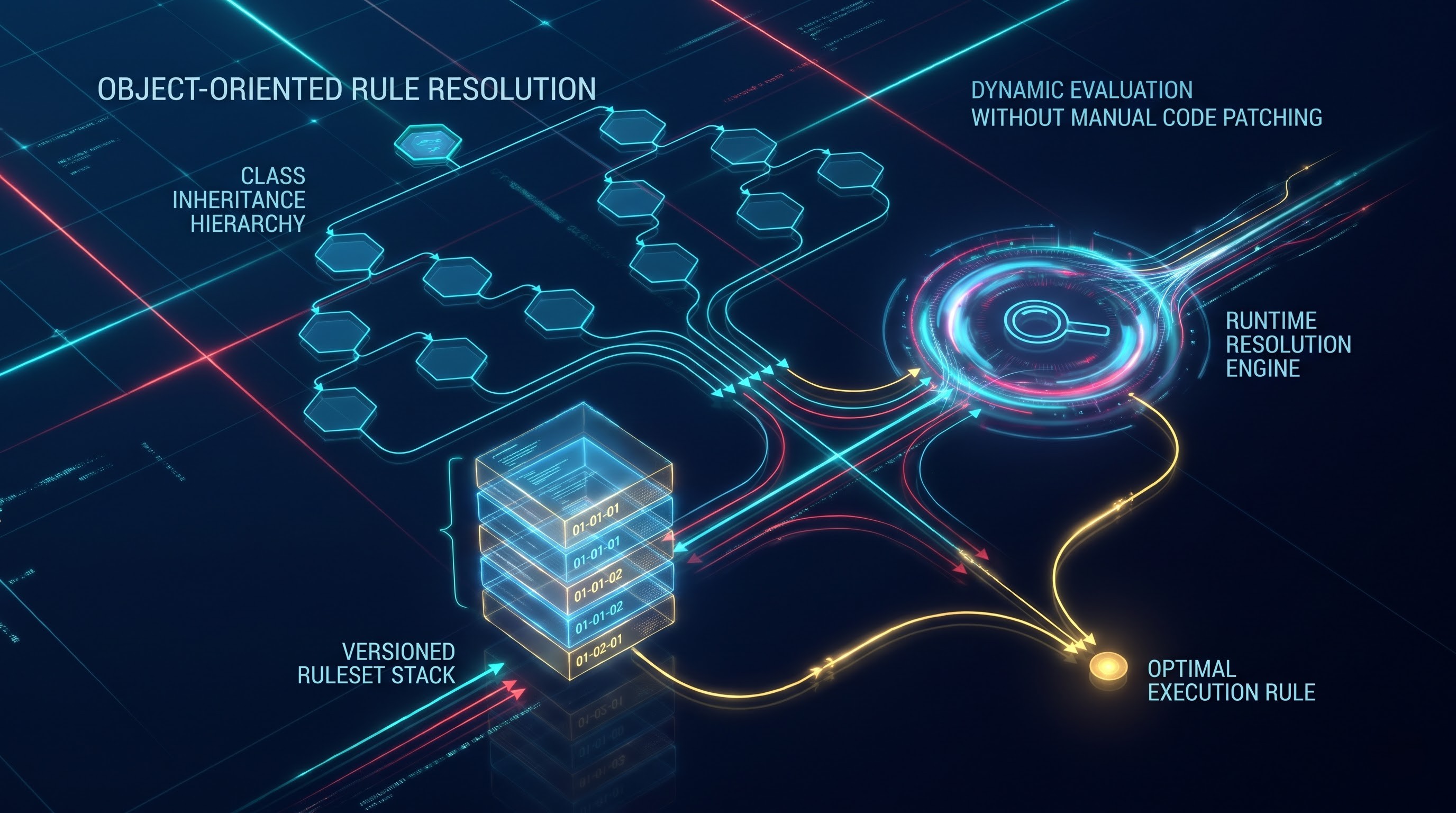
To be able to understand how the process can be upgraded, inherited and customized without any changes in the code we should know how the Rule Resolution strategy operates in this system. While when working with the programming language you should search for the variables and functions in the necessary files where they are declared, in Pega any logic, screens, data definition and integration points are called "rules".
Rule Inheritance Advantages
There are two types of rule inheritance which occur in Pega:
Class Inheritance: Very similarly to object-oriented programming languages there is a hierarchy of classes in Pega. The child class inherits all the attributes, flows and rules from the parent class. In case the company wants to make its own customization of the standard process in certain region or brand, the company can inherit the whole process but change only some rules.
Pattern Inheritance: Inheritance of rules between rules from different organizational hierarchies.
Rule Sets and Versions
All the rules present in Pega come under the heading of Rule Sets. All rules have a version associated with them. Whenever there is a change required in business requirement, instead of changing the rules in production environment, the admins create another version of rules in the open rule set version.
The Pega engine is smart enough to determine which rule sets, permission and version of rules needs to be used for execution of the rules. As a result, it makes deployment of the company incremental, independent testing and rollback possible in case of any unforeseen problem. The chances of manual patching like legacy systems development is ruled out.
Pega Cloud and Deployment Capabilities with DevOps
It is important for an enterprise IT environment that the applications should be flexible and run on cloud platform. The Pega technology has come a long way in comparison to the legacy on-premise technology.
Pega Cloud
Pega Cloud is the managed cloud environment for enterprise applications with the highest level of security and which operate on the most advanced cloud architecture like AWS. Such actions as database management, patches, availability, backups and recovery, performance management - all this is done automatically within Pega Cloud and you need to create your application which will bring additional value.
Hybrid and Multi-Cloud Deployments
In case you need more control over the deployment of your application due to data residency or financial considerations, Pega gives you the chance to package your application into docker/kubernetes environment. Enterprises can deploy their Pega applications in their own cloud data centers or on Microsoft Azure, Google Cloud Platform or even hybrid clouds.
Automated CI/CD Pipelines
Integration of Pega Cloud with DevOps platforms (Jenkins, Azure DevOps, GitLab, GitHub Actions) via Deployment Manager gives you the possibility to create CI/CD pipelines for your application deployment process in which rule sets with the latest code will be automatically exported, tested using automated test suites and deployed into various environments.
The part played by Generative AI in present day Pega Development
On the introduction of the use of artificial intelligence in the development of software for organizations, Pegasystems has adopted the latest technology of generative AI in its Pega platform called the Pega GenAI.
Development of Application made Faster using the Pega GenAI Blueprint
The difficulty in developing software is how to translate the concept of the business into the architectural design of that concept. Pega GenAI Blueprint helps business leaders and architects to state their needs for the application in plain English, and Pega GenAI Blueprint creates an interactive model of the architecture of the application in seconds. This would save the time of discovery and scoping phase at the onset of the project.
Enhancement of User Experience in Running Applications
In running applications, Pega GenAI helps customer service representatives and back office users in:
Creation of a summary of long case histories, communications, and multichannel interaction history in a matter of seconds.
Creation of context-specific emails, responses, and notes for human agents, which contributes to reduced handling time and increased customer satisfaction.
Real-time coaching of human agents while communicating with customers, and therefore maintaining regulatory compliance and brand standards.
Pega Community, Marketplace and Ecosystem
It is impossible to become successful with enterprise software products without building a thriving community and ecosystem of pre-built components. The Pega Platform has all necessary tools for success of the practitioners throughout the whole development process:
Pega Marketplace (Previously Exchange)
In place of creating something new from scratch, the developers have an option to utilize the Pega Marketplace to download connectors, UI components, widgets, integration tools and accelerators not only created by Pegasystems, but by their partners worldwide. Any organization that requires a ready-to-use connector for electronic signatures, specific algorithms for fraud detection, or even particular dashboard widgets, will find development in the Marketplace easier.
Community and Support of Pega
Pega Community is among known online communities where millions of people from system architects, business analysts to Pega lovers interact, pose technical questions, exchange ideas and get acquainted with the newest updates of Pega.
Frequently Asked Questions (FAQs) by Newbies
Is Pega the programming language?
Not really, Pega is not the programming language such as Java, Python and C++. Pega is the development platform and the engine of execution of your programs. But occasionally, you might have to utilize the features of Java/JavaScript to configure certain components, yet the bulk of applications are created visually via configuration forms, flow builder and declarative rules.
Can I learn Pega even not having the IT background?
Yes, it is quite possible without any difficulties. There are two different ways of learning Pega. The first way is for business analysts or people having the background in process design and the second one is for logical people lacking programming skills.
What is so special about Pega in comparison with the traditional software development?
In the typical software development, it will include boilerplate coding, building a user authentication, dealing with the database schema and even creating the unit test by the developer. However, when using Pega, all the above mentioned functions can be achieved out of the box, as all the developer needs to do is to model the organization-specific business logic, the customer journey and integrations. Hence, the impressive increase in the delivery speed.
Conclusion: Pega, The Future Ahead
With the rapid digital transformation in each and every industry, the demand for the intelligent and flexible software solutions increases. In this respect, Pega platform turns out to be an optimal solution, since it possesses all of the needed capabilities like visual modeling with the low code, case management, AI-based decision-making and RPA.
Whatever it may be: the legacy system modernization, the automation of the complex financial process or the improvement of the customer experience, Pega has everything you need.
If you have to optimize your internal process, develop your skills in customer services, or even create your career as an enterprise software developer, then your knowledge about Pega classes will give you many opportunities in the world of modern technologies. To make your way to success faster, you may use pega training online sites.