
When HR Becomes a Detective: What Employee Data Is Really Trying to Tell You
Last updated on Oct 5, 2026
The HR Mystery Nobody Notices at First
A company may have thousands of employees and a polished HR department and a modern human capital management system yet still find it hard to see what is really happening inside its workforce. The problem usually comes without a warning sign. It starts quietly. A few employees from the department resign. Absenteeism goes up a little. Managers begin to say that jobs are slower to fill. Employees join development programs often. One team keeps asking for transfers. Each of these events may not seem scary on its own. When they are linked, they can show a picture. Employee data can help us see these patterns.
This is where HR data becomes more than a place to store employee information
This is where a modern human capital management system becomes more than a place to store employee information. HR data can act like evidence in an investigation. A resignation is not a resignation. A transfer is not a move to another department. A promotion is not a title. Each event can link to changes that happen across the employee lifecycle. When we can see these connections, HR professionals can move beyond simply reacting to problems and begin to investigate the causes. This shift is especially important in organizations where workforce decisions happen each day across departments, locations, managers, and employee groups. Employee data shows how each event connects.
Imagine a fictional company named Northstar Technologies
Imagine a company named NorthStar Technologies. The company has grown fast over the three years. Now has thousands of employees. On paper, everything looks healthy. Revenue rises; recruitment numbers are strong. Employee headcount keeps growing. Then the HR team spots something: employee turnover in one business unit has risen. Leadership thinks the problem is compensation. A salary review is put on the table. When HR looks at the situation closely, a different pattern emerges. Most of the employees leaving have less than three years of tenure; many have recently switched managers, and very few in that group have moved internally in the year. Suddenly the question shifts from "Why're people leaving?" to "What's happening inside this employee journey?" That is when HR stops acting as an administrator and starts acting like a detective. Employee data reveals this hidden pattern.
A Resignation Is a Clue, Not the Whole Story
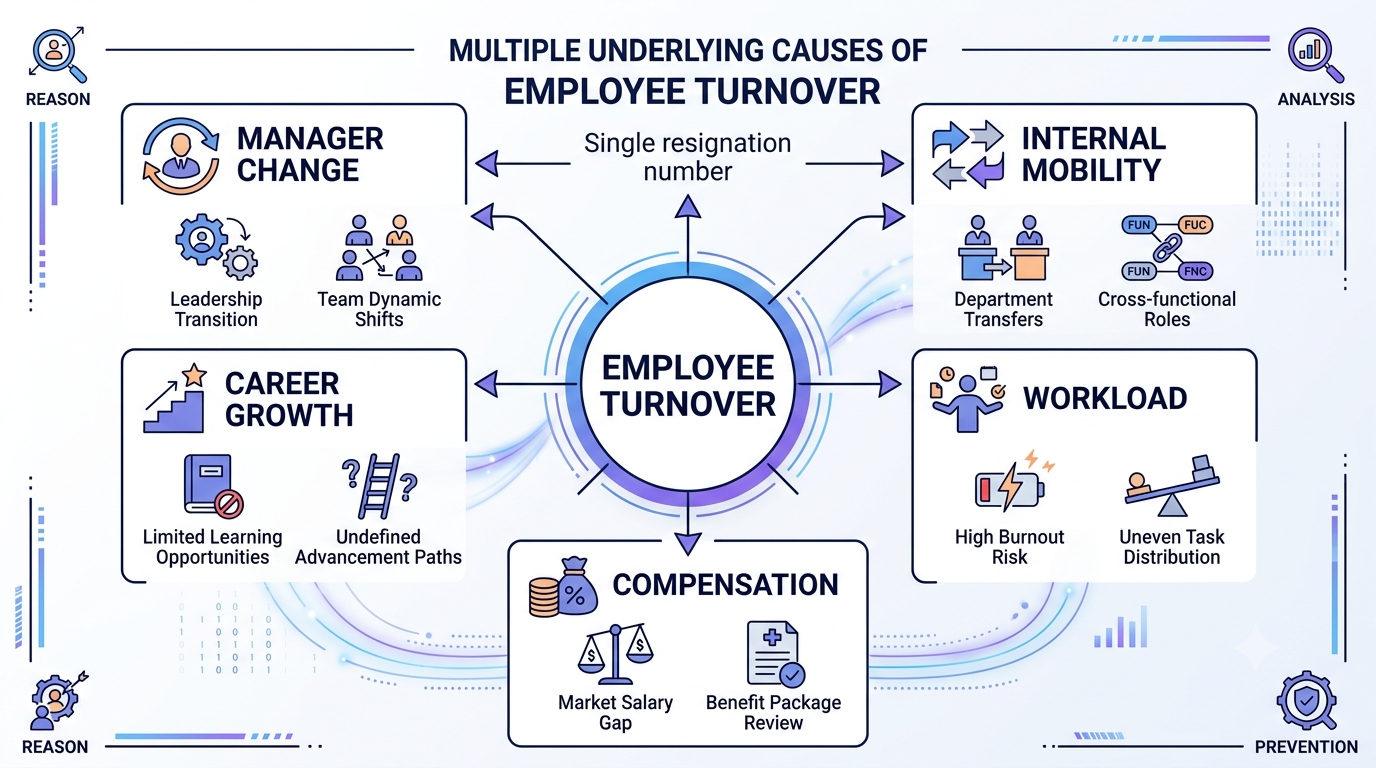
Employee turnover is one of the workforce metrics to misunderstand because a number can say what happened but not why it happened. If a company loses twelve percent of its employees in one year the percentage alone does not show whether people left because of compensation, management, stalled careers, relocation, heavy workload, company restructuring, better opportunities or simply personal reasons. Viewing turnover as a metric can therefore give a sense of understanding. The real value appears when turnover is examined with employee data.
Consider two departments that have the turnover rate. Department A has employees leaving because the business is restructuring. Department B has employees leaving because experienced workers see no chance to grow. The number looks the same. The solution is entirely different. One situation may need planning while the other may need career development, internal mobility, better management practices or changes in how opportunitiesre shared. The data becomes useful when HR investigates the context around the number. Employee data helps HR investigate the context.
A connected HCM environment lets organizations examine employee data across parts of the workforce lifecycle. By opening one system to look at turnover, another for structures, another for compensation and another for talent activity HR can use information that belongs to the employee record and organization. That does not automatically give HR the answer. Should technology be seen as a machine that magically fixes workplace problems? What it does give is a basis for asking questions.
The important difference is between reporting and investigation
The important difference is between reporting and investigation. Reporting might tell a manager that turnover rose from one quarter to the next. Investigation asks which employee populations are affected, whether the pattern is focused on a role or manager group, whether tenure matters, whether internal movement has changed and whether other workforce events happened at the time. The second approach gives an understanding of the problem. Employee data is key to investigation.
The clue: employee data has a timeline
One way to understand an employee is to stop seeing employee data as a fixed list. An employee is not a name with a job title, department, manager, salary and location. The link between an employee and the organization shifts over time. An employee joins, learns, receives feedback changes duties, moves teams takes leave receives pay gets promoted or sometimes chooses to leave. The timeline matters because events become clear when we look at them in order.
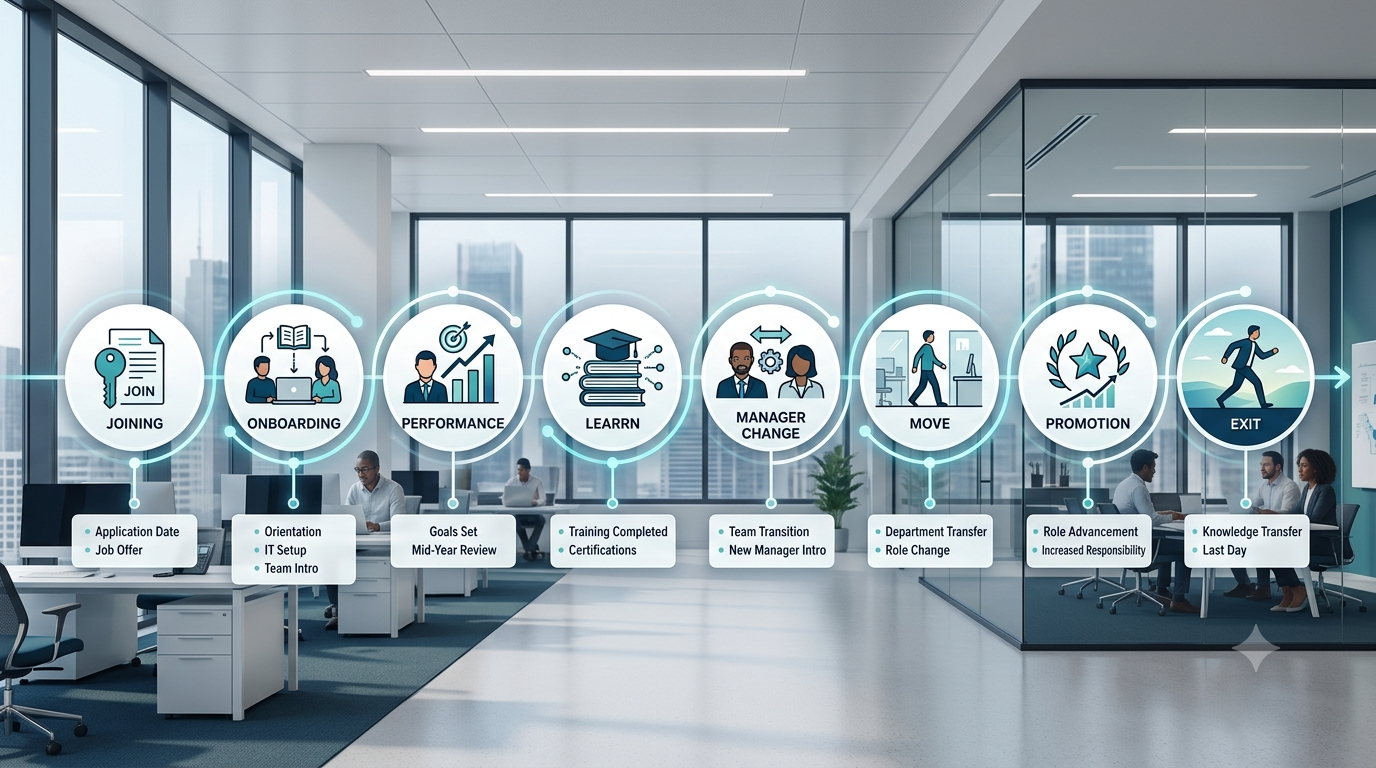
Suppose an employee joins an organization and works through the year. During that year the manager of the employee changes. Six months later the employee applies for a position but is not hired. Months later the employee leaves the organization. If we only look at the resignation HR might label the employee as an exit.. When we read the timeline many questions appear. Did the change of manager affect the experience of the employee? Did the internal opportunity show that the employee wanted to grow? Did the unsuccessful application hurt the engagement of the employee? Was another opportunity hard for the employee to find?
This timeline view is useful because HR problems rarely happen alone. Workforce events link together over time. A promotion can come after a performance review. A transfer can come after a talk with a manager. A pay change can come after a role change. A resignation can come after attempts by an employee to move inside. When the organization looks at all these events together the organization finds patterns that the organization would miss if each transaction were seen as a single admin task.
For someone learning workday hcm course online this is a lesson. The technology is easier to grasp when the learner stops seeing the system as a set of screens and begins to think about the employee life cycle that lies below those screens. Every transaction in the system is a business event. Every business event can change another business event. Knowing those links is often more useful than memorizing the system’s functions.
The Second Clue: The Org Chart Can Tell a Story
The structure looks simple when shown in a format. A senior leader sits at the top managers appear below. Employees sit inside teams. Behind every organizational structure are relationships that shape reporting, approvals, access, budgeting, compensation, workforce planning and the everyday life of an employee. This means a small change in the organization can affect employees.
Return to the NorthStar Technologies example. HR sees that turnover went up after several teams restructured. At first the organization does not link the two events. After looking at the workforce timeline HR finds that many employees who left had seen a reporting-line change just before they left. That does not prove the reorganization caused the turnover. It does give a clue that HR should explore.
This is where organizational data becomes more than a shape. A change of manager can affect who approves an employee’s requests. A change of department can alter reporting ties and workforce analysis. A change of position can affect pay, budgeting or staffing plans. A restructuring can build ties among employees, managers and business units. If those changes are not seen as events HR may see separate transactions instead of the big story of the organization.
For this reason HCM systems are especially useful in organizations where structures shift often. The system must show not who employees are but where employees belong and how the roles of employees connect to the larger organization. When HR looks into a workforce problem the context of the organization can be a piece of evidence.
The Third Clue: Managers Leave Fingerprints on Workforce Patterns
Managers are often one of the factors in an employee’s life yet the impact of a manager can be hard to see without linked data. Two teams may have the duties, similar salaries and similar hiring rules but show different retention results. The difference could come from a manager’s leadership style how workload's spread, how a manager talks the chances for growth or how an employee is helped.
This does not mean HR should think of managers as suspects whenever turnover rises. That would be a bias. Instead manager patterns should form part of an inquiry. If turnover is much higher across teams, HR might want to see what those teams share. The manager influence could be one factor. It should be weighed with pay, workload, tenure, location, role type, business changes and the growth of an employee.
A strong HCM environment makes comparisons easier because workforce information can be examined through relationships. HR can look at employee populations reporting structures, movement, performance information and other relevant workforce indicators without treating each data point as a record. The goal is not to give a manager a " manager" score. The goal is to find patterns that should be investigated by people.
This difference is very important because employee data must be interpreted. Technology can show a pattern. HR must understand the context. A manager may appear to have turnover because that manager leads a business unit that is being restructured. Another manager may have turnover because that manager’s team has existed for many years and has very few open positions. Numbers need context before they become evidence.
The Fourth Clue: Promotions Show What Employees Want
Career movement is another part of the investigation. When employees leave an organization HR often focuses heavily on competition. Sometimes the problem starts earlier when employees cannot see a path forward inside the organization. Imagine an employee who has done well for three years. That employee has taken learning programs, met goals, and taken on work beyond what was expected. That employee’s job title has not changed. Eventually, that employee starts looking for jobs outside the company. When that employee finally quits the company, might call it turnover. That employee’s history shows a situation.
Internal movement can therefore be a sign of how healthy the workforce is. Employees do not always need a promotion to stay interested. Employees often need to see possibilities. A move to a new project, more responsibility or a chance to grow can change how an employee feels about the future in the company. If internal options are hard to find or to go through, employees may look outside even when good chances exist inside.
This is one reason modern HCM systems now link information from talent, performance, career and organizational processes. The goal is not just to track when someone gets promoted. The bigger goal is to understand how people move through the company and where problems might be. When HR looks at these patterns a resignation can be seen as part of a story that started a time ago.
The Fifth Clue: Pay Matters but It Is Not Always the Problem
Pay is one of the things companies think about when employees leave and pay definitely matters. Making every problem about pay can lead companies to spend money without solving the issue. Suppose a company raises pay in a department that has turnover. The turnover rate goes down a little. Employee engagement remains low and few people apply for internal jobs. This could show that pay was part of the problem. Employees may still feel like careers are not moving forward. Managers may not be giving feedback or workloads may still be too much.
A good approach is to look at pay with workforce data. Are people in roles getting the pay? Have recent changes in the company affected pay? Are people leaving after pay reviews? Are performers getting chances to move up? Are some locations or job types having issues? Workday HCM can help here because pay is not separate from the rest of the employee information. Job position organization, employee and pay details can be linked in the HCM system. The value lies in understanding the connections not just looking at a number.
This is also where the learning part of Workday is important. Someone taking a workday course online should learn not only where to find information in the system but also why that information is important for real HR work. Understanding the business problem behind a task makes the system easier to use. It makes the person better at thinking like an HR professional than just following steps.
The Sixth Clue: Absences Can Be a Sign
Turnover is often seen as a problem because people quit and it is obvious. Absences are quieter. A slow rise in people missing work may not get the attention as someone leaving. Patterns in absences can sometimes show something to look into. Again, absences should not be seen as proof that someone's unhappy. People take time off for reasons, and companies must respect privacy and avoid making guesses. When looking at groups of people, patterns can show information. If a team suddenly has people away at the time as workloads go up or staffing is low, HR may have a reason to look more closely.
The key is to analyze. When one person is absent, that absence is information. It should not be seen as a sign of a problem. If a pattern shows up across people, then the situation can be different. Human Resources can look at the data to understand what is happening while respecting privacy and rules. This shows why Human Capital Management is not about gathering data. It is about finding ways to understand workforce information. More information does not always lead to decisions. The quality of the question the quality of the data and how the information is used all matter.
The Seventh Clue: Poor Data Can Ruin the Search
There is a truth in Human Resources analytics: a good system cannot fix data. Imagine a company trying to look at turnover by department. If employees are in a department, managers are not updated after changes, job details are not consistent, or there are records, then the analysis may be wrong. The dashboard may look nice. The charts may be pretty. The numbers may add up. The real story could be wrong. This is why data governance is part of Human Capital Management. Employee data needs ownership, standards, validation, access and ongoing care. Organizations must know who is responsible for changing data, who can approve those changes and how those changes affect parts of the system.
It is like detective work. Evidence is only useful if it is reliable. A detective would not build a case on a document. Human Resources should do the same with workforce data. Before asking what the data means, Human Resources should ask if the data is accurate enough to make a decision. For people learning about Human Capital Management this is one of the important lessons. The exciting part of a system may be dashboards, automation or analysis. The real base is well-managed information. Without that base analysis can just lead to mistakes.
The Investigation Needs Than One System
Modern companies do not use a single Human Resources system. Recruiting, payroll, finance, time tracking, learning, performance, identity systems, and other business tools can all play a role in the employee journey. This creates another issue: when each system works well, the company may struggle to see the picture if the data is disconnected.
For example, recruitment may know how many people applied. Human Resources may know how many joined. Learning may know who took courses. Payroll may know who gets paid. Performance may have goal reviews. Finance may know costs. If these systems do not talk to each other, leaders may have to piece the story alone. That is why integration is important in enterprise Human Capital Management. The goal is not just to connect systems because it sounds good. The real reason is to let business processes work across systems while keeping things consistent, secure, and properly managed.
For people taking a workday online course, this bigger picture is important. Learning the platform should include understanding how Human Capital Management processes work with business functions. An employee change rarely stops at one screen. A new hire, promotion, transfer, termination or change in the company can affect processes. Understanding these links is what separates knowledge from enterprise skills.
When the Pattern Finally Shows Up
Back to Northstar Technologies. After weeks of looking the Human Resources team finds that turnover is happening more with employees who have been with the company for two to four years. Many of them work under managers who recently took over teams after a change. A lot of them applied for jobs. Did not move. Participation in learning also dropped. Pay is good compared to the market so salary alone does not explain the problem.
The investigation did not give one answer. Instead it showed signs. Employees seem to be at a point where they want to grow. A recent change in the company changed how managers work. Internal movement slowed. Learning activity decreased. The company now has something valuable than a turnover number: it has a list of questions to explore.
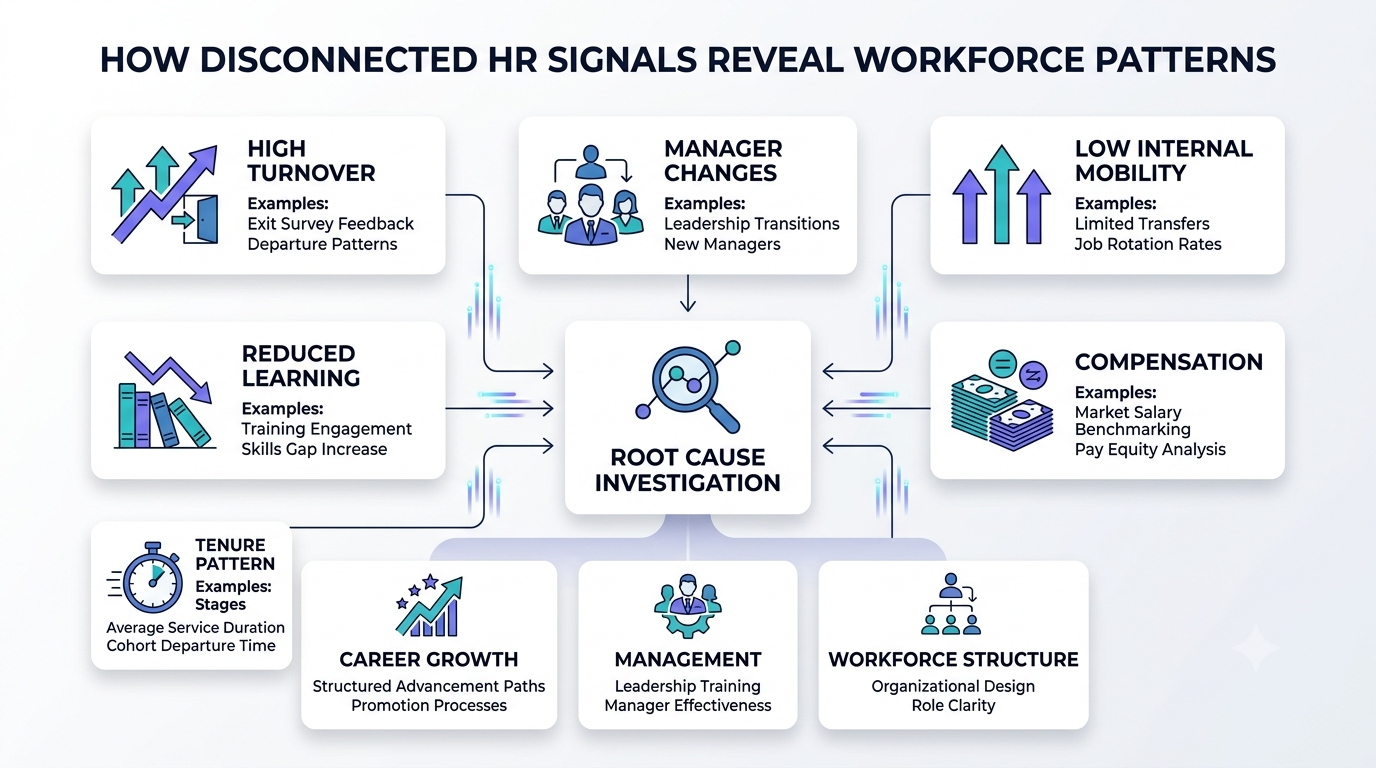
Leadership does not choose to raise pay, for everyone. Instead the company looks at how people move within the company how managers are handling teams, how career talks are happening, how development is offered and how roles are shared. After months the company starts to see more people moving internally and more people taking learning courses. The lesson is not that Workday Human Capital Management fixed the turnover problem. Technology did not make the decision. People did. What Workday Human Capital Management and its connected data gave was a view. It helped the company move from a symptom to a look.
What HCM Professionals Should Learn From the Detective Way
The detective way changes how people think about HCM technology. Of asking "Where do I enter this data?" a better question is "Why does this data exist and which business process relies on it?" Of asking "How do I make this report?" a better question is "What decision will this report help with and what could cause the result to be wrong?”
That difference matters because HCM technology is about business processes. A system may contain thousands of fields reports, workflows and more. Each one exists because the company needs to manage something. The best HCM professionals understand both the technology and the business problem. A learner who knows how employees move through the company how data stays clean how reports connect, how pay works, how people move inside and how systems talk to each other can approach Workday with confidence. Of just memorizing features they can understand how a change in one part of the system affects another part. That way of thinking is useful whether someone is in HR operations, implementation, consulting, business analysis or enterprise technology.
This is also why an online Workday HCM course can be more helpful when it teaches business situations of just system parts. A good learning experience should push learners to ask: what happens before a change what happens after a change who's responsible who approves the change, which data is changed and what other processes depend on the change. These questions turn knowledge into understanding.
The Future of HR May Depend on Better Questions, Not More Data
Companies are often told that they need data. What they may really need are questions.
How many people left this year? That is helpful.
Which groups of employees are leaving? Better.
When did the pattern start? Better.
What changed before the pattern? Better.
Are those employees facing issues with management, career growth, pay, workloads or the company structure? Even better.
These steps show that data becomes more useful when the question is more focused. HCM technology can provide the information needed to ask these questions. How well the company uses that information is what makes the difference.
This is really important because HR is becoming more focused on data. The aim should not be to turn employees into numbers or to let dashboards make decisions. Workforce data should help HR spot trends while still using judgment respecting privacy, considering context and being fair. A report about people leaving should start a discussion, not judgments. A pattern in performance should lead to looking into it, not just putting a label on someone. A trend over time should make people ask questions, not make assumptions about individuals.
The best way to use HCM technology is in the middle of data and judgment. Technology brings order and clarity. People bring meaning and accountability.
When HR Stops Counting and Starts Investigating
What is interesting about Workday HCM is not a screen, report or feature. It is the ability to bring together parts of an employee's story that might otherwise stay apart.
- A resignation can be connected to career changes.
- Career changes can be connected to development.
- Development can be connected to performance.
- Performance can be connected to management.
- Management can be connected to structure.
- Organizational structure can be connected to business strategy.
Suddenly, what seemed like a single HR event becomes part of a workforce story. I think the detective idea works here. HR does not need to become a group of people looking for mistakes in every employee record. Instead, HR professionals can learn to spot trends, challenge assumptions, check facts, and look past the explanation. I believe the future of HCM is not about having employee data. I believe the future of HCM is about making that data useful. From my experience, the organizations that get value from their HCM system are not the ones with the dashboards. From my experience, the organizations that get value from their HCM system are the ones who know what questions to ask when something unexpected happens. Because sometimes the important HR story is not the number on the dashboard. It is the story behind the number.