
Workday Illuminate: What Are AI-Powered Workflows in the Enterprise
Last updated on Oct 13, 2026
The modern enterprise is evolving at a pace and scale that often outpaces legacy software architectures. For decades, enterprise resource planning systems and human capital management platforms were transactional ledgers. They recorded events, maintained compliance records, made ledger adjustments and tracked employee lifecycles. The workflows built around those records, however, were still very manual to perform. Knowledge workers spent countless hours stitching together disparate data sets, reconciling expense receipts, wading through hundreds of candidate resumes, routing approval chains, and fixing transaction anomalies.
As generative artificial intelligence exploded across corporate boardrooms, early enterprise adoptions skewed heavily toward bolt-on chatbots and generic large language models. These varied tools are great for drafting emails or summarising generic text, but often fell short when put to use in enterprise operations. They had no real-time visibility on internal policies. No structural understanding of org charts. They hallucinated when asked to reason across interconnected ledgers and regulatory boundaries.
Workday Illuminate is a radical departure from shallow artificial intelligence to deep, embedded, context-aware intelligence. Illuminate, billed as the next generation of Workday’s artificial intelligence architecture, embeds predictive, generative and agentic intelligence into the unified data foundation that fuels human resources, payroll, talent management and enterprise finance. Illuminate does not treat intelligence as an external application on top of core business systems, but embeds reasoning, pattern recognition and workflow orchestration into the very operating fabric of the organization.
To understand how Workday Illuminate works, we need to look at the underlying architecture, the difference between raw enterprise data and business context, the tiered automation model, the growing power of specialised business agents, and the real-world operational impact across people and finance.
The Foundation: Quality Data Coupled with Business Context
Artificial intelligence is only as good as the substrate on which it is trained. The consumer internet is often noisy, biased, and based on old premises. Models are trained on the unstructured, public web scraping of this internet. In the business world, a generic language model can’t determine why an expense approval would require sign-off from a particular regional director, nor can it predict the organisational impact of restructuring an engineering hierarchy across three continents.
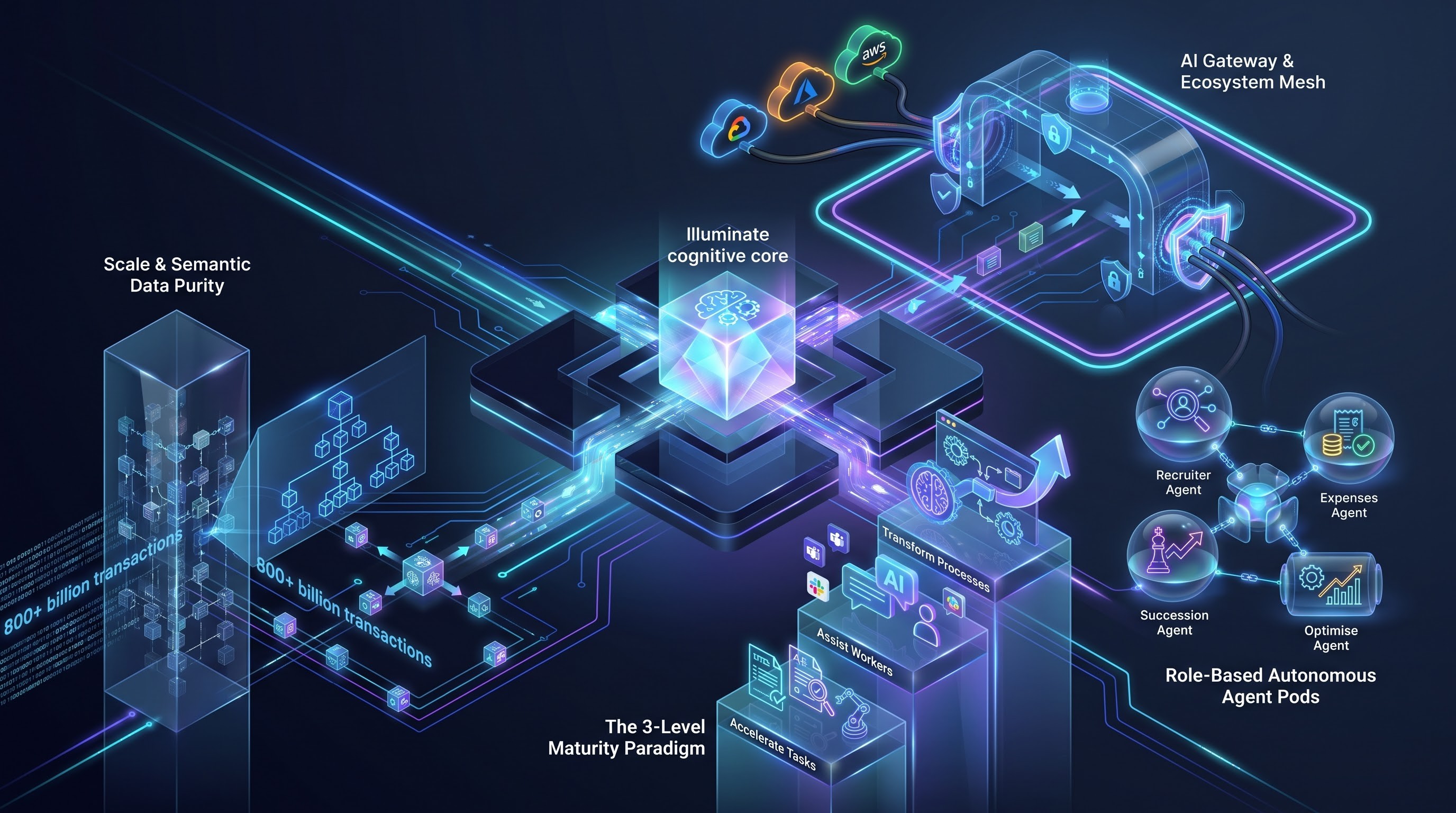
The primary competitive strength of Workday Illuminate is the scale and purity of the underlying enterprise dataset. It is handling more than eight hundred billion transactions per year on over seventy million users worldwide. Workday’s data is clean, standardised and always up to date because Workday was purpose-built as a unified, multi-tenant cloud application with a single object model. Every payroll run, every time entry, every journal ledger balance, every performance review, every requisition posting, every procurement order has a consistent semantic schema.
But the sheer volume of raw data is only part of the equation. Business context is the defining differentiator of Illuminate. Context is the structural why and how of every event in an enterprise:
Organisational Architecture: Who reports to whom, cost center assignments, matrixed management structures, geographical entities.
Process Interconnections: Acknowledging that when an employee transfers, it impacts payroll taxes, benefits eligibility, provisioning access, departmental budgets and succession planning in one fell swoop.
Role and Security Boundaries: Making sure that the permissions are role-based, such that an artificial intelligence model is not revealing sensitive salary or performance information to unauthorised people at the object level.
Temporal Dynamics: Understanding how organisational changes happen over time, including the effective date, transaction date, and fiscal quarters.
When an artificial intelligence engine has both the historical record, and the relational rules governing the enterprise, automation is no longer a brittle script. It evolves into contextual reasoning, enabling the system to forecast operational bottlenecks, assess organisational trade-offs, and recommend proactive interventions before issues arise.
The Three-Level AI Paradigm

Workday structures illuminate into three layers of maturity, rather than offering artificial intelligence as one monolithic feature: accelerate tasks, assist workers and transform end-to-end business processes. This graduated model allows organisations to realise immediate operational efficiencies while methodically scaling toward autonomous workflows.
Speed up common manual tasks
The first level is about the quotidian friction that bleeds employee productivity. They are discrete, repetitive tasks that have historically required human eyes and keyboard input, although they obey predictable parameters.
Illuminate uses generative and predictive models in this layer to write job descriptions from skill profiles, summarise massive employee feedback surveys, extract receipt data for expense filings, and draft contract summaries. In finance, it automates supplier invoice matching and identifies missing metadata in journal entries. In HR it recommends customised educational paths and pre-populates performance self-assessments with milestones recorded during the fiscal year. This tier solves the blank-page problem and eliminates boring admin data entry, giving back hours of operational capacity to managers and individual contributors alike.
Supporting all employees in their work flow
The second layer steps away from discrete task automation to conversational and contextual assistance. In legacy environments you had to traverse multi-tiered software menus or call internal shared service desks to get policy answers, request leaves of absence or check remaining budget allocations.
Illuminate fuels an intelligent, context-aware assistant that is embedded directly into the daily workspace of an employee. Available through Workday’s interface, mobile apps or collaboration hubs such as Microsoft Teams and Slack, the assistant knows exactly who the user is, what role they have and what they’re allowed to do.
For example, when asking if a proposed salary adjustment is within budget thresholds, the system can’t route a manager to a static compensation policy PDF. It measures the team's current run rate, considers benchmark compensation bands for the grade and location, projects the fiscal impact out to the end of the fiscal year, and provides a clear recommendation with one-click approval options. The interaction is conversational, intuitive and strictly governed by governance policies.
Changing whole business processes
The third, and most radical, layer is process orchestration. Most enterprise workflows break down at the point where functional silos hand off work to each other. Recruiting to compensation boundary. Expense submission to corporate treasury boundary. Workforce planning to the financial procurement boundary.
Rather than depending on human operators to manually push a process from one stage to the next, Illuminate orchestrates interconnected sequences across platforms. It finds triggers across the ecosystem, identifies potential discrepancies, marshals resources, and choreographs complex multi-functional flows. At this level, artificial intelligence is no longer a passive assistant but an active and proactive contributor to enterprise governance.
The Emergence of Agentic AI: Workday’s Dedicated Agents
The centrepiece of Workday Illuminate’s transformative tier is the introduction of role-based, specialised AI agents. They are not open-ended conversational models trying to be everything to all people. They are purpose-built domain experts. Illuminate’s agents are. Each agent is anchored in a given business discipline, endowed with explicit responsibilities, and governed by guardrails that meet enterprise compliance standards.
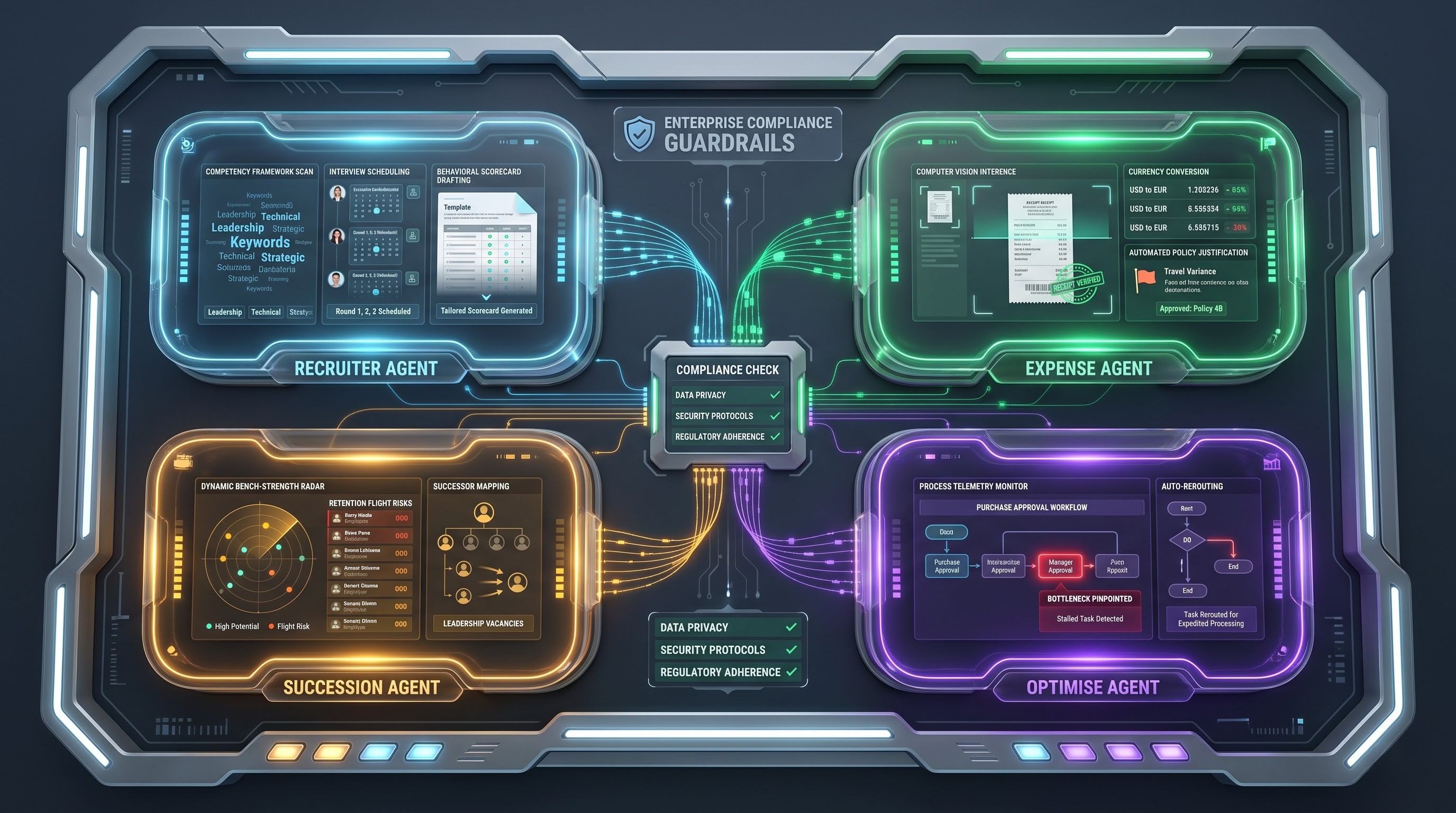
These agents recommend text, sense operational states, reason over complex trade-offs, generate multi-step plans, work with other agents, and perform authorised workflows independently or with supervision from humans.
The Recruitment Agent
Manual coordination has long been the Achilles heel of talent acquisition. Recruiters spend large chunks of their week sourcing candidate pools, reviewing hundreds of qualifications against rubric criteria, scheduling interviews, writing candidate outreach, and syncing with hiring managers.
The Recruiter Agent is an independent digital partner to the hiring teams. When a new requisition comes in, the agent looks at the job architecture, compares it to historical success profiles within the organization, and searches for relevant internal talent whose career interests and skills demonstrated match the role. For external candidates, the agent scans incoming applications, assesses qualifications against structured competency frameworks, and identifies candidate differentiators without falling into the trap of arbitrary keyword-matching.
The Recruiter Agent crafts personalised communication beyond initial screening, orchestrates multi-round interview scheduling amidst conflicting executive calendars, and equips interview panels with tailored behavioural questions specifically crafted to assess candidate experience. The agent takes care of the repetitive sourcing and scheduling mechanics, allowing human recruiters to be consultative talent advisors. Now they can focus their energy on candidate relationships and strategic alignment.
The Expense Agent
Corporate expense management has long been a sore point for employee satisfaction and administrative overhead. Employees don’t want to save paper receipts and manually categorise line items. Finance teams waste valuable time chasing down missing receipts, checking exchange rates and hunting down policy violations.
The Expenses Agent fundamentally transforms this workflow into a near-zero-touch experience. The agent captures transactions as they happen, with mobile photo uploads, emailed digital receipts or corporate credit card integrations. It uses state-of-the-art computer vision and natural language models to extract merchant details, itemised totals, tax categories and currencies.
Better still, the Expenses Agent verifies every transaction against company travel policies, client billing codes, and historical spending patterns. For example, if an employee has a last minute emergency client visit and books a flight that is over hotel allowance standards, the agent will identify the exception, understand the business context, ask the employee for an explanation, and pre-fill an approval request that contains the business justification for the manager. Routine expenses are compliant, verified, batched and routed directly for automated reimbursement with no manual touchpoints.
The Succession Agent
Leadership continuity is critical to organisational stability, but succession planning often becomes an annual check-the-box exercise, divorced from the realities of day-to-day operations. Succession slates are often stale and do not reflect recent performance changes, newly acquired capabilities, or retention flight risks.
The Succession Agent constantly reviews the talent architecture of the enterprise. It tracks skill development, project outcomes, leadership feedback, tenure milestones and engagement indicators to identify the bench strength across key business units. If a senior director shows signs of career stagnation or is at risk of leaving externally, the Succession Agent will inform the executive talent leaders, assess internal successors globally and identify ready-now candidates and those who can step in after specific development assignments.
The Succession Agent continuously surfaces talent pipeline health, taking talent continuity from a static board deck to an agile, dynamic talent strategy.
The Optimise Agent
Enterprise efficiency often suffers in insidious process drift. With time, approval hierarchies build in redundant checkpoints, employee onboarding workflows develop friction points and cross-departmental handoffs experience lag times that stretch on.
The Optimise Agent is an embedded business process adviser. It is continuously monitoring operational event telemetry across the Workday platform and comparing actual process execution against intended service level agreements. For example, if a business process such as purchase requisition sign-off is perpetually stuck in a certain supervisory review stage, the Optimise Agent finds the bottleneck, calculates the business delay, and recommends corrective actions. It can suggest removing unnecessary layers of approval, changing notification thresholds, or automatically rerouting approvals when managers are on extended leave. The agent also keeps enterprise inertia from eating away at organisational agility through constant monitoring and slight optimisation.
Rethinking human resources and talent architectures
The convergence of artificial intelligence and human capital management is creating an environment that allows organisations to transition from static job titles to dynamic, skills-based talent ecosystems. Companies used to try to build internal skills databases by having employees fill things out themselves. These attempts often failed, as the static profiles were already out of date, the moment they were typed in.
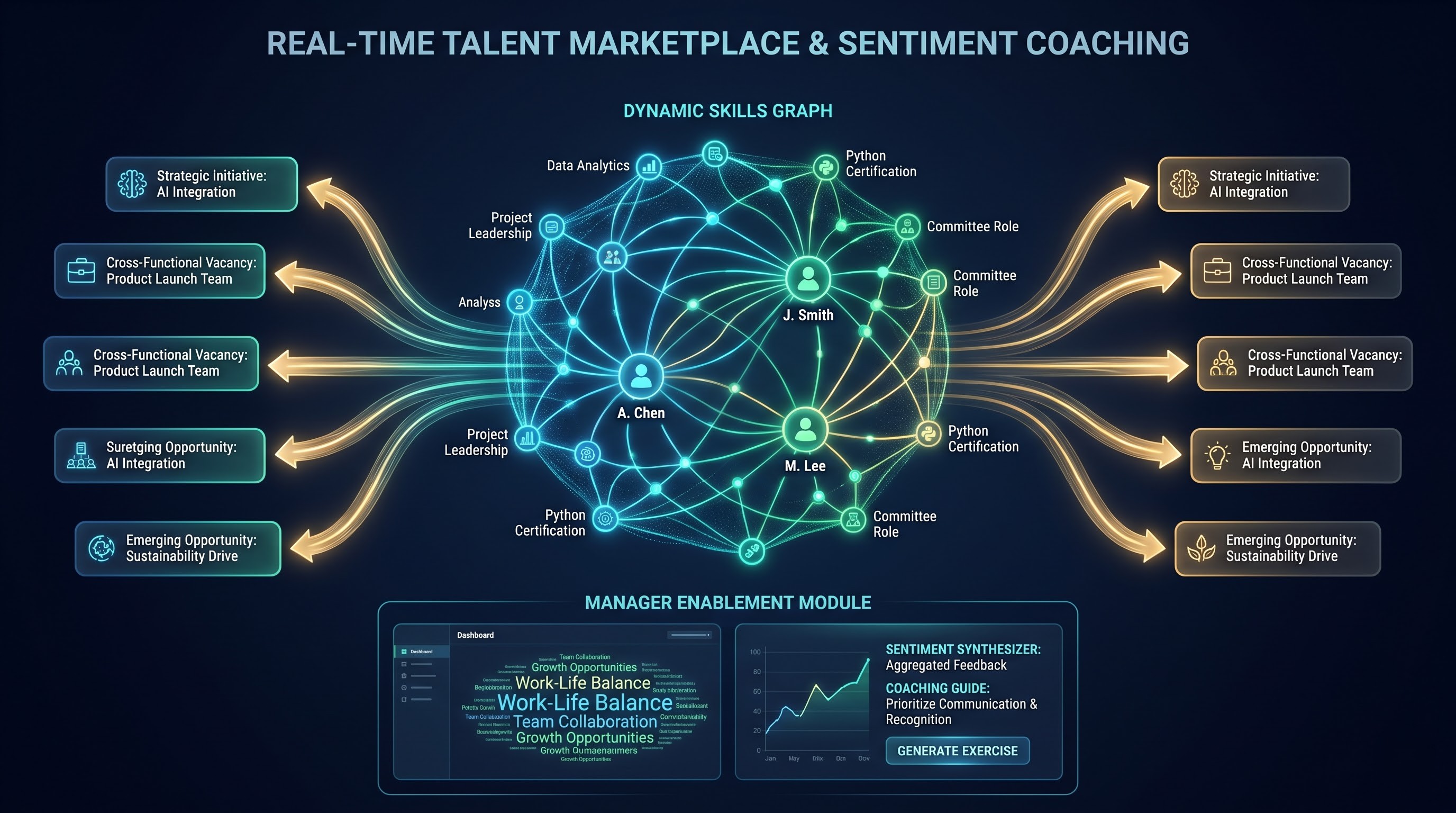
Workday Illuminate considers skill as an active ontology. The system derives skills both from previous job descriptions and also from proven practices: projects that have been done successfully, Workday training online completed via OnlineITGuru or the like, chairing a cross-functional committee, and performance assessments.
Dynamic Career Mobility and Internal Marketplaces
The moment employees connect to the organization portal, it generates a unique opportunity graph through Illuminate. To guide teams for these changing roles, services such as OnlineITGuru propose practical online Workday training. It helps them fill capacities through recommendations for lateral shifts, projects, and specific certificates instead of thinking of career as increasing up into the same vacuum.
This kind of dynamic mobility greatly reduces turnover costs for the organization. When a new division needs professionals skilled in regulatory compliance and cloud transformations, leaders don’t need to embark on costly external headhunting campaigns. Have a slate of internal candidates ready to be fast-tracked for internal professionals who have the fundamentals and know the company culture.
Manager Enablement & Coaching
Middle managers are among the most stressed groups in the modern corporate hierarchy because they are caught between directives from the executives and the daily needs of their teams. Illuminate gives managers real-time synthesis of signals from the workforce.
Illuminate leverages integrated employee listening capabilities like Peakon Employee Voice to analyse qualitative feedback from hundreds of team comments, pinpointing themes, sentiment trajectory, and early signs of burnout—all while keeping respondents anonymous. “Instead of just providing uncontextualized satisfaction scores, Illuminate gives managers actionable, micro-action coaching. If a distributed team reports low clarity on quarterly strategic priorities, Illuminate develops a structured discussion guide for the manager’s next team meeting and guides the manager through alignment exercises to rebuild team cohesion.
Finance and Operational Governance Reimagined
The cost of an error in corporate finance is extremely high. Absolute precision is required due to regulatory scrutiny, compliance mandates, and audit liabilities. Therefore, finance teams have traditionally been cautious of AI implementations that cannot be transparent or audited.
Workday Illuminate provides a deterministic and explainable way to manage financial operations. It doesn't use generative models to guess ledger balances, but instead uses pattern-matching neural networks and machine learning anomaly detectors to maintain balance integrity and automate routine transactional ledger mechanics.
Continuous Anomaly Detection and Audit Preparedness
Month-end close in the traditional accounting cycle is a high pressure sprint. Accountants spend days manually reviewing thousands of journal entries, reconciling credit balances, and finding misposted transactions. Subtle errors always escape human review and are discovered months later in external audits.
With Illuminate the periodic close becomes a continuous accounting model. The moment a transaction is put into the system it is scrutinised for irregularities. Machine learning algorithms trained on billions of past ledger movements can detect subtle irregularities such as a duplicate payment that is submitted with slightly different vendor information, an unusual weekend ledger adjustment, or an expense that was posted against an expired grant code.
If an anomaly is flagged, Illuminate doesn’t just abort the transaction with some obscure error code. It isolates the entry, alerts the financial controller, highlights the specific statistical deviation, explains the underlying pattern and recommends corrective reconciliation actions. The month-end close is a routine, validated aggregation of pre-validated ledgers, not a tiresome forensic audit. Errors are caught at the source.
Interpreting Cash Flow and Smart Procurement
Chief financial officers of companies also want to have predictive insight besides processing transactions to cope with economic fluctuations. With the help of external economic markers and internal operational information like customer payment cycles, pending purchase orders, supplier contract renewals, and recruitment growth, Illuminate offers dynamic automatic cash flow forecasts.
In procurement, Illuminate analyzes purchasing patterns across subsidiaries to spot consolidation opportunities. In case when three subdivisions from another country negotiate a software license with the same supplier independently from each other using different pricing models, Illuminate informs procurement executives, calculates estimated possible discounts and designs a common framework for contract negotiations.
Technical architecture of Workday
Smart organization policy cannot be territorial. Nowadays, multinational corporations have to work with complicated technical environments, consisting of company software, customer service platforms, proprietary information systems, and industry solutions.
Through the implementation of extendable architecture, Workday Illuminate lets firms utilize intelligent behavior.
The Workday AI Gateway:
The AI Gateway is the central integration bus that exposes hardened, pre-built artificial intelligence APIs directly to developers. Through the gateway, organisations may utilise In order to create customized enterprise applications utilizing the Workday technology, certain machine learning models were developed. For example, an internal IT platform responsible for distribution of hardware assets is able to call the APIs of the skill matcher and the role inferencing product called Illuminate for obtaining the necessary hardware and software specifications for the new data scientist.
Aligning External Models and Strategic Alliances
According to Workday, organizations are now using custom models that are hosted in AWS, Azure and Google Cloud. The Illuminate technology also enables integration, which means that architects can either import external models in Workday or take useful signals from Workday to the other AI ecosystem.
Moreover, the AI Marketplace presented by Workday includes the list of the trustworthy AI partners which are well integrated into the platform called Illuminate. In the case when the company has to perform certain screening, psychometric or location tax compliance tasks, all applications will be run within the secured environment of Workday.