
Workflow Data Fabric Explained for ServiceNow Developers
Last updated on Jun 3, 2026

The ServiceNow ecosystem is rapidly changing with the introduction of artificial intelligence, automation, intelligent workflows, and enterprise-wide data connectivity. One of the most notable innovations impacting the platform is Workflow Data Fabric. As a ServiceNow developer looking to expand your knowledge and skills, it is important to understand Workflow Data Fabric, as any modern organization must have seamless access to data, distributed across applications, databases, and cloud environments.
The usual approach to feeding data into a centralized system is to use complex integrations, data replication, and expensive ETL (Extract, Transform, Load) processes. But these approaches were prone to data silos, complexity of maintenance, and slow decision-making. Workflow Data Fabric resolves these issues by providing real-time access to enterprise data with governance and security.
In the modern ServiceNow platform, Workflow Data Fabric is one of the few concepts to grasp if you're looking to attend a ServiceNow course online or take a ServiceNow training. It allows organizations to link data sources, automate processes, and provide smart experiences without the need for a lot of data migrations.
This detailed guide examines Workflow Data Fabric, its architecture, advantages, use cases, career prospects, salary expectations, and ways for aspiring ServiceNow developers to develop proficiency in this new technology.
What is Workflow Data Fabric in ServiceNow?
Workflow Data Fabric is a ServiceNow feature that allows organizations to interrelate, retrieve, and use data across a variety of systems with no need to move the data or duplicate it. The platform offers a single source of enterprise information, rather than having to build multiple data repositories.
This technology serves as a link between different business systems, enabling workflows to gain access to the relevant data as and when required. The information can be stored in ERP systems, CRM applications, HR platforms, security tools, cloud databases, or any other system you can think of, and Workflow Data Fabric makes it accessible in ServiceNow workflows.
It has some benefits for modern businesses:
Business data is available at the right time.
Reduced data duplication
Faster workflow automation
Improved governance & compliance
Enhanced AI-powered decision-making
Improved user experiences
With a large number of organizations already on the path of digital transformation, ServiceNow developers are increasingly adopting Workflow Data Fabric to develop intelligent applications that can interact with multiple enterprise systems at the same time.
While traditional integration techniques can be learned in a ServiceNow online course, understanding Workflow Data Fabric will give students a competitive edge in the job market.
Why is Workflow Data Fabric important for ServiceNow developers?
Smaller businesses tend to use hundreds of software programs in various functions. ERP systems are employed by finance teams, human capital management platforms by HR teams, CRM applications by sales teams, and specialized tools by IT teams to manage the infrastructure.
With a fragmented data approach, organizations have a lot of problems:
Replicate data across systems
Delayed reporting
Inconsistent customer information
Integration maintenance overhead
Lack of visibility into the business operations.
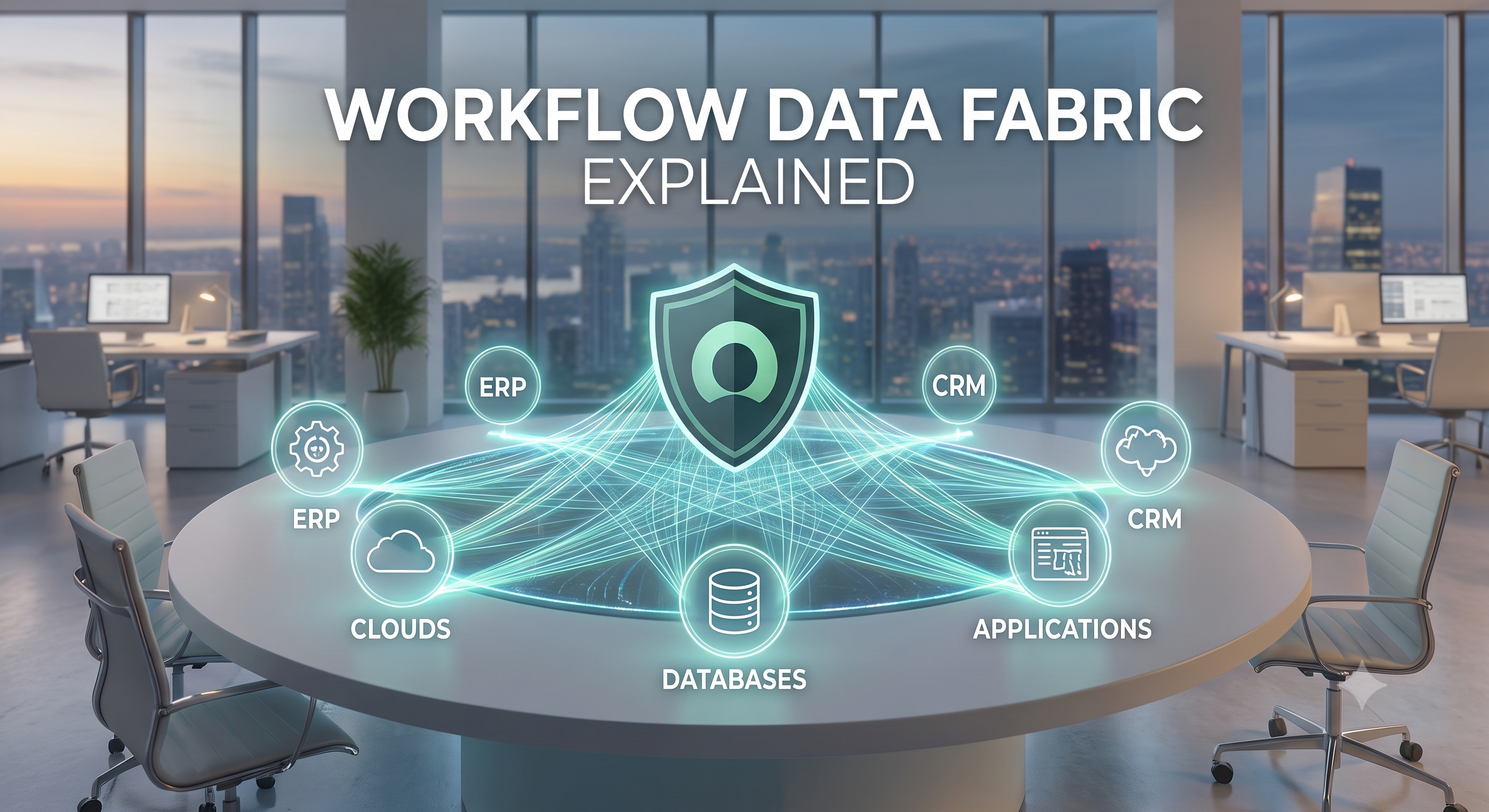
The problems are addressed by Workflow Data Fabric, which builds a connected data ecosystem. This allows developers to seamlessly tap into other systems and get the needed information without extensive custom integration work.
For example, a ServiceNow incident management workflow can automatically gather:
HR system employee records.
This will give you device information from your CMDB.
Data on security incidents from cybersecurity platforms
Data on assets obtained from inventory systems.
Information on assets that comes from inventory systems.
This translates to quicker issue resolution and increased operational efficiency.
For students aiming to become certified in ServiceNow, the Service Data Fabric is a key component to learn, especially with the trend of enterprise customers looking for individuals who can navigate around connected data architectures.
Key Components of Workflow Data Fabric
Workflow Data Fabric is made up of multiple components that are designed to integrate and deliver seamless data access within enterprise environments.
Data Connectivity
Data connectivity is the backbone of Workflow Data Fabric. It enables ServiceNow to connect with various enterprise applications and databases.
Common data sources are
Salesforce
SAP
Oracle
Microsoft Dynamics
Workday
AWS
Azure
Google Cloud
External databases
These connections enable workflows to pull information dynamically without having to duplicate datasets.

Data Federation
Data federation allows data to stay "where it belongs" and be made available in ServiceNow. This will save space and avoid sync problems.
Data federation provides an added benefit for ServiceNow developers by allowing information to be accessed as needed without having to replicate the data across environments.
Workflow Integration
Workflow Data Fabric can be seamlessly integrated into ServiceNow workflows, Flow Designer, and automation tools.
This integration allows:
Automated approvals
Intelligent routing
Context-aware decision-making
End-to-end process orchestration
Governance and Security
Security is a major issue in enterprise environments. Workflow Data Fabric has governance features that make sure that only authorised users and applications can access sensitive information.
Organizations benefit from:
Role-based access control
Audit logging
Data encryption
Compliance monitoring
These capabilities enable organizations to stay compliant with regulations and get the most value from connected enterprise data.
How does Workflow Data Fabric work?
Knowing how Workflow Data Fabric works can make a ServiceNow developer's life easier when creating applications and workflows.
The steps in the process are:
Step 1: Connect Data Sources
APIs, connectors, or integration tools are used to create links between ServiceNow and external systems.
Step 2: Define Data Relationships
Other data sets are mapped and configured into relationships.
Step 3: Develop a Single Point of Access
Workflow Data Fabric builds a single fabric that makes information accessible no matter where it resides.
Step 4: Create a Workflow Resource
ServiceNow workflows have access to relevant data whenever it is needed for business processes.
Step 5: Deliver Insights
The connected data can be used to generate recommendations, predictions, and automation opportunities by using AI and analytics tools. This architecture simplifies things and makes things more flexible for enterprise-level Service Now developers.
Workflow Data Fabric Advantages
The advantages of organizations implementing Workflow Data Fabric are significant business and technical gains. The good news is that Workflow Data Fabric offers several advantages:
Improved Data Accessibility
Employees have access to information in several systems in one place.
Benefits include:
Faster decision-making
Reduced context switching
Better user productivity
Enhanced collaboration
Reduced Integration Complexity
Traditional integrations are intensive on the part of the integrator. Workflow Data Fabric makes connectivity easy and cuts down on operational overhead.
Enhanced AI Capabilities
Artificial intelligence systems depend on accurate and comprehensive data. Workflow Data Fabric enables enterprise-wide information to be accessed by AI tools. AI is becoming more commonplace, and Service Now developers with a grasp of connected data architectures are more and more valued.
Better Customer Experiences
By having access to data across departments, organizations can provide personalized and responsive customer experiences.
Lower Operational Costs
Less data duplication and smoother integrations lead to lower infrastructure and maintenance costs.
For enterprises around the globe, Workflow Data Fabric is a strategic investment due to these benefits.
Discussing real use cases of the Workflow Data Fabric.
Workflow Data Fabric can be used for many business cases in various industries.
IT Service Management
IT teams can automatically collect data from various systems during incident resolution.
Examples include:
Device information
User profiles
Network status
Asset ownership
Human Resources
Human resource managers can optimize new employee orientation and employee lifecycle management.
The following types of data can be connected:
Employee records
Payroll information
Training status
Compliance certifications
Customer Service Management
A complete view of the customer is available to customer service representatives without having to switch applications.
Benefits include:
Faster issue resolution
Personalized support
Improved satisfaction scores
Security Operations
Security teams are able to link up data from many monitoring tools and threat intelligence feeds.
This helps to speed up incident detection and response.
These use cases show how Workflow Data Fabric can help with enterprise-wide digital transformation for aspiring Service Now developers.
These workflow and AI tools enable the creation of AI-driven workflows.
Artificial intelligence is gaining a major role in the ServiceNow ecosystem. To provide accurate insights and recommendations, AI systems must have access to high-quality data.
Workflow Data Fabric enables AI efforts by:
Accessing real-time data
Eliminating information silos
Improving context awareness
Enhancing predictive analytics
AI-driven workflows can:
Automatically classify incidents
Recommend solutions
Route requests intelligently
Predict service disruptions
It would be helpful for students taking ServiceNow training online to know that AI and Workflow Data Fabric are two pieces of the puzzle that are essential for creating enterprise applications of tomorrow.
Service Now developers are becoming more sought-after to integrate workflow automation, AI, and connected data strategies.
The skills required to work with Workflow Data Fabric
Individuals planning a career in this field should work on both technical and business skills.
ServiceNow Platform Administration, including:
Flow Designer
IntegrationHub
REST APIs
JavaScript
Data Modeling
CMDB Concepts
Security Best Practices
Business skills include:
Process Analysis
Workflow Design
Stakeholder Communication
Problem Solving
Documentation
To build the skills, a structured ServiceNow course can be used to teach these skills to beginners before moving forward to the concepts of Workflow Data Fabric.
Several students opt for online learning to get hands-on experience using real-world scenarios and projects with ServiceNow Developer Online Training.
ServiceNow Job Opportunities
Service Now developers have a wide range of career opportunities.
The need for ServiceNow professionals is growing across the globe. Whether in the healthcare sector or in the financial world, ServiceNow is a critical component in helping organizations across all industries to streamline their operations and increase efficiency.
Some common careers are:
ServiceNow Developer
ServiceNow Administrator
ServiceNow Consultant
Service Now Technical Lead
Service Now Architect
Service Now Integration Specialist
Service Now Platform Engineer
Service Now Solution Architect
ServiceNow job opportunities are present in the following industries:
Banking
Healthcare
Telecommunications
Manufacturing
Retail
Government
Insurance
Technology
A ServiceNow certification is a step in the right direction for enhancing job prospects and conveying knowledge to prospective employers.
ServiceNow Developer Salaries in India
India is still one of the fastest-growing ServiceNow talent markets out there.
The approximate salary ranges are as follows:
Entry-Level Service Now Developers
₹4 LPA to ₹8 LPA
Mid-Level Service Now Developers
₹8 LPA to ₹18 LPA
Senior Service Now Developers
₹18 LPA to ₹35 LPA
ServiceNow Architects
₹35 LPA to ₹60+ LPA
The factors that impact salary include:
Experience
Certifications
Platform expertise
Integration skills
Understanding of AI and automation.
Industry specialization
Those who finish the higher levels of Service Now training online may have access to greater opportunities for employment with higher pay as a result of their specialized skills.
The costs of ServiceNow developers overseas
The market is still extremely strong for ServiceNow consultants.
United States
Junior Developers: $75,000–$100,000
Mid-Level Developers: $100,000–$140,000
Senior Developers: $140,000–$180,000+
Architects: $180,000–$250,000+
Canada
CAD 80,000–160,000+
United Kingdom
£45,000–100,000+
Australia
AUD 90,000–180,000+
Germany
€60,000–120,000+
Companies around the globe are still investing in ServiceNow implementations, which results in some of the best jobs for Service Now developers. Countries that have a high demand for Service Now developers are located here.
There are many countries available for ServiceNow professionals these days.
Top destinations include:
United States
Canada
United Kingdom
Germany
Netherlands
Singapore
United Arab Emirates
India
Companies seek out professionals who have:
Platform development skills
Integration expertise
Automation knowledge
AI implementation experience
An efficient ServiceNow developer online training, along with projects, can make a candidate ready for international job markets.
Roadmap for Students and Beginners
Students and beginners can have a roadmap for their successful careers.
Step 1: Learn Platform Fundamentals
Start with:
Navigation
Tables
Forms
Lists
Users and Roles
The second step is to master development skills. The second step is to learn development skills.
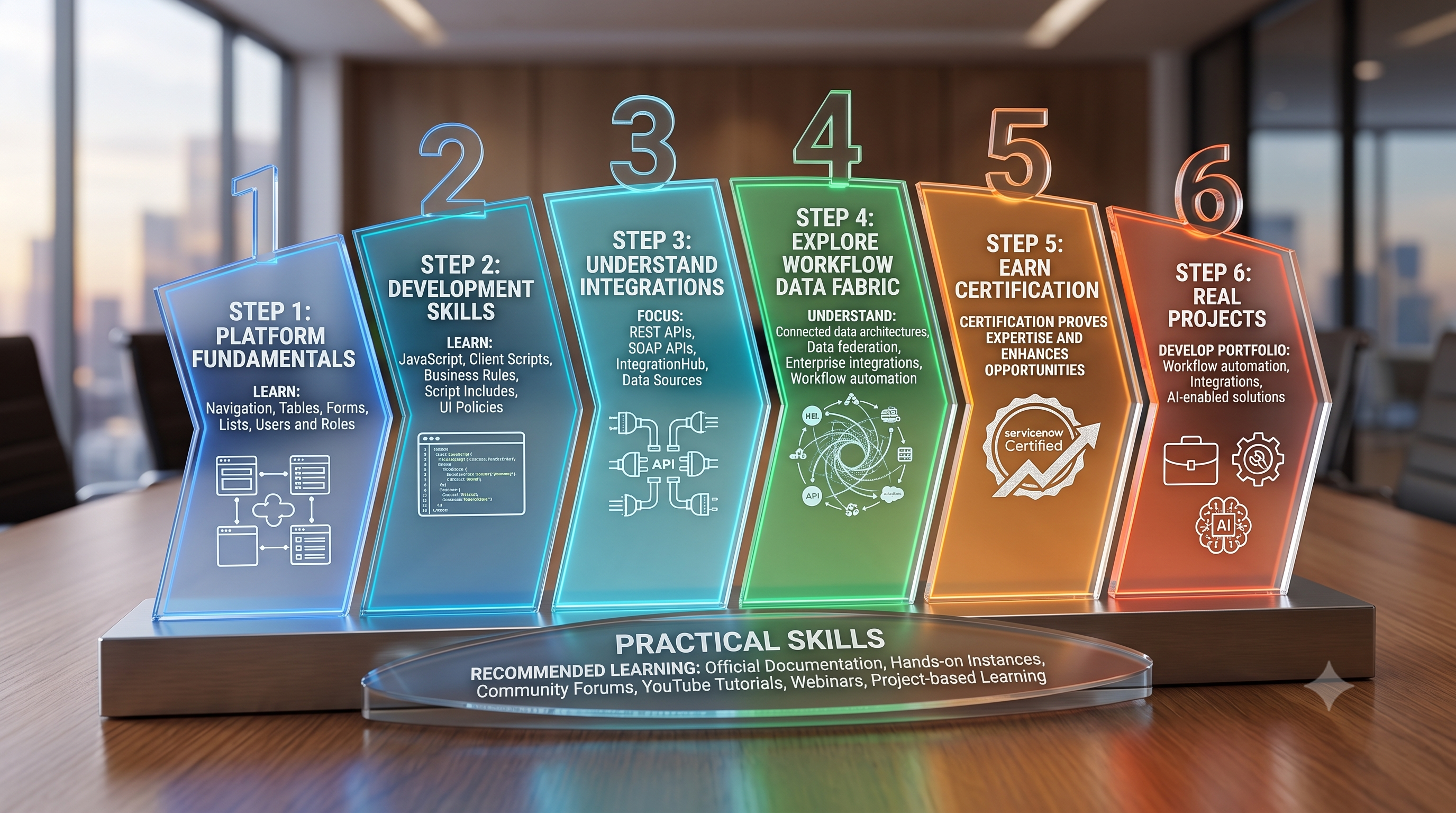
Step 2: Learn Programming skills
JavaScript
Client Scripts
Business Rules
Script Includes
UI Policies
Step 3: Understand Integrations
Focus on the skills:
REST APIs
SOAP APIs
IntegrationHub
Data Sources
Step 4: Explore Workflow Data Fabric
Understand the following skills:
Connected data architectures
Data federation
Enterprise integrations
Workflow automation
Step 5: Earn Certification
ServiceNow certification proves your expertise and enhances your career opportunities.
Step 6: Real Projects
Develop portfolio works of:
Workflow automation
Integrations
AI-enabled solutions
Employing a Workflow Data Fabric implementation. Using a Workflow Data Fabric implementation.
This road map is designed to help aspiring ServiceNow developers gain a practical understanding of ServiceNow and to be able to differentiate themselves in the competitive job market.
Practical Skills
The following are the best Service Now preparation materials for the Service Now aspirants. If you want to learn ServiceNow, it is important to put effort into finding good resources to help you and practice consistently.
Recommended methods of learning are:
Official ServiceNow documentation
Hands-on developer instances
Community forums
YouTube tutorials
Industry webinars
Project-based learning
A structured service now course offers directed learning and lets students steer clear of frequent problems. Several individuals opt to do a mix of self-study and instructor-led ServiceNow training courses to quicken their learning curve. To be flexible, it is possible to take a course on ServiceNow development online that can be studied at the student's own speed and experience development.
This will be the future of workflow data fabric in ServiceNow.
About Workflow Data Fabric
Workflow Data Fabric is likely to be an integral part of future ServiceNow deployments. The need for a single access point to data will continue to increase as organizations move toward AI, automation, and connected enterprise solutions.
Possible future enhancements:
Enhanced AI integration
Smarter workflow recommendations
Expanded connector ecosystems
Improved analytics capabilities
Greater automation intelligence
Acquiring Workflow Data Fabric knowledge now could give tomorrow's ServiceNow developers a big edge over competing developers. 21st-century platform capabilities will make it easier for professionals to meet future industry needs when they are learning ServiceNow.
The concept of a workflow data fabric is quite different from the traditional data integration methods.
Traditionally, organizations used to depend on a variety of integration techniques to connect enterprise applications before the advent of Workflow Data Fabric. The techniques were frequently custom APIs, middleware solutions, or ETL tools to move data between systems. These solutions worked in some situations, but added a lot of complexity, maintenance issues, and infrastructure expenses.
In contrast to this, Workflow Data Fabric provides a modern alternative by allowing companies to retrieve data from the source without having to replicate it extensively. This enables businesses to build workflows that are integrated without needing to handle too much integration overhead. This distinction matters to any aspiring developer of ServiceNow, as many enterprises are moving away from more traditional approaches to integration towards more scalable architectures.
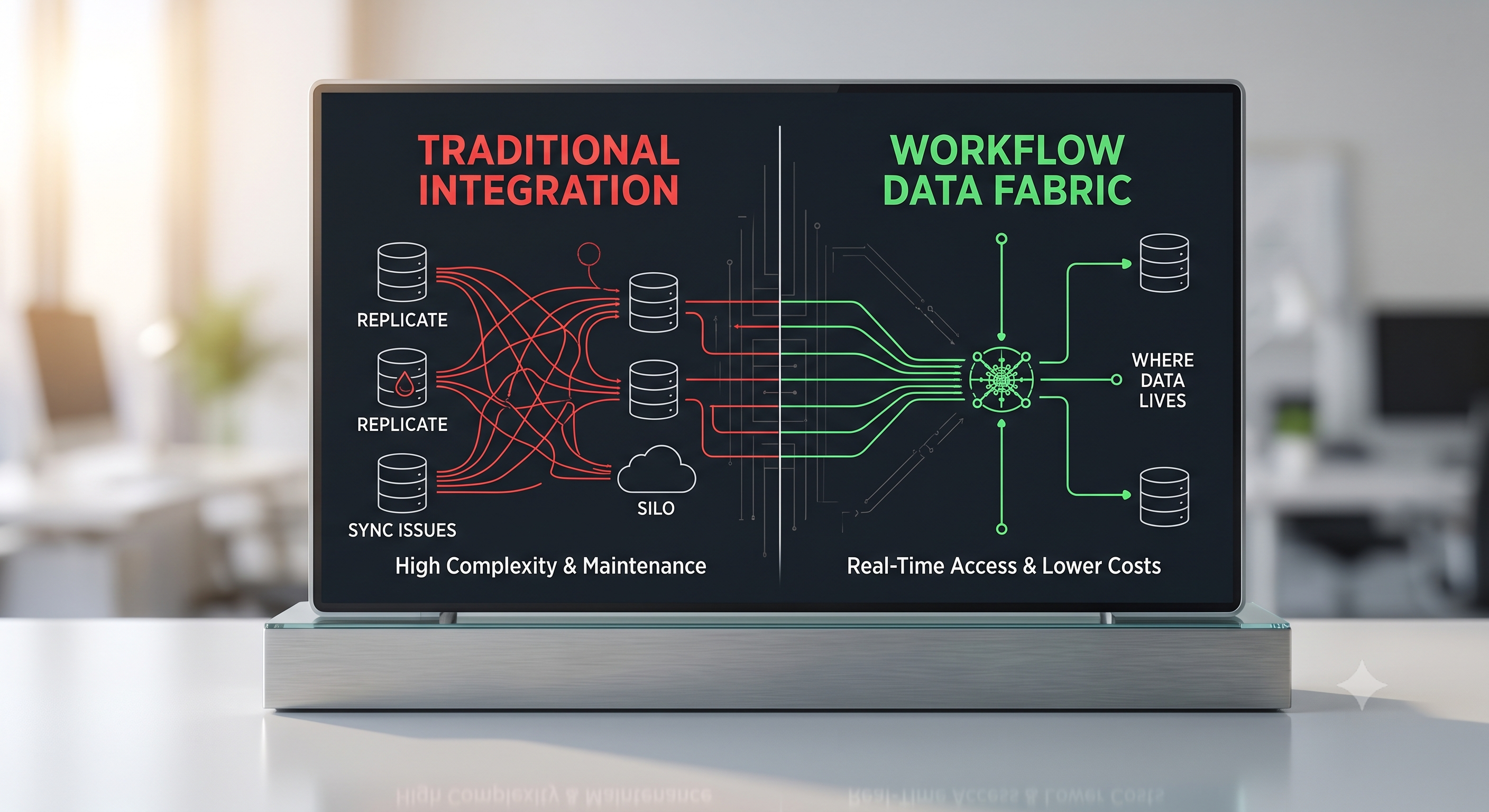
Let's take a look at the two methods:
Traditional Data Integration
In this case, the data has to be replicated between systems.
Higher maintenance costs
Increased storage requirements
Potential synchronization issues
Longer implementation timelines
Complex troubleshooting processes
Workflow Data Fabric
Offers access to real-time data
Minimizes data duplication
Reduces operational complexity
Improves scalability
Supports intelligent workflow automation
Enables faster innovation
Students in ServiceNow courses need to be aware of both approaches, as some organizations may have a mix of both legacy and modern integration implementations. Having a solid knowledge of both technologies will enable ServiceNow developers to create solutions in the enterprise effectively.
ServiceNow Developer Challenges
Some common challenges that a ServiceNow developer may encounter when using Workflow Data Fabric.
While Workflow Data Fabric makes enterprise connectivity easier, it still needs to be planned for and executed carefully and with technical skill. There are several issues that new ServiceNow developers face when starting their first project.
A frequent problem is having to deal with data relationships in multiple systems. In enterprise environments, there can be thousands of tables, applications, and business processes. When building a workflow, it is important for developers to correctly identify the data sources that are needed and how they should interact with each other.
The consistency of data quality is another challenge. Systems that are connected can have incomplete, duplicate, or outdated information. While it can be accessed by Workflow Data Fabric efficiently, workflow performance and decision-making could be affected by data quality issues.
Additional challenges include the following:
Managing API limitations.
Managing authentication and authorization.
Maintaining compliance requirements.
Monitoring integration performance.
Improving the efficiency of workflow executions.
Ensuring system scalability.
In the case of ServiceNow training programs, students are required to learn through hands-on activities related to integrations and workflow design. Future ServiceNow developers will learn about these challenges and apply effective solutions by getting hands-on experience.
Workflow Data Fabric Best Practices
Learn the best practices to follow when implementing a workflow data fabric.
The successful implementation of a Workflow Data Fabric is more than just knowledge. To achieve optimal performance, security, and scalability, organizations need to adhere to best practices.
Set up clear business goals
Define business goals you hope to meet before connecting systems. Clear objectives guide implementation decisions, whether it's for improved incident response times, customer service, or reporting.
Get the business cases right by focusing on high-value use cases first
Don't add all enterprise system connections right away; consider use cases that are going to provide tangible business value. Such a strategy enables organizations to show success and win the support of stakeholders.
Prioritize Data Governance
In connected environments, data governance is more important than ever. Establish policies for:
Data ownership
Access controls
Compliance monitoring
Retention policies
Audit requirements
Monitor Performance Continuously
It is important to regularly monitor the performance of the workflow to identify bottlenecks and to fine-tune the system's behaviour.
Document Everything
Future ServiceNow developers can use comprehensive documentation to gain knowledge about how to handle the data flow, integration points, and workflow dependencies.
Within enterprise projects, many professionals looking to become certified on ServiceNow can be expected to know these best practices.
Workflow Data Fabric and ServiceNow Career Growth
Learning about Workflow Data Fabric has one of the greatest benefits for career development. There is a growing trend in the employment of individuals who can bridge business processes, enterprise data, and automation technologies.
The job of the Service Now developer is constantly changing as businesses continue to pursue their digital transformation efforts. Modern developers don't have to be confined to the creation of forms, workflows, and business rules. Rather, they are becoming experts in enterprise automation who can create intelligent and connected business solutions.

The typical career path is:
ServiceNow Administrator
Junior ServiceNow Developer
ServiceNow Developer
Senior ServiceNow Developer
Technical Lead
Solution Architect
Enterprise Architect
Understanding Workflow Data Fabric, AI integrations, and enterprise connectivity can help to speed up this trajectory. Those who finish a specialized course called a service now course and then put that into practice can be very beneficial to their organization.
Employers are now looking at candidates who have an understanding of connected data architectures as they directly relate to enterprise automation strategies.
ServiceNow Developer Certification
The following is a list of top certifications and learning paths to get started as a future ServiceNow developer.
Workflows Data Fabric learners should take a course that builds the platform and then includes advanced courses on integration and automation.
Recommended certifications include:
An individual who has met the requirements of the exam and has been certified as a qualified system administrator.
This is the prerequisite training to understand the ServiceNow platform. It is commonly the first certification that new aspiring ServiceNow developers seek.
Certified Application Developer (CAD)
CAD certification is dedicated to application development, scripting, and workflow creation. It enables developers to create bespoke applications and automation solutions.
Certified Implementation Specialist (CIS)
These certifications are targeted at specific ServiceNow products and modules. They support professionals' specialization.
Micro-Certifications
ServiceNow has micro certifications regularly available for emerging technologies, workflows, AI capabilities, and platform innovations.
These certifications could be the reason why students opt for a quality ServiceNow online course and get hands-on experience with real-world development scenarios.
Anyone who has both project experience and certifications is likely to find high-paying positions locally and abroad.
What is the projection for the demand for ServiceNow developers?
Industry analysts forecast that enterprises around the globe will continue to grow ServiceNow adoption. Automation, artificial intelligence, employee experiences, transformation of customer service, and digital workflows are the areas where organizations are investing.
This expansion has consequences for the demand for skilled ServiceNow developers who are able to design, build, and maintain these solutions.
This need is being fuelled by several factors:
More companies are working on automation initiatives.
AI-driven processes are becoming more common.
Increasing use of AI-driven workflows.
Cloud-based business operations expansion.
Requires enterprise information connected to one another.
Digital transformation investments.
Need for better customer experiences.
Need for ServiceNow Professionals
The need for professionals who are able to interface between business needs and technical implementation is gaining significance in companies. Workflow Data Fabric is one of the key components in this evolution, as it facilitates seamless integration of workflows across various business systems.
Pupils interested in learning ServiceNow today are entering a market with promising long-term career prospects. Companies from all industries are recruiting skilled workers.
What's more, remote jobs are becoming more common and more abundant, and talented ServiceNow developers can now work for businesses overseas from their home countries.
From classroom ServiceNow courses to instructor-led ServiceNow Institute in Hyderabad and flexible ServiceNow developer courses online, mastering the skills of Workflow Data Fabric can be a game-changer in a crowded job market.
If you're a professional aiming to get the ServiceNow certificate, understanding connected enterprise architectures, intelligent workflows, and data-driven automation will certainly be one of the most worthwhile investments you can make in your career.
Conclusion
Workflow Data Fabric is a significant breakthrough in organizational connectivity, access, and use of enterprise data. It breaks down the barriers of traditional data silos, allowing real-time information access and enabling businesses to create smarter workflows, make better decisions, and provide better experiences for customers.
In today's ever-changing ServiceNow landscape, mastering Workflow Data Fabric is becoming a must-have skill for budding ServiceNow developers. Whether you're taking a ServiceNow course, advanced ServiceNow training, a ServiceNow certification, or just getting started learning ServiceNow, mastering connected data architectures will help improve your career opportunities.
As the world continues to demand more from ServiceNow developers, India and other parts of the globe have enticing salaries, plenty of job opportunities, and even more reason to embrace AI-driven enterprise workflows. Students and professionals who take the time to invest in a quality service now course or a comprehensive ServiceNow developer course online will be able to set themselves up to be successful in the fastest-growing technology in the IT industry.