
The Role of AI in Business Analysis: Future Trends
Last updated on Apr 19, 2026

Artificial Intelligence (AI) is rapidly transforming the field of business analysis, shifting it from a traditional, process-driven role to a more strategic and data-centric function. Today, Business Analysts (BAs) are no longer limited to gathering requirements and creating reports—they are becoming key contributors to data-driven decision-making.
One of the biggest impacts of AI is the automation of routine tasks such as data collection, cleaning, and report generation. This allows analysts to focus more on interpreting insights and delivering strategic value. AI-powered tools can analyze vast amounts of data in seconds, identify patterns, and even predict future trends, helping organizations make faster and more accurate decisions.
Another major trend is augmented business analysis, where AI acts as a co-pilot. With technologies like machine learning and Natural Language Processing (NLP), analysts can interact with data using simple language and instantly generate insights, dashboards, and business reports. This significantly improves efficiency and reduces manual effort.
AI is also driving a shift toward predictive and prescriptive analytics. Instead of just understanding past performance, businesses can now forecast future outcomes and receive recommendations for optimal actions. This enhances competitiveness and enables proactive decision-making.
However, as AI adoption grows, the role of the Business Analyst is evolving significantly. Modern BAs must develop new skills, including a solid understanding of AI concepts, data analytics, and strong communication abilities to effectively explain complex insights to stakeholders. In addition to technical expertise, ethical considerations such as data privacy, security, and bias in AI models are becoming increasingly important, requiring analysts to ensure responsible and transparent use of data.
To stay competitive in this rapidly changing landscape, enrolling in Business Analyst Course Online programs has become essential. These training programs help professionals build core competencies in requirements gathering, data analysis, visualization tools, and emerging technologies like AI and machine learning. They also enhance problem-solving and decision-making skills, which are critical for modern business environments.
By combining practical experience with structured business analyst training, professionals can stay updated with industry trends and tools. This continuous learning approach enables business analysts to adapt quickly, add strategic value to organizations, and confidently navigate the challenges of an AI-driven world.
Bottom of Form Introduction: The Shift Toward AI-Driven Business Analysis
Traditionally, business analysts focused on gathering requirements, analyzing data, and preparing reports to support decision-making. While these responsibilities remain relevant, the growing volume, variety, and velocity of modern data require far more advanced capabilities. This is where Artificial Intelligence (AI) plays a transformative role. AI-powered tools enable analysts to process massive datasets quickly, identify hidden patterns, and generate meaningful insights in a fraction of the time compared to manual methods.
More importantly, the true impact of AI lies in augmentation rather than replacement. Instead of eliminating the role of business analysts, AI enhances their efficiency and effectiveness. Routine and time-consuming tasks such as data cleaning, report generation, and basic analysis are increasingly automated, allowing analysts to shift their focus toward higher-value activities.
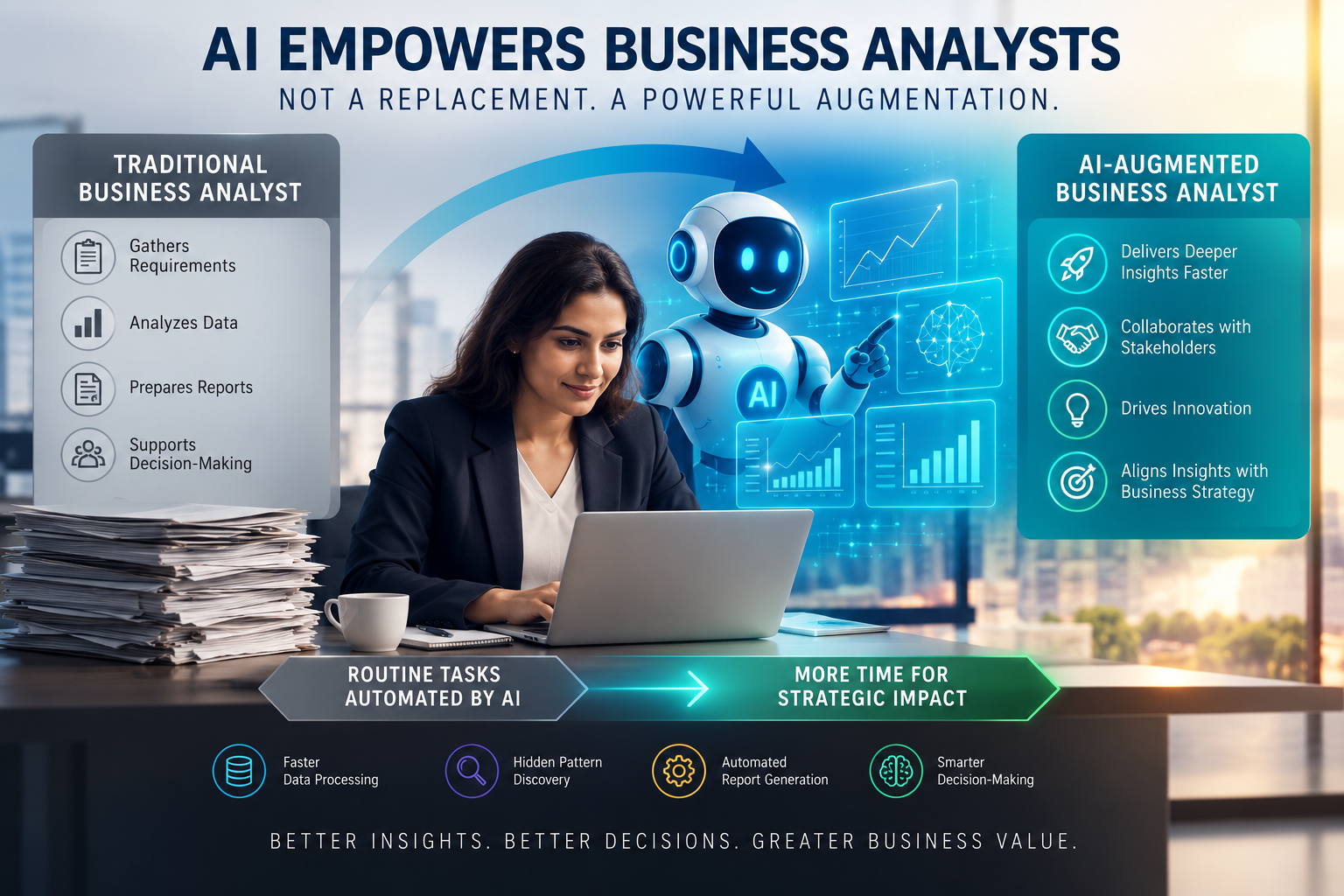
As a result, business analysts are now more involved in strategic decision-making, collaborating closely with stakeholders, and driving innovation within organizations. They act as a bridge between data insights and business strategy, ensuring that AI-driven outputs align with organizational goals. In this evolving landscape, analysts who embrace AI can deliver deeper insights, faster outcomes, and greater business value than ever before.
1. AI as a Strategic Decision-Making Partner
One of the most important trends in business analysis is the rise of AI as a strategic partner. Organizations are no longer just experimenting with AI—they are integrating it into core business operations to drive measurable results and gain a competitive advantage.
AI-powered tools help businesses predict market trends, identify potential risks and opportunities, and recommend data-driven strategies. For instance, predictive analytics enables companies to forecast demand, optimize pricing, and enhance customer experiences with greater accuracy. As a result, organizations can make faster and more informed decisions, often accelerating decision-making by a significant margin.
Looking ahead, the role of business analysts will continue to evolve alongside AI. Rather than relying solely on manual analysis, analysts will collaborate with AI systems to validate insights, interpret results, and ensure alignment with business objectives. This partnership will enable more strategic, efficient, and impactful decision-making across organizations.
2. Automation of Routine Tasks
AI is increasingly automating many repetitive and time-consuming tasks that were traditionally handled by business analysts. These tasks include data collection and cleaning, report generation, requirements documentation, and process mapping. By reducing the need for manual effort, AI not only speeds up these activities but also minimizes the risk of human error, leading to more accurate and reliable outputs.
As a result, business analysts can shift their focus toward higher-value responsibilities such as strategic planning, stakeholder engagement, and decision support. AI-powered tools can now generate interactive dashboards, summarize large volumes of data into clear insights, and even recommend potential business improvements based on patterns and trends.
This transformation significantly boosts productivity and efficiency, enabling faster project delivery and better outcomes. Ultimately, AI empowers business analysts to move beyond routine tasks and contribute more meaningfully to business growth and innovation.
3. Rise of Augmented Business Analysis
The concept of augmented business analysis is rapidly gaining momentum as organizations adopt AI to enhance decision-making processes. In this approach, AI functions as a “co-pilot” for business analysts, supporting them with real-time data analysis, insights, and recommendations. Rather than replacing human expertise, AI complements it by handling complex data processing and enabling faster, more informed decisions.
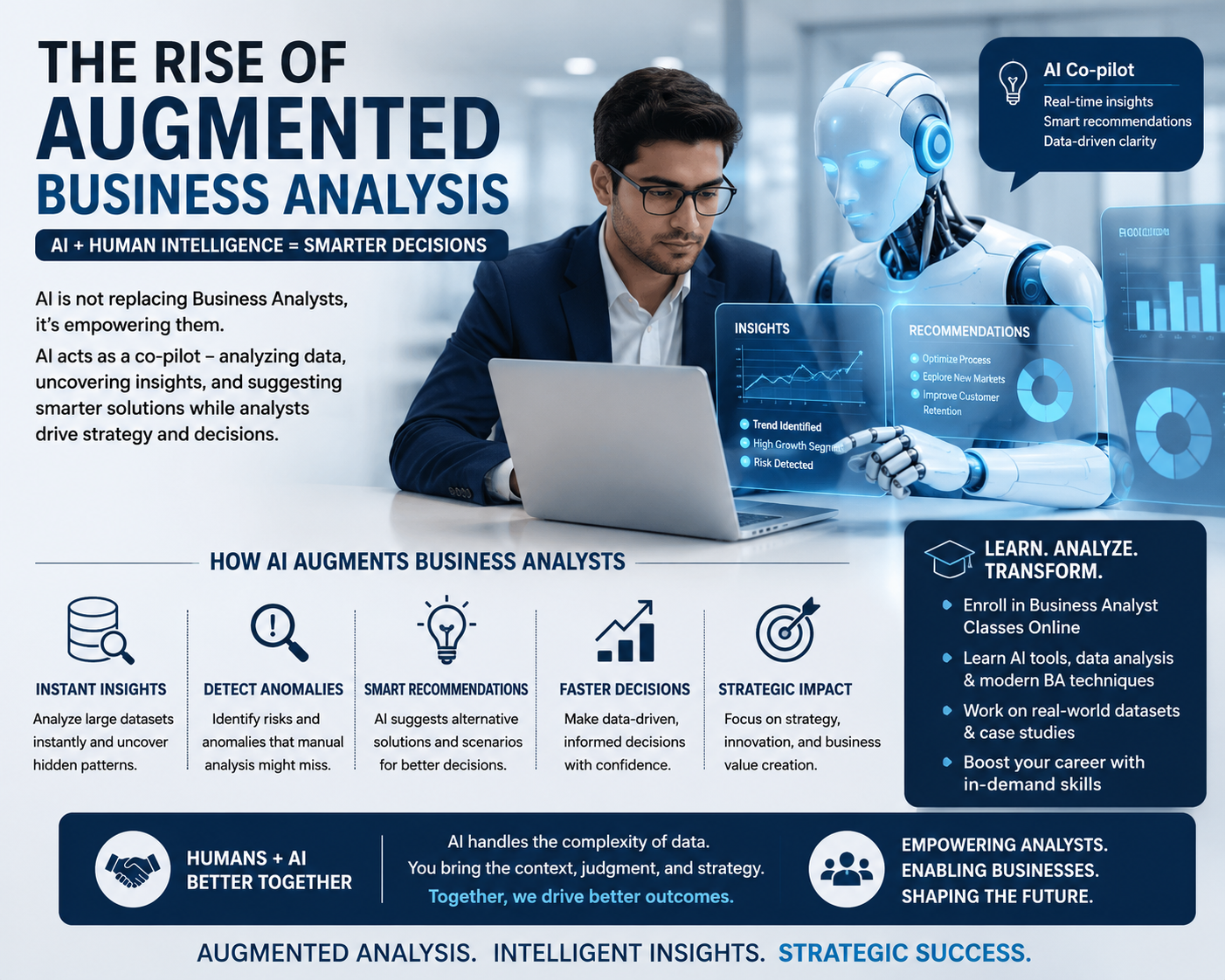
AI enhances the capabilities of business analysts in several powerful ways. It provides instant insights from large and complex datasets, enabling analysts to quickly identify trends, patterns, and key business drivers. AI can also detect anomalies that might be overlooked in manual analysis, improving accuracy and supporting better risk identification. Additionally, it can suggest alternative solutions and possible scenarios, allowing analysts to evaluate multiple options before making well-informed decisions.
To fully leverage these capabilities, enrolling in a Business Analyst Classes Online is highly beneficial. Such courses equip professionals with the knowledge of data analysis tools, AI fundamentals, and modern business analysis techniques. They also provide hands-on experience in working with real-world datasets and case studies.
By combining AI-powered tools with structured learning from a Business Analyst Course, professionals can enhance their analytical skills, make smarter decisions, and deliver greater value to organizations in today’s competitive, data-driven environment.
This collaboration between humans and intelligent systems leads to improved efficiency, accuracy, and strategic outcomes. Business analysts are no longer limited to processing data; they become orchestrators of insights, focusing on interpreting results and aligning them with business goals. As augmented analysis continues to evolve, it empowers analysts to deliver greater value and drive innovation within organizations.
4. Generative AI and Natural Language Processing (NLP)
Generative AI and Natural Language Processing (NLP) are transforming how business analysts interact with data, making analysis faster and more intuitive. Instead of relying on complex queries or technical tools, analysts can now ask questions in simple, natural language. For example, they can easily explore insights by asking, “What were the top-performing products last quarter?” or “Why did sales decline in a specific region?”
AI-powered systems can instantly deliver accurate answers, along with visualizations and actionable recommendations. This significantly reduces the time required to extract meaningful insights from large datasets.
In addition, generative AI supports everyday business analysis tasks such as creating reports, writing documentation, and generating user stories. By automating these activities, it minimizes manual effort and enhances overall efficiency. As a result, business analysts can focus more on strategic thinking and decision-making rather than routine tasks, leading to better project outcomes.
5. Hyperautomation in Business Processes
Hyperautomation integrates AI, machine learning, and robotic process automation (RPA) to automate entire business workflows, driving end-to-end efficiency. This trend is significantly reshaping business analysis by enabling organizations to streamline operations, reduce manual intervention, and optimize processes at scale.
The key benefits of hyperautomation include faster process execution, reduced operational costs, and improved accuracy. By automating repetitive and rule-based tasks, businesses can achieve consistent results while freeing up resources for more strategic activities.
Business analysts play a crucial role in this transformation. They are responsible for identifying automation opportunities, analyzing process gaps, and ensuring that automated solutions align with overall business goals. By evaluating workflows and understanding business needs, they help organizations implement efficient and scalable automation strategies.
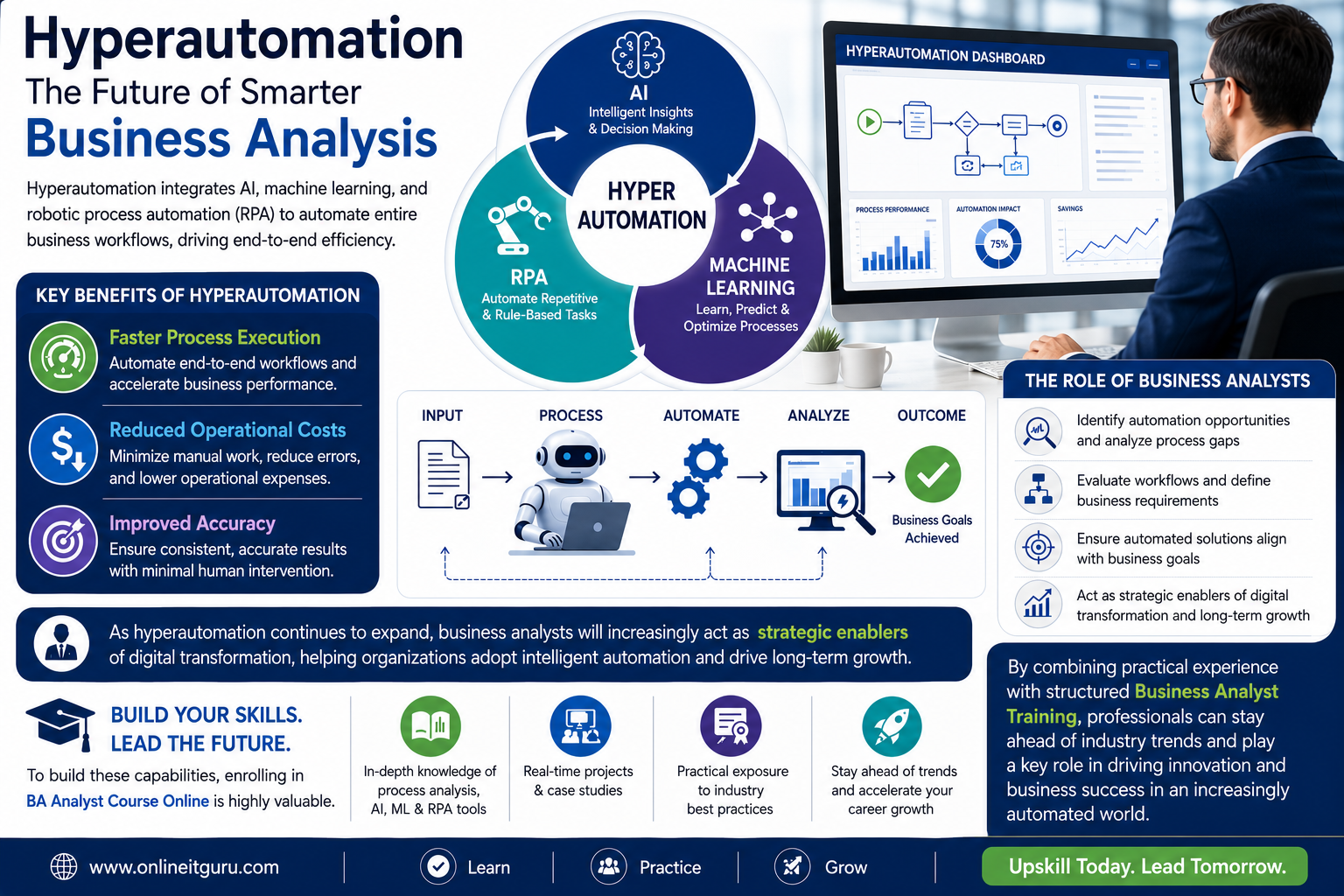
As hyperautomation continues to expand, business analysts will increasingly act as strategic enablers of digital transformation, helping organizations adopt intelligent automation and drive long-term growth. Their ability to bridge the gap between technology and business objectives makes them essential in achieving successful outcomes.
To build these capabilities, enrolling in BA Analyst Course Online is highly valuable. Such training programs provide in-depth knowledge of process analysis, automation tools, and emerging technologies like AI and RPA. They also offer practical exposure through real-time projects and case studies, enabling professionals to apply their skills effectively.
By combining practical experience with structured Business Analyst Training, professionals can stay ahead of industry trends and play a key role in driving innovation and business success in an increasingly automated world.
6. Data-Driven Culture and Advanced Analytics
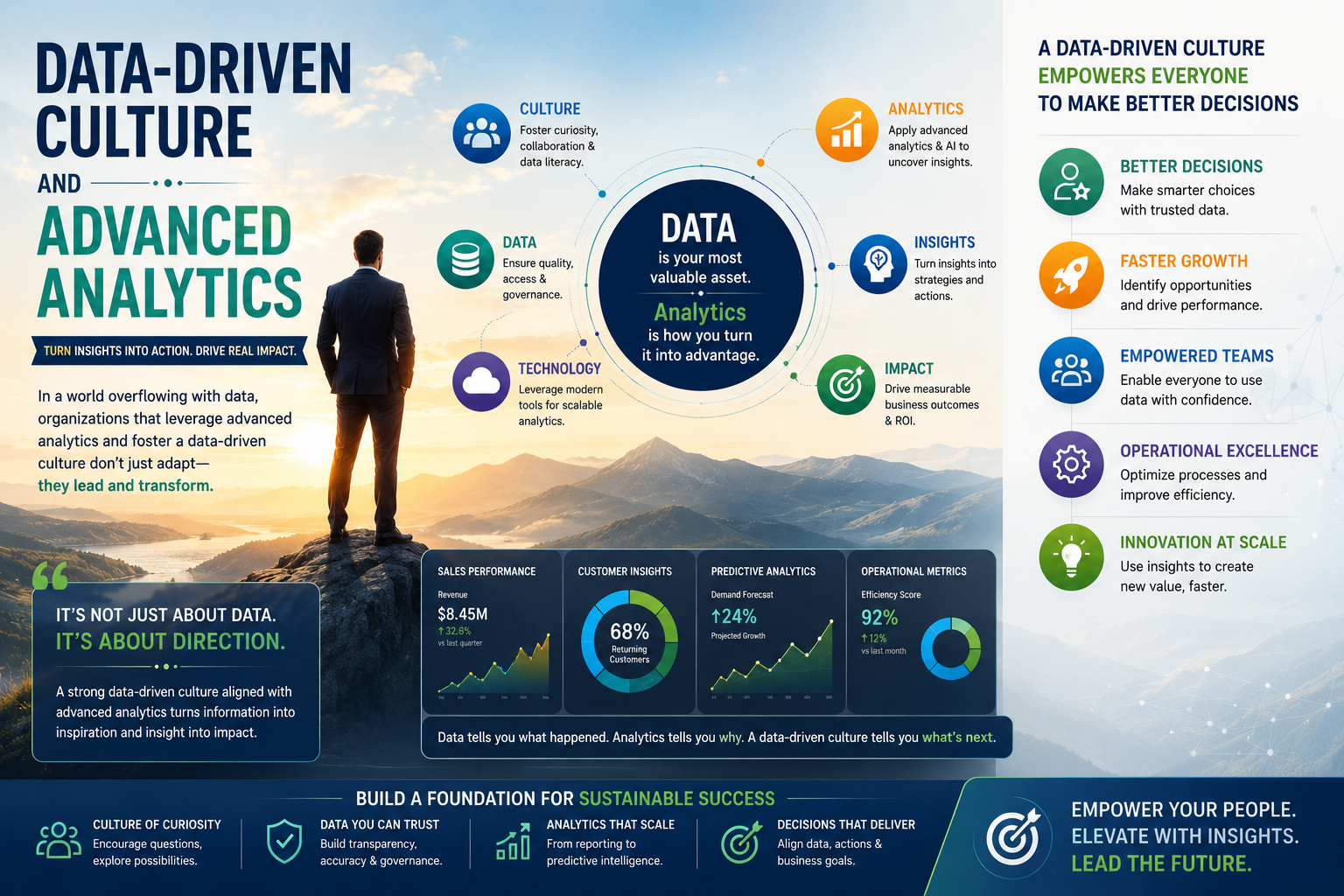
Organizations are increasingly adopting a data-first culture, where every decision is driven by insights derived from data rather than intuition. In this environment, Artificial Intelligence (AI) plays a crucial role by enabling advanced data analysis techniques that go beyond traditional reporting. These include predictive analytics, which helps forecast future outcomes; prescriptive analytics, which recommends the best course of action; and real-time insights, which allow businesses to respond instantly to changing conditions.
AI has the ability to process and analyze massive volumes of structured and unstructured data at high speed. It can uncover hidden patterns, correlations, and trends that may not be visible through manual analysis. This empowers organizations to gain deeper insights into customer behavior, market dynamics, and operational performance.
As a result, businesses are shifting from reactive decision-making—focused on understanding what has already happened—to proactive and predictive strategies that anticipate future scenarios. This transformation enables organizations to reduce risks, seize opportunities faster, and maintain a competitive edge. Ultimately, a data-first approach supported by AI allows companies to make smarter, faster, and more strategic decisions in an increasingly complex business landscape.
7. Changing Role of Business Analysts
The role of a business analyst is evolving significantly in the age of Artificial Intelligence. Traditionally seen as intermediaries between business stakeholders and IT teams, business analysts are now transitioning into strategic consultants who play a vital role in shaping organizational success. This shift is driven by the growing importance of data, automation, and AI-powered insights in decision-making.
One of the key changes is the increased focus on business strategy rather than just documentation. While creating requirement documents remains important, analysts are now expected to contribute to high-level planning and decision-making processes. They are also becoming more actively involved in digital transformation initiatives, helping organizations adopt new technologies and optimize business processes.
Another major development is the growing collaboration between business analysts, data scientists, and AI teams. Analysts work closely with these professionals to ensure that AI models and data solutions align with real business needs and deliver meaningful outcomes.
Additionally, business analysts are now responsible for interpreting AI-generated insights and translating them into actionable strategies. This requires strong analytical thinking, domain knowledge, and communication skills. As the role continues to evolve, business analysts who embrace AI and develop strategic capabilities will become indispensable assets to modern organizations.
8. Demand for New Skills
As AI continues to reshape business analysis, the skillset required for Business Analysts (BAs) is evolving rapidly. Relying solely on traditional technical skills is no longer enough to stay relevant in today’s data-driven environment. Future-ready analysts must develop a balanced mix of technical knowledge and strong soft skills to deliver real business value.
A solid understanding of AI and machine learning concepts is becoming essential, enabling analysts to work effectively with advanced technologies. In addition, data analysis and visualization skills help in interpreting complex datasets and presenting insights in a clear, meaningful way. Critical thinking and problem-solving abilities are also crucial, allowing analysts to evaluate scenarios and make informed decisions.
Equally important are communication and storytelling skills. Business analysts must translate complex AI-driven insights into simple, actionable recommendations for non-technical stakeholders. This ability ensures better decision-making and alignment across teams, making soft skills just as important as technical expertise in the AI era.
To strengthen these essential skills, enrolling in BA Online Training can be highly beneficial. Such training programs not only focus on technical concepts but also emphasize communication, presentation, and stakeholder management. They help analysts learn how to structure insights, create compelling data stories, and confidently present recommendations to business leaders.
By combining strong soft skills with knowledge gained through business analyst training, professionals can effectively bridge the gap between data and decision-making, making them more impactful and valuable in modern organizations.
9. Ethical AI and Data Governance
With the increasing adoption of Artificial Intelligence, ethical considerations have become a vital responsibility for business analysts. As organizations depend more on AI-driven insights, ensuring responsible and fair usage of these technologies is essential. Business analysts act as key guardians of ethical standards in AI implementation.
One of the most important aspects is maintaining data privacy and security. Analysts must ensure that sensitive customer and business data is protected, handled securely, and complies with relevant regulations. Another critical factor is transparency in AI models. Decision-making processes should be clear and explainable so that stakeholders can trust and understand how outcomes are generated.
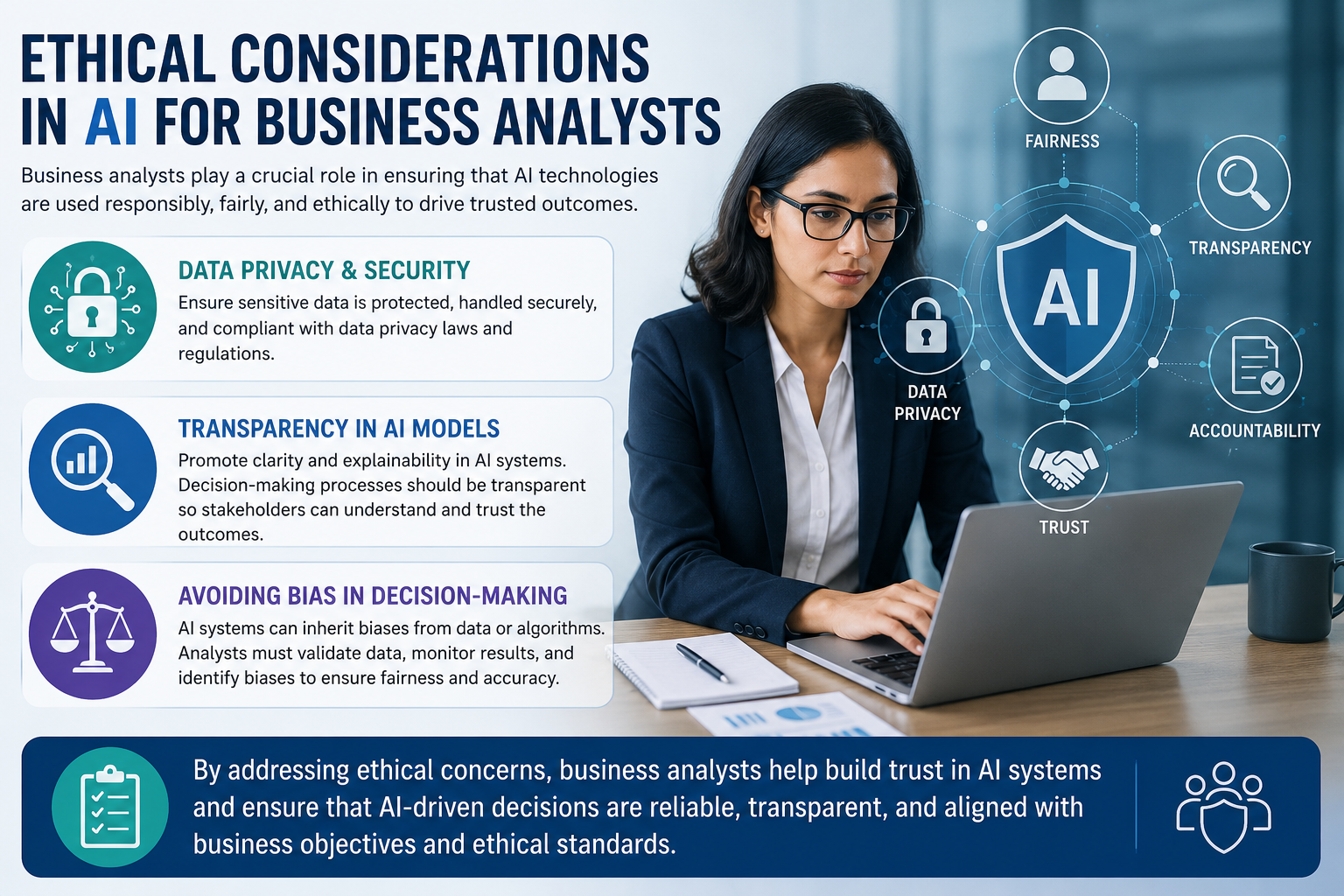
Equally important is the avoidance of bias in decision-making. AI systems can sometimes produce inaccurate or biased results due to poor-quality data or flawed algorithms. Business analysts must validate data sources, monitor outputs, and identify potential biases that could impact fairness and accuracy.
By addressing these ethical concerns, business analysts help build trust in AI systems. Their role is essential in ensuring that AI-driven decisions are reliable, transparent, and aligned with both business objectives and ethical standards.
10. Future Workplace: AI-Powered Teams
Analysts will handle more strategic responsibilities • Teams will rely on AI for execution tasks • Collaboration between humans and AI will become standard Rather than replacing jobs, AI is redefining roles and creating new opportunities. generate 200 words of content
The future workplace is rapidly evolving toward smaller, more agile teams powered by Artificial Intelligence. Organizations are increasingly leveraging AI to streamline operations, enhance productivity, and reduce reliance on large, resource-heavy teams. By automating routine and execution-focused tasks, AI allows companies to operate more efficiently while maintaining high performance.
In this new environment, business analysts and other professionals are expected to take on more strategic responsibilities. Instead of focusing on manual tasks, analysts will concentrate on interpreting insights, guiding business decisions, and driving innovation. Teams will depend on AI systems to handle repetitive processes such as data processing, reporting, and workflow automation.
Collaboration between humans and AI will become a standard way of working. Employees will work alongside intelligent systems that provide real-time insights, recommendations, and support. This partnership enhances both speed and accuracy in decision-making.
Importantly, AI is not eliminating jobs but redefining them. It is creating new roles, encouraging upskilling, and opening opportunities for professionals to focus on higher-value work. As a result, the future workplace will be more dynamic, efficient, and innovation-driven.
Conclusion: The Future of Business Analysis in an AI World
AI is not replacing business analysts—it is transforming them into strategic, data-driven professionals who play a key role in modern organizations. By automating repetitive tasks such as data processing and reporting, AI allows analysts to focus on high-value activities like strategy, decision-making, and stakeholder engagement. As businesses increasingly adopt AI, continuous learning becomes essential, with a strong focus on data analytics, AI concepts, and communication skills. Additionally, ethical AI practices and governance are critical to ensure transparency and fairness. To stay competitive in this evolving landscape, enrolling in a BA Online Course from OnlineITguru can help professionals gain the necessary skills and stay ahead in the field of business analysis