
Why MongoDB is Perfect for AI and Big Data Applications
Last updated on May 6, 2026

In the modern era of data-driven business, it is Artificial Intelligence (AI) and Big Data that is changing the way businesses operate, make decisions and deliver value to customers. Starting with personalized suggestions, to predictive analytics, modern applications are heavily dependent on large volumes of structured and unstructured data. Conventional relational databases are not always able to manage this complexity and scale effectively. It is here that MongoDB, a top NoSQL database, is a strong contender.
The flexible, scalable, and high-performance architecture of MongoDB makes it a perfect option to be used in AI and Big Data applications. We will discuss the reasons why it is unique and how it will help the next generation of smart systems.
If you are interested in developing expertise in this potent technology, you can enroll in a MongoDB Classes that will help you gain practical experience, learn about real-world applications of AI, and develop the skills at working with Big Data applications efficiently.
Knowledge of the Needs of AI and Big Data.
The applications of AI and Big Data require highly capable and flexible database systems capable of keeping pace with the size, speed, and variety of contemporary data. The applications usually need databases that have the capability to support large amounts of data that are produced by multiple sources, such as user interactions, IoT devices, social media, and enterprise systems. Also, they should support real-time data processing to enable real-time insights, which is essential in use cases such as fraud detection, recommendation engines, and predictive analytics.
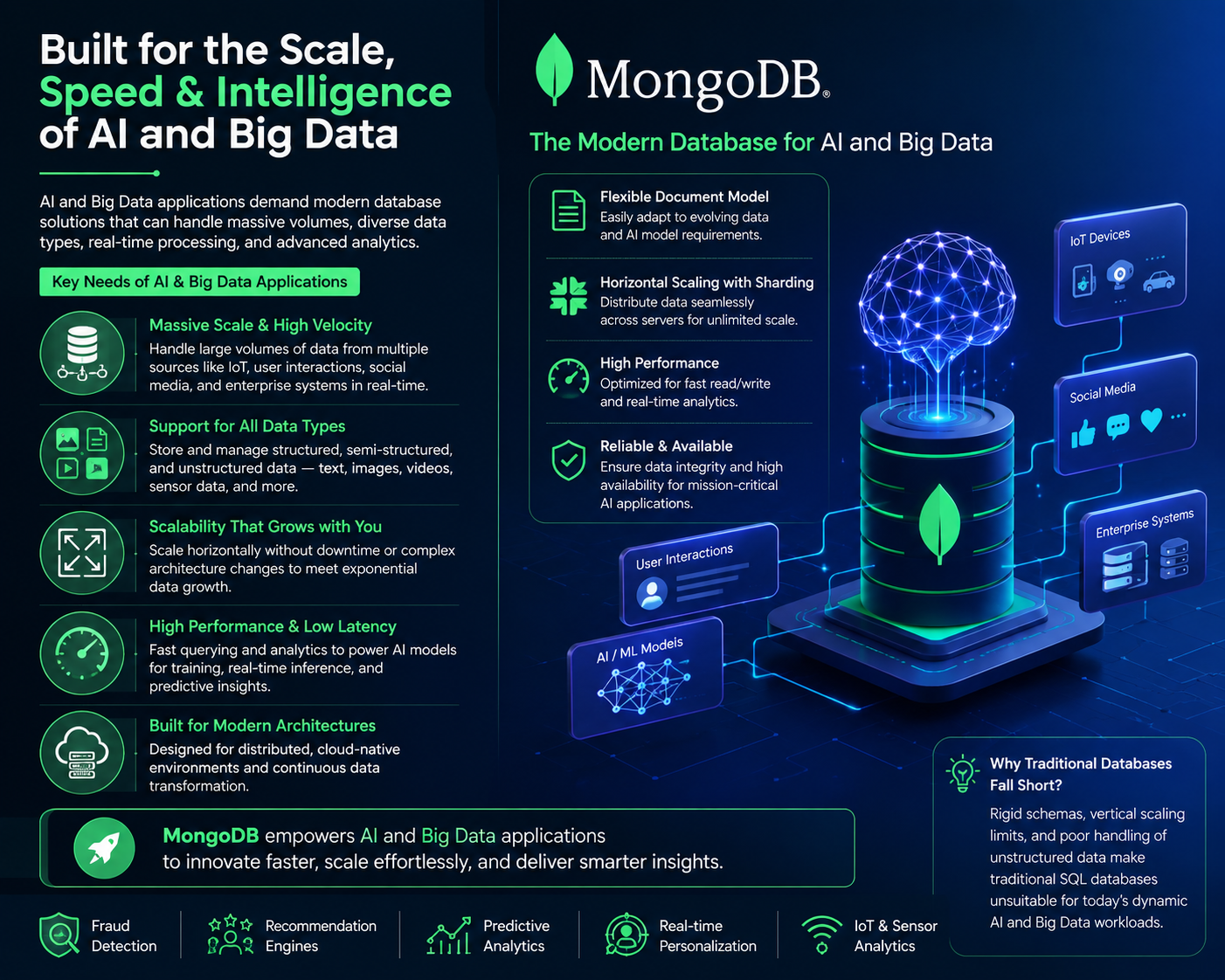
The other important requirement is capability of storage and management of structured, semi structured and unstructured data. AI systems frequently handle a combination of data types, such as text, images, videos and sensor data. Conventional databases find it very difficult to deal with this diversity effectively. Scalability is also of great significance since data is ever-increasing exponentially. The current applications require scaled-out databases that can be expanded without negatively affecting the performance or necessitating complicated changes in the architecture.
It is also necessary to have fast querying and advanced analytics capabilities. The AI models are based on fast access to the appropriate data to train, test and make real-time decisions. The latency in data retrieval can have a substantial effect on the performance and the user experience.
The traditional SQL database with its inflexible schema and low scalability in horizontal direction may not match these changing demands. They are not aimed to manage the dynamic and distributed environment of Big Data. AI systems especially the ones that require machine learning demand a constant influx of data, transformation, and analysis. It is here that MongoDB outshines. Designed to be efficient and reliable in supporting the complex needs of an AI and Big Data application, MongoDB was built with a flexible document model, horizontal scaling through sharding, and high-performance characteristics.
Dynamic Data on Flexible Schema.
A schema-less design is one of the most important benefits of MongoDB in comparison to the traditional relational databases. In traditional systems, the developer has to come up with a rigid schema and then store data in it and then it becomes difficult to adapt it in case the requirements change. Instead, MongoDB leverages a document-based model which is flexible and allows it to store data in forms of JSON-like documents (BSON). This enables every record to possess a unique structure and developers are free to add and modify their data model as needed without being bound to a fixed set of predefined schemas.
This flexibility is especially useful in AI and machine learning projects, where data is always dynamically changing and evolving. New features, attributes and data types are often added as models are trained, tested, and refined in the lifecycle of an AI application. As an example, a recommendation system can begin with simple user information but then expand to behavioral patterns, preference, and real-time data to interact with users. In a traditional database, this would involve intricate schema migrations, possible downtime, and major development.
MongoDB does away with these issues by enabling smooth updates to the data structure. This allows developers to add and/or edit existing fields without affecting the application. This enables experimentation to be faster and more efficient- a crucial requirement in AI development whereby the speed and effectiveness of experimentation is paramount to success.
Also, the flexible schema of MongoDB allows quick prototyping, allowing teams to develop and test new AI models quickly without worrying about the database constraints. This flexibility does not only shorten the development cycles but also enhances innovation by enabling the teams to react fast to new knowledge and evolving business requirements. In general, the schema-less architecture of MongoDB enables programmers to create scalable, adaptable, and future-oriented AI applications with ease.
Fluency in Processing Unstructured Data.
Unstructured data (text, images, videos and sensor-generated information) are important to AI systems. This kind of data is not packed into a fixed format as traditional structured datasets are, which makes it difficult to store and process such data with the help of traditional relational databases. MongoDB can deal with this challenge by a flexible and document-oriented data model, which is designed to handle many and complex data format with ease.
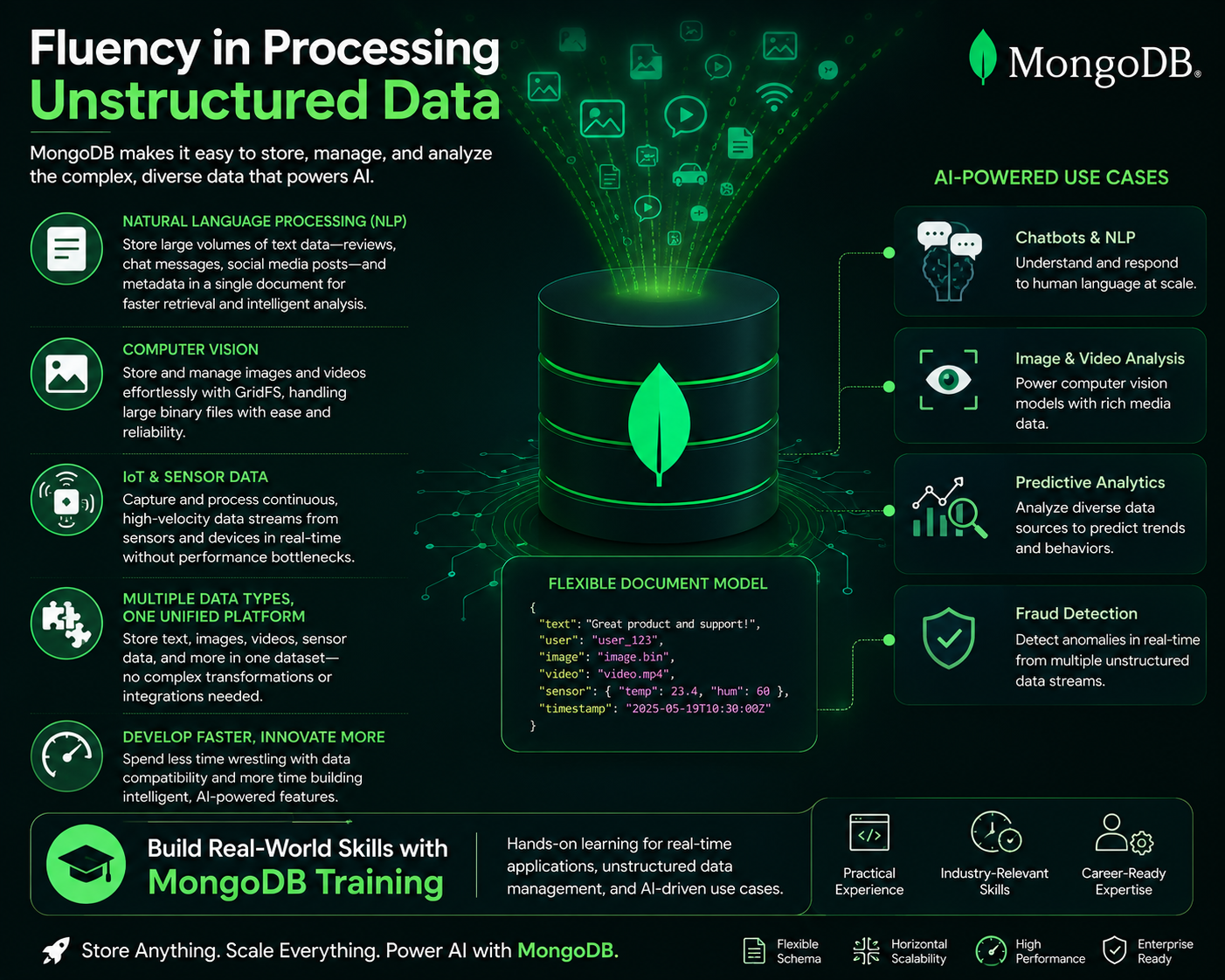
As an example, Natural Language Processing (NLP) applications process a large amount of textual data, such as user reviews, chat messages, and posts on social media. MongoDB will enable the developer to store this text data and metadata in a single document making it easier to retrieve and analyze it. In the same way, computer vision systems are based on images and videos, which can be stored in MongoDB using features such as GridFS, which can allow handling large binary files easily. Continuous sensor data streams are produced in real time in the case of IoT based AI solutions. The large write throughput and scalability of MongoDB makes it suitable to capturing and processing this constant stream of information without performance bottlenecks.
The other important benefit is that MongoDB allows a developer to store numerous types of data in one dataset. This integrated solution does not require the development of complex data transformations and integrations, minimizing development time and effort. Due to this, teams will have more time to develop smart features instead of spending time on handling data compatibility problems.
To any professional seeking to acquire knowledge on how to handle such a contemporary data problem, a MongoDB Training can be very helpful. It offers a practical experience in how to work with unstructured data, real-time applications, and AI-driven use cases, helping learners develop the practical skills needed in the modern industry that is data-centric in nature.
Big Data Horizontal Scalability.
The first property of a Big Data application is scalability, which is essential given that organizations are ever-growing in terms of generating and processing large amounts of information. Conventional databases may not be efficient in scaling, especially to those datasets that may grow rapidly. MongoDB overcomes this challenge by its strong horizontal scaling feature called sharding. Sharding enables data to be created and spread across numerous machines or clusters to enable the system to sustain more workloads without compromising on its performance.
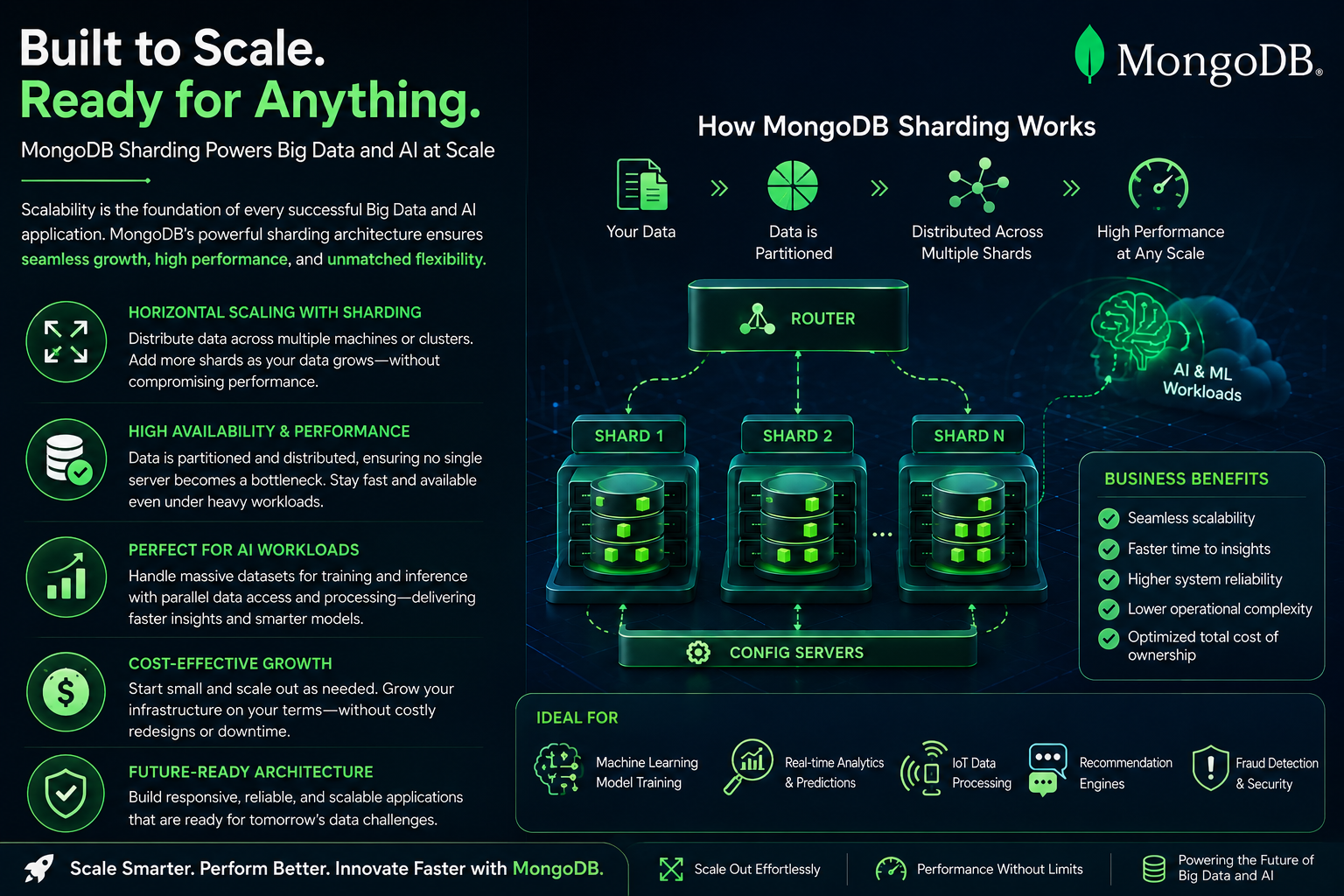
A sharded MongoDB environment is whereby the data is broken into smaller bits and they are distributed to various nodes. This makes sure that none of the servers becomes a bottleneck, and the database can be highly available and performing even when it is under heavy load. With increased data, one can add new shards without much hassle and it is simple to scale the system with a cost-effective and efficient solution.
This is especially useful with AI workloads, which in many cases require large datasets to be trained and inferred upon. Machine learning models demand access to large volumes of data and any delay in retrieving or processing data can affect its overall performance. The distributed architecture of MongoDB allows access to and processing of data in parallel, which is much faster and more efficient.
Furthermore, organizations do not have to incur huge expenses on infrastructure at the start-up phase. They have the opportunity to begin with a smaller deployment and incrementally scale as their needs of data and applications become increasingly important. This leeway lowers the complexity of running operations and avoids the significant system redesign and downtime.
In general, the sharding feature of MongoDB allows making Big Data and AI applications responsive, reliable, and scalable, which makes it an ideal solution when a company needs to develop future-ready, high-performing systems.
Real-Time AI Applications with High Performance.
Real-time data processing is a key demand of many AI-based applications, where timely insights have a direct effect on business. Fraud detection, recommendation engines, predictive maintenance, and dynamic pricing are just a few examples of the types of use cases, which depend on the capabilities to process and analyze the data as it is generated. Any time lag in accessing or interpreting this data may decrease the effectiveness of AI models and result in missed opportunities or greater risk.
MongoDB is perfect in such real time situations because it has high read and write throughput. It is meant to accommodate massive volumes of incoming information and to provide that queries be executed in an efficient manner. This renders it the best option when it comes to applications that require a live glimpse and updated data.
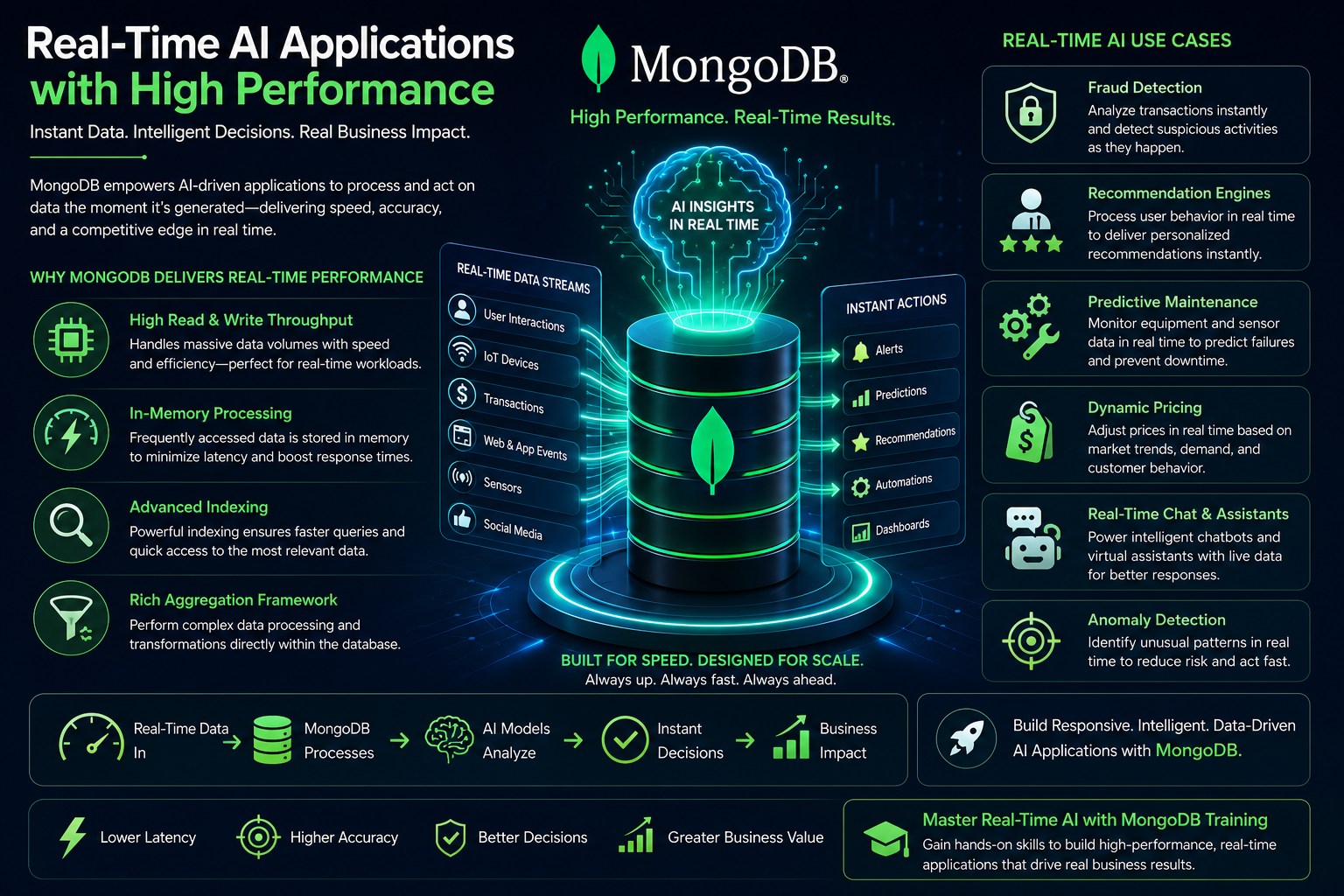
There are a number of important attributes that contribute to the real-time performance of MongoDB. Its in-memory processing power can enable frequently accessed data to be stored in memory, thus reducing latency to a minimum and enhancing response times. More sophisticated indexing facilities allow quicker access to data by reducing the amount of data that has to be scanned. Besides, the rich aggregation framework of MongoDB enables developers to do complex data processing and transformations directly in the database, without the need to work with external processing tools.
All of these features collaborate to make sure that AI models continually have access to the most up-to-date and relevant data. This leads to more accurate and reliable predictions and decisions. To illustrate, in fraud detection systems MongoDB can be used to analyze transaction patterns in real-time to identify suspicious activities. In recommendation engines, it is able to immediately analyze user activity to provide them with personalized recommendations.
In general, the capacity of MongoDB to support real-time processing of data makes it a powerful platform on which to develop responsive, intelligent and data-driven AI applications.
Connection with AI and Machine Learning Tools.
MongoDB is also a great choice in the contemporary data-driven development, as it is seamlessly integrated with popular AI and machine learning frameworks, including Python-based libraries, Apache Spark, and TensorFlow. This compatibility enables data scientists and developers to operate within their favorite ecosystems and harness the power of MongoDB in managing data. Consequently, the process of AI model building, training, and deploying becomes smoother and more efficient.
The fact that MongoDB is capable of managing the entire data lifecycle is one of the most important benefits of using MongoDB in AI workflows. It allows developers to store large training datasets easily, with its adaptable document model, which can accommodate a variety of data formats. The retrieval of data to train the models is also quick and efficient due to the indexing and query optimization feature of MongoDB. This makes sure that machine learning models can be trained on the latest and relevant data without delays.
Moreover, MongoDB allows teams to store model outputs, predictions, and logs in a well-structured and flexibly structured manner. It is especially helpful in monitoring the model performance, comparing performance and version control. Its integrated aggregation framework also enables users to analyze results in-database, without external analytics tools, and enables simplified overall workflow.
This end-to-end support greatly simplifies the AI development lifecycle in data collection and preparation, model deployment and monitoring. It simplifies, saves time and improves productivity among both developers and data scientists.
To those who may want to develop proficiency in this field, a MongoDB Course can prove to be quite helpful. This type of course offers students practical experience with real life AI integrations, and helps students understand how to effectively use MongoDB and machine learning frameworks to build scalable and intelligent applications.
Powerful Aggregation and Analytics
MongoDB’s aggregation framework is a powerful feature that enables developers to perform complex data processing and transformations directly within the database. Alternatively to exporting data to external data analysis tools, in MongoDB, it is possible to create multi-stage data pipelines that filter, group, sort and restructure data efficiently and in one place. This greatly simplifies data workflow and reduces the requirements of extra processing layers.
In the case of Big Data applications, this ability has a number of significant benefits. First, it provides faster insights because data is processed closer to where it is stored and thus, eliminates delays due to the data transfer between systems. Second, it minimizes data flow that will not only enhance performance, but also reduce infrastructure costs and risk of data inconsistencies. Third, it improves overall system performance through the use of the optimized query engine and parallel processing of MongoDB.
The aggregation framework is an essential part of data preparation to train and analyze a model in AI and machine learning situations. Raw data may require to be cleansed, filtered, and converted to organized formats so that it can be utilized efficiently. MongoDB provides the ability to implement such transformations in real time so that AI systems can promptly transform raw inputs into meaningful features that can be used to make accurate predictions.

As an example, user behavior data can be aggregated to identify patterns, preprocess sensor data to predictive maintenance or transform transactional data to fraud detection models. Using these operations in the database, MongoDB simplifies the entire data pipeline.
In general, the aggregation architecture enables organizations to create faster, more efficient, and scalable AI and Big Data applications by simplifying data processing and accelerating the process between raw data and actionable insights.
Real-World Use Cases
MongoDB is flexible and can be scaled, and deals with a variety of data types; allowing it to be used across industries in AI and Big Data applications. Its document-based model makes it especially useful to handle complex and high-volume data, and thus allow organizations to derive meaningful insights and develop intelligent systems.
In the e-commerce sector, MongoDB plays a key role in powering personalized product recommendations. Based on real-time user behavior analysis, browsing and purchase history, businesses can provide personalized recommendations that can improve customer experience and sales. On the same note, in healthcare, MongoDB facilitates predictive analytics, through handling large amounts of patient data, such as medical records, diagnostic reports, and real-time monitoring data. This assists healthcare professionals to give precise diagnoses and prescribe effective treatment.
MongoDB is also popular in the finance industry in methods of fraud detection and risk analysis. To track transactions, discover a suspicious pattern, and curb frauds, financial institutions depend on its real-time processing powers. In the case of IoT applications, MongoDB is highly scalable to continuously process sensor data in real-time to enable real-time monitoring and predictive maintenance of industry applications, including manufacturing, logistics, and energy.
MongoDB can also be applied in the media and entertainment industry by taking advantage of its abilities to develop content recommendation engines. Analyzing the preferences of the users, viewing history, and engagement metrics, platforms are able to provide personalized content and keep the users engaged.
These various use cases show how MongoDB can handle the complex and large-scale data environments and can provide fast and actionable insights. Its adaptability makes it a preferred choice for organizations looking to implement AI-driven solutions and gain a competitive edge in today’s data-centric world.
Enhanced Developer Productivity
The usability of the intuitive data model and the friendliness of MongoDB is instrumental in the quicker development of modern applications, particularly those that are AI-driven. Contrary to traditional databases, which have complex schema definitions and require constant maintenance, MongoDB provides a flexible document-based structure, easy to grasp and work with. This ease of use enables developers to concentrate more on developing intelligent application logic as opposed to spending time in dealing with database constraints and configurations.
One of the key advantages is easy data modeling. The developers are able to represent the real world objects in natural, JSON-like format, narrowing the gap between application code and database structure. This makes development more intuitive and reduces the learning curve to new users. Also, MongoDB allows using faster prototyping, as a team can rapidly build and test ideas without being limited by strict schemas. This is especially crucial in AI projects, where experimentation and iteration are important to fine-tune models and enhance results.

The other significant advantage is less time on development. Using the inbuilt capabilities such as indexing, aggregation and smooth scalability, developers can afford intricate functionalities without using numerous external programs. Such a lean methodology accelerates the entire development life cycle and assists teams in delivering applications at a faster rate.
MongoDB also has a strong global community and extensive documentation, providing developers with access to resources, support, and best practices. This ecosystem simplifies the process of troubleshooting problems and constantly enhancing applications.
To organizations that are interested in implementing AI within the shortest time possible, these benefits would be translated into increased productivity and rapid innovation. MongoDB allows teams to concentrate on the development of intelligent, scalable and high-performing applications.
Security and Reliability
Applications of AI and Big Data frequently contain highly sensitive data, such as personal data, financial data, and insights vital to the company. There is therefore the need to ensure that there is high level of security and data protection. MongoDB tackles these issues through a list of security options that aim at securing data at each level.
It offers a powerful authentication and authorization system, enabling organizations to regulate which individuals are allowed to access the database and the actions that they can perform. The other important feature is that the information is encrypted at rest and also during transmission to minimize the chances of data breach. Moreover, MongoDB is integrated with role-based access control (RBAC) enabling administrators to assign certain permissions depending on user roles, which promotes security and simplifies management.
In addition to security, MongoDB also guarantees high availability and reliability with its replication feature built-in. Data is automatically replicated in multiple servers so that applications can continue to run even in case of failure of hardware or any other unforeseen problem. This is particularly critical with mission-critical AI systems, which must operate at all times and deliver consistent performance.
To individuals who wish to acquire knowledge in these more advanced capabilities, a MongoDB Learning Path is perhaps of great value. It assists learners to comprehend the manner in which it is possible to apply security, manage data well and develop reliable, enterprise grade AI and Big Data applications.
Companies that invest into AI and Big Data require solutions that will not only meet the demands of today, but also be able to adjust to the requirements in the future. MongoDB is doing well in this regard, by supporting new technologies like real-time analytics, edge computing, and AI-driven automation. Its data processing and analysis will enable businesses to make faster and data-driven decisions and remain competitive in dynamic markets.

Additionally, the flexible schema of MongoDB and its strong data processing capabilities make it easier to experiment, iterate and scale AI models. With the ever-increasing rate of innovation, the availability of a future-ready database such as MongoDB will ensure organizations are able to keep pace with the shifting technological environment without compromising on performance, reliability, and agility.
Conclusion
MongoDB is a versatile option to use in AI and Big Data applications as it is flexible, can be scaled, and is high-performing. The use of documents as its model and its smooth integration with AI tools make it the most suitable to the modern development. Be it creating smart apps or processing big data, MongoDB offers a solid base. A MongoDB Course Online at OnlineITGuru can boost your career and equip you with the tools needed to be successful in the data-driven world of today.