
Top 10 ServiceNow Modules to Learn in 2025
Last updated on Nov 16, 2025

With ServiceNow modules, you can drive key functions for growth, ServiceNow remains at the forefront of enterprise digital transformation. With a wide range of process automation solutions, ServiceNow empowers companies. In addition to advancing individual careers, understanding the appropriate ServiceNow modules in 2025 will increase ROI across IT, HR, asset management, compliance, and security areas. With actionable insights, feature highlights, and pertinent trending keywords for ServiceNow admins, developers, and consultants, this book will reveal the top ServiceNow modules set to rule in the upcoming year.
ServiceNow Modules to Learn
1) IT Service Management (ITSM)
The backbone of ServiceNow is ITSM, which is likely the most important aspect for businesses that prioritize smooth IT operations. Effective incident management, problem, change, request, and risk management is made possible by ITSM, enabling support teams to increase productivity and client satisfaction. It is essential for modern IT departments due to its advanced capabilities, including analytics, self-service portals, and automated workflows.
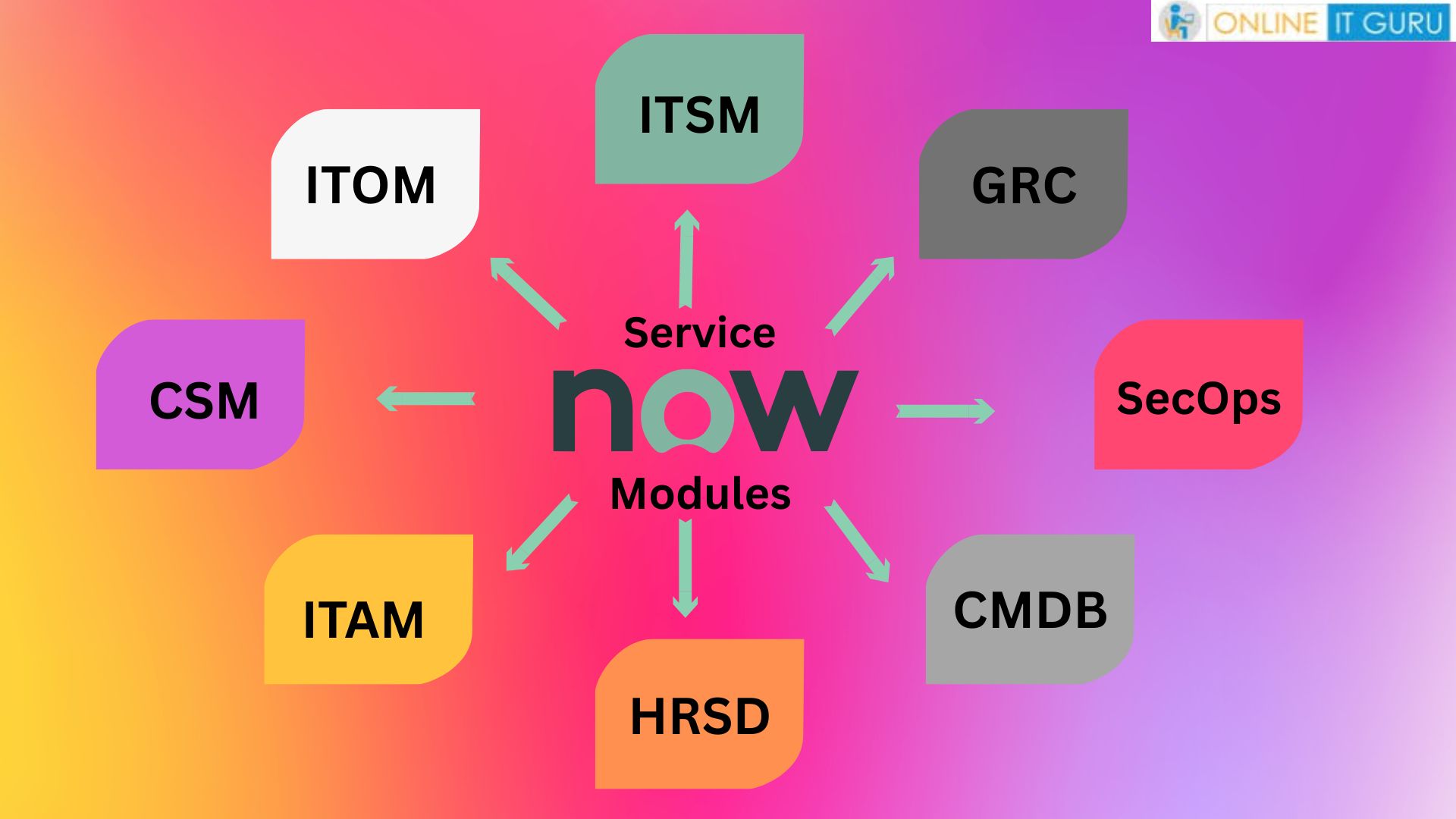
2) Management of IT Operations (ITOM)
The ITOM module includes robust features for event/incident management, service mapping, infrastructure monitoring, and predictive AIOps. ITOM uses broad insight into apps and hybrid environments to mitigate operational risks, improve service availability, and proactively address performance issues.
3) IT Asset Management (ITAM)
Asset lifecycle optimization emerges as a key value proposition for ServiceNow Modules as businesses grow. ITAM enables companies to manage operating expenses and uphold regulatory compliance by organizing procurement, inventory, licensing, and compliance.
Get hands-on ServiceNow Training with Onlineitguru through industry experts in real-time.
4) Management of Customer Service (CSM)
ServiceNow CSM's hallmark is providing outstanding customer experiences. To increase customer happiness and loyalty, this module automates procedures, combines support services with customer data, and expedites case resolution. CSM stands out for B2B and B2C businesses with features like automatic case assignment, continuous support, and real-time collaboration.
5) Human Resources Service Delivery (HRSD)
Through a single employee interface, HRSD streamlines HR processes, benefits control, onboarding and offboarding, and document handling. This module improves compliance, speeds up service requests, and removes manual duties in light of the increased emphasis on employee experience.
6) Risk, Governance, and Compliance (GRC)
Risk exposure and regulatory complexity are growing challenges for modern businesses. Responsive governance is made possible by the GRC ServiceNow Module, which offers real-time risk assessment, automatic audits, policy management, and compliance reporting.
7) Security Operations (SecOps)
In 2025, cybersecurity cannot be compromised. SecOps automates threat detection, incident prioritization, and response procedures by integrating security and IT activities. Dynamic defense against changing threats is provided by integration with external security products and dashboards.
8) Now Platform App Engine
The Now Platform App Engine encourages innovation and quick deployment by enabling businesses to create unique apps in a low-code environment. By fusing tight integration of current ServiceNow modules with drag-and-drop architecture, it is driving enterprise digital shifts in 2025.
9) Database for Configuration Management (CMDB)
By mapping interactions and dependencies between services, systems, and assets, the CMDB module establishes a single source of truth for enterprise infrastructure. Advanced impact analysis and service quality enhancement are supported by automated discovery, lifecycle management, and change integration.
Gain expertise in real-time ITSM skills with ServiceNow Course online with mentorship.
10) Knowledge Management & Service Catalog
Self-service request fulfillment is made easier by the Service Catalog, which also reduces IT workload by automating end-user processes. Knowledge management offers an extensive collection of departmental best practices, solutions, and frequently asked questions. Both components improve service transparency, decrease ticket quantities, and increase efficiency.
Why Learn These ServiceNow Modules?
Career Impact: In ITSM, HR, security, and operations career paths, mastery of the best ServiceNow modules is an important asset. Certified proficiency in modules like ITSM, ITOM, and CSM is becoming more and more valued by recruiters.
Organizational Transformation:
By streamlining processes, cutting expenses, and improving compliance, businesses that implement several ServiceNow modules see an increase in return on investment.
Agility & Scalability:
Businesses can grow digital initiatives, include leading-edge technologies, and get ready for emerging trends, like PI and AI-driven workflow automation. This is possible with ServiceNow's modular architecture.
How Do ServiceNow Modules Work Together to Boost Enterprise Efficiency?
The smooth integration of ServiceNow modules is one of their best features. For instance, the CMDB and ITSM modules work closely together to enable effective issue prioritization based on asset linkages and service impact. In the same manner, IT Operations Management (ITOM) effectively minimizes operational downtime by using real-time data from ITAM and CMDB to identify faults and start prompt rectification.
HRSD can interact with knowledge management and digital workflow modules using ServiceNow's extensible low-code platform. It simplifies intricate onboarding and cross-functional activities. Speedy staff ramp-up and consistently good client journeys are the results of this synergy.
Get updated skills in ServiceNow ITOM with the ServiceNow Developer Course.
Advanced Features Powering Modern Modules
Advanced features like virtual agents, AIOps, workflow orchestration, and automated discovery are introduced by modern ServiceNow modules. For example, AI-driven conversational interfaces are used by virtual agents in ITSM and CSM to automate ticket production and answer FAQs, increasing user satisfaction and freeing up staff for high-value tasks.
By combining enterprise-scale workflow capabilities with drag-and-drop UX design, ServiceNow's App Engine enables even non-coders to create unique apps. Key components of ITOM and CMDB, automated discovery and dependency mapping, offer deep visibility into cloud, on-premises, and hybrid systems. They facilitate robust risk mitigation and proactive care.
Driving Strategic Value with Reporting and Analytics
All of the top ServiceNow modules incorporate actionable analytics. For continuous improvement, ITSM and ITOM, for instance, provide dashboards that monitor incident trends, change success rates, and SLA performance. Adaptive compliance methods and proactive asset management are made possible by real-time data from ITAM and GRC. It keeps costs down and risks under control.
Additionally, CIOs and business executives may correlate service performance with business outcomes and optimize resource allocation. It is backed by ServiceNow's unified data model, which offers cross-module analytics.
ServiceNow Modules: Competitive Advantage and Market Impact
Because of their user-friendly interfaces, strong workflow automation, and capacity to grow with enterprise demands, industry experts regularly rank ServiceNow Modules as market leaders, particularly in ITSM, ITOM, and CSM. Full native discovery capabilities, a vast integration hub with hundreds of connectors, and best-in-class AI/automation, such as Now Assist and Virtual Agent features, are features of ServiceNow's modules that set them apart from competitors.
Businesses that use ServiceNow gain from deep integration readiness, extensive ecosystem support, and a wide range of customization options—a key advantage for diverse companies and quickly changing markets.
Related Article - ServiceNow CMDB
Real-World Use Cases Across Industries
IT departments are not the only places where ServiceNow modules are used. Workflows related to staff onboarding, patient case management, and regulatory compliance are managed by HRSD and CSM in the healthcare industry. GRC and SecOps automate audit trails, lower the risk of fraud, and speed up incident response for safe transactions in the financial industry. For situations with a lot of assets, manufacturers use ITOM and CMDB to ensure system reliability and economical maintenance cycles.
The impact on multiple industries ensures that ServiceNow certified experts will always be in high demand. The companies that use these modules will continue to be robust and flexible.
Conclusion
ServiceNow modules continue to drive corporate creativity in 2025 by enhancing employee satisfaction, security, and operational agility. Learning these modules will put people and companies in a position for long-term success. It can be HRSD for employee engagement, ITOM for infrastructure dependability, or ITSM for core service management. To get the most out of these innovative modules, keep up with Service Now trends, make certification investments, and place a high priority on ongoing education.