
The Future of Automation: How AI is Transforming Azure DevOps Workflows
Last updated on Apr 29, 2026

Software development is changing. From basic scripting and build automation to smart, artificial intelligence (AI) based systems that learn, predict and make decisions. This is particularly true with Azure DevOps, where AI is changing how we build, test and release our software.
From Automation to Intelligence
Until now, the automation of DevOps has been rules based - scripts to automate routine build, test and deployment activities. They were reliable and efficient but not robust. They needed human intervention in case something went wrong, and thus were subject to constant change. As applications got more and more complex, it was difficult to scale the automation using the rules.
Today, the industry is moving towards "agentic DevOps". This approach leverages intelligent agents with artificial intelligence (AI) capabilities to support or even replace the existing scripts using the added intelligence, adaptability and decision-making abilities. Agents can process and process large volumes of data in real time, to learn, predict and react, rather than scripts. This eliminates the need for human intervention and allows for stronger and quicker responses.
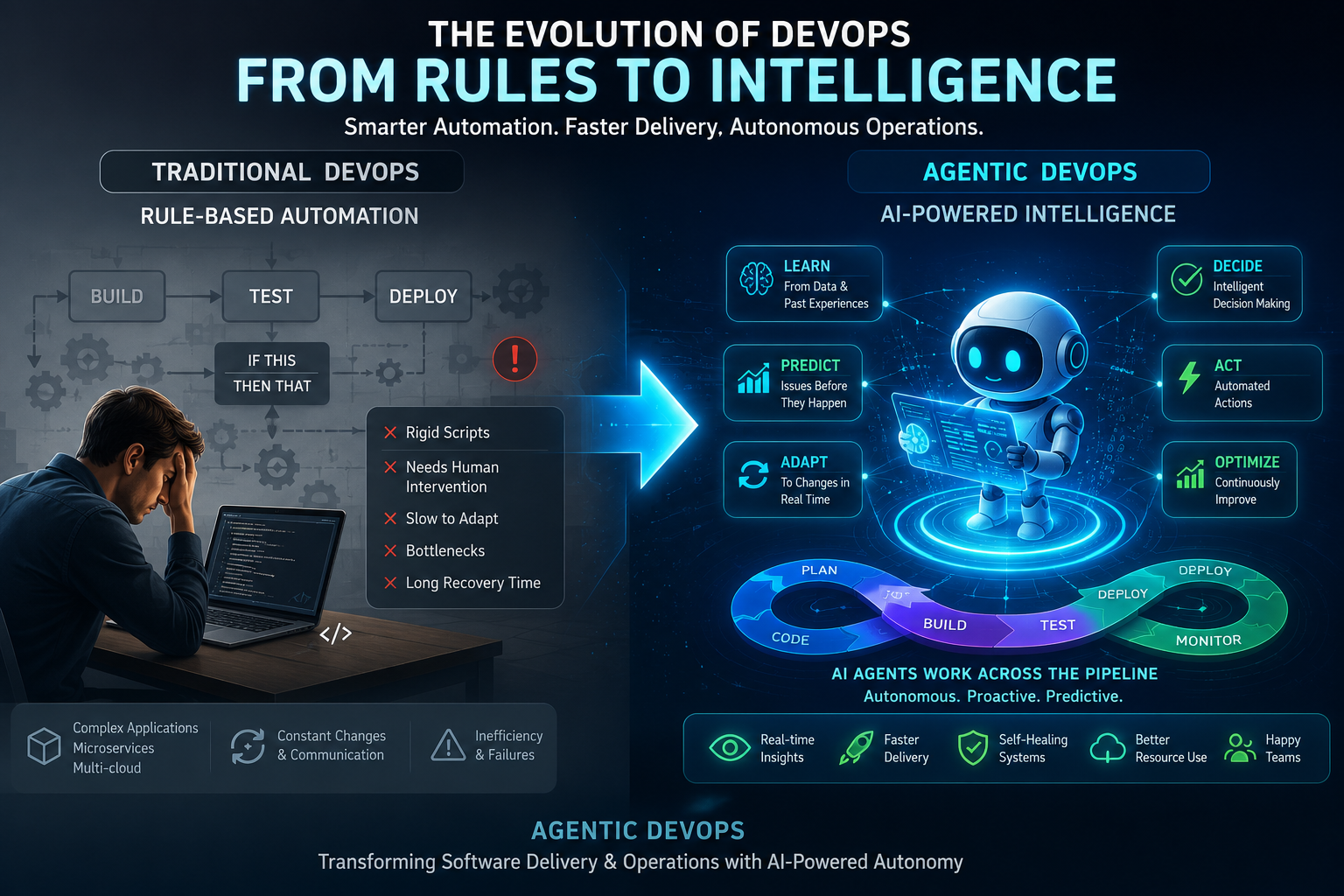
Software is getting more complex and that means the move to agentic DevOps. They are using microservices, containers and multi-cloud/hybrid clouds. They create data and need to communicate with each other. So the old rule-based automation is not fast enough to handle the changes, and it leads to inefficiency, bottlenecks or long recovery time in the event of failures.
In this new era, systems such as Azure DevOps are increasingly using AI to provide more intelligent processes. But to benefit from these innovations, it's not just about technology - it's also about people. This is where Microsoft Azure DevOps Training Courses comes in. This training helps people build AI-driven pipelines, manage dynamic situations and explore new concepts such as agentic DevOps.
With practical experience and tools, this training enables a transition from automating to dynamic AI-powered systems. It enables developers and DevOps professionals to manage distributed systems, improve processes and proactively fix problems. As systems evolve to be more complex and complicated, training will be required to make the most of agentic DevOps.
AI also provides responsiveness, with the system adapting to past experiences and responding in real time. For instance, AI agents can assist with resource allocation, resource deployment, issue detection and even diagnosis and solution. This makes DevOps more reactive, and even predictive and optimising.
So, agentic DevOps is not only about new tools, but it's also about transforming the process of software delivery and operations management from rigid automation to smart and autonomous systems.
AI in the DevOps Lifecycle from Azure
The Azure DevOps platform offers the DevOps lifecycle of planning, code, tests and deployments. But now AI is being integrated into these phases, to boost productivity.
AI-Driven Planning and Work Items
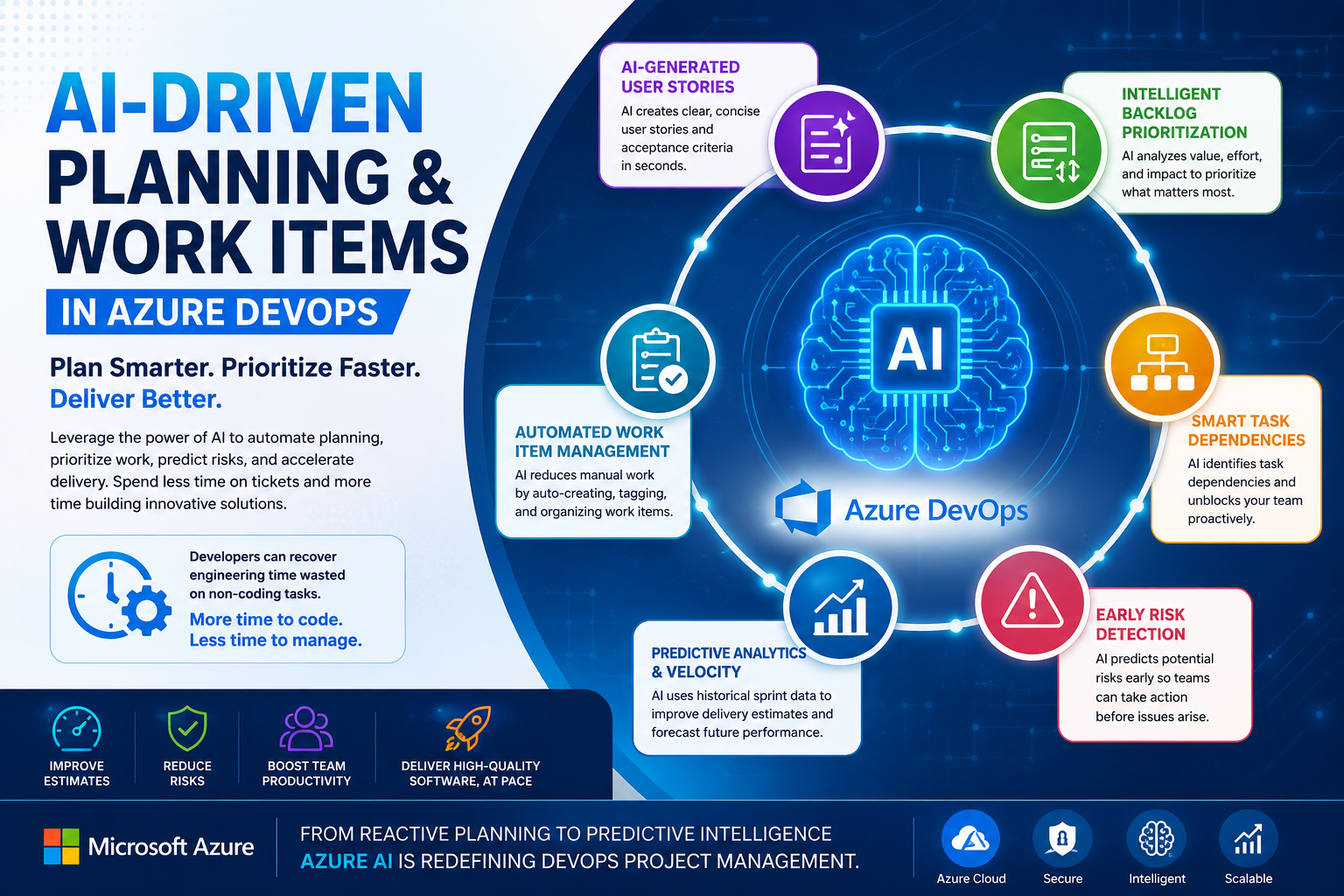
Planning for software development is being improved in Azure DevOps with AI. The technology can create user stories, backlog prioritisation and task dependency, freeing up time that would normally be spent on tasks such as ticket management and project management. This leaves more time to code, and less time to manage tasks.
Microsoft claims that by incorporating AI in its development process, developers can recover engineering time wasted on non-coding tasks. This not only speeds up the development process, but also boosts productivity and morale.
AI helps with decision making through predictive analytics, as well as automation. AI can calculate velocity and historical data from sprints to improve estimates of delivery. AI can also anticipate risk factors early in the development process so teams can proactively address these.
So, using AI in Azure DevOps transforms project management from lagging to leading indicators. This gives teams more insight, foresight and a better process, allowing them to develop high quality software, at pace.
|AI-Assisted Development
Perhaps the most obvious effect of AI on software development is on programming. Developers have access to AI-powered programming tools like GitHub, Copilot that integrate with software development tools like Azure DevOps to suggest code, refactoring and even include code documentation. This integration enables the use of AI-based tools in a context familiar to the developer, their integrated development environment, thus improving productivity.
These intelligent tools are more than "autocomplete". These tools learn the context of the code, variable names, project structure and the programmer's intentions, using state-of-the-art machine learning algorithms. This makes them a valuable source of suggestions on how to improve the code, adhere to best practices and even generate entire functions or even modules from a few lines of code.
This speeds up the development process. This also leaves engineers to tackle more complex issues and innovation. Also, AI support helps avoid common programming mistakes, maintain code uniformity and enhance code quality.
By adding intelligence to programming, tools like GitHub Copilot are changing the traditional software development process, making it faster, more efficient and more automated, aiding all coders.
Intelligent Testing and Quality Assurance
Testing is a costly part of the DevOps cycle in terms of time and human labour to guarantee software quality and reliability. But with AI, we see a change in the way this is done with the use of smart automation for test case generation, defect prediction and prioritization.
The new methods can learn the changes in the code and generate test cases. This minimizes the manual work required for test case design and enhances the coverage, particularly in large and frequently changing codebases. These tools can learn from past test and code change results to improve their efficiency.
AI also helps in test selection, or test prioritisation. Testers can select tests that are more likely to reveal bugs, rather than running all of their tests. This ensures faster testing, while keeping (or improving) quality.
In addition, AI tools for code analysis will identify vulnerabilities, inconsistencies and bugs as they are written. These tools can assist with static code reviews, but also understand the behaviour, usage and context of code to detect problems even sooner. AI tools have machine learning capabilities to learn from historical bugs and development patterns to detect issues and improve code.
Modern apps, like Azure DevOps, now provide such "intelligence" in the development process so developers can ensure the code quality while accelerating development. But to make the most of these capabilities, it may be useful if developers have the opportunity to explore these technologies, through an Azure DevOps Training Online , so they can learn how to use these technologies to test and analyse code.
So, AI testing transforms testing from verification to validation. They can identify and fix issues early in the software development lifecycle through feedback and monitoring. This not only increases software quality, but also accelerates delivery as developers can confidently deliver software at a faster pace.
Smarter CI/CD Pipelines
Continuous integration and continuous delivery (CI/CD) pipelines are foundational to DevOps, allowing for fast software delivery. But as software becomes more complex, maintaining CI/CD pipelines is becoming more complex. AI is helping CI/CD pipelines with smarter automation, predictive and optimisation capabilities.
An important use of AI in CI/CD pipelines is automatic build and deployment. AI-based tools can consider dynamic information - such as code changes, test results and performance information - to decide what to do next. This results in intelligent and faster deployments.
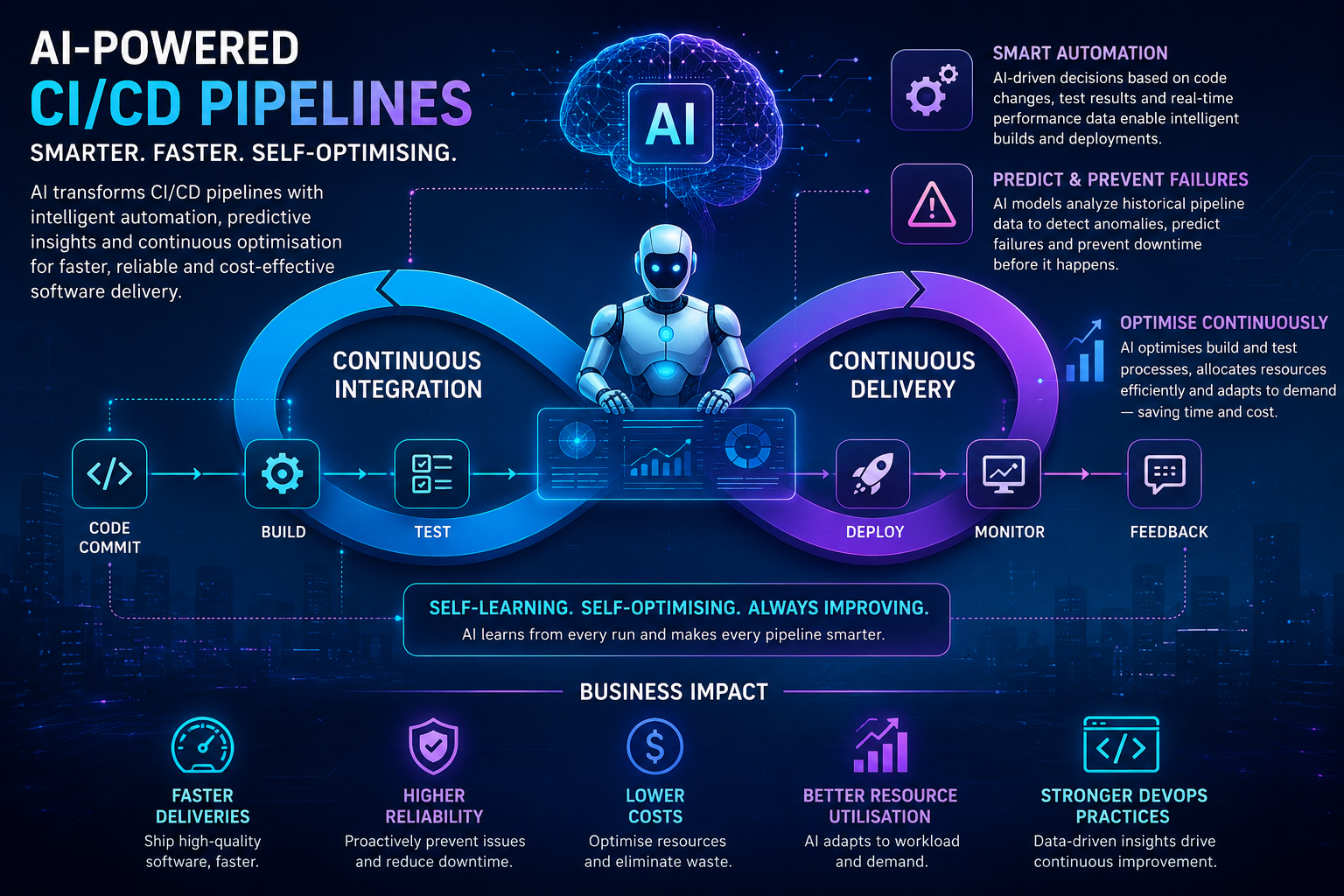
AI can also predict failures. AI models can learn from historical data of the pipeline, including malfunctions and performance metrics, to detect anomalies. This helps to proactively solve problems and prevent downtime, improving the pipeline's reliability.
AI also optimises the pipeline. It can adapt to demand, build and test in the most efficient manner, avoiding wasted time and resources. This increases velocity and reduces costs.
With the help of predictive analytics and AI, CI/CD moves from reactive to self-learning and self-optimising. They adapt to previous runs and optimise their behaviour to get faster deployments, better use of resources and stronger software development practices in more complex environments.
Monitoring, AIOps and Self-Healing
AI is also making inroads in the operations of DevOps. AIOps can help services such as Azure DevOps monitor systems in real-time, process huge amounts of data and identify issues in real-time. This allows the team to transition from "fire fighting" to "fine tuning".
Another area of innovation is self-healing systems. These intelligent systems are able to detect incidents, determine the cause and perform automatic responses. For instance, if a service is down it can restart the service, load balance or roll back deployments to recover the service.
This will lower the Mean Time to Resolution (MTTR) and improve incident resolution time and outage time. Meanwhile, it can learn from these incidents, and respond to new incidents and avoid potential issues.
Through intelligence in the operation, AIOps allows for a resilient system, high availability and manageability of the increasingly complex system.
The AI Agent in DevOps
The most exciting prospect of DevOps is the rise of intelligent systems that are capable of performing complex tasks across the value chain: AI agents. These agents will elevate automation that is based on rigid scripts and processes to a higher level through the capacity to learn, evolve and adapt. This is a game-changer in software development, deployment and operations.
AI agents can automatically review source code, review commit comments and provide recommendations to improve code quality, simplicity and maintainability. They can even create documentation and keep it up-to-date, documenting the project's knowledge automatically. In terms of security, AI agents can scan code for vulnerabilities and even fix or provide suggestions to eliminate bugs.
AI agents can also help a lot with infrastructure. They can be applied to optimise the system to the workload, dynamically allocate resources and manage systems in cloud and hybrid cloud settings. This intelligence not only makes it cheaper to operate, but faster and more robust.
But the real power of AI agents is that they can switch between deterministic and probabilistic reasoning. Not only do they understand what to do, but also the why, how and when, via context information. This makes DevOps more responsive, robust and even predictive.
As AI agents are introduced, DevOps is evolving from being human and process automation, to becoming self-organising - where software not only carries out the work but also learns, adapts and optimises itself, based on the software it is built to support. Tools such as Azure DevOps are helping this transformation by delivering AI-based capabilities to development and operations.
In this new world, jobs change. Developers must adapt to the new processes and skills required to create for these smart systems and AI-driven pipelines. That's where Azure DevOps Course Online can assist. This training enables teams to learn and experiment with automation and AI-driven processes and new deployment techniques, allowing them to utilise agentic DevOps.
AI is not a substitute for human skills, but an extension of human skills and can be used to do the heavy lifting work and free up human time to think, strategise and innovate. By using AI for both smart orchestration and continuous learning (Azure DevOps training) organisations can deliver more agile, efficient and resilient DevOps processes.
Benefits of AI-Driven Azure DevOps
The benefits of incorporating AI in the Azure DevOps processes include the following which improve software development.
The first is that it increases productivity. AI automates tedious and routine tasks, such as code generation, testing and build and release management, freeing up time for more value-adding activities like innovation, design and problem solving. This results in faster development and cost savings.
AI also enhances software quality. Through intelligent testing, analysis and feedback, we can identify bugs, security vulnerabilities and optimisation opportunities. This helps eliminate issues before software is shipped, resulting in higher quality software.
Second is faster time to market. Using AI to optimise the CI/CD pipeline and predict issues can help accelerate the release cycle and remove bottlenecks. It allows businesses to quickly adapt and keep up with the competition.
Improved decision-making is another benefit. AI tools can help provide insights by analysing large amounts of historical and current data. This can help with decision-making for resources, risk reduction and time management, which can improve outcomes.
Finally, AI helps to reduce costs. It helps to reduce costs by improving processes and use of infrastructure resources. Resource optimisation and autoscaling help to avoid resource waste.
Challenges and Considerations
While AI has many benefits, there are also challenges for organisations adopting AI for their Azure DevOps processes.
Governance and trust are key issues. AI can do complex decision-making. If it isn't, this can lead to risks with deployment, security and infrastructure. Experts agree governance, accountability and transparency are critical to ensure processes enabled by AI-based technologies are accurate and meet business objectives.
Second, there is a skills shortage. They need to learn how to use AI tools, which may require knowledge of the basic concepts of machine learning or data analysis and AI models. This can involve AI training or retraining, and change in culture from DevOps to data-centric DevOps.
Integration complexity also poses a barrier. AI may be difficult to integrate with CI/CD This can involve infrastructure, software and process changes. Companies should do this safely.
Human supervision is also crucial. AI is the assistant to human ability. Humans should make decisions in architecture, security and strategy.
Completely Self-Managing CI/CD Pipelines
The latest trend is to build fully autonomous CI/CD pipelines. Current pipelines are set-up, monitored and debugged by humans. Even self-serve pipelines need human input to deal with unexpected edge cases, tweak processes and ensure stability.
The next generation of AI-powered pipelines will be human-free. They will be able to assess code changes, determine how to test software, build and deploy it and handle failures. AI will use past data and experience of running pipelines, and optimise processes, to make the pipelines run faster and more consistently.
This will eliminate bottlenecks caused by human approvals and bug fixing, and enable faster and more reliable software delivery. But companies will still need policies and constraints to provide guidance and limits for AI.
Smart AI Agents for Full Workflow Automation
The next step is smart AI agents to automate the DevOps workflow. They can automate and understand, make inferences and decisions throughout the process. They are integrated into systems such as Azure DevOps and are the next wave of intelligence systems that increase productivity and precision in app development.
AI agents can help with development activities like planning, development, testing, deployment and monitoring. They can help orchestrate tasks across teams, automate workflows and predict problems. For instance, an agent can identify a production problem, pinpoint the cause (such as recent changes to code), suggest a fix and even roll it out.
This is transforming DevOps from tool-based to agent-based, making it not only automated but also intelligent and adaptive. Agents also enhance collaboration between development, IT operations and the business to facilitate communication and co-ordination.
In this rapidly evolving new landscape, DevOps Azure Course is critical. It's beneficial to have knowledge of AI agents, smart processes and automation. With training and investment in new technologies, businesses will adopt the advantages of agent-based DevOps to create more flexible, robust and future-proof software systems.
Integration with GitOps and Infrastructure as Code
Another advancement in the future of AI in DevOps will be the use of AI in combination with new practices such as GitOps and infrastructure as code (IaC). GitOps is a method of managing infrastructure and application configuration as code in a repository and IaC is a method of managing infrastructure with code.
AI will assist with these by monitoring changes in the repository, identifying configuration drift and suggesting changes. It can also apply policies, perform tests before deployment and make sure things are consistent. This helps remove errors and increase deployment success.
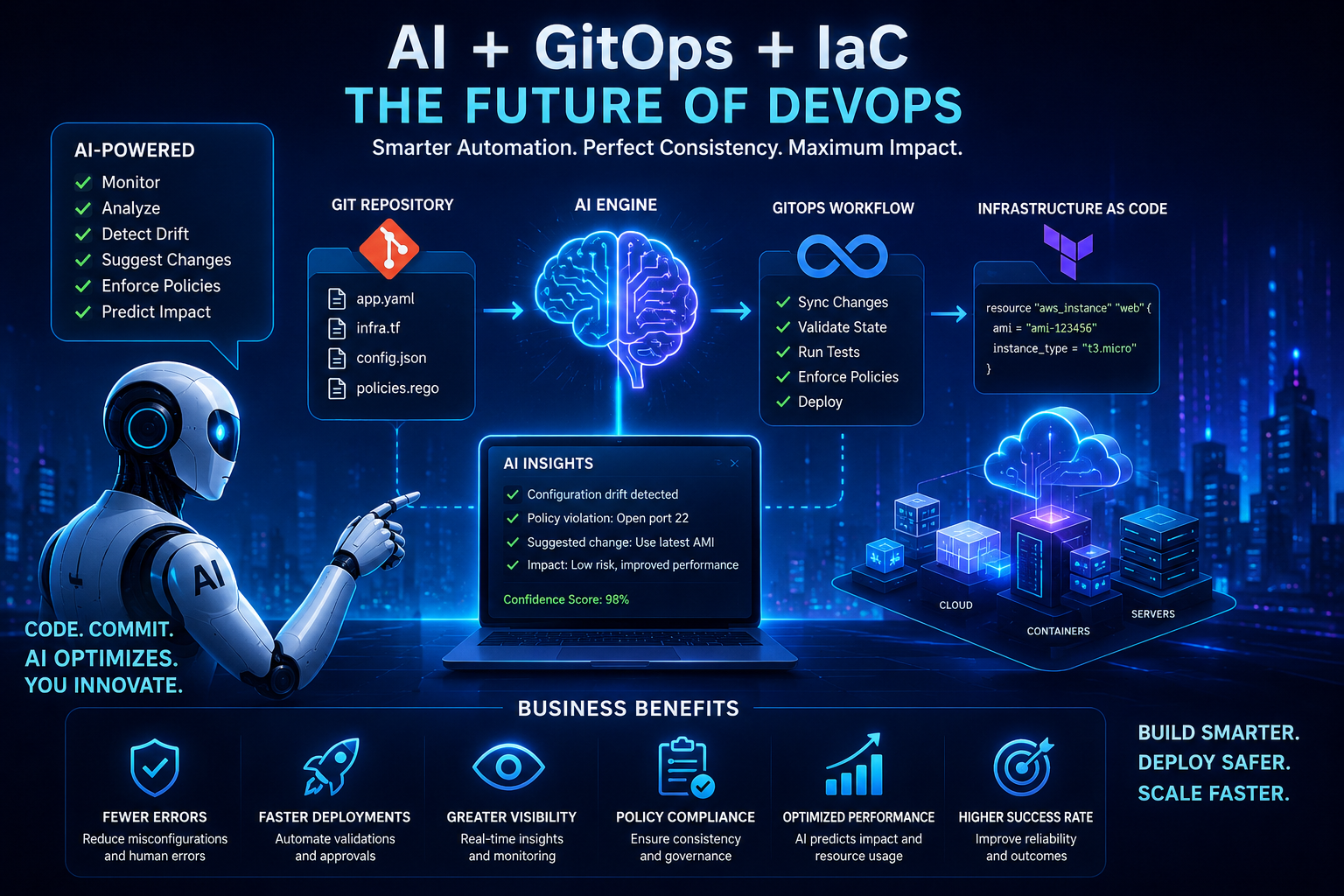
AI can also provide insights on how changes to infrastructure will affect performance and resource use, and detect issues. AI and GitOps and IaC will help organisations reach a new level of automation, control and visibility.
Improved Teamwork with AI
Collaboration is a key element of DevOps and AI will play a role. AI can perform analysis of data from the entire development process to provide insights that aid collaboration and decision making.
For example, AI can assist in detecting bottlenecks, inefficiencies and recommend solutions. It can also provide feedback on code to help developers improve their code quality and follow best practices. AI can also be used to prioritise backlogs, plan sprints and manage risks in project management.
This allows teams to collaborate more efficiently and make more informed decisions. Rather than making decisions based on gut feel or partial information, businesses can use the information provided by AI to optimise and fine-tune their processes to achieve greater success.
AI can also provide a translator to convert technical language into plain English. It can help bridge the gap between strategy and technology to ensure development efforts are focused on the right goals.
Balancing Automation with Control
AI-driven DevOps has many advantages, but it has its complexities. One of these is maintaining control.
With increasing automation, transparency is crucial. Companies must establish governance policies to determine the decision-making processes that AI uses, the data it uses and the verification of results. This includes monitoring, audit and compliance procedures.
Security is another key concern. AI systems need to secure data, and take actions to thwart hostile actions. This includes robust user authentication and monitoring systems and frequent reviews of AI systems and processes.
Humans will play a significant role in DevOps. AI will be used to perform tasks and automate processes, but people will be needed to make decisions and solve problems. Developers and DevOps engineers shouldn't be afraid of AI, but should be open to it and use it to their advantage.
The Road Ahead
We can also expect to see more AI being integrated into Azure DevOps, which will lead to improved innovation and productivity in software development. This will allow those who embrace this change to manage the complexity of systems and get to market faster.
But it won't be just a matter of new tools. It will involve a shift in how decisions are made through data-driven, lifelong learning and human-AI interactions. Organisations need to prioritise skills, governance and ethics.
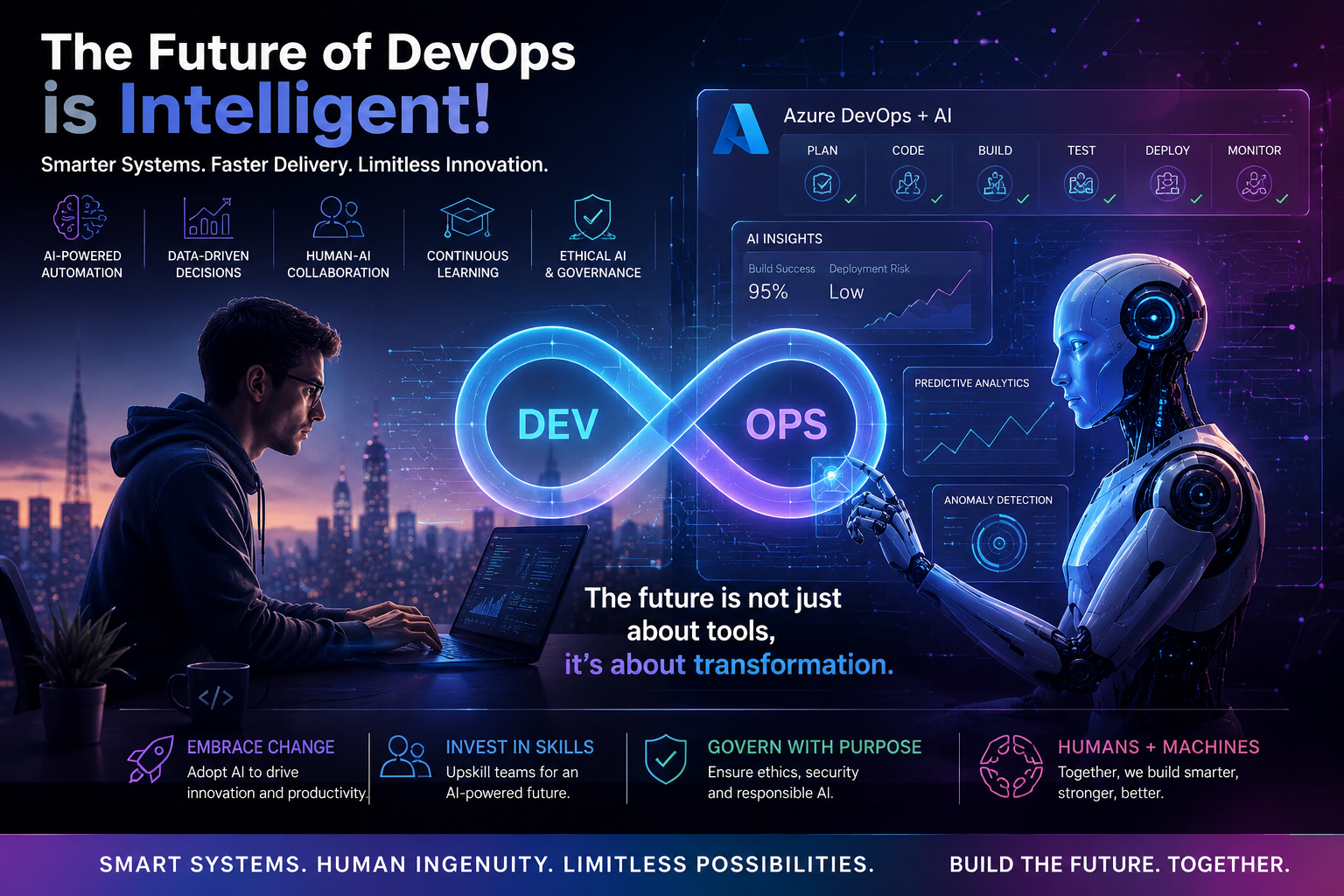
In short, the future of DevOps is smart systems - a balance between AI and human ingenuity. The synergy between humans and machines will also enable organisations to fully harness the power of AI-powered DevOps to create more robust, responsive and creative software systems.
Conclusion
AI is not just improving but revolutionising Azure DevOps. Automation to intelligence is the power for quick, efficient and intelligent software development. But it is not about man vs machine, but man and machine, where AI automates and processes the data, while humans innovate, plan and decide.
To adapt, you need to learn. A Azure DevOps Course from OnlineITGuru will help you learn about AI-powered workflows, automation and new DevOps. This keeps teams ahead of the curve and helps to develop quality products fast.